Skip to content
German support from hosting providers offers tangible benefits for companies of all sizes: faster problem solving, legal security in accordance with the GDPR and better customer communication without language barriers. For companies that rely on reliability and legal compliance, this service not only creates clarity, but also real certainty of action.
Key points
- Linguistic clarity prevents misunderstandings and speeds up problem solving.
- GDPR compliance provides legal security for data protection.
- Responsiveness Support from locally available, German-speaking teams.
- Technical expertise ensures fast help with hosting-specific issues.
- Regional proximity improves loading times and strengthens customer loyalty.
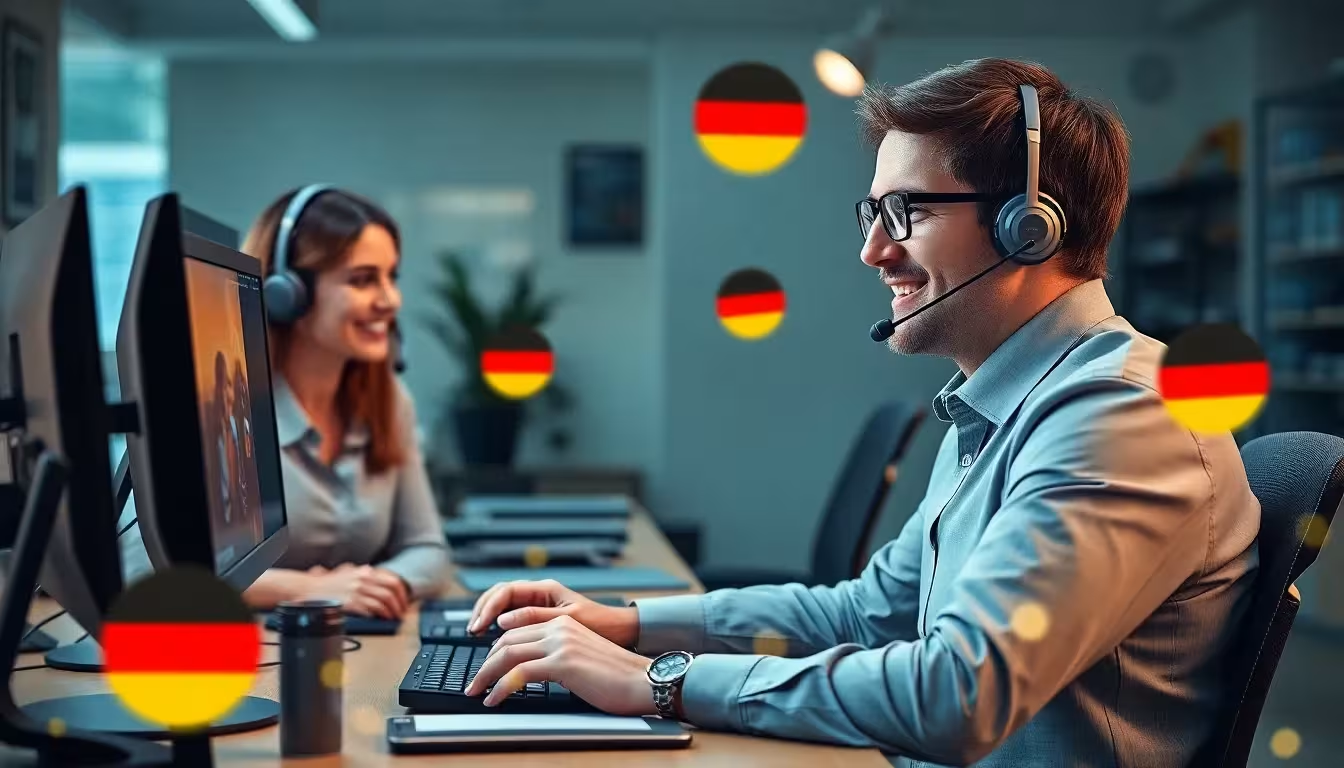
German-language support is not just a pure language advantage, but also an investment in long-term customer satisfaction. In-depth knowledge of the German market means that hosting providers can often respond to specific requirements on a much more individual basis. It is also invaluable for smaller companies setting up a website for the first time to receive advice in their own native language, making it easier for them to understand technical issues.
Immediate availability also plays an important role, as a fast and reliable solution is required, especially when time constraints and company pressure come together. This shows that a provider who not only offers a ticket system in German, but also provides competent German-speaking employees, can be a real competitive advantage.
Fast, clear communication: a decisive advantage
German-speaking support enables smooth communication without language barriers. I don't have to take dialectical nuances, unclear expressions or cultural misunderstandings into account. The contact person not only understands the technical challenge, but also the local customs in dealing with customers. This clarity saves time and reduces frustration - especially in critical situations such as website outages or security vulnerabilities.
What's more, every minute counts, especially in day-to-day business. If I first have to explain things to a support team or provide translations, this costs valuable resources. German support effectively avoids these pitfalls.
In addition, the common language often facilitates mutual trust. If both sides can communicate precisely, even complex issues such as server logs, database errors or script adjustments can be clarified more quickly. This also ensures that no details are forgotten and that the solution works as a whole. Many customers find this direct line to support very reassuring. This lowers the inhibition threshold for addressing problems at an early stage instead of putting them off.
Another aspect of fast, clear communication is that it frees up my own resources. Instead of explaining issues several times, everything can often be clarified in a short phone call or a quick chat message. Especially in urgent cases, such as server outages, a solution can be found within a few minutes without misunderstandings costing time and money.
Legally secure thanks to GDPR-compliant support
Hosting from Germany means support with a legal understanding of the General Data Protection Regulation (GDPR). Here I know that my data will be handled in accordance with the law. I can rely on customer data being stored, processed and deleted - in accordance with the legal data protection guidelines in Germany.
Another plus: if there are any questions about data protection, imprint obligations or order processing, the German-speaking support team quickly provides specific information that complies with German law. This creates security - both technically and legally.
It is particularly important that support staff are not only familiar with the technical but also the legal background. Anyone offering hosting in Germany knows about data retention obligations, potential liability risks and the requirements for companies. In many cases, any mistakes can be nipped in the bud before fines or warnings are issued. The trust that results from this is invaluable for many companies.
Legal security also pays off in the long term. Once you have dealt with a GDPR-compliant provider and are familiar with the processes, you can be sure that there will be no nasty surprises in the future. This continuity gives customers a good feeling - after all, many companies do not want to have to constantly change hosting providers as they grow.
Support when I need it: 24/7 availability
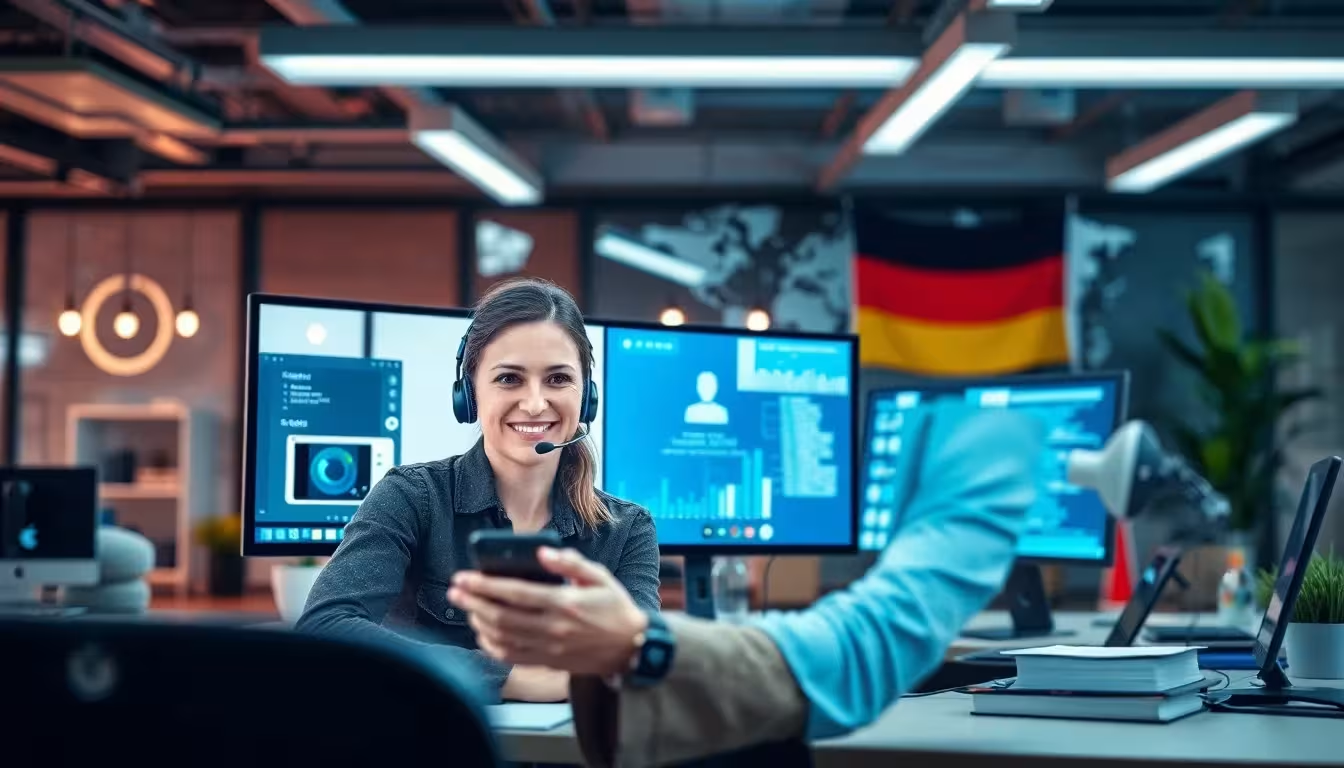
Technical problems do not adhere to office hours. That's why it's crucial that I can get support from my hosting provider at any time - be it by phone, email or live chat. Providers such as WebhostOne even offer a 24/7 emergency contact that responds immediately in critical moments. This is particularly useful for professional web projects, where downtime can cause financial damage.
German-speaking support not only recognizes the technical problem quickly, but also prioritizes it correctly according to business relevance - an essential point in the event of a fault.
Many companies work on projects or campaigns that often take place late in the evening or at the weekend. An event can lead to a sudden spike in traffic on a Sunday evening, which in turn leads to a server problem. If no German-speaking support is then available, hours can pass in which potential customers drop out. Rapid availability is therefore more than just a nice-to-have - it is a business-critical factor.
The 24/7 availability also ensures a professional image towards your own customers. If problems are solved quickly, trust increases. If I run an online store, for example, I firmly expect orders to work just as well at the weekend as they do during the week. An outage during these hours costs sales and potential regular customers. The added value of German-speaking support at any time of the day or night is priceless at such times.
Technical expertise that impresses
German-speaking support staff are more than just a communication interface. They have in-depth technical know-how. From CMS configurations and DNS problems to individual server customization: I get competent answers without time-consuming escalation loops.
Many providers rely on specialized departments. With hosting services such as WordPress, I can speak directly to technical experts who know every configuration parameter. Even as an experienced user, this targeted support saves me many hours of research and troubleshooting.
Anyone who has ever worked with complex server setups knows how important sound advice is. Especially when it comes to scaling issues, performance tuning or protection against DDoS attacks, it is essential that support is up to date. German-speaking teams that are familiar with the local IT landscape often have a deeper insight into regional peculiarities. This can, for example, relate to the choice of the right data center or specific settings for German store systems that are linked to legal requirements.
In addition, technical expertise is not only evident in answering difficult questions, but also in recognizing potential problems. Many German-speaking support teams proactively carry out regular checks and provide information if they find security gaps or performance brakes. This proactive nature is a quality feature from which customers benefit greatly.

Optimized charging times thanks to regional infrastructure
Hosting with server locations in Germany brings not only legal but also technical advantages. The shorter physical distance between server and user significantly speeds up loading times. This not only has an impact on the user experience, but also on the Google ranking.
In addition, websites aimed at a German audience benefit from better traffic. This is precisely why a German infrastructure has clear performance advantages compared to offers abroad.
However, it is not just geography that is decisive, but also the quality of the connection. Many German hosting providers operate their own data centers, which are equipped with state-of-the-art technology and work with redundant lines. This means that bottlenecks in data transmission can be avoided. This is reflected in stable loading times - even with large numbers of visitors. Those who rely on a local infrastructure can also assess the ecological footprint of their project more transparently, as the energy consumption of data centers and the technologies used are more clearly regulated in Germany.
Loading time is particularly critical for online stores. Long waiting times at the individual order steps lead to an abandonment rate. Regional hosting, which does not require half a continent to be crossed, creates a better basis for fast response times. Customers are more likely to stay on the site and are less likely to abandon their purchase. In this respect, the decision for German servers and support is not only reflected in customer loyalty, but also in direct sales effects.
What makes more sense: local or international support?
In the following table, I compare important criteria between German-language and international support. It quickly becomes clear how strong the added value is with local support:
| Criterion | German support | International support |
|---|---|---|
| Language & comprehensibility | High | Medium to low |
| Reaction speed | Fast, often 24/7 | Irregular, depending on location |
| Legal compliance according to GDPR | Guaranteed | Unclear or otherwise regulated |
| Customer proximity | Personal contact person | Automated systems |
| Geographical advantage | Server nearby | Global distribution |
The table makes it clear that companies looking for a service with a strong focus on the German market are better off with local support. Especially for start-ups or SMEs that do not have a large IT team, a clear point of contact brings considerable relief. Larger companies also benefit because they don't have to waste time clarifying language or legal issues.
On the other hand, international support can offer advantages in certain cases, for example if you have global locations and want to access a network of distributed servers. However, it should not be underestimated that cultural and time-related hurdles often arise in these cases. If you primarily do business in Germany and address customers here, you are usually best positioned with local support.
React flexibly: Support knows local requirements
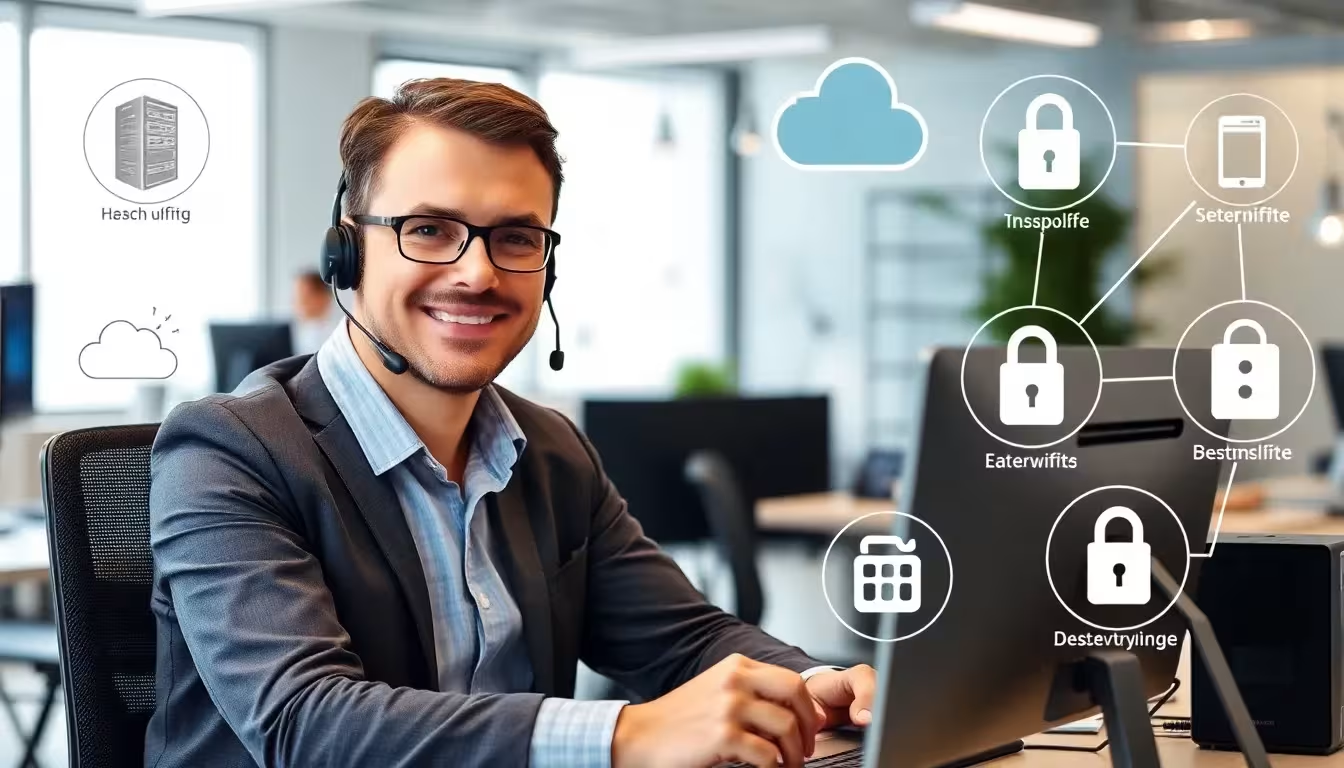
A German-speaking service team not only understands the technology, but also my economic reality. Whether it's tax information in the legal notice, legal information on the GDPR or industry-specific hosting requirements - I can rely on the fact that my topics don't need to be explained. The experts know the terrain.
If my project grows or changes, the support team will immediately understand my requirements and provide suitable solutions - without detours via global teams and explanations in foreign languages.
Especially in fast-moving industries where ad hoc decisions are required, this flexibility is worth its weight in gold. A local provider can put together suitable offers or adapt existing packages to new circumstances within a very short space of time. It helps enormously if the same language is spoken and no intercultural barriers delay the process. This allows scaling or relaunches to be planned without the need for time-consuming coordination with international teams in the background.
I also benefit from the higher level of responsibility that local support teams feel. If a provider has its headquarters in Germany and operates its servers here, a positive image on the German market is particularly important to it. Complaints or public criticism can have a direct negative impact on business. For this reason, local providers often strive to offer a quick and satisfactory solution to problems so as not to jeopardize the trust of their customers.
Individual customer service with a clear approach
Those who use German support benefit from personal contact and clearly structured communication. Offers such as fixed contact persons, direct telephone numbers or call-back functions create trust. This creates continuity - even when requirements change.
It is important to me that my concerns can be resolved in one process. Instead of being stuck in endless ticket systems, I often get a solution in the first conversation. Models like at IONOS with dedicated customer contact show how successful modern support concepts can be.
The personal level created by a dedicated contact person should not be underestimated. Many customers want a "face" behind the service. If you have already solved complex problems together several times, a relationship of trust develops. This makes future projects much easier. With purely international support structures, the contact person may change every time. This makes it difficult to understand special requirements, as every problem has to be explained from scratch.
In addition, individual customer service can provide valuable input that goes beyond pure hosting. For example, recommendations on search engine optimization, the choice of a suitable SSL certificate or backup strategies can be provided if the provider already knows the project well. In this way, customers and support grow together to a certain extent and jointly increase the quality of their own Internet presence.

Trust as a competitive advantage
For me, support is often the deciding factor when choosing a hosting provider. Trust is crucial, especially in the B2B context. No company can afford unplanned outages or data protection uncertainties. German-speaking support systematically removes many of these risks from the equation.
Some providers, such as Webhoster.de, show how customer-oriented structures start right there: personal support, fast response, clear communication. Today, this is often more relevant than pure computing power or low rates.
Trust is hard to build in the digital world and easy to lose. Anyone who has ever had a bad experience with international support knows how frustrating delays due to language or time differences can be. If, on the other hand, a German-speaking team is available in the same time zone, it is possible to react and intervene quickly. For companies that process sensitive data or even host business-critical applications, this is a powerful reason to choose a reliable, German-speaking service provider.
Trust also means that I trust the solutions offered. Support that proactively provides ideas for optimization signals that it is really interested in my project and its success. This can pay off in long-term partnerships that bring economic and technical stability for both sides.

Final assessment: More security, more control
I rely on hosting providers with German-speaking support because reliability and controllability of my infrastructures are a priority. Local support not only brings linguistic advantages, but also technical depth, legal security and faster problem solving. This can be particularly important for self-employed people, medium-sized companies or online stores.
If you want regional support, you shouldn't rely on providers abroad - but rather on hosting partners with German support. This is the only way to ensure that service and technology will also work in an emergency.
This decision is by no means just a matter of convenience. Especially when business grows and requirements become more complex, it pays to rely on short communication channels and sound background knowledge. Many companies are under pressure to work quickly and responsibly at the same time. Support that combines technical expertise and knowledge of the legal framework is worth its weight in gold. Local proximity also reduces potential friction losses. For me, this is an elementary success factor that should not be neglected in times of growing cyber risks and ever stricter data protection regulations.
Overall, it is clear that a provider with German-speaking support does far more than just be available at the right moment. It sees itself as a partner that has the company's back by providing advice, flexibility and expertise. This leaves resources for the actual core business. This combination of technical stability, qualified advice and legal security makes hosting "Made in Germany" a clear recommendation for all those who value stability and responsibility.