Skip to content
In the direct CMS comparison from WordPress vs Laravel fundamental differences become apparent: While WordPress scores particularly well with content-driven sites, Laravel shines with its performance for individually programmed applications. Those who work in the Web development PHP looking for a suitable system - be it for WordPress for beginners or Laravel for agencies -, should keep an eye on the respective strengths in SEO, scaling and usability.
Key points
- User friendlinessWordPress offers an intuitive interface for beginners, Laravel is aimed more at developers with experience.
- FlexibilityLaravel convinces with individual solutions, WordPress is expandable through plugins - but limited.
- PerformanceLaravel achieves higher speeds through modern code, WordPress requires optimizations.
- SecurityLaravel offers up-to-date security features, WordPress is more vulnerable to outdated plugins.
- SEO optionsWordPress scores with SEO plugins, Laravel requires individual implementation.
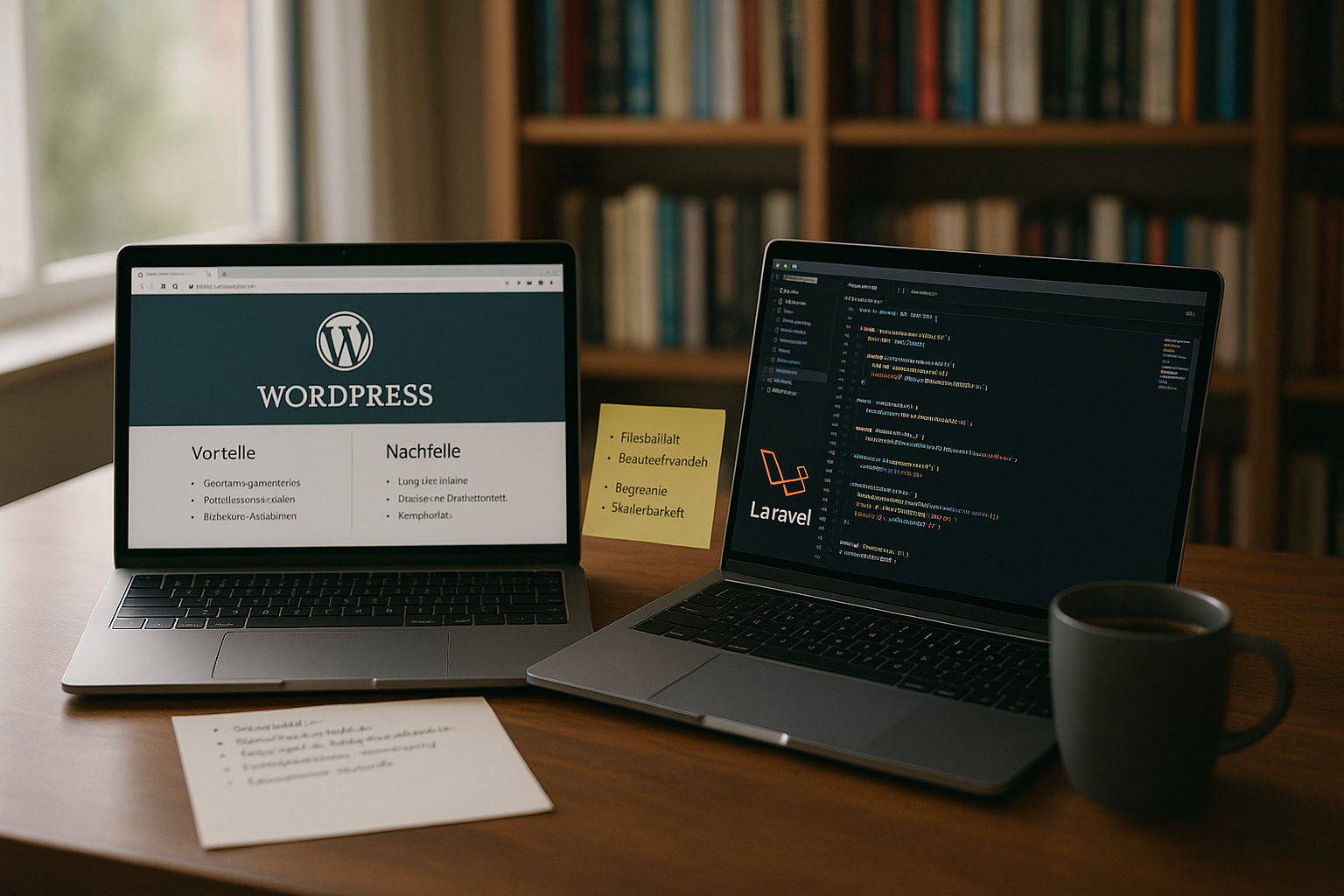
These basic points already provide an initial overview: WordPress has many ready-made building blocks available, while Laravel offers the greatest possible freedom for custom programming. The differences are particularly noticeable in projects that quickly become more complex. Agencies like Laravel because they can control the code structure in detail. Private bloggers, on the other hand, tend to rely on WordPress, where a suitable theme can be easily activated with a few clicks and content can be maintained without a great deal of preparatory work.

User-friendliness & entry hurdle
WordPress is synonymous with simple website creation. The dashboard makes it easy for beginners to maintain content, select themes and install plugins. Many hosting providers even offer preconfigured WordPress installations. Over the years, the community has ensured that even extensive projects can be launched with minimal prior knowledge. For smaller blogs or company websites, a few hours are enough to go live.
Laravel requires technical knowledge. You need basic knowledge of PHP and Composer. If you use Laravel, you write your own code and define structures yourself. The learning curve is steeper, but offers significantly more design freedom in the long term. Laravel doesn't come with built-in themes like WordPress; you develop your frontend and backend exactly as you need them. This aspect is a decisive advantage for large, highly scaled applications.
For small projects WordPress with flexible themes ideal. Agencies and developers often opt for Laravel when structured, data-intensive applications need to be implemented. Laravel has a particular advantage when creating special workflows or complex API connections, as the framework provides a very clear, standardized pattern for the logic.
The documentation is also a key factor: WordPress scores with its huge knowledge base for beginners, while the Laravel documentation is aimed more at advanced developers. If you decide from the outset that you want a clean code architecture and plan for long-term maintenance, you will appreciate Laravel despite the higher initial hurdle. Agencies in particular often bind customers to maintenance contracts or SLA packages; here, a standardized code base in Laravel can provide significantly more control over updates and change processes.
Flexibility and adaptability
Laravel offers a framework that is completely tailored to your own requirements. You develop everything yourself - from routing and controllers to database logic. This makes the application lean, efficient and precisely tailored to the project. The modular structure of the system makes it easier to scale cleanly and adapt requirements successively.
WordPress is based on a fixed framework. The functionality can be expanded with plugins, but many additions interfere deeply with existing processes. WordPress quickly reaches its limits with extensive requirements. This does not mean that WordPress cannot be customized, but the majority of modifications remain dependent on plugins and themes. For very creative or complex ideas, you have to make do with workarounds, which can make the code base confusing.
Laravel offers flexible functions for clean architectures with tools such as Eloquent ORM, middleware and blade templates. WordPress, on the other hand, provides many building blocks directly - which is more convincing for standardized projects. WordPress can also be extended with custom post types or your own taxonomies, but compared to Laravel, this usually means greater dependencies on third-party plugins or greater customization effort in the theme.
Those who have precise ideas about the data model and project logic therefore often choose Laravel. Plugins in WordPress can be installed quickly, but if the specific extension does not exactly match the requirements, it can be tricky. Laravel experts build their own classes or use packages from the community, which can be easily integrated thanks to Composer. At the same time, continuous version management via Git ensures that every change remains transparent.

Performance & scaling potential
The Performance is significantly higher with Laravel in many cases - thanks to modern PHP structures, caching and lean code. Laravel's strengths are particularly evident in scalable applications or API-based projects. Anyone targeting hundreds or even thousands of simultaneous users will benefit from the efficient architecture.
WordPress often loads many scripts and stylesheets, regardless of the actual requirements of the page. This can increase the loading time, especially with many active plugins. With targeted adjustments, the Optimize the performance of WordPress - However, Laravel is often faster here. Especially if you rely on extensive caching solutions or want to decouple certain parts of the system (keyword headless CMS), WordPress can be adapted, but Laravel is inherently more flexible.
| Aspect | WordPress | Laravel |
|---|---|---|
| Initial loading time | 800-1200 ms | 200-600 ms |
| Scaling (number of users) | Limited by plug-in structure | Individually scalable via the cloud |
| Caching | Plugins required, e.g. WP Rocket | Integrated with Laravel Cache |
| Hosting integration | Widely used & optimized | Flexible, e.g. via Scalable Laravel hosting |
Laravel also makes it easier to outsource certain functions as microservices or to split the code into services, which is particularly advantageous for large SaaS solutions and platforms. With WordPress, such concepts can be implemented to a limited extent. For some projects, however, the usual optimization measures (caching, compression, content delivery networks) are sufficient, so that WordPress feels quite fast - at least as long as the number of plugins does not get out of hand.

Safety in everyday life
Laravel is constantly being further developed as a framework and offers numerous security functions: CSRF protection, SQL injection defense and secure authentication processes are standard. Composer allows you to keep an eye on all packages centrally. You can also decide for yourself which package versions you use and how you install updates. This means that the level of security depends heavily on the developers' sense of responsibility, but at the same time offers maximum flexibility.
WordPress is often the target of attacks - not because of the core, but because of outdated themes or plugins. Many users do not update regularly or use untrustworthy extensions. This increases the risk of malicious code or data leaks. However, if you carefully install only reputable plugins and update them immediately, you can run WordPress securely. Nevertheless, the dependency on many components remains, which opens up more potential attack vectors.
Although WordPress plugins also offer security mechanisms, a manually configured Laravel installation still has an advantage. Those who place the highest demands on security benefit from full control over access rights, code structure and server configurations with Laravel. Large companies or institutions with internal compliance guidelines therefore often choose Laravel so that clear processes for patch management and code review are established.
For hobby operators, on the other hand, the attention to security in WordPress can be a disadvantage - if upgrades are not installed regularly. In Laravel, version management is virtually a given, which makes updates more systematic. Ultimately, security always depends on the operator: a well-maintained WordPress can be just as secure as a sloppily maintained Laravel.

Search Engine Optimization (SEO)
WordPress scores highly with many SEO plugins such as Rank Math or Yoast SEO. These tools offer setting aids for titles, meta descriptions, structured data and image optimization. You can adapt and analyze SEO-relevant content without any programming knowledge. This is ideal for bloggers and small companies, as they can immediately see what can be improved. Automatic XML sitemap generation also makes indexing easier.
Laravel does not offer such features out of the box. You have to integrate additional functions such as speaking URLs, structured data or sitemaps yourself - but you have absolute decision-making authority. This means that you can really configure everything in Laravel the way you want. For example, if you want to integrate dinamic metadata for specific content, you can map this exactly in your controller or service without having to adhere to plugin specifications.
Advanced projects that are built with SEO strategy in mind can define all technical conditions themselves in Laravel - without being limited by plugin logics. Beginners, on the other hand, benefit from the WordPress ecosystem, which enables a lot of automation. This is often a crucial point in everyday life: anyone who wants to implement SEO measures quickly will make faster progress with WordPress. If, on the other hand, you need your own SEO strategies or complex tracking, you can develop all the mechanisms yourself in Laravel.
Community, updates & support
WordPress has a gigantic community. Thousands of developers are constantly expanding the system, and there are countless forums, tutorials and help pages. Regular updates improve functions and close security gaps. International exchange - whether via Slack, Facebook groups, meetups or large WordCamps - is also very lively. This makes it much easier for beginners to get started. A solution can be found for almost any problem via the official support forum or external websites.
Laravel also has a strong developer community, but with a stronger focus on professional web development. The documentation is clear and structured, and GitHub is used intensively as a central development tool. For support, there are the official forums, many discussion options on Stack Overflow and a number of blog articles on best practices. Once you have familiarized yourself with the Laravel universe, you will find a very active scene that offers assistance to both beginners and advanced users.
Support for problems is available for both systems - free of charge via the community or through specialized agencies. WordPress offers more entry points for beginners, while Laravel is more suitable for teams with development experience. At the same time, long-term support models are often set up in Laravel, as individual projects require corresponding updates. In WordPress, on the other hand, it can be easier to rely on the plugin ecosystem and have to switch quickly in the event of incompatibilities.

Costs and maintenance
WordPress itself is free, but many professional themes or plugins cost between 40-120 euros per year. In addition, there may be maintenance contracts or regular security checks to keep plugins up to date. Whether a premium plugin is worthwhile in the long term depends on the range of functions and support. However, several paid plugins and add-ons often quickly lead to a larger investment, especially if you cannot do without various premium functions.
Laravel is also open source. The main costs here lie in the initial development effort. In return, you save on licenses later on - and can scale resources better in the long term. Maintenance is carried out by developers and can be planned precisely. Laravel can be more economical in the long term for store solutions, portals or APIs - despite the higher initial investment. WordPress pays for itself much sooner for blogs, company websites or regional landing pages.
Another aspect is hosting. WordPress works well on most shared hosting packages and can be installed quickly. For Laravel, you often need a hosting setup that supports Composer and the latest PHP versions - which some inexpensive providers do not offer. However, there are now also inexpensive alternatives that offer Laravel-optimized servers. The cost-benefit ratio must therefore be weighed up depending on the project. Cloud solutions that allow scaling on demand are often used for large Laravel projects. However, this requires specialist knowledge or agency support.
Especially when it comes to maintenance and upgrades, it's worth keeping an eye on long-term work. A WordPress site that runs for years without updates can quickly become a security vulnerability. With Laravel projects, you can also run into old versions, but many agencies provide for a long-term update plan anyway. The organization of maintenance is therefore a question of both cost and project philosophy. If you prefer to start immediately and don't want to deal much with technology, choose WordPress. Those who want to grow in the long term and ensure a clean code architecture may be better off with Laravel.
What suits your project?
The choice between WordPress vs Laravel depends heavily on the goal of your project. For content-based sites, blogs and smaller company websites, WordPress offers an extremely quick start and countless templates. You can set up a professional presence within a few days, provided you choose a well-thought-out theme and take care not to activate too many plugins at the same time. WordPress is perfect for sole traders or start-ups that do not yet require highly complex processes.
Laravel comes into play when you want to define data structures yourself, use custom APIs or implement complex user logic. It is the first choice for agencies planning modular, maintainable systems without plugin dependency. Tailor-made solutions for e-commerce, CRM systems, complex web portals or SaaS projects are often implemented here. So if you want to map clearly defined business processes, Laravel can create a more stable basis for later extensions.
Many projects start with WordPress and later switch to Laravel as soon as requirements increase. Anyone planning this path should think about structure and scaling right from the start - then the transition will go smoothly. In such cases, you can document the database design properly from the outset so that you don't get too stuck with the old system during future migrations. Sometimes it is even worth outsourcing individual sub-areas to Laravel as a microservice, while WordPress continues to take care of high-quality content maintenance.
Advanced considerations for workflows and project organization
Issues such as version control and deployment also play a significant role for development teams. While WordPress updates are often installed manually via the backend (or via one-click updates), Git-based deployment is standard in Laravel. This allows different branches to be created for development, testing and production. Code changes can be quickly checked in a staging environment before they go live. So if you are aiming for agile development processes and continuous integration, Laravel is usually the better setup.
Although WordPress now also offers deployment workflows via various plugins or hosting panels, these are often not part of the standard functions supplied. In turn, additional tools are used, which sometimes makes the infrastructure more complex. At Laravel, many processes relating to unit tests, integration tests and automated deployment are part of the best practices. However, this also means that you invest more time in setting up a professional CI/CD pipeline - which is definitely worthwhile for large projects.
Project organization is also about content teams, which in the case of WordPress can be accessed quickly and easily. Editors, marketing departments or guest authors will find a familiar environment in WordPress. In Laravel, on the other hand, content creation remains spartan without explicit programming. If you need a user-friendly editorial level, you first have to set up this CMS-like operating concept yourself or use an additional headless CMS. All of this creates more possibilities, but also means more initial effort.
Final consideration
Ultimately, the decision is a question of project goals and resources. WordPress impresses with a quick start, a huge selection of themes and plugins as well as a gigantic community - perfect for simple or medium-sized websites, blogs and many everyday web projects. Laravel, on the other hand, shines with flexibility, performance, clean code structure and almost unlimited customizability. Agencies and companies that have high requirements in terms of customization, maintenance and security will love the framework.
Where WordPress users often fall into plugin dependencies and compromise on structural purity, Laravel can be tailored precisely to their needs. However, if you only want a standard blog or a small company website, you may be investing too much time and budget in development with Laravel. Conversely, WordPress poses the threat of a confusing code base and higher maintenance costs for rapidly growing, data-intensive projects.
So weigh up your priorities and choose either the immediate, plugin-driven approach of WordPress or the long-term, highly customizable architecture of Laravel. In this way, you create the basis for a web project that is designed for each other as well as for the future - regardless of whether you are just taking your first steps on the web or already manage an entire development department.