Skip to content
To ensure that your Shopware 6 online store remains permanently visible in Google search results, a clean basic SEO configuration is mandatory. With the right Shopware 6 SEO-settings, you lay the foundation for better rankings, more organic traffic and noticeable increases in sales - from URL optimization to structured data.
Key points
- URL structureSpeaking URLs increase visibility and usability.
- Meta data: Meaningful titles and descriptions increase click rates.
- Content: High-quality content on category and product pages is a decisive factor in the ranking.
- TechnologySitemap, robots.txt and indexing are relevant for crawler behavior.
- Mobile & PageSpeedMobile display and loading speed have a direct impact on rankings.
If these cornerstones are right, the foundation for your search engine optimization has been laid. It is important that you work on them continuously and keep an eye on the results. Google rates online stores primarily according to relevance, structure and user-friendliness. Only those who consistently optimize here will rank better in the long term and be able to survive in competitive markets.
URL structure for a clear page architecture
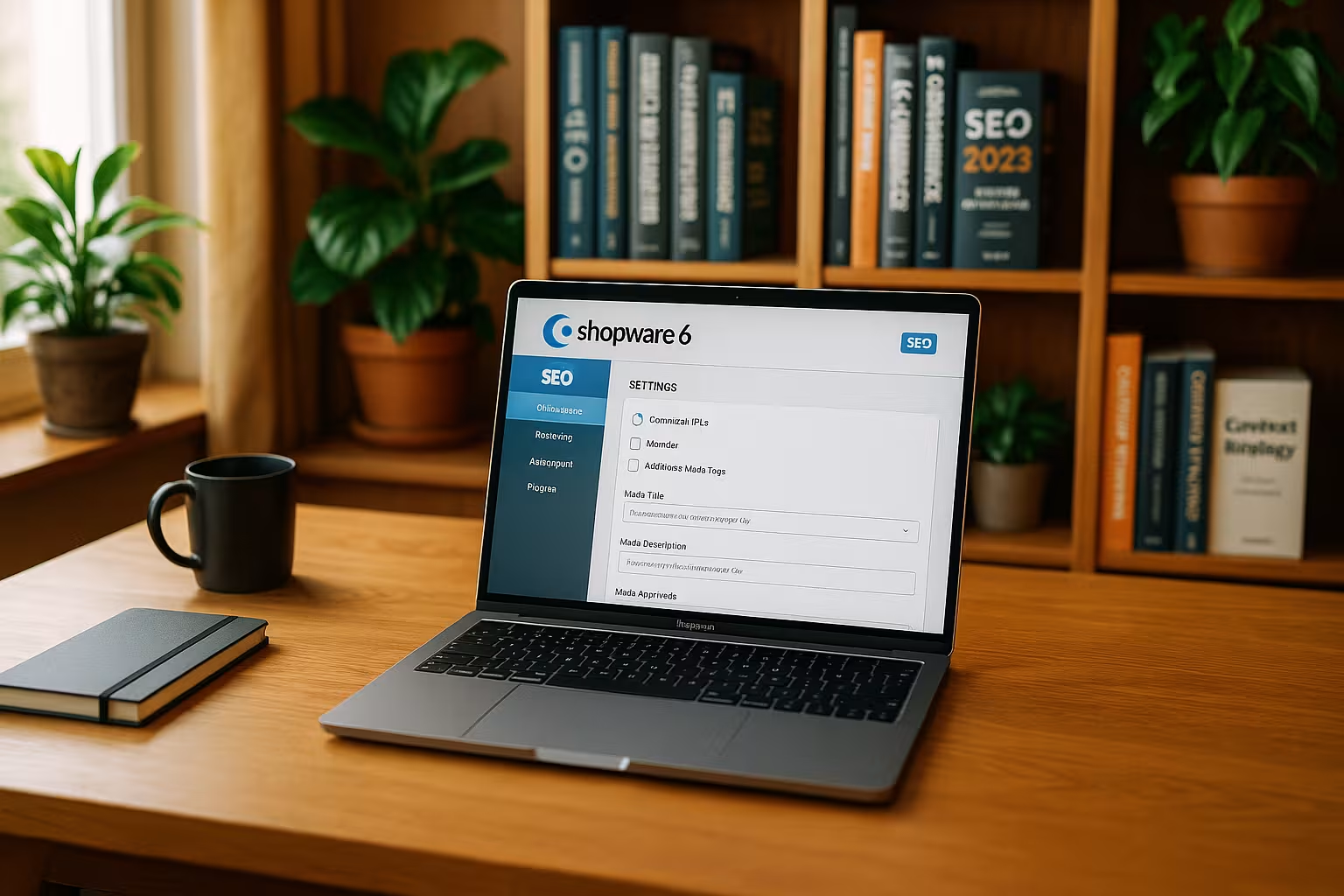
So-called speaking URLs are essential for indexing and user experience. In Shopware 6, the SEO module under Settings > Shop > SEO define exactly how your URLs are structured. A clear structure with relevant keywords - e.g. www.shop.de/herren/schuhe/sneaker - immediately shows Google what the page is about. Shorten your URLs to the essentials and avoid unnecessary parameters or ID characters. This will help your most important pages achieve significantly better positions.
With variable templates, you can define different URL structures for products, categories or CMS pages - this is also central for multilingualism or subshops. Once set up, your store retains its consistent structure, even if you add content.
To avoid duplicate content, you should also use consistent spellings and lower case. Make sure you only use one spelling variant in the link for category pages and avoid umlauts or special characters in URLs, for example. This ensures clean performance and better indexing in international markets. A consistent URL concept also means that you redirect during relaunches and major store updates so that valuable link power is not lost.
Use meta titles and descriptions correctly
The meta title is the first impression of your store in the search results list. Equally important is an informative meta description with a maximum of 160 characters. Formulate both concisely and integrate the main keyword per page. Use targeted trigger words such as "discover now", "incl. free shipping" or "top brands available" to increase the click rate. In Shopware 6, you can find the fields directly in the product, category or CMS management.
Avoid duplicate meta information. Repeated descriptions or titles often lead to a loss of ranking, as Google cannot clearly assign your content. You should overwrite automatic standard texts individually in large store structures - also automatically via plugins such as "SEO Professional".

In addition to the title and description text, it can be useful to use varying formulations for similar product types. This prevents your different product pages from appearing identical to Google. Small differences in the meta details also help to make it even clearer to potential customers in the search results what sets you apart from the competition. Also bear in mind that Google sometimes chooses its own sections for the title and description depending on the search query. It is therefore always worth checking your meta data on an ongoing basis.
Using worlds of experience strategically for content
Shopware 6 offers a powerful tool for content design with the experience worlds. Instead of just listing products, you can integrate blocks of text, images, videos or customer reviews directly on the category pages. This content helps both your visitors and Google to better classify the products.
Take the opportunity to answer key questions from your target group and include valuable long-tail keywords. The more relevant the content on category pages is, the longer users stay - this has a positive effect on the SEO rating. Reusable content blocks save you time, especially with large catalogs.
To create particularly relevant experiences, you can also use interactive elements in the experience worlds. One example is small quiz areas or sliders that contain additional information about products. This increases the length of stay and at the same time promotes interest in certain categories or product groups. For Google, this is a signal of high-quality content and a good user experience. At the same time, these modular layouts allow you to quickly create and adapt new content without having to carry out complex programming.
Internal links to strengthen important pages
Good internal linking distributes the link power ("link juice") within your store and makes relevant content easier to find - for users and crawlers alike. Place text links in product descriptions, include cross-references to suitable categories or display thematically relevant content at the end of a product page.
Deliberately link top sellers, best-selling categories or products that require explanation several times. This will highlight these pages in the internal link network. Be careful not to use dead links - they hinder the crawl process and generate error pages in the index.
Anchor texts should also be set carefully. Try to use meaningful formulations instead of just "click here" or similar generic anchor texts. In this way, you convey to Google much more strongly the relevance behind the link. Meaningful linking can also have a positive influence on user behavior because customers can more easily find exactly the content they are interested in. Last but not least, internal links in combination with structured data help to display your most important pages more prominently in the search results.
Check technical SEO settings
A well-configurable sitemap ensures that new products get into the Google index quickly. In Shopware 6, you can activate the automated sitemap export and update it regularly via the schedule. Also check the robots.txt file, which specifies which content may be crawled - e.g. you should block checkout or login pages.
You can limit variant URLs via NoIndex instructions in the indexing logic. It is also important to minimize duplicate content through clever template strategies.
| SEO component | Recommended setting |
|---|---|
| Sitemap | Automated generation, updated weekly |
| robots.txt | Block sensitive paths (e.g. /checkout, /account) |
| Meta Robots | Set NoIndex for filter URLs and variants |
In Shopware 6, you can also use canonical tags to ensure that Google does not include different URL variants with identical content in the index. This is a common problem, especially for articles with multiple variations or filters for sizes and colors. Also make sure you have a clear 404 error page that signals to users and crawlers that a particular page no longer exists. A 404 page can be provided with search fields and links to popular categories to maintain the shopping experience despite the error. Such details make your store more professional and help Google to classify pages correctly.
Implement mobile optimization consistently
Since Google prioritizes the mobile index, it is essential that the website is optimized for smartphones. Shopware 6 already provides a responsive basic framework. However, additional optimization is worthwhile for shorter loading times - for example through image compression, caching or the use of lightweight themes.
With performance plugins such as "Optimize PageSpeed" or services such as "Kraken.io", you can reduce loaded scripts and data by up to 40 %, which has a noticeable effect on your rankings - and conversion rate.

Another aspect of mobile optimization is touch usability. Avoid buttons that are too small or links that are too close together so that users can easily navigate through the store. Also regularly check via Google Search Console whether your website is classified as "optimized for mobile devices". Here you will also find indications of errors such as clickable elements that are too close together or content that overlaps. A good mobile user experience is directly reflected in purchasing behavior and signals to Google that your store is designed with the user in mind.
Structured data for more visibility
Rich snippets display additional information such as price, stock or rating directly in the Google result. Shopware offers an easy way to insert structured data tags cleanly via extensions such as "Google Rich Snippets".
Product pages in particular benefit visibly from this, as reviews or price promotions are convincing at first glance. FAQ snippets for categories or information pages can also be enriched in a targeted manner - and thus significantly increase the click rate.
When implementing, make sure to fill out the structure of the data as comprehensively as possible. Information on the manufacturer, product availability and reviews are relevant factors for many buyers. With structured data, you make it easier for Google to assign information and thus have the chance of a more prominent display in the SERPs (search results pages). By regularly maintaining and updating your product information, these rich snippets are kept permanently up-to-date, which increases your visibility in the long term.
Combining content & keyword research sensibly
Well thought-out keyword research forms the basis of your SEO strategy. Use specific terms that your target group really clicks on - and don't fill your content with empty phrases. Sensible combinations of short and long-tail keywords improve relevance.
Analysis tools help you to uncover weaknesses in your content and make targeted improvements. For start-ups, it is worth taking a look at Store solutions for young companiesbecause the structural starting position often plays a decisive role in content planning.

During your keyword research, you should regularly check which terms are new or closer to a purchase. A good example is long combinations such as "red sneakers men breathable size 44", which already signal a very concrete interest in buying. Long-tail keywords like these are ideal for placing on specific product pages to serve high-traffic niches. Also analyze which questions users often have about your product categories ("Which soles are particularly non-slip?"). Such content can flow into your experience worlds or FAQ areas and generate targeted organic clicks.
Optimize images & use ALT tags
Product images appeal to customers visually - search engines need additional data. Use descriptive file names (e.g. nike-air-max-black.jpg) and add ALT tags with important terms from your keyword list. In addition, all images should be compressed.
Avoid oversized images, which drastically reduce the loading speed. Tools such as TinyPNG or automated image optimization via CDN (Content Delivery Network) will help you with this.
Bear in mind that images can also be found via Google image search. Good ALT texts or image headings increase the likelihood that you will pick up additional visitors there. Also pay attention to the correct placement of images within the content. Ideally, product images should be placed directly next to the relevant description or call-to-action to lead users to a purchase more quickly. Smart lazy loading functions can speed up loading without compromising the user experience, especially in stores that are very image-heavy.
Targeted use of automation & plugins
Shopware 6 offers numerous enhancements to automate SEO tasks and map them in a more structured way. Particularly noteworthy is the Plugin ecosystemwhich integrates seamlessly into existing installations.
Whether automatic metadata generation, AMP integration for mobile pages or structured data according to Schema.org - well-chosen plugins make it easier to support your SEO goals in the long term. Important: Only use extensions that are actively maintained to avoid security risks.
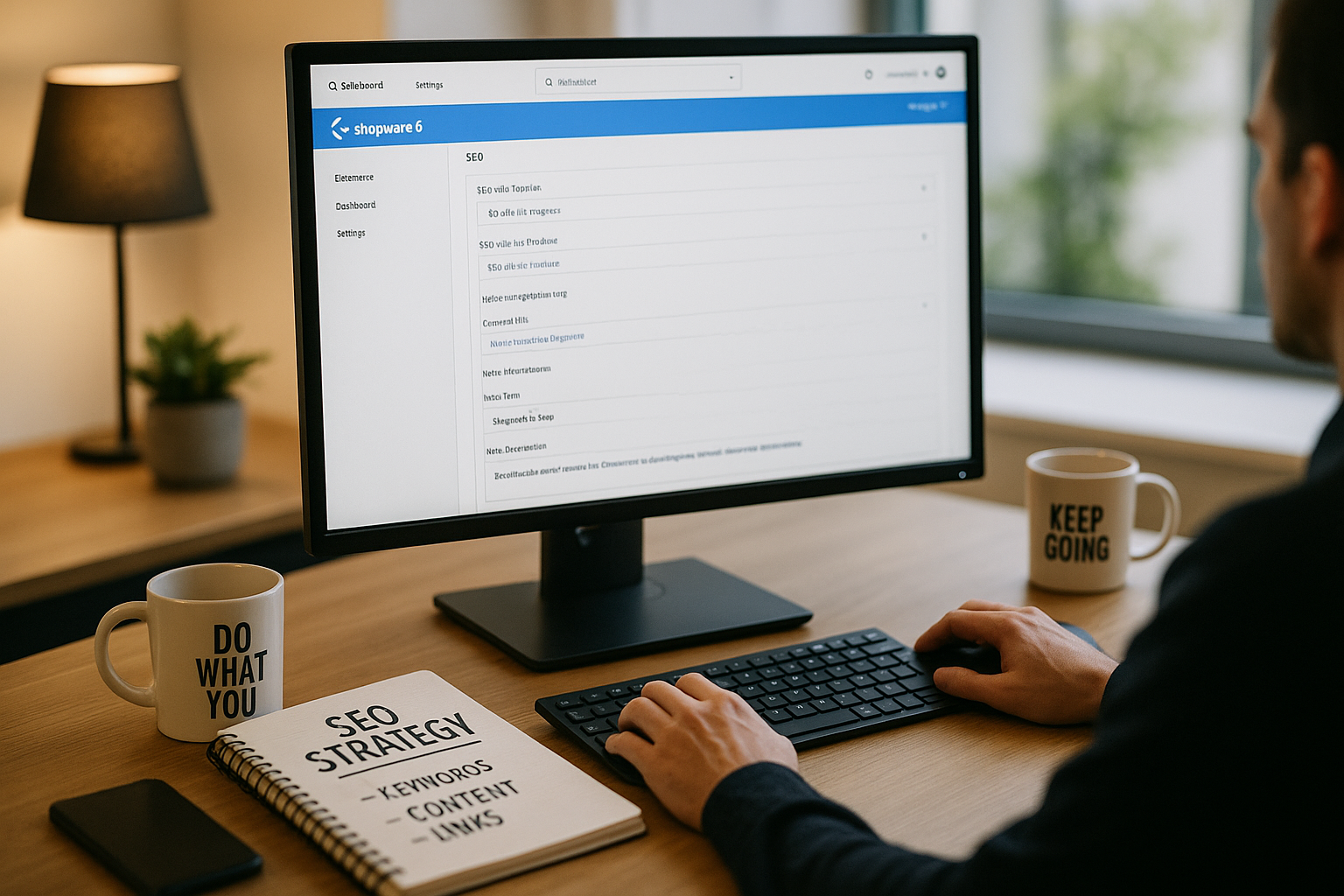
However, automation does not mean leaving the entire SEO process to its own devices. Even intelligent plugins need regular monitoring to ensure that settings continue to be used sensibly and that important content is not inadvertently overwritten. Periodic updates of the plugins also ensure that security gaps are closed and new SEO functions are integrated. If you install a lot of plugins, you should also make sure they are compatible with each other. Plugin conflicts can slow down your store or lead to malfunctions, which can ultimately have a negative impact on the user experience and therefore also on your Google ranking.
Analysis is mandatory
Without sound data analysis, optimization remains blind. Google Search Console can be used to analyze the ranking potential of your pages. Pay attention to click numbers, impressions and technical crawling errors. SEO tools such as SISTRIX or Ahrefs also help to identify gaps and potential.
Shopware 6 also allows standardized reporting in the admin area. Use these values to plan new content based on data and to further develop old content in a structured manner.
To really analyze effectively, you should set yourself goals: Where do you want to see your rankings in the next three months, which products should be given more prominence? The comparison between target and current status can be carried out at regular intervals (e.g. monthly). Not only positions in the search results are important here, but also key figures such as the bounce rate or the conversion rate. This allows you to quickly identify whether visitors are coming to your site but may be leaving again because the content or loading times are not convincing. You can use this information to adjust your SEO strategy in a targeted manner.
Hosting is the basis for SEO
Fast hosting servers and high-performance databases have a positive effect on loading times and user experience. A stable infrastructure is therefore essential for your SEO results. Especially for stores with over 1,000 products, it is worth switching to providers that offer a high-performance architecture and standardized SEO extensions.
A convincing provider with a focus on Shopware is webhosting.com with hosting packages for demanding projects. Loading times of less than 1.5 seconds are easily possible there - a clear competitive advantage for your store.
You should also make sure that your hosting provider offers you sufficient SSL certificates, caching options and server locations. Google prefers secure websites and rewards low latency times from close to the visitor. If you want to sell internationally, you can also benefit from additional services such as content delivery networks. Well-chosen hosting can therefore form the most important cornerstone for your entire SEO strategy. Stable and fast stores not only have a better chance of achieving good rankings, but also minimize abandoned purchases because users become impatient.
Another important factor is the scalability of the server performance. Especially on days with high visitor numbers (e.g. Black Friday or Cyber Monday), you should be able to handle more traffic without a drop in performance. It is worth choosing flexible hosting packages that automatically absorb peak loads. Also think about fail-safety and backup solutions to prevent data loss in the event of an emergency. A proactive hosting provider can also inform you about security patches and updates that contribute to the stability of your store. This relieves you of the burden of care and maintenance and gives you more time for in-depth SEO optimization.
All these aspects of the infrastructure ultimately form the foundation for a professionally positioned e-commerce business that is rated well by both customers and search engines. In combination with the SEO measures presented here, you will achieve long-term competitive advantages, greater reach and stronger customer loyalty.