Skip to content
A Domain Alias SEO can specifically increase your visibility on Google, intercept user errors and reach international target groups efficiently - provided the technical implementation is right. In this article, I will show you how to configure alias domains correctly, boost rankings and avoid duplicate content.
Key points
- 301 redirects are mandatory to correctly redirect search engines and visitors
- With Canonical tags Avoid duplicate content and ranking losses
- A Domain strategy with matching aliases strengthens brand and reach
- Technical cleanliness is crucial for indexing and SEO performance
- Regular SEO audits ensure correct alias usage in the long term

However, the successful use of domain aliases is not just about basic requirements such as 301 redirects or canonical tags. Understanding potential SEO synergies between the main domain and the alias domains is also essential. This relates to branding aspects, among other things: A good alias strategy can not only intercept scatter loss, but also direct new search queries from other countries or from users who make typos to the main domain.
The focus is always on ensuring that Google and other search engines can clearly assign all content to a main address. If this clarity is missing, you risk diluting your domain authority. In international projects, it often happens that administrators create domains in different variants but do not take care of uniform redirects. As a result, well-intentioned "security" registrations can quickly become SEO traps. It is therefore essential to check your domains regularly to ensure that all aliases are working correctly.
What is a domain alias - and why is it relevant?
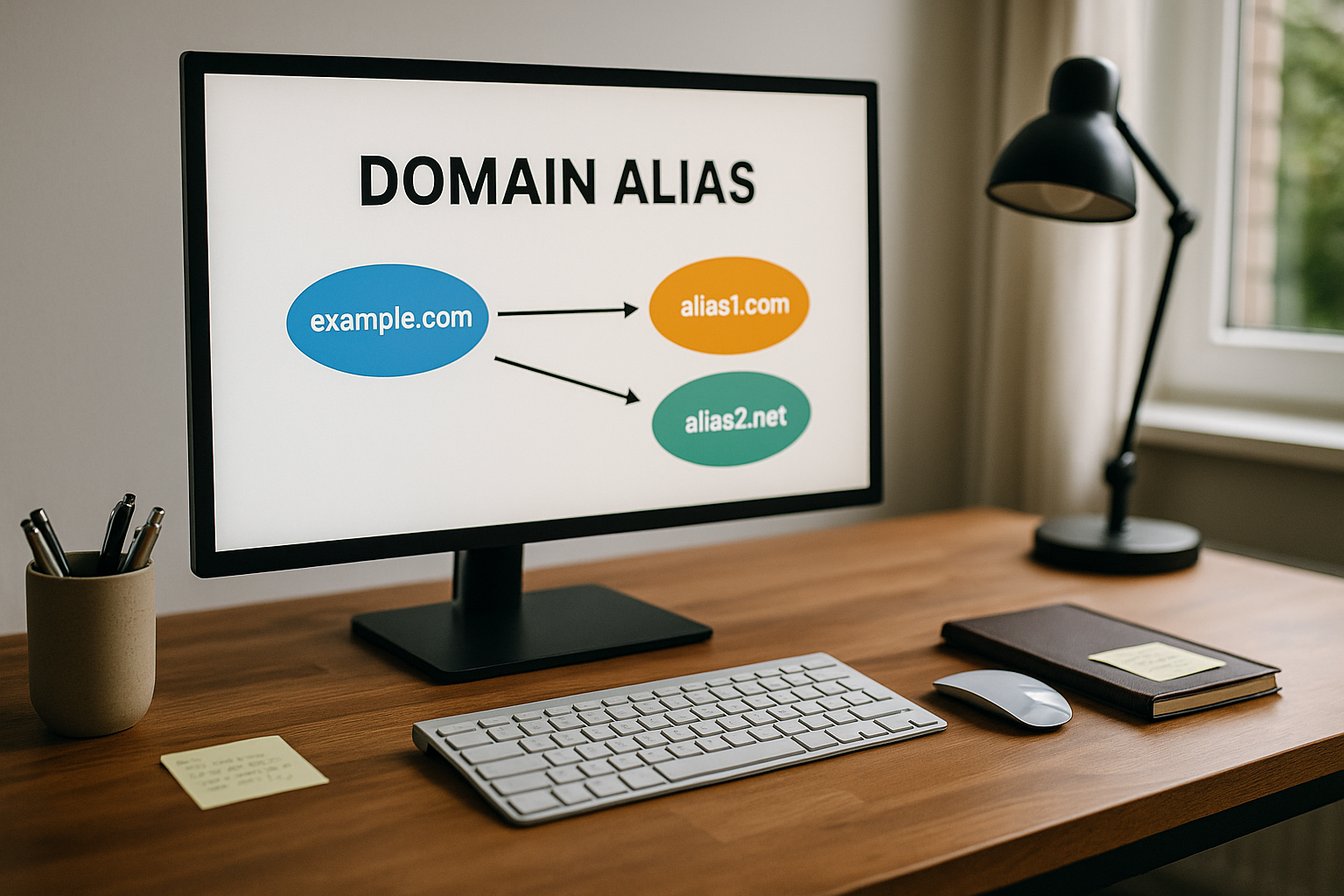
A Domain alias is an alternative address on the web that leads to the same website as your main domain. Users often don't notice this because they either see exactly the same content or are forwarded directly. Common cases: You have mysite.de, but also register my-site.de or mysite.com. In this way, you avoid losing traffic in the event of typing errors or country-specific search queries.
For companies with an international focus, it can make sense to use various top-level domains such as .de, .com or .eu as aliases. These aliases bundle access without additional maintenance and can be easily configured technically in the hosting environment. Domain forwarding correctly is essential.
Another advantage is the quick reaction to trends: if a new relevant keyword appears, you can register a new domain at short notice and connect it via an alias. This allows you to direct the resulting traffic to your main project and benefit from the increased attention. Nevertheless, you should ensure that you do not dilute your overall strategy with each additional domain - too many aliases without a clear structure can also have a counterproductive effect.
SEO levers: How domain aliases support findability
If managed correctly, alias domains offer valuable advantages for search engine optimization. All incoming links via alternative domains can be optimized via permanent 301 redirects to your main domain. This allows backlink signals to flow together centrally - the biggest SEO advantage of this method.
If the appropriate redirect is missing, Google recognizes two identical pages with different URLs. This leads to Duplicate contentwhich can damage your domain authority. To prevent this, many professionals use a canonical tag. This allows you to define the relevant main URL for indexing for each page with the same content.

An important SEO aspect here is the distribution of your keyword and content focus. In some cases, separate landing pages on an alias domain can make sense, especially if they contain country-specific information or content. To ensure that these do not count as duplicate content in the long term, you must either make real differentiation in the content or - if you do want to keep it identical - clarify which URL should be authoritative from an SEO perspective. This also makes indexing management easier.
Also optimize your meta tags, titles and descriptions: domain aliases should clearly refer to your main page so that search engines receive a consistent signal. The interplay of redirection, canonical and clean on-page optimization is the strength of your alias SEO. Especially in competitive industries, it can be crucial to make good use of existing aliases instead of letting them "hang around" uncontrolled on the web.
Clear rules for successful domain alias SEO
Successful SEO use of alias domains starts with the technology. I generally recommend the following measures:
- 301 redirectsEach alias should have a permanent redirect to the main domain.
- Canonical tagThis is particularly important if forwarding is not possible or does not make sense.
- No identical contentAvoid operating an alias domain with the same content as the main domain.
- Landing pages with country-specific content can be useful, but should be optimized for uniqueness.
Paying attention to these points will strengthen your visibility in the long term and protect your domain structure from SEO problems.
It is also important to continuously monitor the technical status of your alias domains. You can use SEO tools or the Google Search Console to check whether all aliases are pointing to the correct page. This allows you to detect errors in the forwarding configuration or possible DNS problems at an early stage. You should also ask yourself whether you know the alias-related URLs and document them properly. Especially if you manage several domains for different brand products, it is easy to lose track.
Typical mistakes that thwart your SEO goals
I have seen many cases where alias domains have prevented the hoped-for ranking gain. One of the most common mistakes: redirects are missing or set up incorrectly. As a result, Google recognizes multiple versions of the same content - with fatal consequences for the ranking.
Another stumbling block is a misleading alias strategy. Different domains show the same content, but the branding changes uncontrollably. Or there are language versions without suitable hreflang tags - so the search engine lacks context.

It is also often underestimated how dangerous domain aliases can be if they are outdated in hosting or DNS configurations. If an alias is not set up correctly for years, it can happen that pages that are not maintained or even contain outdated content inadvertently remain accessible. An "orphaned" alias can thus become a gateway for spam, malware or poorly programmed scripts, which in turn can damage the SEO profile of the main domain.
It is therefore advisable to regularly check all domains that are connected to your main site for function, redirect type and visibility in the index. Only if you keep an eye on these potentials and risks in the long term will alias domains bring you the desired success and protect your project at the same time.
How to choose the optimal domains and aliases
A good alias starts with a brand-clear main domain. This should be short, understandable and ideally keyword-relevant. When adding aliases, I prioritize country-specific TLDs, frequent misspellings and essential keyword combinations.
Use smart domain selection tipsto avoid typical mistakes when extending aliases. Choosing the right domain landscape is a fundamental step for long-term SEO growth and brand management.
Another consideration is the extent to which you align aliases with specific thematic search queries. A topic-oriented keyword domain can be particularly useful for projects that consist of several sub-areas. However, it is important to note that search engines usually attach great importance to content quality. Pure keyword domains without substantial content are unlikely to be successful in the long term. If, on the other hand, you offer thematically in-depth landing pages or blog articles on such an alias domain, you can grow organically and at the same time boost the ranking of your main domain via 301 redirects.
Brand perception also plays an important role: too many domains can confuse users. After all, if someone knows your main domain but suddenly lands on a completely different address name, this could raise doubts about your seriousness. Therefore, make sure you keep your branding consistent by making your brand name clear in titles and meta descriptions and clearly communicating which website is central.
Table: Comparison of domain alias strategies
The following table shows typical alias paths and their SEO impact:
| Alias type | Method | SEO impact |
|---|---|---|
| Misspelling (e.g. mywesite.de) | 301 Forwarding | Avoidance of traffic loss |
| Country variants (e.g. mysite.fr) | Content or forwarding with hreflang | Geotargeting can be used efficiently |
| Keyword domain as alias | 301 redirect or landing page | Additional visibility |
| www / non-www variants | Canonical + forwarding | Technical standard, SEO-neutral |
The strategies listed in the table can be further differentiated in practice. An important point here is that some companies decide against country-specific content and refer all international top-level domains to the main domain in a single language via 301 redirection. This saves maintenance effort, but at the same time can leave the potential of the respective national market untapped. If you are explicitly active in several languages, you should take a close look at hreflang tags and country-specific SEO strategies.
Technical implementation: Hosting makes the difference
Whether an alias domain works properly depends largely on the hosting model. Reliable forwarding functions, stable DNS management and simple alias setup are particularly important for large projects. A service like webhoster.de offers a powerful infrastructure and controlled access.
Who is on the right domain extension and redirects them in a technically clean way, you can be sure of better loading times, greater reliability and simpler administration in the long term - especially with many alias domains.
Another important detail in the hosting environment is SSL certificate management. If you want to offer your users HTTPS across the board - which should now be standard from an SEO perspective - every alias domain must also have a valid certificate or at least link to a correspondingly encrypted page. This can quickly become complex for large projects with many country-specific domains. Good hosting providers simplify the process here with automated SSL solutions (e.g. via Let's Encrypt). Also check whether your provider supports wildcard certificates if you are integrating subdomains into your alias structure.
When it comes to DNS management, you should ensure that each domain uniquely points to your target address, for example via an A or CNAME entry. Errors in the DNS configuration often lead to visitors arriving at a blank page or an error page. To avoid technical difficulties, it is worth documenting all domain settings in detail. Especially in growing companies, SEO and IT personnel change frequently - structured documentation is worth its weight in gold.
Strategic SEO integration of domain aliases
I recommend actively integrating alias domains into your SEO measures. This includes regular technical analyses with Google Search Console, maintaining internal links and controlling external signals. The better your domains are orchestrated, the more you will benefit from cross-channel SEO consistency.
Set up your redirects so that all signals converge on a central URL. This increases the authority of your main domain and reduces unnecessary scatter loss due to confusion or duplicate content.
You can also use alias domains to run target group-specific advertising campaigns. For example, if you are planning a marketing campaign exclusively in a specific country, you could use a country-specific domain that leads to a customized campaign landing page. You then use tracking to check how successful the campaign was and direct general traffic to the main page in the long term. In this way, campaigns remain clearly separated and your main domain still benefits from the collected user interactions via the redirects.
Another important aspect is control over backlinks. If media, blogs or partners link to a certain alias domain, you want to make sure that this linkjuice is not lost. You should therefore regularly check which backlinks lead to which domains. Ideally, you should redirect all collected link signals permanently and cleanly to your central page via 301. With strategic SEO integration, it is ultimately important to design domains and aliases in such a way that your brand appears uniformly everywhere - without creating unnecessary parallel structures.
Conclusion: Use domain aliases specifically as an SEO tool
Domain aliases are more than just a nice add-on - they act as a Strategic SEO tool. Configured correctly, you protect your brand, secure valuable traffic and increase organic reach. Pay attention to consistent 301 redirects, good domain selection and a clear canonical strategy.
If you carry out regular technical audits and keep your domains technically and strategically clean, you will not only make your website more robust, but also more visible. Take advantage of the opportunities - and get the most out of your domain landscape.