Skip to content
The php 8.3 changes provide me with immediately noticeable advantages: typed class constants, dynamic constant access, fast JSON validation and a clear override attribute improve code quality and speed. I also benefit from better error diagnostics, practical string and random tools and finer options for read-only objects in the cloning process.
Key points
The following key points help me to quickly classify the new features and prioritize my code.
- Typed Class constants increase security and readability.
- Dynamic Access to constants and enums simplifies meta-programming.
- json_validate() saves memory and speeds up API checks.
- Override-attribute supports clean refactoring.
- DX-Improvements and new string/random functions make everyday life easier.

Typed class constants: clear contracts for APIs
I use typed class constants to ensure the expected Values directly at the contract of the class or interface. Instead of laboriously searching for type errors later, I stop them during compilation and thus save time in the review. I now store constants as string, int, float, bool, array or even as separate types and keep the intentions crystal clear. In larger teams, this type of Type safety The difference because misunderstandings between components are eliminated. The result: a more consistent API design, shorter debugging phases and smoother deployment.
Practical example and team conventions
In service APIs, I formulate constants as part of the public contract. This stabilizes behavior and autocompletion in IDEs provides more precise hints:
// PHP 8.3
final class Http
{
    public const string METHOD_GET = 'GET';
    public const string METHOD_POST = 'POST';
    public const int DEFAULT_TIMEOUT = 5;
}

function fetch(string $url, string $method = Http::METHOD_GET): void
{
    // ...
}
Important in teams: I specify that constants in base classes are not "silently" semantically changed. Breaking changes are noticed more quickly due to typing. The usual visibility rules apply to inheritance; anyone who overwrites constants documents this deliberately and keeps the types identical.
Dynamic retrieval of class constants and enums
I now access without detour via constant() dynamically on Constants and enum members and obtain a much more readable syntax. Especially in frameworks that work with conventions and metadata, this access feels natural. Routing tables, DTO mappings or feature flags can be compiled more elegantly in this way. The code is shorter, the intention remains clearand I can manage with fewer helper functions. For tooling that derives rules from configuration values, this provides a real productivity boost.
Use cases with code
// Dynamic class constants
$class = Http::class;
$const = 'METHOD_POST';
$method = $class::{$const}; // 'POST'

// Dynamic enum cases
enum Role: string { case Admin = 'admin'; case User = 'user'; }

$caseName = 'Admin';
$roleCase = Role::{$caseName}; // Role::Admin (enum case object)
I take visibility into account: Private/protected constants still respect encapsulation and trigger errors outside their validity context. In metaprogramming and configurations (e.g. "Read case name from YAML"), the code becomes more straightforward, without auxiliary functions that disrupt the reading flow.

json_validate(): quick syntax check for large payloads
With json_validate() I check a JSON string for correct syntax without having to decode. This saves memory because no arrays or objects are created and reduces CPU time for large API messages. In event streams, webhooks and log pipelines, I can sort out defective payloads at an early stage. This increases the Stability of my ingestion routes and get to relevant error locations more quickly. This is a quick win for gateways and edge services, which is directly reflected in latencies.
Use in gateways and queues
In reverse proxies and worker jobs I use json_validate() as a pre-filter. Only with true I decode the data - or respond early with an error:
function acceptPayload(string $payload): bool
{
    // Only check the syntax - no creation of large structures
    if (!json_validate($payload)) {
        // Optional: rate limiting/logging
        return false;
    }
    $data = json_decode($payload, true, 512, JSON_THROW_ON_ERROR);
    // Further processing...
    return true;
}
Important: json_validate() optionally accepts depth/flags, but does not change any json_last_error()-values. For detailed error messages, I decode in a controlled manner with exceptions; for throughput and protection against out-of-memory, validation is usually sufficient.
Developer experience: sharper highlighting, better errors, consistent warnings
The HTML output of highlight_file() and highlight_string() looks tidy and makes reviews in tools clearer, which makes my Analysis accelerated. Date functions now return more specific exceptions, so I no longer have to catch generic messages. With unserialize() I get reliable warnings instead of inconsistent hints, which makes logs more meaningful. These small adjustments add up to a more pleasant DXbecause I waste less time on background noise. I concentrate on logic instead of a lack of clarity in the feedback.
Tooling synergies
In combination with static analysis, the improvements raise the basic quality: typed constants are clear signals for analysis tools, the #[\Override]-attribute reduces interface divergences, and clearer error messages simplify CI issues. Build pipelines become smoother because warnings occur more consistently and are fixed faster.
Override attribute: safe overrides during refactoring
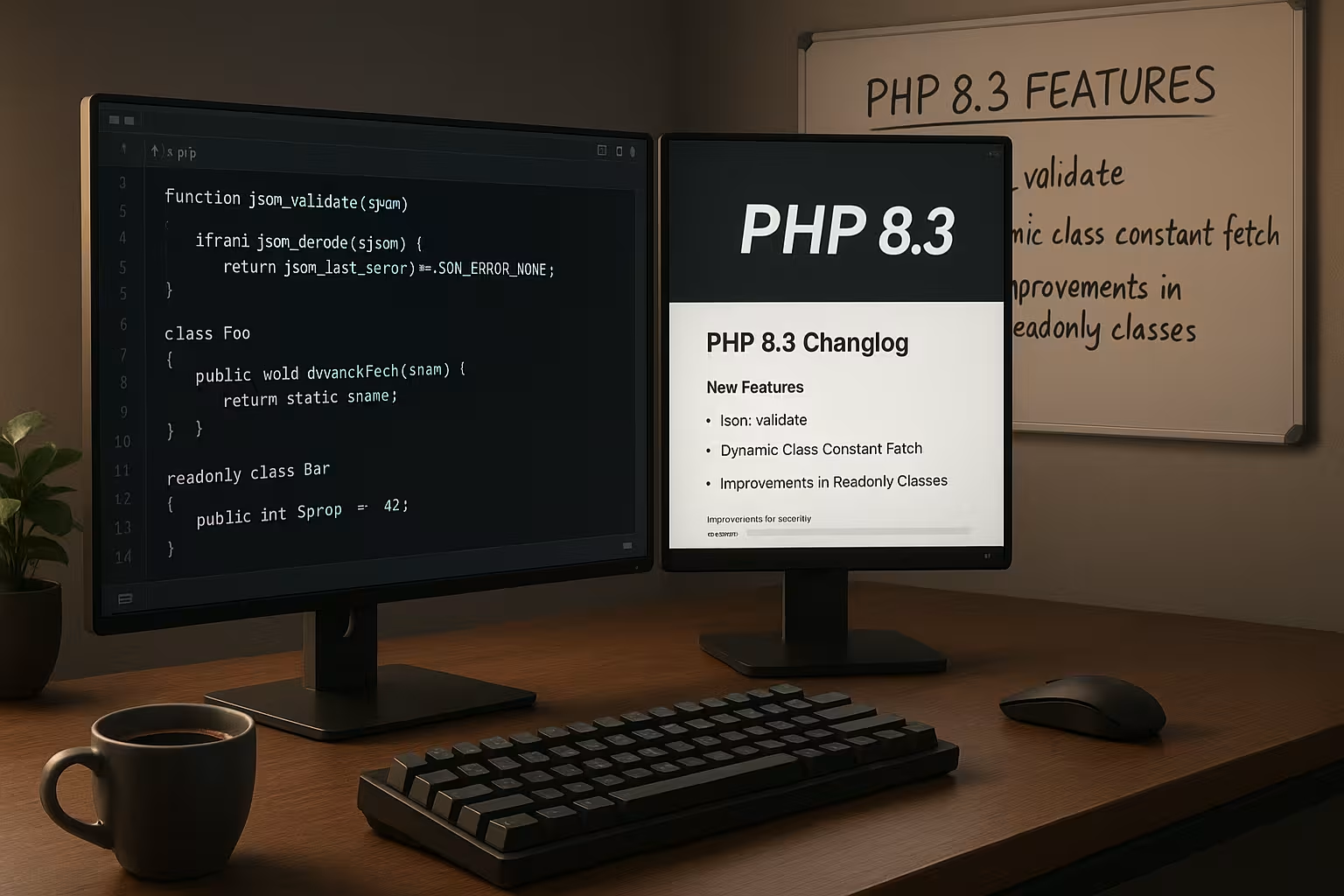
With #[\Override] I mark a method in the child class as Overwriting and have PHP check whether the signature really matches the parent. The engine immediately exposes typos in the method name or incorrect parameters. I plan refactorings in a more relaxed way because the language itself provides me with the guard rails. In projects with many interfaces, this increases the Reliability of release cycles. I save manual checks and reduce consultations in code reviews.
Troubleshooting and compatibility
The use of attributes is particularly helpful when implementations run across many levels:
interface Clock { public function now(): DateTimeImmutable; }

final class SystemClock implements Clock
{
    #[\Override]
    public function now(): DateTimeImmutable
    {
        return new DateTimeImmutable('now');
    }
}
If the signature in the base changes, the attribute stops faulty code early. It applies both for real overrides and for interface implementations. I use it specifically where I intentionally fulfill a parent API - and deliberately leave auxiliary methods unmarked.
Read-only properties rethought in the clone context
Read-only properties give me more since 8.2 Control about immutable objects, and with 8.3 I am allowed to use them in the __clone() customize in a targeted manner. This supports patterns for immutable designs, where I create variants of an object without changing the original state. This serves as a practical lever for value objects, configuration snapshots or calculation results. I use it to keep data flows comprehensible and minimize side effects. The cloning exception is small, but very useful in everyday life.
Example: Immutables with patch mechanics
Because changes to readonly fields exclusively in the __clone() are allowed, I work with a small patch mechanism that pre-memorizes the desired changes before cloning:
final class Config
{
    public function __construct(
        public readonly string $env,
        public readonly array $flags = []
    ) {}

    // Träger für Clone-Änderungen (nicht readonly)
    private ?array $clonePatch = null;

    public function withFlag(string $name, bool $value): self
    {
        // Patch am Original vormerken
        $this->clonePatch = ['flags' => $this->flags + [$name => $value]];
        try {
            $clone = clone $this; // __clone liest den Patch und setzt readonly Felder
        } finally {
            $this->clonePatch = null; // Aufräumen
        }
        return $clone;
    }

    public function __clone()
    {
        if ($this->clonePatch !== null) {
            foreach ($this->clonePatch as $prop => $value) {
                $this->{$prop} = $value; // in __clone erlaubt
            }
        }
    }
}
The pattern remains clear: read-only properties remain outside of __clone() protected, I can initialize them specifically in the cloning context.

Additional tools: Multibyte padding, randomizer and string increment
mb_str_pad() allows me to pad Unicode strings, so that formatting for Multilingualism remain consistent. The randomizer gains in convenience, for example with getBytesFromString() for secure random bytes from a permissible alphabet. I use it to generate controlled but random sequences for codes, tokens or test data. The new functions str_increment() and str_decrement() Simplified counter in Stringsfor consecutive IDs, for example. Small features, big everyday simplifications.
Practical snippets
// Multibyte padding (e.g. for column tables in UTF-8)
$title = mb_str_pad('Overview', 14, '-', STR_PAD_RIGHT, 'UTF-8');

// Randomizer with restricted alphabet
use Random\Randomizer;

$alphabet = 'ABCDEFGHJKLMNPQRSTUVWXYZ23456789';
$random = new Randomizer();
$token = $random->getBytesFromString($alphabet, 10); // e.g. '9ZK3M7H2QF'

// String counter for file names, invoice numbers etc.
str_increment('INV-009'); // 'INV-010'
str_decrement('file010'); // 'file009'
I make sure that str_increment()/str_decrement() map simple counting rules. For complex schemes, I combine them with my own format and check rules.
Performance boost, parallelism and hosting setup
Under high loads, I benefit from tighter Request-processing and more responsive pipelines. AI-related scenarios with fast JSON rounds and FFI connections can be orchestrated more smoothly. I achieve better latency values when I combine PHP 8.3 with a suitable hosting stack. For guidance on technologies and environments, I use the PHP Hosting Guide 2025 to help you get started. This is how I use server parameters and caching layers in a targeted manner and keep performance stable.
Opcache, autoloading and JIT in practice
I get more performance from clean basics:
- OPcache: Sufficient memory, high revalidationintervals and preloading for hot-paths reduce start-up costs. Large frameworks benefit noticeably.
- Autoloading: Optimized composer classmap and few, well-grouped namespaces avoid file system lookups and improve warmup times.
- JIT: JIT can help for CPU-heavy sections (parsing, numerical routines); the effect is smaller for I/O-heavy web apps. I measure and activate specifically.
- FPM/PM: I adapt the number of processes, max requests and timeouts to load profiles. Short, constant request times are often more important than "maximum" parallelism.
Especially in connection with json_validate() and lean middleware, consistent hot-path optimization pays off quickly.

Migration and compatibility: planning clean steps
I start with a local test environment, activate strict Error messages and run my suite against 8.3. Then I check discontinued patterns, such as the parameterless call of get_class() or get_parent_class()and replace them at an early stage. For servers with Plesk, I compare configurations and notes from 8.2 to realistically assess stumbling blocks; the page on PHP 8.2 on Plesk. I look at my own interfaces and class constants and plan where typing real Value deliver. Finally, I open logs, analyze warnings and do the rollout step by step.
Upgrade checklist for everyday life
- Check compatibility: Composer-Require on
^8.3update dependencies, run CI against 8.3. - View deprecations: Test runs with maximum error levels, dynamic properties and targeted replacement of old patterns.
- Introduce typed constants: First in core modules, which have many consumers; then gradually in satellites.
#[\Override]mark: Prioritize critical services and adapters so that signature errors become visible early on.- Set read-only clone pattern: Define a standardized patch/with() pattern that the team understands.
- harden json paths:
json_validate()before decoding, collect metrics on error rates. - Test deployment: Compare OPcache/JIT/FPM settings, use Blue-Green or Canary for gradual rollout.
Quick comparison of the most important changes
The following table briefly classifies key features and shows what I get out of them in projects.
| Feature | What is changing? | Effect in the code |
|---|---|---|
| Typed Class constants | Constants carry explicit types | Earlier mistakes, clearer contracts |
| Dynamic Constant accesses | Access without constant() | Shorter, readable meta code |
| json_validate() | Syntax check without decode | Less RAM, faster gateways |
| Override-attribute | Compilation check for overwriting | Secure refactoring of large bases |
| Readonly in the clone | Targeted adjustment for __clone() | Better patterns for immutables |
Tuning, storage and monitoring in everyday life
For APIs and jobs, I pay attention to sensible limits, log sizes and Memory-reserves. If payloads increase, I make gradual adjustments and monitor latencies and error rates. The article provides me with pragmatic instructions Increase PHP memory limitwhich I use to methodically tackle bottlenecks. I also set process manager parameters with a sense of proportion and keep APM and structured logs to hand. This enables me to recognize trends early on and prevent follow-up costs due to unstable processes.

Quick overview to take away
PHP 8.3 sharpens my Tools in many places: tighter contracts, cleaner dynamics, lightweight JSON checking and helpful DX details. I invest a few hours in testing, typing and refactoring markers and get more reliable deployments in return. For faster responses, I combine the features with suitable hosting settings and choose logs, APM and alerts wisely. All in all, this pays off in terms of productivity, readability and Speed out. Anyone running APIs, stores or AI-related services today will get a powerful update for daily use with 8.3.