Skip to content
WordPress maintenance contract for me means: clear services, transparent prices and reliable tools for a secure, fast website. In this article, I'll show you which content makes sense, which price levels have proven themselves and which software I use for ongoing support - including specific Packages and practical recommendations.
Key points
I will briefly summarize the following key aspects before going into more detail. I focus on services, prices, tools and implementation in everyday life so that you can quickly make a decision for your Service can meet.
- Updates and backups as a mandatory program for security and fast recovery
- Monitoring for uptime, performance and attacks with clear alerts
- Support as required: ticket, telephone or fixed hourly quotas
- Price levels from €9 to €149+ depending on size and risk
- Toolstack from central administration, security, cache and SEO
These points form the guidelines for my work. I focus on comprehensible processes so that you understand every step and clearly recognize the benefits. This creates trust, fewer failures and predictable Costs. In the next section, I explain how a contract is structured and why this is important. This is followed by specific price examples, tools and practical tips for implementation.
What is a WordPress maintenance contract - and for whom is it worthwhile?
A maintenance contract defines clear tasks, intervals and responsibilities for updates, backups, monitoring and support - and thus protects your website during operation. I use fixed routines and escalation levels so that problems are not only noticed when it is too late. This approach is particularly worthwhile for company websites, stores and blogs with revenue, because downtimes directly affect sales and revenue. Reputation costs. Smaller projects also benefit because regular maintenance keeps plugins lean, closes security gaps and prevents major construction sites later on. If you work without a contract, you often pay for it in an emergency: recovery, damage limitation and data recovery take longer and cause higher costs. A contract brings order, measurable quality and reliability to support - without surprises in terms of effort and price.
Services in detail: updates, backups, monitoring, support
I keep updates for core, plugins and themes up to date, test them for staging and only make them live after a brief check - this is how I ensure Compatibility and minimal risk. Automated backups run daily or weekly; in addition, I make manual backups before major changes so that a clean copy is available in an emergency. A security scan detects malware, insecure file permissions and suspicious logins, while a web application firewall blocks attacks and protects against unauthorized access. Alerts triggers. Uptime checks check accessibility every minute, and performance metrics show loading time, database load and core web vitals. For questions and errors, I offer support via e-mail or telephone; depending on the package, an hourly quota is included or I charge fairly according to time. This structure prevents surprises, keeps the site fast and saves money in the end.
Additional services that are worthwhile
In addition to basic maintenance, I rely on recurring SEO checks to keep an eye on technology, loading time and metadata and Ranking-potential. I reduce form tests, database optimization and image compression to fixed intervals because such details often determine performance and conversion. I use staging environments for changes so that new features can be prepared without risk and Rollbacks remain possible at all times. I address GDPR issues with consent management, cookie scans and regular checks of third-party scripts. E-commerce businesses receive additional controls for payment and shipping workflows as well as protection against fraudulent orders. The result is an all-round package that covers the most important risks and prepares for growth.
Calculate prices and packages sensibly
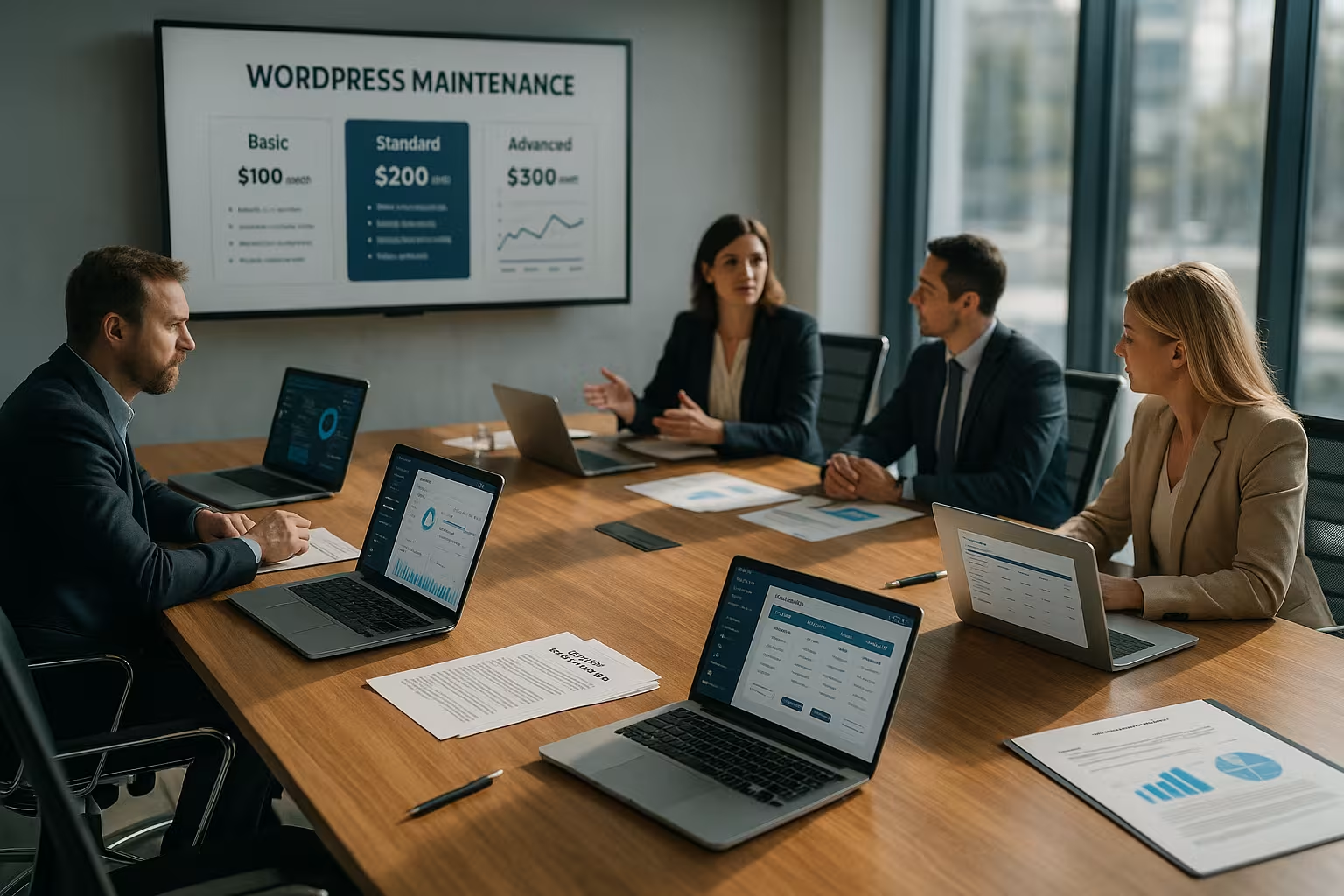
I structure packages according to website size, risk and response time so that effort and Budget fit together. Small sites with just a few plugins start at €9-15 per month if it's primarily about security updates and backups. For corporate sites and stores with active marketing, I calculate €29-79 per month, including monitoring, backup management, support and performance checks. Large projects with individual development, high traffic and extended security checks are from €100 per month, sometimes significantly more - depending on SLA, availability and Reporting. If you want to keep an eye on the entire annual planning, take a look at the Costs of a website 2025to bundle terms, licenses and maintenance in a sensible way. This creates a reliable pricing model that fairly reflects performance and risk.
| Package | Price/month | Updates | Backups | Monitoring | Support | Security | Performance | Recommended hoster |
|---|---|---|---|---|---|---|---|---|
| Basic | from 9 € | ✅ | Weekly | ✅ | Basic protection | Partial | webhoster.de | |
| Standard | from 29 € | ✅ | Daily | ✅ | E-Mail/Phone | Extended | Yes | webhoster.de |
| Premium | from 79 € | ✅ | Daily | ✅ | Personal | Firewall | Maximum | webhoster.de |
| Enterprise | from 149 € | ✅ | Daily/external | ✅ | Individual | Premium | Complete | webhoster.de |
The table is a starting point that I expand depending on the plugin landscape, traffic, compliance requirements and desired response time. It is important to clearly delineate: what is included, what is optional, how quickly do I react and in which way? Situation? This transparency prevents discussions in an emergency and creates trust. Those who plan for the long term benefit from annual billing with a discount and clear SLA definitions. This means that support remains predictable and scalable, without surprises in the ongoing process. month.
Tools for efficient maintenance: from central management to SEO
For several projects, I rely on central management tools such as ManageWP, MainWP or InfiniteWP to bundle updates, uptime checks and security scans. steer. I back up automatically (e.g. with UpdraftPlus) and regularly check restores so that they really work in an emergency. For security, I use solutions such as iThemes Security, add log analysis and set fixed notifications for Anomalies. I optimize performance with caching, image compression and database maintenance; premium plugins such as WP Rocket and EWWW Image Optimizer help with this. If a hosting panel is available, I use the Plesk WordPress Toolkitto reliably map staging, cloning, hardening and mass updates. For SEO checklists and metadata, I like to work with SEO Press PRO so that content and technology work together.
Hosting as the basis for reliable maintenance
A good host reduces disruptions, speeds up the site and simplifies my work. Work. I pay attention to current PHP versions, high-performance databases, caching at server level and tools for staging and backups. Equally important is responsive support that provides logs and helps quickly in the event of DDoS or server errors. In tests, webhoster.de scores highly in terms of speed, technology and customer service, which makes maintenance contracts noticeably simpler and more efficient. Failures minimized. If you work efficiently on the hosting side, you save time and money on maintenance - and you notice this every month. This creates a solid foundation on which monitoring, updates and security measures work reliably.
Draw up clear contracts: Services, SLA and reports
I write out all services clearly: Intervals for updates, backup frequency, restore tests, monitoring, response time and Support-channels. An SLA defines how quickly I respond to critical faults and what times apply (e.g. office hours, emergency support). I note optional services (e.g. content maintenance or major conversions) separately so that no misunderstandings arise. Regular reports show completed updates, backup status, security events, uptime and performance trends. For more in-depth information, I recommend my article on the Maintenance contract in the blogwhich provides examples and formulations. This ensures that the collaboration remains plannable, transparent and legally documented.

Reporting, KPIs and communication
My reports contain metrics that really count: Uptime, Average Response Time, Core Web Vitals, Backup Success, Security Events and Changes on plugins/themes. I note risks, prioritize to-dos for the next month and suggest concrete measures. This structure helps you to plan budgets and make measures tangible. I am available by email or phone to answer any queries and hold short coordination meetings when major updates are due. Those who understand figures make better decisions - reporting is therefore an integral part of every packages.
Security, performance and SEO during operation
Security starts with updates, strong passwords, 2FA and a good firewall; I summarize logs and alerts into handy Alerts together. When it comes to performance, I rely on clean caching, lean images, few external scripts and regular database maintenance. I check core web vitals on a recurring basis to ensure that UX and conversion remain stable. SEO sweepings uncover missing meta data, 404 errors and redirect requirements so that visibility does not suffer. In this way, security, speed and visibility intertwine - a triad that ensures sustainable Results brings.
Practical examples: typical scenarios from everyday life
A small blog with ten plugins needs infrequent interventions, but benefits greatly from backups and Updates - The basic package is sufficient here. A local business with forms and Google Ads needs better performance, clean tracking setups and faster response times. A WooCommerce store requires daily backups, staging tests before plugin updates and extended security controls to ensure that no orders are lost. A content portal with many editors needs rights management, audit logs and clear workflows for changes. For all these cases, I customize intervals, SLAs and Tools with clear documentation and reliable processes.
Common mistakes - and how to avoid them
The most common mistake is untested updates on Live - that's why I work with staging and Rollback-plans. Equally risky: a lack of restore tests, because a backup is worthless if the restore doesn't work. Unclear responsibilities lead to downtime; I define responsibilities in the contract and record response times. Too many plugins slow down the site and increase risks - I reduce dependencies and check alternatives. A lack of reports prevents learning from incidents; structured evaluations provide Insight and derive improvements.
Onboarding: initial audit and quick wins
To get started, I record the status of your site with a clear checklist: Hosting setup (PHP version, OPcache, HTTP/2/3), cron jobs, update status, plugin/theme inventory, licenses, user rights, 2FA, backup paths, error logs, consent setup, CDN, caching and email deliverability (SPF/DKIM/DMARC). From the findings, I prioritize quick wins (e.g. remove outdated plugins, activate caching, fix faulty cron jobs) and define medium-term measures. This creates immediate tangible benefits while we improve the basis in a structured way.
SLA, response times and emergency management
I work with clear degrees of severity: Critical (Site down, checkout disrupted), High (functional restrictions), Medium (performance, layout), Low (contents). For each package, I define MTTD/MTTR targets (detection and resolution time) and communication channels. There are fixed maintenance windows for planned changes and an escalation chain for incidents. After each incident, I document the cause, effects, measures and prevention - so every incident becomes a learning moment.
Backup strategy, RPO/RTO and recovery tests
I plan backups according to the 3-2-1 principle: three copies, two media, one copy offsite. Data is stored in encrypted form, with defined retention (e.g. daily 14 days, weekly 8 weeks, monthly 6-12 months). Depending on the package, I set RPO/RTO targets (e.g. RPO ≤ 24 h in Standard, ≤ 1 h in Premium; RTO 2-8 h). Test restores on staging are mandatory - because only tested restores are resilient.
Change management and deployment standards
Changes are made via staging with clear approval: create ticket, define scope, test updates, note changelog, acceptance, live deployment with maintenance mode or blue-green approach. Where appropriate, I use Git workflows, semantic versioning and WP-CLI for reproducible processes. Rollbacks are prepared (code + DB snapshot) so that you can be up and running again in minutes in case of doubt.
Documentation, runbooks and knowledge transfer
I maintain living documentation: system overview, accesses, monitoring rules, backup plan, hardening checklist, playbooks for typical incidents (e.g. malware discovery, 500 error, email failure). Monthly brief notes show what has been completed, planned or blocked. On request, you can receive compact handouts for your team (editorial workflow, image sizes, publication checklist).
Compliance and data protection in practice
Data protection is an integral component: DP contract, technical and organizational measures, rights and role concepts, logging of security-relevant events, deletion and retention periods. I regularly check consent management, cookie lists and third-party scripts. Backups are encrypted, access is secured with 2FA and access rights are assigned according to the principle of least privilege. This keeps the site not only fast and secure, but also legally compliant.
Performance capacity planning and seasonal peaks
I work with performance budgets (e.g. time to first byte, LCP, server response time) and scale as required: edge caching, object cache, database tuning, query optimizations, queue jobs instead of heavy cron runs. Before campaigns or sales phases, I plan load tests and monitoring thresholds so that peaks do not pose a risk.
Email deliverability and transactional emails
Transactional emails (orders, password resets, forms) run via dedicated SMTP/API services with authentication and monitoring. I monitor bounce rates, set clean sender domains and check spam scores. Test runs are part of every release to ensure that no order or request ends up in nirvana.
Special cases: WooCommerce, Membership, Multisite
Stores need special care: checkout tests, payment and shipping workflows, tax and legally compliant updates, protection against fake orders. Membership and LMS sites require role/rights fine-tuning and capacity planning for peaks (courses, launches). I check multisite and multilingual setups centrally so that updates are rolled out consistently and securely.
Delimitation of the scope of services
Maintenance is not a free pass for new features. In the contract, I specify what is included (updates, monitoring, backups, minor fixes) and what is ordered separately (design, extensive development, content production, integrations). For ad hoc emergencies outside the SLA, transparent hourly rates and minimum billing apply - with no hidden costs.
Offboarding and exit strategy
Changes are uncomplicated: I transfer all access, licenses, documents, backup plans and the latest reports in a structured manner. On request, I can create a final snapshot and note any special features during operation. This ensures that your system remains traceable and secure even after the contract ends.
Making prices, planning and ROI visible
Maintenance pays off when outages become rarer and shorter and the site remains permanently fast. I measure this with key figures (uptime, MTTR, core web vitals, security events, restore success) and compare before/after. Annual planning with bundled licenses, fixed maintenance windows and discounts provides cost certainty. This turns maintenance from an expense into a Investment in stability and growth.
Summary for quick decisions
A Maintenance contract brings order to updates, backups, monitoring and support - and reduces risk and costs. Simple packages start at €9 per month, while demanding sites require higher levels with SLAs, security checks and staging. With central tools, clear reports and a strong hosting partner, your website remains accessible, fast and secure. I rely on fixed routines, comprehensible documentation and direct contacts so that decisions can be made quickly. If you choose services, price levels and tools in line with your goals, you'll get stable maintenance - and a website that is reliable. performs.