Skip to content
I optimize web hosting performance by specifically comparing litespeed vs apache and using the stronger mechanisms. LiteSpeed often delivers significantly more requests per second, lower latencies and better PHP performance with the same hardware, which I consider a clear advantage for demanding projects. Advantage use.
Key points
I summarize the following core statements and highlight the strongest ones Lever for your everyday server life.
- Event architectureLiteSpeed processes many connections simultaneously more efficiently than Apache.
- LSCacheIntegrated caching accelerates dynamic content without high tuning effort.
- PHP LSAPIFaster delivery of PHP scripts than mod_php or FPM.
- HTTP/3 & QUICModern protocols reduce latency, especially on the move.
- CompatibilityEasy migration thanks to support for .htaccess and mod_rewrite.
I classify these points and show how they take effect in everyday life and create measurable Effects generate. The architecture determines the resource requirements, caching reduces server work, modern protocols reduce waiting times. PHP LSAPI makes dynamic pages faster without additional complexity. And thanks to Apache compatibility, the changeover is possible without downtime. The result is a high-performance setup that reliably handles peak loads. cushioned.

Why the web server determines performance
The web server determines how efficiently it accepts, processes and delivers static files and dynamic scripts, and this is where the wheat is separated from the chaff. Wheat. Apache works on a process or thread basis, which quickly consumes memory and stretches response times when there are many simultaneous requests [1][4][6]. LiteSpeed relies on an event-oriented model that processes thousands of connections in just a few processes and thus noticeably conserves CPU and RAM [2][4]. These differences are particularly evident with growing stores, social features, APIs and heavily cached blogs. I therefore prioritize an architecture that handles load efficiently. channeled and tips are checked.
Architecture: Event loop vs processes
Apache's process-based strategy only scales with significantly more threads or processes for high connection numbers, which eats up RAM and increases context switching. LiteSpeed solves this with an event loop that processes connections in a non-blocking manner and thus simultaneously processes more requests per second [2][4]. This design pays off, especially in shared hosting and on vServers with limited RAM, because there is less overhead. Those who are also concerned about Differences to OpenLiteSpeed to find out which engine suits your needs. I rely on the event-driven architecture because it smoothes load peaks, reduces timeout chains and makes caching efficient. embedded.
Benchmarks from practice
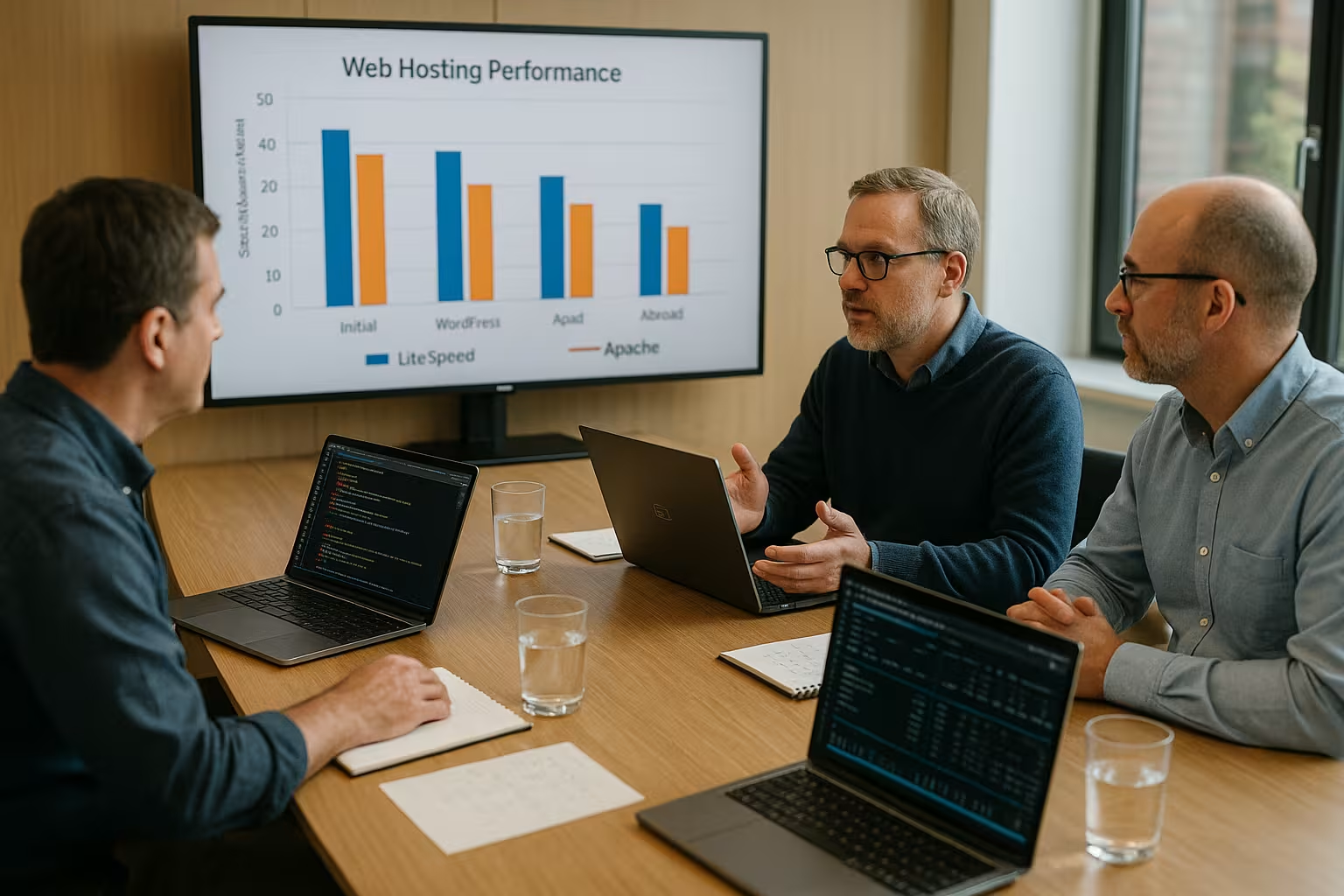
In realistic load scenarios, LiteSpeed processes identical traffic peaks significantly faster than Apache, and this is reflected in clear figures. With 2,000 simultaneous requests, Apache required around 87 seconds (approx. 150 requests/sec.), while LiteSpeed completed the job in around 2.6 seconds (approx. 768 requests/sec.) [3][5]. Transfer rates and latencies are also more favorable with LiteSpeed, which noticeably reduces time-to-first-byte and loading time. In tools such as GTmetrix, LiteSpeed is often ahead, especially with dynamic pages and high parallelism. If you are also interested in practical tuning impulses, you will find the LiteSpeed-Turbo a good Jump start for fine adjustment screws.
Cache power for dynamic pages
LiteSpeed comes with LSCache, an integrated cache engine that I consistently use for WordPress, WooCommerce and other CMSs. Thanks to page, object and ESI caching, the server delivers frequently requested content extremely quickly and bypasses expensive PHP execution [2][4][7]. Apache only achieves similar effects with several modules and tuning, but usually falls short of the efficiency of a natively integrated solution. For personalized content, I use ESI and targeted tag invalidation to combine fresh content and caching. This way I achieve fast TTFB values, reduce database load and keep the interaction noticeable reactive.

PHP performance and protocols
With PHP LSAPI, LiteSpeed often delivers dynamic content up to 50% faster than Apache with mod_php or even PHP-FPM, which I see clearly with customer-relevant peaks [2][5][7]. The close integration of the handler with the event loop saves context switches and reduces latencies under load. I also exploit HTTP/2, HTTP/3 and QUIC to minimize head-of-line blocking and keep connections faster over unstable mobile networks. These protocols make a significant difference, especially on smartphones and in weak Wi-Fi. I use them consistently because they noticeably speed up page views. shorten and promote conversions.
Static content and resources
For images, CSS and JavaScript, LiteSpeed shines with low latency and high parallelism, which I see particularly clearly in media galleries and landing pages. The CPU and RAM load remains lower than with Apache, which creates more scope for peaks. This also has a positive effect on caching hits because the server passes through more requests without bottlenecks. This is worth its weight in gold for shared or reseller hosting, as customer projects remain responsive in parallel. I use this strength in a targeted manner in order to efficiently serve.

Safety without loss of speed
I secure projects without slowing down by relying on integrated DDoS mechanisms, ModSecurity/WAF and IP Access Control [4]. LiteSpeed recognizes conspicuous patterns early, throttles or blocks them and keeps the site accessible, while Apache often needs additional layers. Rate limits, request filters and lean rules help to keep the attack surface small. The goal remains the same: legitimate traffic flows, attacks lose power. My security profile thus remains effective and performance constant high.
Migration and compatibility
Many admins fear the change because of existing .htaccess and mod_rewrite rules, but LiteSpeed largely understands this syntax natively [4]. I migrate projects in manageable steps, activate LSCache on a test basis and measure TTFB and response time. I check critical rewrite chains in advance and adjust exceptions if necessary. In this way, URLs, redirects and canonicals remain correct while performance increases. This approach reduces risk and shortens the Changeover time.

Operation and support
Apache benefits from a large community and diverse modules, which I appreciate with standard stacks. As a commercial solution, LiteSpeed provides direct manufacturer support and rapid updates, which often brings features to the server more quickly. This reliability pays off in operation, because fixes and extensions arrive predictably. I decide according to my project goals: if I need new protocol features and high efficiency quickly, I prefer LiteSpeed. The stability of the releases and short reaction times ensure my day-to-day work. Room for maneuver.
Application scenarios with an advantage
WordPress and WooCommerce installations benefit greatly from LSCache, PHP LSAPI and HTTP/3, especially with high user numbers [7][8]. Busy portals and stores use the low latency to serve sessions quickly and avoid aborts. LiteSpeed demonstrates its efficiency in multi-tenant environments and keeps several projects responsive at the same time. Those who want to hand over responsibility to professionals often benefit from Managed server with LiteSpeedto neatly bundle performance, backups and monitoring. I choose this setup when growth and availability are measurable. critical are.
Comparison table: LiteSpeed vs Apache
The following table summarizes the most important differences and shows where I see the biggest differences. Profits achieve.
| Criterion | LiteSpeed | Apache |
|---|---|---|
| Architecture | Event-driven | Process-based |
| PHP performance | Very high (LSAPI) | Good (mod_php/FPM) |
| Caching | Integrated (LSCache) | External modules, less efficient |
| Resource consumption | Low | Higher |
| Compatibility | Broad (incl. Apache syntax) | Very high |
| Security | Integrated DDoS/WAF features | Depending on add-ons |
| HTTP/3/QUIC | Yes, integrated | Only with patches |
| Migration | Simple (Apache-compatible) | - |
| Maintenance | Manufacturer support available | Open Source/Community |
| WordPress Hosting Note | webhoster.de (1st place) | webhoster.de (1st place) |
Practical implementation: quick wins
I start on LiteSpeed with active LSCache, HTTP/3 and clean image delivery so that loading times are immediately noticeably reduced. For WordPress, the LSCache plugin, unique cache tags and specific exceptions (e.g. shopping cart, login) are part of the basic configuration. In PHP, I rely on LSAPI, adjust the workers slightly and monitor TTFB and 95th percentile response times. TLS session resumption, Brotli and a clean HSTS deployment round off the stack without generating overhead. In this way, I build a setup step by step that carries the load, avoids failures and is measurable. performs.
Resource management and multi-client capability
In everyday life, I decide performance not only on raw throughput, but also on clean Resource limits. LiteSpeed allows me to set connection, bandwidth and process limits per virtual host to tame noisy neighbors in multi-tenant environments. In combination with user isolation and fair CPU allocation, all projects remain responsive even during peaks. Apache can also be limited, but the thread/process based architecture creates more overhead under high concurrency. In practice, I define conservative default limits and extend these specifically for services that are demonstrably scalable. In this way, I secure the overall system and prevent individual tenants from "sucking the platform dry".
I also plan headroom for cache hits and TLS handshakes. LiteSpeed particularly benefits here because it keeps connections open efficiently for longer and maximizes reuse. The result: less backlog, Shorter queues and more stable p95/p99 values when traffic bursts arrive. I particularly notice this effect on vServers with limited RAM, because the event architecture simply uses memory more sparingly.
Measurement methodology, monitoring and troubleshooting
I make reliable statements with a clean measurement strategy. I separate hot and cold start tests, measure TTFB, throughput and error rate and pay attention to p95/p99 instead of just mean values. I combine synthetic load (e.g. with realistic concurrency profiles) with RUM data to map real user conditions. It is important to me to specifically empty or prime caches before the test so that results remain comparable. I correlate logs with metrics: request runtimes, upstream wait times, cache hit rates, TLS duration and CPU and IO saturation. The comparison of "backend time" and network latency in particular shows where I have the strongest impact. Lever must be applied.
For troubleshooting, I use light sample sessions under load: I check which endpoints have the longest response times, whether timeouts occur in chains and whether regex rewrites generate unwanted round trips. In LSCache, I monitor the Vary headers and cookie exceptions so that personalized areas are not inadvertently served statically. And I check whether the 95th percentile latency comes from the app layer or whether the network layer (e.g. faulty MTUs or proxy cascades) is slowing things down. Only when the line of sight is right do we avoid bogus optimizations.
License, costs and consolidation
One practical aspect is the Cost structure. LiteSpeed as a commercial solution comes with vendor support and functionality that utilizes the hardware more efficiently in projects with a real load profile. This efficiency often means that I need fewer instances or smaller VM sizes - the license costs are amortized over time. Consolidation. For development environments or very small sites, OpenLiteSpeed can be an option as long as you know and accept the differences (e.g. in .htaccess behavior and individual features). In demanding production environments, I rely on the Enterprise version because it provides me with the predictable stability and feature set that I need under SLA conditions.
Important: I tie the license decision to measurable targets (p95 reduction, error rate, CPU/GB costs). Only when it is clear what throughput and latency I need do I evaluate TCO. This keeps the choice pragmatic and not ideological.
Migration playbook without downtime
For a change I use a step-by-step playbookSet up staging environment, adopt Apache config, test critical rewrites and evaluate LSCache in "passive" mode first. Then I activate cache rules in small steps (e.g. only for anonymous users), observe TTFB and error curves and only extend the scope after stable results. At the same time, I have a rollback ready: Lower DNS TTLs, version config snapshots and define a clear switchover time with monitoring.
For dynamic sites, I pay attention to cookie variables (e.g. login, shopping cart, session cookies) and define specific cache exclusions. I validate database and session layers in advance under load so that no sticky sessions are necessary. And I check header parity: caching headers, HSTS, security headers, compression and Brotli settings must be identical or deliberately improved. In this way, the changeover succeeds without interruption - with controllable risk.
Scaling, HA and load distribution
In high-availability setups, I scale horizontally: several LiteSpeed instances behind a load balancer. I pay attention to connection reuse and keep-alive so that the LB does not become a bottleneck. QUIC/HTTP/3 brings mobile advantages - if you put an LB in front of it, you should use the UDP paths for QUIC or alternatively terminate at the Edge and speak internally to HTTP/2. If QUIC fails, the H2 fallback without user frustration is crucial.
I hold sessions as far as possible statelessExternal stores for sessions and cache invalidation via tags make it possible to expand or decouple nodes as required. I use tag-based invalidation for content purges so that a full purge is not necessary after deployments or price updates. I plan rolling restarts and config reloads outside of business peaks, monitor the error rate for a short time and ensure that health checks on the LB only give the green light after complete initialization.
Security and compliance in detail
I harden setups without sacrificing performance. This includes a lean WAF configuration with few false positives, rate limiting on critical endpoints (login, search, API) and clear 429 responses instead of hard blocks so that legitimate users can move on quickly. I implement modern TLS (forward secrecy, sensible ciphers, OCSP stacking) and control certificate lifecycles to avoid handshake errors. I consciously activate HSTS in stages to prevent unwanted lock-in of subdomains.
In logging, I separate access, error and WAF audit logs, minimize personal data and define retention periods. LiteSpeed helps to recognize conspicuous patterns at an early stage and to throttleinstead of overloading the application. This keeps the protection effective, the latency low and the user experience stable.
SEO, Core Web Vitals and Business Effect
Technical acceleration pays off directly Core Web Vitals on. Less server time (TTFB) brings the LCP forward, clean caching strategies reduce INP fluctuations under load. Especially on mobile devices, HTTP/3/QUIC and LSCache make the difference because connections are stable faster and first bytes arrive earlier. I pay attention to consistent cache control headers and clear variants for personalized pages so that crawlers and users receive the correct version in each case.
On the business side, I measure conversion and abandonment rates against p95 improvements. In projects with high traffic, a Stable latency to more session progress and better checkouts - not only through peak values, but above all through fewer outliers at the long end of the distribution. This is precisely where event architecture, LSCache and LSAPI excel, because they visibly reduce tail latency.
Summary for decision-makers
LiteSpeed delivers clear speed and efficiency gains over Apache for static and dynamic content, especially under load. The event-based architecture, LSCache and PHP LSAPI reduce latency, increase throughput and improve the user experience [2][3][4][5][7]. Modern protocols such as HTTP/3 and QUIC make mobile access faster and keep pages responsive even with a weak connection. The high level of compatibility with Apache syntax facilitates the changeover and avoids long maintenance windows. Those who prioritize performance, scalability and availability rely on LiteSpeed and thus create a reliably fast Stack.