Skip to content
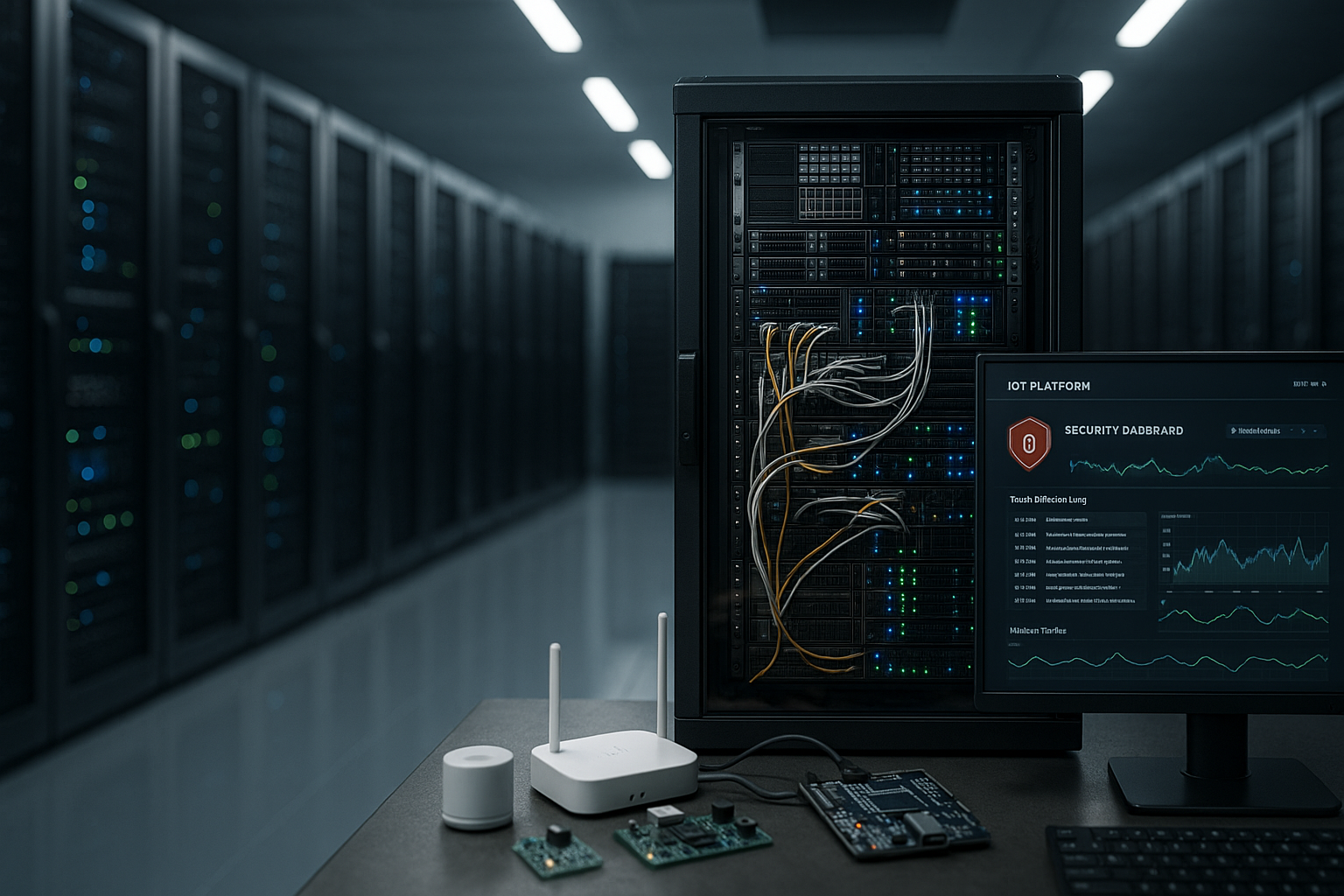
I plan iot hosting so that Latency, I prioritize structured storage classes, storage throughput and security controls to reliably handle millions of sensor messages per day. For IoT platforms, I prioritize structured storage classes, segmented networks and strong identities down to the device to minimize outages, delays and attack surfaces.
Key points
I summarize the most important focal points for sustainable IoT platform hosting and provide clear guidance for decisions. The choice of storage technology controls costs, access speed and retention in equal measure. A well thought-out network topology reduces latency, isolates devices and scales cleanly. Security must be end-to-end and leave no blind spots. Edge approaches relieve the backbone and open up reactions in milliseconds - without the Data quality to jeopardize.
- Storage strategyHot/warm/cold tiering, time series, backups
- Network latencyEdge, QoS, segmentation
- End-to-end Security: TLS/DTLS, certificates, RBAC
- Scaling and monitoring: auto-scaling, telemetry
- Compliance and NIS2: patching, logging, audit

IoT hosting as a hub for modern platforms
IoT platforms bundle devices, gateways, services and analytics, so I base the infrastructure on Real time and continuous availability. The architecture is clearly different from classic web hosting because data streams arrive constantly and have to be processed in a time-critical manner. I prioritize message brokers such as MQTT, a high-performance storage route and APIs that reliably connect backends. Backpressure mechanisms protect the pipeline from overflowing if devices send in waves. For operational stability, I rely on telemetry that visualizes latency, error rates and throughput per topic or endpoint.
Storage requirements: Data flows, formats, throughput
IoT data are mostly time series, events or status messages, so I choose storage to match the Type of use. I use optimized engines and targeted indices for high write rates and queries along the time axis. A hot/warm/cold model keeps current data in the fast layer, while I compress older information and store it at a low cost. For reports and compliance, I adhere to audit-proof retention periods and have backups tested automatically. If you want to go deeper, you can benefit from guides on the topic Manage time series data, especially if queries are to run in minutes instead of hours.

Fast memory in practice
In practice, what counts is how quickly I write values, aggregate them and deliver them again, so I pay attention to IOPS, latency and parallelism. SSD-based volumes with write-back caches secure throughput peaks. Compression and retention policies reduce costs without sacrificing analysis quality. With time series functions such as continuous aggregates, I noticeably accelerate dashboards and reports. I provide snapshots, point-in-time recovery and encrypted offsite backups for restarting after disruptions.
Network: bandwidth, latency, segmentation
An IoT network can only cope with spikes and thousands of simultaneous connections if I Segmentation and QoS cleanly. I logically separate devices, gateways and platform services so that a compromised device does not move laterally into the backend. I prioritize latency-critical flows, bulk transfers move to off-peak windows. With regional ingress points and anycast, I load-balance cleanly. I summarize how Edge really helps in this overview Edge computing advantages together.

Edge IoT hosting: proximity to the data source
I process data where it is generated in order to Response time and backbone bandwidth. Edge nodes calculate anomalies locally, compress streams and only send signals that really count. This reduces costs and protects central services from load waves. For industrial control systems, I achieve response times in the single-digit millisecond range. I roll out staggered and signed firmware updates so that no site is at a standstill.
Security: end-to-end from the device to the platform
I start with immutable identities on the device, secure boot processes and certificates. I protect the transmission with TLS/DTLS, suitable cipher suites and a narrow port strategy. On the platform, I implement role-based access, rotate policies and fine-grained scopes. On the network side, I segment strictly, log every escalated authorization and activate anomaly detection. A practical blueprint for Zero trust networks helps me to avoid trust zones and actively check every access.

Standards, interoperability and protocols
I stick to open protocols such as MQTT, HTTP/REST and CoAP, so that Variety of devices and platforms work together. Standardized payload schemas facilitate parsing and validation. Versioned APIs with deprecation plans prevent disruptions during rollout. For security, I follow recognized standards and keep audit logs tamper-proof. Gateways take over protocol translation so that old devices do not become a risk.
Sustainability and energy efficiency
I reduce energy requirements by bundling loads, optimizing cooling and Autoscaling with real telemetry data. Measurable targets drive decisions: Watts per request, PUE trends, CO₂ equivalents per region. Edge saves transportation energy when local decisions suffice. Sleep cycles for devices and efficient cryptography significantly extend battery life. Data centers with green energy and heat recovery have a direct impact on the balance sheet.

Comparison: providers for IoT platform hosting
When choosing a partner, I pay attention to reliability, scaling, support times and Security level. A look at key features saves trouble later on. High network quality, flexible storage layers and short response times have a direct impact on availability. Additional services such as managed message brokers or observability stacks accelerate projects. The following table classifies the key features.
| Place | Provider | Special features |
|---|---|---|
| 1 | webhoster.de | High performance, excellent safety |
| 2 | Amazon AWS | Global scaling, many APIs |
| 3 | Microsoft Azure | Broad IoT integration, cloud services |
| 4 | Google Cloud | AI-supported evaluation, analytics |
Planning and costs: capacity, scaling, reserves
I calculate capacity in stages and keep Buffer ready for load jumps. To get started, a small cluster that grows by additional nodes within minutes is often sufficient. I reduce storage costs with tiering and lifecycle rules, for example €0.02-0.07 per GB and month depending on the class and region. I plan data outflows and public egress separately, as they have a noticeable impact on the bill. Without monitoring and forecasting, every budget remains an estimate, so I measure continuously and adjust quarterly.
Practical guide: Step-by-step to the platform
I start with a minimal slice that captures real telemetry and Learning curves visible at an early stage. I then secure identities, segment networks and activate end-to-end encryption. In the next step, I optimize hot storage and aggregations so that dashboards react quickly. I then move latency-critical paths to the edge and regulate QoS. Finally, I automate deployments, keys and patches so that operations remain predictable.
Outlook: AI, 5G and autonomous platforms
I use AI to detect anomalies, plan maintenance and Resources automatically. 5G reduces latencies at remote locations and provides greater reliability for mobile IoT scenarios. Models are increasingly running at the edge so that decisions are made locally and data protection requirements are better met. Digital twins link sensor data with simulations and increase transparency in production and logistics. New security requirements sharpen processes for patching, logging and response plans.
Device lifecycle and secure provisioning
I think about the life cycle of a device from the very beginning: from the safe Onboarding through operation to proper decommissioning. For the initial contact, I rely on factory-branded identities (Secure Element/TPM) and just-in-time provisioning so that devices roll out without shared secrets. Attestation and signatures prove origin and integrity. During operation, I rotate certificates on a time-controlled basis, keep secrets short-lived and document every change in a traceable manner. During decommissioning, I lock identities, delete key material, decouple the device from topics and remove it from inventory and billing - without leaving data residues in shadow copies.
Messaging design: topics, QoS and order
To ensure that brokers remain stable, I design a clean Topic taxonomy (e.g. tenant/location/device/sensor), interpret ACLs narrowly with wildcards and prevent fan-in peaks on individual topics. With MQTT, I use differentiated QoS: 0 for non-critical telemetry, 1 for important measured values, 2 only where idempotence is difficult to implement. I use retained messages specifically for the latest status, not for complete histories. Shared subscriptions distribute the load on consumers, session expiry and persistence save connection setups. For order, I guarantee order per key (e.g. per device), not globally - and I make consumers idempotent, because duplicates are unavoidable in distributed systems.
Schema management and data quality
I standardize payloads early: Unique timestamps (UTC, monotonic sources), units and calibration information belong in every event. Binary formats such as CBOR or Protobuf save bandwidth, JSON remains useful for diagnostics and interop. A versioned Schema evolution allows forward- and backward-compatible changes so that rollouts succeed without hard breaks. Field validation, normalization and enrichment run close to the ingress to avoid error cascades. For analytical loads, I keep raw data separate from processed datasets so that I can run replays and retrain models.
Resilience: fault tolerance and back pressure
I plan for errors: Exponential backoff with jitter prevents synchronization errors during reconnects, Circuit Breaker protect dependent services, and bulkheads isolate tenants or functional units. Dead letter queues and quarantine paths keep malicious messages out of the main route. I design consumers idempotently (e.g. via event IDs, upserts, state machines) so that replays and duplicates are processed correctly. Backpressure works at every level: broker quotas, per-client rate limits, queue lengths and adaptive sampling policies prevent overflow without losing important alerts.
Observability, SLIs/SLOs and operation
I measure what I promise: SLIs such as end-to-end latency, delivery rate, error rate, broker connection stability and storage write latency. From this I derive SLOs and manage error budgets so that innovation and reliability remain in balance. I collect metrics, traces and logs consistently per tenant, topic and region to quickly localize bottlenecks. Synthetic devices check paths around the clock, runbooks and clear on-call handovers shorten MTTR. Warnings are based on SLO violations and trend breaks instead of pure threshold noise.
Disaster recovery and multi-region
I define RTO/RPO targets and set up replication accordingly: From warm standby with asynchronous mirroring to Active-Active across multiple regions. I combine DNS or anycast failover with state synchronization so that devices continue to transmit seamlessly. I replicate databases per use case: time series with segment-by-segment replication, metadata synchronized and low conflict. Regular DR drills and restore tests from offsite backups are mandatory - only tested backups are real backups.
Identities, PKI and key management
I operate a hierarchical PKI with root and intermediate CAs, key material is stored in HSMs. Devices use mTLS with device-bound keys (TPM/Secure Element), short certificate runtimes and automated rotation. Revocation lists (CRL) or OCSP checks prevent misuse, enrollment processes can be audited. For people, I rely on strong authentication, least privilege and Just-in-time-authorizations. I version and rotate secrets deterministically, service-to-service identities are given limited scopes and clear expiration dates.
Edge orchestration and secure updates
I roll out updates in stages: Canary per site, then waves based on telemetry feedback. Artifacts are signed, delta updates save bandwidth, rollbacks are possible at any time. I encapsulate edge workloads (e.g. containers) and tightly control resources: CPU/memory limits, I/O quotas, watchdogs. Policy engines enforce local decision rules if the backhaul fails. I resolve conflicts between central and local states deterministically so that no inconsistencies remain after reconnection.
Data protection, data locality and governance
I classify data, minimize collection and only store what is necessary. Encryption applies in transit and at rest, also field-based for sensitive fields. I observe data locality per region, deletion concepts (incl. histories) are automated. Access paths are logged, audit logs are tamper-proof and requests for information can be handled in a reproducible manner. I anchor processes for NIS2: Asset inventory, vulnerability management, patch rules, reporting paths and regular effectiveness checks.
Testing, simulation and chaos engineering
I simulate fleets realistically: different firmware versions, network conditions (latency, packet loss), burst behavior and long offline phases. Load tests check the entire chain through to dashboards, not just the broker. Fuzzing uncovers parser weaknesses, traffic replays reproduce incidents. Planned chaos experiments (e.g. broker failure, storage delay, certificate expiry) train the team and harden the architecture.
Connectivity in the field: IPv6, NAT and mobile communications
I plan connectivity by location: IPv6 simplifies addressing, IPv4 NAT often requires MQTT via WebSockets or outbound-only connections. Private APNs or Campus-5G offer hard QoS guarantees and isolate production networks. eSIM/eUICC facilitate provider changes, network slicing reserves bandwidth for critical flows. Time synchronization via NTP/PTP and drift controls are mandatory because time series become worthless without correct clocks.
Client capability and fairness
I separate clients via namespaces, topics, identities and Quotas. Rate limits, storage budgets and priority classes prevent noisy neighbor effects. Dedicated resource pools are available for sensitive customers, while shared pools optimize costs. Billing and cost reports per tenant remain transparent so that technical and economic control can be combined.
Briefly summarized
I set up IoT hosting according to Latency, data throughput and security level and keep the architecture flexible. Storage determines costs and speed, so I rely on time series, tiering and strict backups. In the network, segmentation, QoS and edge provide short paths and clean scaling. End-to-end security remains a must: strong identities, encrypted transports, zero trust and continuous monitoring. Planning in this way keeps outages to a minimum, keeps budgets under control and makes the platform future-proof.