Skip to content
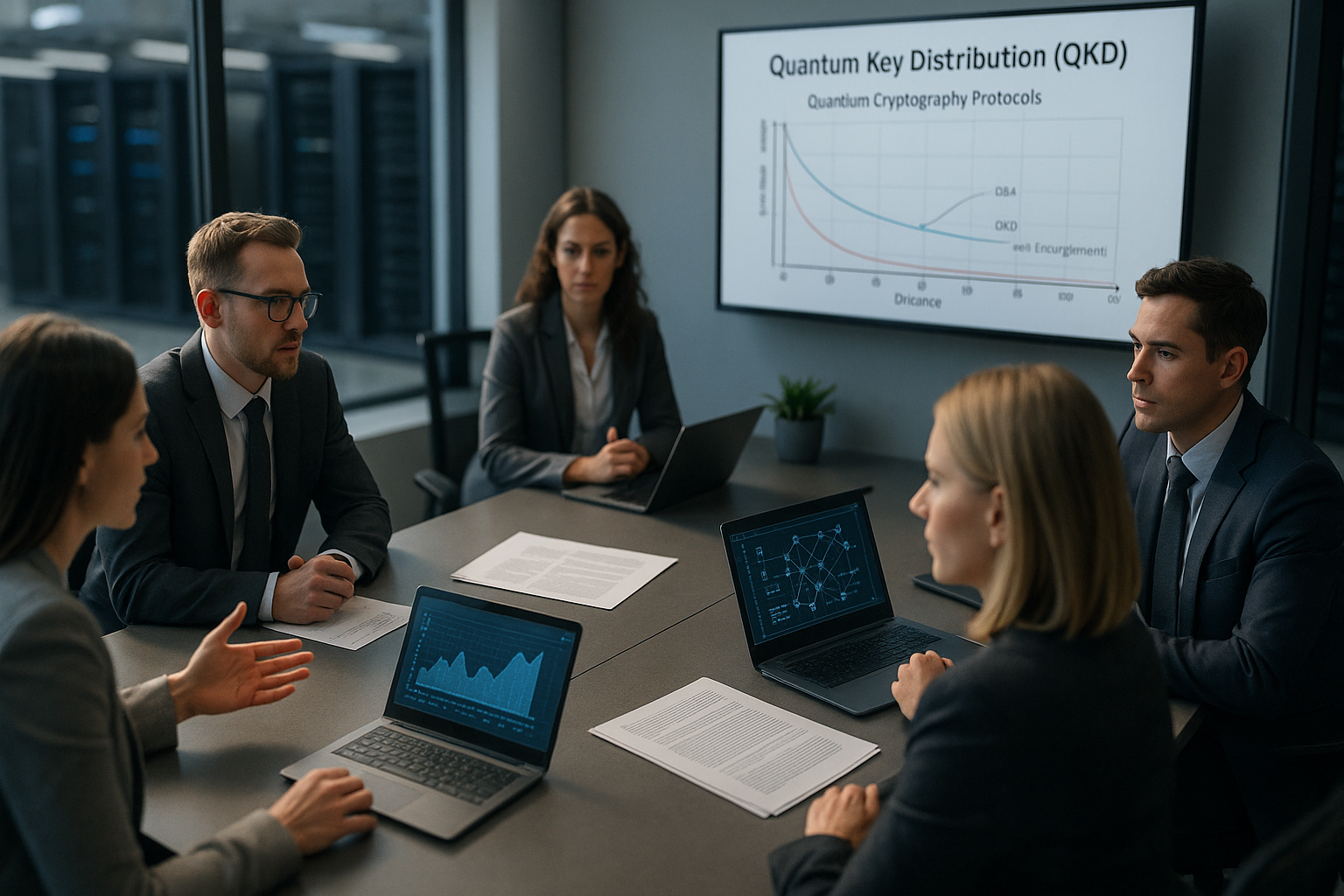
Today, quantum key distribution in the data center seems like the logical response to the threat of attacks by quantum computers. key, where every eavesdropping attempt is immediately noticeable. I clarify the question „Future or hype?“ based on the functionality, limits, integration and real application scenarios of the Quantum key distribution.
Key points
- Eavesdropping detection in real time thanks to quantum physical effects
- Hybrid approach from QKD and classic encryption
- Distances limited - repeaters and trusted nodes required
- Standardization and interoperability as the key
- Zero Trust consistently implement at network level
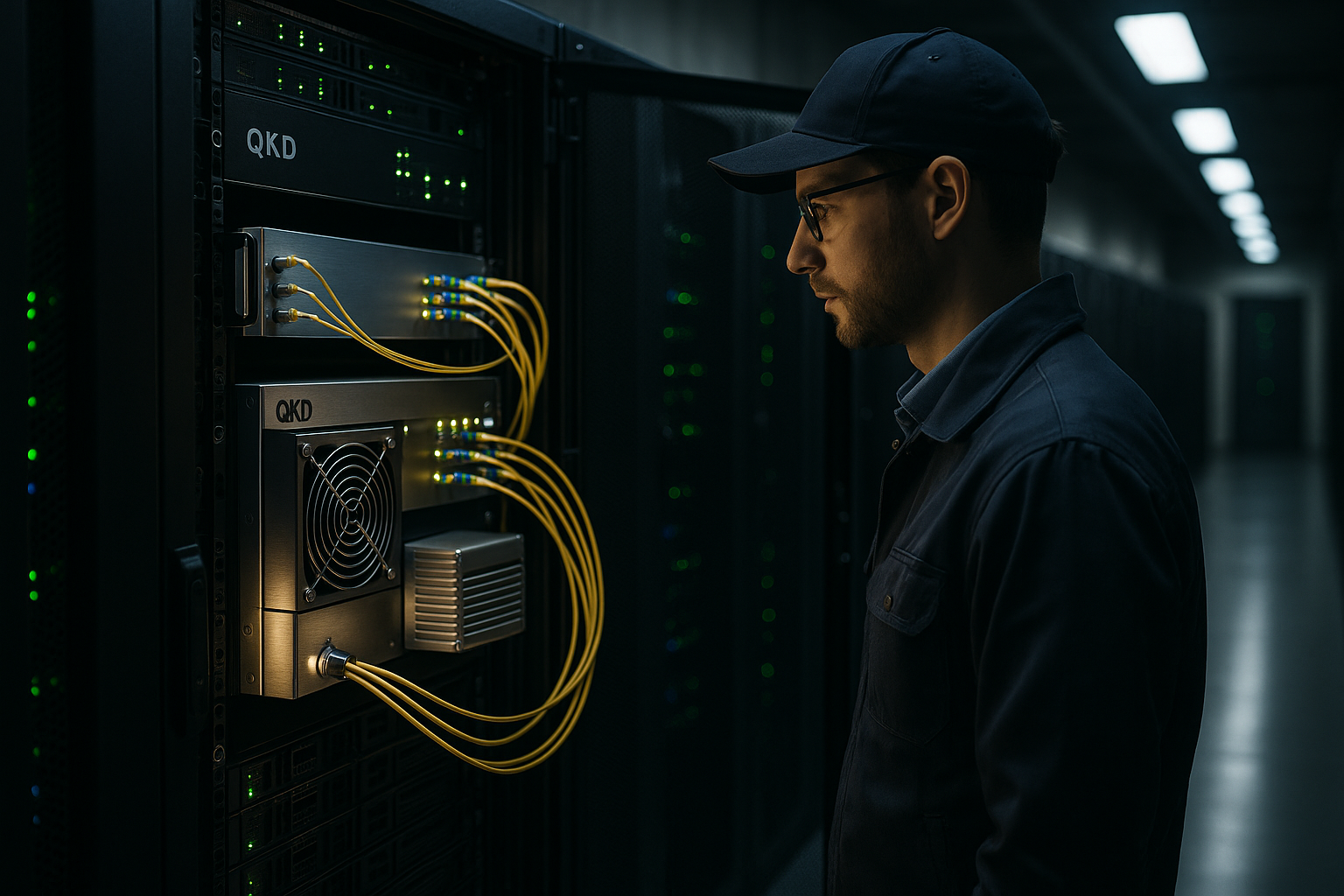
What quantum key distribution does in the data center
With QKD, I use the quantum properties of Photons, to generate and distribute symmetric keys. Each measurement attempt changes the quantum state, immediately exposing any eavesdropping on the wire [1][2][7]. This mechanism shifts the defense from mathematical assumptions to physics, which is a significant security gain for data centers with sensitive workloads. In practice, I use QKD for key exchange and then encrypt the payload efficiently with established algorithms such as AES. In this way, I combine physically secure keys with a high data rate and get a Security advantage.
Principle and protocols: BB84, E91 & Co.
The BB84 protocol forms the practical basis: the transmitter and receiver select random bases, measure the photon polarization and then filter out unsuitable measurements [4]. The resulting raw key is matched via a classic channel and hardened using error correction and privacy amplification. E91 takes a different approach and relies on entanglement, whereby both sides gain correlated random bits. I choose the protocol depending on the hardware, fiber optic link and desired key rate. The decisive factor remains that every intervention in the quantum state leaves traces that I can measure via the error rate in the key stream. recognize.
QKD is not QRNG - and why this is important
I make a clear distinction between QKD and quantum random number generators (QRNG). QKD distributes keys via a quantum channel and detects eavesdropping. A QRNG provides high-quality entropy locally, but does not replace tap-proof transmission. In practice, I combine both: the QRNG feeds the key management system (KMS) with additional entropy, while QKD distributes fresh session keys between locations. Health checks (e.g. statistical tests for bias and failures) and an entropy pool prevent a faulty source from undetectably affecting the Key quality lowers.
Extended protocols: MDI-QKD and device-independent approaches
To reduce points of attack, I consider measurement-device-independent QKD (MDI-QKD). Here the photons from both sides meet in an untrusted measuring station, which hardens the detector side in particular. Device-Independent QKD (DI-QKD) goes even further and derives security from Bell tests. Both approaches address real vulnerabilities such as detector manipulation, but are more complex in terms of hardware and structure and more demanding in terms of key rate. For data center operations, I plan to use MDI-QKD as a medium-term option when supply chain or site trust is difficult [5].
Limits of classical cryptography and post-quantum strategies
Asymmetric methods such as RSA or ECC are vulnerable to quantum computers, which is why I do not plan to use them as the sole support in the long term. Post-quantum algorithms on a classical basis address this risk, but they are no substitute for physically guaranteed key generation. I am therefore taking a two-pronged approach: QKD for key generation, post-quantum methods as a security and compatibility layer. If you want to evaluate this approach, you will find quantum-resistant cryptography helpful starting points for a graduated migration. In this way, I build up a multi-layered protection in which physical and mathematical security interact.
Technical implementation in the data center
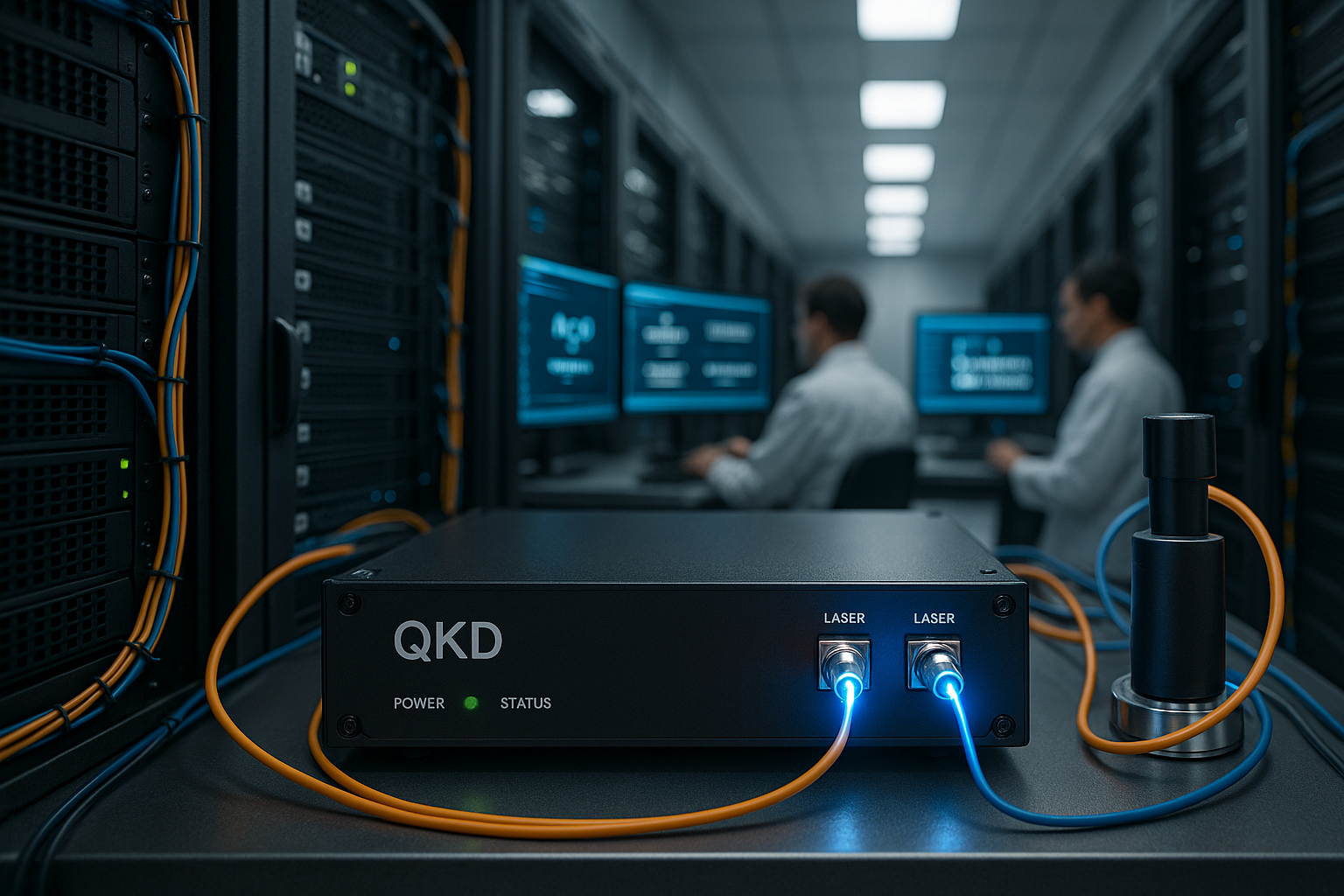
QKD systems consist of a quantum source, channel components and highly sensitive detectors, which can detect individual Photons measure. Fiber optics are well suited, but attenuation and decoherence limit the distance; after about 50 km, large parts of the key information are already lost [4]. To cover longer distances, I use trusted nodes and, in the future, quantum repeaters that securely bridge the endpoints [3]. In practice, I connect the QKD boxes to key management systems and VPN gateways that use the supplied keys directly. Initial long-distance experiments over fiber optics show ranges of up to 184.6 km (2019) [4], which makes operational use between locations more tangible and gives me planning security for Cluster there.
Physics of transmission: Attenuation, coexistence and stabilization
In the data center, I often share fibers with classic data traffic. This forces me to limit Raman stray light and crosstalk. I consciously select wavelength bands (e.g. O- vs. C-band), use DWDM filters with steep edges and plan the launch power of the classic channels conservatively. Typical fiber losses of approx. 0.2 dB/km quickly add up; in addition, connectors, splits and patch panels put a strain on the budget. Polarization drifts over time and temperature, so I rely on active stabilization or time modes (time-bin encoding), which are less susceptible. Detectors cause dark count rates, which I minimize through temperature management and gate control. I continuously measure the quantum bit error rate (QBER) and only accept keys whose QBER is below the protocol thresholds (typically in the single-digit percentage range for BB84); above this, I switch off or reduce the QBER. Key rate.
Integration into networks and security stacks
I integrate QKD into existing network paths: between data center areas, colocation suites or metro locations. I feed the QKD keys into IPsec, MACsec or TLS termination, often as a replacement for the usual Diffie-Hellman negotiation. This hybrid approach delivers the throughput of classical cryptography with the confidentiality of a physically protected key. For strategic planning, I recommend taking a look at Quantum cryptography in hosting, to outline roadmaps and migration paths. It remains important to consistently adapt internal processes for key rotation, monitoring and incident response to the new Key source adapt.
Operation, monitoring and automation
During operation, I treat QKD like a critical infrastructure service. I integrate telemetry (key rate, QBER, loss, temperature, detector status) into my central monitoring and define SLOs per link. Alarms trigger playbooks: Threshold exceeded -> throttle rate; QBER jumps -> switch path; link down -> fallback to PQC-KEM or classic DH with strictly limited validity. KMS integration takes place via clearly defined interfaces (e.g. proprietary APIs or near-standard formats) that mark keys as „externally provided“. I automate key rotation: Fresh QKD keys regularly feed in new IPsec SAs, MACsec SAKs or TLS PSKs. For audits, I log when, where and for how long keys have been used - without disclosing content, but with reproducible Traceability.
Challenges: Distance, costs, speed, standards
I plan realistically with the limits: The key rate does not scale arbitrarily and, depending on the topology, limits the maximum data throughput. The construction of separate fiber optic lines, the acquisition of quantum sources and detectors as well as operation significantly increase CAPEX and OPEX. Standardization is still in flux; I am testing interoperability between manufacturers in the lab and in pilot routes. Trusted nodes require structural and organizational security to ensure that the overall system remains consistent. If you take these points into account, you reduce risks and achieve long-term reliability. Security from QKD [1][4].
Attack vectors and hardening in practice
QKD is only as strong as its implementation. I consider side-channel attacks such as detector blinding, time-shift or Trojan Horse injections over the fiber. Countermeasures include optical isolators, input power monitoring, relevant filters, rate limiting and watchdog lasers. Firmware and calibration are part of supply chain security; I require reproducible builds, signatures and independent testing. At protocol level, I strengthen information reconciliation and privacy amplification to push remaining information leaks below useful thresholds. Where mistrust of endpoints is particularly high, I evaluate MDI-QKD as an additional layer of security. Security situation [5][8].
Security models: Zero Trust meets quantum
I anchor QKD in a zero-trust model in which no channel is considered „trustworthy“ by assumption. Every connection receives fresh, short-lived keys; every measurement error in the quantum part signals an immediate need for action [1]. This means I don't get lost in assumptions, but react to physical evidence. This transparency improves audits and reduces the attack surface in the event of lateral movements in the network. All in all, QKD strengthens the implementation of Zero Trust and makes concealment tactics much more difficult.

Compliance and standardization: What I can already check today
I align myself with emerging standards in order to avoid subsequent migrations. This includes profiles and architectures from ETSI/ITU-T, national specifications and guidelines for QKD operation, key management and interfaces. A clear allocation of roles is important: who operates trusted nodes, who audits them, and how are key material, logs and statuses versioned and stored in an audit-proof manner? For certifications in a regulated environment, I document operating limits (key rate per km, fault tolerances, maintenance windows), define test catalogs (jitter, loss, temperature) and assign interoperability in Pilot environments to.
Fields of application in the data center and beyond
I see QKD everywhere where key compromise would have existential consequences. Banks secure high-frequency trading and interbank communication against future decryption [4][6]. Hospitals and research institutions protect patient data and study protocols that must remain confidential for decades. Governments and defense use QKD for particularly sensitive connections and diplomatic channels. Operators of critical infrastructures harden control center links to prevent manipulation of energy and supply networks. prevent.
Specific DC use cases: from storage to control plane
In practice, I address three typical scenarios. Firstly: storage replication and backup over metro distances. Here, QKD reduces the risk of „harvest-now, decrypt-later“ attacks on sensitive data streams. Secondly: cluster and control plane traffic. Low latency and high availability are critical; QKD provides short-lived keys for MACsec/IPsec without limiting throughput. Third, key distribution between HSMs and KMS instances in separate zones. I use QKD keys to protect KMS synchronization or to periodically exchange master wrapping keys. For small, very sensitive data (e.g. configuration or authentication tokens), even the One-Time-Pad knowing full well that the key rate sets the hard limit for this.
QKD and hosting providers in comparison
Security is becoming a business-critical criterion in hosting decisions, especially when compliance sets deadlines. QKD options are becoming a differentiating feature that measurably secures companies with the highest requirements. Anyone planning today should compare the range of functions, integration capability and roadmap in the medium term. A good way to get started is via Quantum hosting of the future, to assess future viability and investment protection. The following overview shows how I categorize offers according to security level and integration status of the QKD structure.
| Hosting provider | Security level | QKD integration | Recommendation |
|---|---|---|---|
| webhoster.de | Very high | Optional for servers | 1st place |
| Provider B | High | Partially possible | 2nd place |
| Provider C | Medium | Not yet available | 3rd place |
I pay attention to robust SLAs for key rates, alerts in the event of anomalies and defined response times. Traceable tests that address measurement errors, manipulation attempts and failover scenarios are important to me. A clear roadmap for interoperability and standard compliance rounds off the selection. In this way, I ensure that QKD does not remain an isolated solution, but interacts seamlessly with security and network tools. This view of operation and lifecycle saves time and money later on. Costs.

Economic efficiency: costs, TCO and risk reduction
QKD is worthwhile where the expected damage from key compromise exceeds the investment. The TCO calculation includes fiber optics (dark fiber or wavelength), QKD hardware, colocation for trusted nodes, maintenance (calibration, spare parts), energy and monitoring. I also take process costs into account: training, audits, incident response exercises. On the benefit side, there are reduced liability and compliance risks, the avoidance of future migrations under time pressure and the ability to protect confidential data against later decryption. Especially in the case of long-lived secrecy (health, IP, state secrets), this factor has a strong impact and justifies the Investment often earlier than expected.
Scaling and architecture patterns
For multiple locations, I plan the topology deliberately: hub-and-spoke reduces hardware costs, but can become a single point of failure; mesh increases redundancy, but requires more links. I view trusted nodes like bank vaults: physically secured, monitored and clearly separated. Key pools can be kept in reserve to cushion peak loads. For international scenarios, I throw satellite QKD into the equation, with ground stations being treated as trusted nodes. My goal is an end-to-end design in which fallback paths and policy gates are defined: If QKD fails, I fall back to PQC-based procedures in an orderly fashion - with tightly bounded keys, increased Monitoring and immediate return to QKD as soon as available.
Roadmap and investment planning
I start with a site analysis: fiber paths, distances, availability and security zones. This is followed by a pilot on a critical but easily controllable route, including an audit of trusted nodes. In the next step, I scale up to several links, integrate key management properly and automate key rotation including monitoring. This allows me to determine early on how maintenance, spare parts and support times are organized. A staggered rollout distributes the Investments and creates empirical values for productive operation.
Assessment: future or hype?
QKD is not a magic bullet, but it is a powerful building block against eavesdropping and subsequent decryption. The technology is already paying off in data centers with high requirements, while costs, range and standards are still slowing down its widespread introduction. Today, I rely on hybrid architectures to realize benefits immediately and at the same time be prepared for quantum attacks. As the infrastructure grows, standards become clearer and prices fall, QKD will evolve from a special tool to a standard for particularly sensitive links. The direction is clear: those who invest in time will create a long-term Head start [3][4].