Skip to content
Datacenter Audit Hosting determines whether I truly ensure availability, data protection, and clear evidence. I demonstrate what hosting customers should look for in Security and Operation must be taken into account – from certificates to restart times.
Key points
- Scope and clearly define responsibilities
- Compliance with GDPR, ISO 27001, SOC 2, PCI DSS
- Physics Secure: access, electricity, climate, fire
- IT controls Check: Hardening, segmentation, MFA
- Monitoring and reporting with SIEM/EDR

What a data center audit achieves in hosting
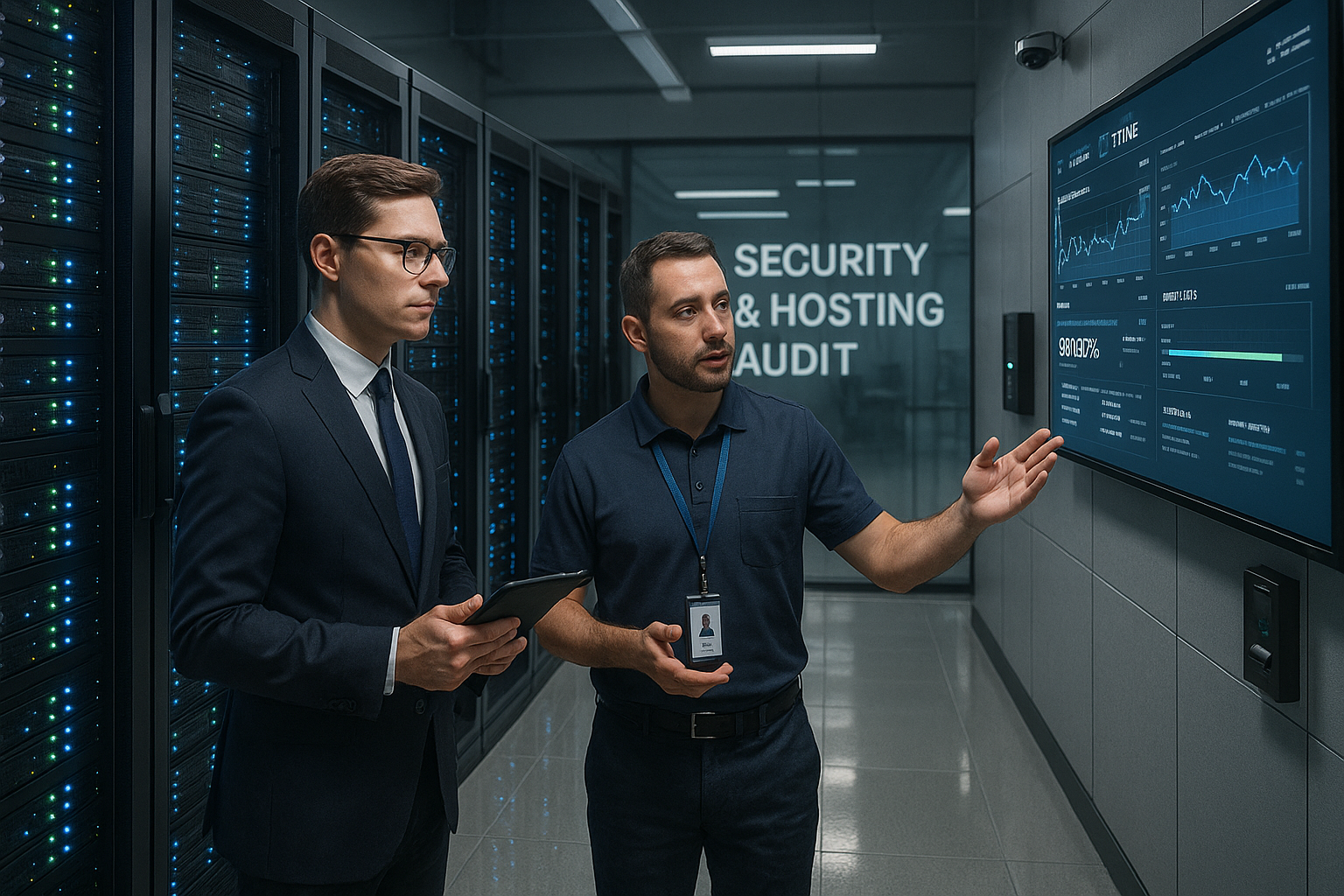
I use a structured audit to Risks and to test technical and organizational controls in a measurable way. To do this, I first define the scope: location, racks, virtual platforms, management networks, and service providers. I then compare policies, standards, and operational evidence and request documentation such as change logs, access reports, and test protocols. For a systematic audit review I set clear criteria for each control objective, such as access monitoring, patch status, backup tests, or restart times. This allows me to continuously validate what the provider promises and ensure that I have Transparency about all safety-related processes.
Legal & Compliance: GDPR, ISO 27001, SOC 2, PCI DSS
I check whether the host processes data in compliance with the GDPR, whether data processing agreements are in place, and whether data flows are documented, including Deletion concept and storage locations. ISO 27001 and SOC 2 show whether the information security management system is actually being implemented—I look at catalogs of measures, audit reports, and the latest management assessment. For payment data, I request the current PCI DSS status and inquire about the processes for segmenting card environments. I make sure that third-party providers and the supply chain are included in compliance, because only an entire ecosystem remains secure. Without complete evidence, I do not accept any Promise, but demand concrete evidence from internal and external audits.

Physical security: access, energy, fire protection
I control access with visitor rules, multi-factor access, video surveillance, and minutes, so that only authorized persons can access the systems. I protect redundant power paths with UPS and generators through maintenance plans and load tests; I ask to see test reports. Sensors for temperature, humidity, and leakage report deviations early on, while gas extinguishing systems and early fire detection minimize damage. I inquire about location risks such as flooding, earthquake classification, and protection against burglary; geo-redundancy increases reliability. Without proven redundancy concept I don't trust any data center operation.
Technical IT security: Network and server hardening
I consistently separate networks with VLANs, firewalls, and microsegmentation so that attackers cannot move laterally; I keep track of changes in approved regulations I consider IDS/IPS and EDR to be mandatory because they make attacks visible and respond automatically. I harden servers through minimal installations, deactivated default accounts, strict configurations, and up-to-date patch management. For access, I rely on strong authentication with MFA, just-in-time rights, and traceable approvals. Encryption in transit (TLS 1.2+) and at rest with clean Key management remains non-negotiable for me.
Backup, restore, and business continuity
I require automated, versioned backups with offsite and offline copies, encrypted with verified Keys. I check RPO/RTO targets, recovery tests, and playbooks for prioritized services so that I can handle outages in a controlled manner. Immutable backups and separate admin domains protect against ransomware extortion and admin abuse. For emergencies, I need a scenario-based emergency manual that clearly describes roles, escalation paths, and communication plans. I do not accept any solutions without documented restore reports and test logs. SLA regarding availability or data integrity.
Monitoring, logging, and reporting
I call for centralized log collection, tamper-proof storage, and clear retention periods to ensure successful forensics and Duties remain achievable. SIEM correlates events, EDR provides endpoint context, and playbooks describe actions to be taken in the event of alerts. I insist on defined thresholds, 24/7 alerting, and documented response times. Dashboards for capacity, performance, and security help me identify trends in a timely manner. Regular reports provide management and audit teams with traceable Insights in risks and effectiveness.

Supply chain, third-party providers, and location selection
I map the entire supply chain, evaluate subcontractors, and request their certificates and contract appendices For cross-border data flows, I review legal bases, standard contractual clauses, and technical safeguards. I choose the location based on latency, risk score, power supply, and access to peering nodes. Tier classification (e.g., III/IV) and measurable SLA evidence count more for me than marketing statements. Only when I see clear evidence of physical, legal, and operational criteria do I evaluate a Data Center as suitable.
SLAs, support, and evidence in the contract
I read contracts thoroughly and check service windows, response times, escalation, and penalties for non-compliance. Backups, disaster recovery, monitoring, and security measures must be explicitly included in the contract, not in vague white papers. I demand a clear process for major incidents, including communication obligations and lessons learned reports. For reliable criteria, I use the guidelines on SLA, backup, and liability, so that nothing is overlooked. Without audit-proof evidence and auditable key figures, I do not award any business criticality to a service.

Tabular audit matrix for quick audits
I work with a short audit matrix to ensure that audits remain reproducible and Results comparable. For each control objective, I assign questions and evidence, including an assessment of effectiveness. I use the table as a basis for discussions with the technical, legal, and purchasing departments. I document deviations, plan measures, and set deadlines to ensure that implementation does not fall by the wayside. With each repetition, I further refine the matrix and increase the Significance of the reviews.
| audit domain | test objective | key questions | Proof |
|---|---|---|---|
| Physics | Control access | Who has access? How is it logged? | Access lists, video logs, visitor processes |
| Network | Segmentation | Are Prod/Mgmt/Backup separate? | Network diagrams, firewall rules, change logs |
| Server | Hardening | How are patching and baseline performed? | Patch reports, CIS/hardened configurations |
| Data protection | Comply with GDPR | Are there AVVs, TOMs, deletion concepts? | AV contract, TOM documentation, deletion logs |
| Resilience | restart | Which RPO/RTO apply, tested? | DR playbooks, test reports, KPIs |
Continuous implementation: roles, awareness, tests
I assign roles strictly according to need-to-know and monitor them. Authorizations regularly through recertification. I keep training sessions short and practical so that employees can recognize phishing, social engineering, and policy violations. Regular vulnerability scans, penetration tests, and red teaming show me whether controls are effective in everyday use. For defense, I rely on a multi-level security model, covering perimeter, host, identity, and applications. I measure progress using metrics such as MTTR, number of critical findings, and status of open Measures.

Practical perspective on provider selection and evidence
I prefer providers who offer audit reports, certificates, and technical documentation. Details Be open instead of repeating marketing clichés. Transparent processes, clear responsibilities, and measurable SLAs create trust. Documenting penetration tests, awareness programs, and incident postmortems saves me time in the evaluation process. In comparisons, webhoster.de regularly stands out positively because security standards, certifications, and controls are consistently implemented. This allows me to make decisions that balance costs, risks, and Performance balance realistically.
Shared responsibility and customer side
I set clear shared responsibility model Fixed: What is the provider responsible for, and what remains my responsibility? On the hosting side, I expect physical security, hypervisor patches, network segmentation, and platform monitoring. On the customer side, I take care of image hardening, application security, identities, secrets, and the correct configuration of services. I document this in a RACI or RASCI matrix, including onboarding/offboarding processes for teams and administrators. I keep break-glass accounts, emergency rights, and their logging separate and test them regularly. This is the only way to rule out gaps at the interfaces.
Risk assessment, BIA, and protection classes
Before conducting detailed checks, I perform a Business Impact Analysis to classify protection requirements and criticality. From this, I derive RPO/RTO classes, encryption requirements, and redundancies. I maintain a living risk register, link findings to controls, and document accepted risks, including expiration dates. I evaluate deviations from baselines based on severity, probability, and exposure time. The combination of these factors results in a prioritized action plan that controls budget and resources—measurable and audit-proof.
Change, release, and configuration management
I demand standardized changes with dual control, approved maintenance windows, and rollback plans. I maintain infrastructure as code (IaC), manage it in versions, and detect configuration drift early on. I regularly check gold images against CIS benchmarks and document any deviations as exceptions with an expiration date. I link a well-maintained CMDB to monitoring and tickets so that root cause analyses can be carried out quickly. Emergency changes are subject to a post-implementation review to prevent risks from growing unnoticed.
Vulnerability, patch, and policy compliance
I establish fixed Remediation SLAs By severity: Critical gaps within days, high within a few weeks. Authenticated scans on servers, containers, and network devices are mandatory; I correlate results with asset lists so that nothing remains under the radar. Where patching is not possible in the short term, I rely on virtual patches (WAF/IPS) with close monitoring. I continuously measure policy compliance against hardening standards and document exceptions with compensation. This keeps the security level stable – even between release cycles.
Web, API, and DDoS protection
I check whether an upstream WAF/API protection active: schema validation, rate limits, bot management, and protection against injection/deserialization. I implement DDoS defense in multiple layers—from Anycast Edge to the provider backbone, supplemented by clean egress/ingress filters. I secure DNS with redundant authoritative servers, DNSSEC, and clear change processes. Origin shielding and caching reduce load peaks, while health checks and automatic failover increase availability. Rotation and revocation processes apply to API keys and OAuth tokens as they do to certificates.
Identities, accesses, and secrets
I anchor Identity & Access Management Core controls: central identities, strict roles, JIT rights via PAM, traceable approvals and recertifications. Break-glass accesses are strictly separated, logged, and regularly practiced. Secrets (passwords, tokens, keys) are stored in a vault, undergo rotation cycles, dual control, and—where possible—HSM-supported key management (e.g., BYOK). I check whether service accounts have minimal permissions, non-person accounts are documented, and included in offboarding. Without clean identities, every other control objective loses its effectiveness.
Deepen logging, evidence, and metrics
I standardize Log Schemas (timestamp, source, correlation ID) and secure time sources via NTP/PTP against drift. I store critical events in WORM-compatible format and verify integrity with hashes or signatures. For forensic purposes, I maintain chain-of-custody processes and locked evidence storage. I define metrics with clear calculations: MTTD/MTTR, change failure rate, patch compliance, mean time between incidents. SLOs with error budgets help me balance availability and change frequency. Reports go not only to security, but also to product and operations—so decisions are data-driven.
Regulatory update: NIS2, DORA, and ISO extensions
Depending on the industry, I receive NIS2 and – in the financial environment – DORA into the audit. I look at reporting requirements, maximum response times, scenario tests, and supply chain requirements. In addition, I check whether ISO 22301 (business continuity) and ISO 27701 (privacy) are useful additions. For international locations, I record data location, access requests from authorities, and legal bases. This ensures that operations, legal requirements, and technology remain consistent across national borders.
Procurement, costs, and capacity
I demand Capacity planning with early warning thresholds, load tests, and reserves for peaks. For cost control, I rely on tagging, budgets, and chargeback/showback models; inefficient resources are identified automatically. In the contract, I check quotas, burst rules, and the predictability of pricing models. I record performance tests (baseline, stress test, failover) and repeat them after major changes. This keeps costs, performance, and risk in balance—with no surprises at the end of the month.
Software supply chain and third-party code
I demand transparency regarding Software supply chains: signed artifacts, verified repositories, dependency scans, and SBOMs on request. I check end-of-life data and update roadmaps for appliances and platforms in use. I secure build pipelines with code reviews, secrets scanning, and isolated runners. Third-party code is subject to the same testing standards as in-house development—otherwise, libraries and images open silent gateways. This discipline reduces risks before they reach production.
Sustainability and energy efficiency
I rate energy indicators such as PUE, electricity source, and waste heat utilization concepts. I document hardware lifecycles, spare parts, and disposal with a focus on safety and the environment. Efficient cooling, load consolidation, and virtualization save costs and reduce CO₂ emissions—without compromising availability. For me, sustainability is not a bonus, but part of resilience: those who have energy and resources under control operate in a more stable and predictable manner.
Audit playbook, maturity levels, and scoring
I work with a compact audit playbook: 30 days for scope/inventory, 60 days for controls/evidence, 90 days for completion and action tracking. I assign maturity levels to each control (0 = not available, 1 = ad hoc, 2 = defined, 3 = implemented, 4 = measured/improved) and weight them according to risk. Findings result in an action plan with responsible parties, budget, and due dates. A recurring review meeting ensures that implementation and effectiveness do not fall behind day-to-day operations.
Briefly summarized
I evaluate hosting environments in terms of physics, technology, data protection, resilience, and reporting—in a structured, measurable, and repeatable. Those who proactively ask questions, request audit results, and test implementations significantly reduce risks. With a hosting data center checklist, responsibilities remain clear and priorities visible. Continuous audits lead to reliable security, fewer outages, and clean compliance. This way, data center audit hosting remains not just theory, but practice. Practice in operation.