 Skip to content
Multi-cloud orchestration in web hosting combines technology, processes, and provider selection so that I can control applications across multiple clouds in a targeted manner—without being tied to a single provider. This guide compares tools, strategies, and providers for multi-cloud hosting and shows how I neatly combine performance, reliability, and compliance.
Key points
- Orchestration About clouds: Consistent deployments, updates, scaling.
- Independence and cost leverage: switching providers as routine rather than risk.
- Security with governance: consistent policies, secrets, identities.
- Transparency and control: monitoring, FinOps, real-time metrics.
- Standardization via IaC: Terraform modules, GitOps, CI/CD.
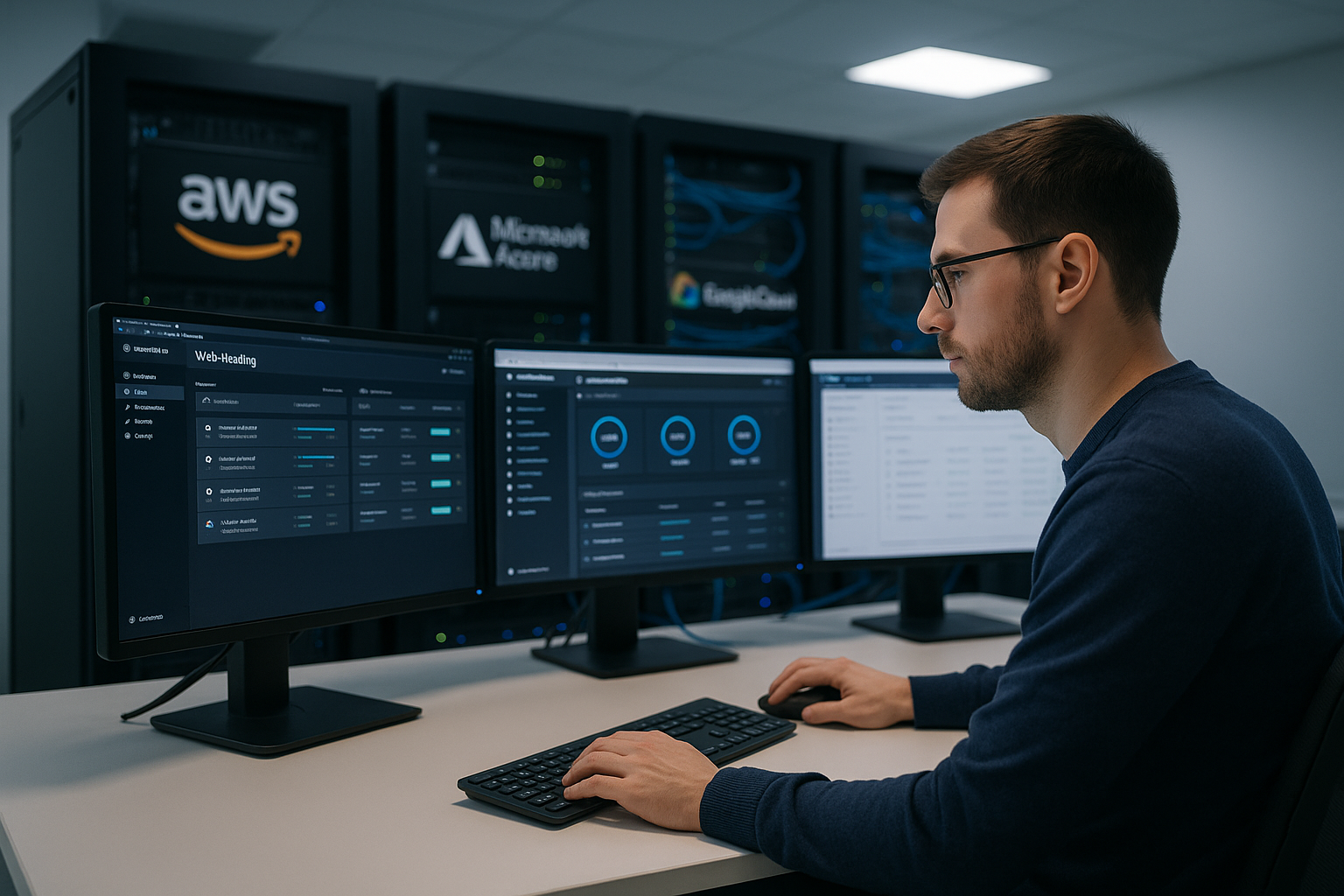
What multi-cloud orchestration achieves in web hosting
I centrally control deployments, scaling, and rollouts across multiple providers—for me, that's real Orchestration. Containers, VMs, and databases run where price, proximity to customers, and compliance are right. I map services to the appropriate cloud and keep configurations synchronized. I define policies once and implement them identically in all target environments. Release cycles remain short because pipelines work reproducibly. I plan migrations as code changes, not as large-scale projects—this creates Portability and speed.
Business benefits and application scenarios
For reliable services, I need alternatives—active-active or active-passive across two clouds delivers exactly that and increases the Availability. I handle peak loads with global load balancing and autoscaling. I address legal requirements with clear storage locations and encrypted transfers. I reduce lock-in by using open standards and keeping workloads portable. If you want to dive deeper, you'll find compact Multi-cloud strategies with typical patterns and selection criteria. This is how I achieve Flexibility without loss of control.
Network and traffic engineering in multi-cloud
I plan inputs and outputs carefully: a global DNS layer with health checks and latency or georouting distributes traffic to the clouds. Below that, I rely on L7 load balancers that terminate TLS, communicate with backends via mTLS, and enforce policies such as rate limits, bot protection, and WAF. I avoid sticky sessions—instead, I store state externally (e.g., in caches or tokens) so that failover works seamlessly. For connections between clouds, I use private links, VPN (IPsec/WireGuard), or dedicated interconnects; I minimize egress costs through regional caches, replication „near consumers,“ and clear data flows. I define timeouts, retries, and circuit breakers centrally to prevent cascade effects. This keeps latency predictable and failover reproducible.
The orchestration stack in practice: Kubernetes, Terraform, Ansible
Kubernetes is my linchpin for container-based workloads, whether EKS, AKS, or GKE—managed offerings reduce operational overhead and increase Productivity. For infrastructure, I use Terraform as declarative IaC, with modules for networks, clusters, databases, and observability. I implement configurations on servers, containers, and services with Ansible, agent-free and traceable via Git. Rancher helps me with multi-cluster management across provider boundaries. For in-depth container use cases, I often link to Managed Kubernetes hosting, to make operating models and cost frameworks tangible. The trio of Kubernetes, Terraform, and Ansible covers most of my Requirements from.
Service mesh and policy-driven traffic management
I use a service mesh to standardize communication and security between services. I implement mTLS, authorization, retries, timeouts, and traffic shaping as policies—version-controlled and auditable. For multi-cloud, I connect multiple clusters to a federated mesh topology: ingress and egress gateways control which traffic is allowed to leave the cloud and encrypt it. I control progressive delivery (canary, blue-green) via the mesh—including percentage shifts, header routing, and automatic rollback in the event of SLO violations. I make a conscious decision between a sidecar-based and „ambient“ mesh model, depending on overhead and team expertise. This allows me to keep release speed high without increasing risks.
Alternative platforms: OpenShift, Nomad, Morpheus, etc.
OpenShift comes with CI/CD, security controls, and enterprise convenience built in, which helps in regulated environments and Compliance Simplified. Nomad scores points for its ease of use for containers, VMs, and batch jobs—ideal when I want to maintain fewer components. Morpheus and Cloudify address multi-cloud governance, self-service, and end-to-end workflows. Humanitec facilitates platform engineering and abstracts environments for teams. For data-intensive scenarios, I look at Mesos; small setups can be started quickly with Docker Swarm. The bottom line remains: I choose the Platform, that matches the team size and maturity level.
Open standards and interoperability
I prioritize open APIs, OCI images, Helm charts, and standardized CRDs to keep workloads mobile and vendor lock-in decreases. I manage secrets uniformly, for example via External Secrets Operator with cloud backends. For identities, I rely on OIDC and central role models. GitOps with Argo CD or Flux ensures reproducible deployments across all environments. I abstract storage with CSI drivers and select appropriate classes depending on the data type. These building blocks reduce the amount of work required for changes and increase my Consistency in operation.

Requirements for orchestration tools
A good toolset enables real Portability, Otherwise, multi-cloud becomes nothing more than a gimmick. I expect automation across all lifecycle phases: provisioning, deployment, patching, scaling, and deprovisioning. Interfaces must be clearly documented and expandable. Security functions—from secret handling to policy enforcement—are a must. I need clear monitoring, meaningful dashboards, and reliable events. I also want to see FinOps data so that I can make informed decisions and Costs control.
Security, identities, and compliance
Without a uniform IAM, there is a risk of uncontrolled growth and shadow rights – that's why I rely centrally on Rollers, federated identities, and short token lifetimes. I define network boundaries based on a zero-trust approach: segmentation, mTLS, restricted egress rules. I encrypt data in transit and at rest, with rotation and audit trails. I test backups regularly as a restore exercise, not just as a switch in the console. For GDPR, I consciously control storage locations, log accesses, and minimize data records. This is how I maintain Compliance testable.

Supply chain security and artifact management
To ensure that I can use build artifacts across clouds with confidence, I secure the supply chain. I generate SBOMs, cryptographically sign container images, and check provenance evidence in the pipeline. I replicate artifact registries between regions and providers, separated into „quarantine,“ „staging,“ and „prod.“ Scans for containers, base images, and IaC run „shift-left“ with every commit; critical findings block releases, less critical ones generate tickets with deadlines. Build runners run in isolated environments, and I manage secrets centrally with minimal privileges. I keep base images lean, patchable, and repeatable—this way, deployments remain reproducible and auditable.
Monitoring, observability, and cost control
I am setting up a uniform telemetry system: logs, metrics, and traces belong together, otherwise I am missing correlations. I measure SLA-relevant metrics per cloud and globally. Alerts define clear ownership, and runbooks ensure a quick response. I visualize costs per team, service, and cloud, including budgets and anomaly detection. For productivity, I use an overview of Management tools 2025 and combine open solutions with provider functions. This setup makes performance and FinOps tangible.
FinOps in detail: price levers and guardrails
I consciously use cloud pricing models: on-demand for flexibility, reservations and savings plans for base capacities, spot/preemptible for tolerant workloads. I combine right-sizing and automatic scaling with budget limits and quotas. I keep an eye on egress costs: data remains „local“ as much as possible, and I use caches, compression, and asynchronous replication. I negotiate discounts, standardize instance families, and plan capacities along the product roadmap. Showback/chargeback motivates teams to optimize; tagging and a FinOps data model ensure transparency. Technical guardrails—such as maximum cluster size, storage classes with cost caps, policy-based region selection—prevent outliers right from the start of deployment.
Architecture patterns for web hosting
Active-active across two regions reduces latency and increases Resilience. Blue-green releases reduce the risk of updates and allow for quick rollbacks. Canary rollouts provide feedback in small steps. Geo-DNS and Anycast distribute traffic intelligently; WAFs and rate limits provide front-end protection. I deliberately plan stateful services: either regionally with sync mechanisms or centrally with cache strategies. This allows me to combine speed, quality, and Stability in day-to-day business.
Stateful services and data architecture in multi-cloud
Data determines the degrees of freedom. I decide on a per-workload basis: either I operate a „primary region“ with replicated „read replicas“ in other clouds, or I choose eventual consistency with asynchronous replication. I usually avoid multi-primary across multiple clouds—latency and split-brain risk are high. For changes, I use change data capture and event streams so that write loads migrate in a controlled manner. I encrypt and replicate backups across clouds, and I test restores regularly as an exercise; I define RPO/RTO realistically and measure them. I prioritize idempotent operations, dedicated key spaces, and clear „source of truth“ systems. Caches, read shards, and regional data proximity reduce latency without sacrificing consistency. This keeps data portable and operations manageable.

Organization, roles and operating model
I think of the platform as a product: a dedicated team is responsible for the roadmap, SLOs, security, and developer experience. „Golden paths“ and self-service catalogs accelerate teams without restricting freedom. SRE practices with error budgets and blameless postmortems embed quality in everyday work. On-call rules, runbooks, and clear RACI assignments prevent gaps in on-call duty and incident response. Training and „inner source“ promote the reuse of modules. Governance remains lightweight: policies as code, peer reviews, and automated controls replace meetings. This allows processes to scale instead of slowing down.
Provider comparison for multi-cloud web hosting
When it comes to hosting providers, I look for genuine multi-cloud integration, clear SLAs, response times, and SupportQuality. Location and GDPR play a decisive role in many projects. Additional services such as managed Kubernetes, observability packages, and migration assistance can significantly reduce effort. I check whether the provider offers Terraform modules, APIs, and self-service. Only when technology and service work together can we see whether multi-cloud works in practice and whether the Goals fulfilled.
| Place | Provider | Multi-cloud support | Special features |
|---|---|---|---|
| 1 | webhoster.de | Very strong | Modern multi-cloud and hybrid cloud hosting, proprietary platform combined with leading public clouds, maximum flexibility, German data protection, excellent support |
| 2 | IONOS | Strong | Extensive cloud and VPS products, integration with international clouds |
| 3 | Hetzner | Medium | High-performance servers with cloud connections, locations in Germany |
| 4 | AWS, Azure, GCP | Very strong | Native public cloud capabilities, wide variety of deployment options |
| 5 | Strato | Solid | Good entry-level cloud products, affordable prices |
For demanding scenarios, I often rely on webhoster.de because they offer multi-cloud integrations, consulting, and Data protection together. International hyperscalers remain the first choice for global reach and specialized services. IONOS and Hetzner offer attractively priced setups based in Germany. Strato is suitable for simple projects and tests. The gap between the feature list and everyday implementation remains crucial—I check this in advance with a ProofProof of concept.

Anti-patterns and common pitfalls
I avoid patterns that slow down multi-cloud:
- „Lowest common denominator“If I only use the lowest common denominators, I lose added value. I encapsulate provider specifics behind clear interfaces instead of prohibiting them.
- Unplanned data flowsEgress costs and latency skyrocket when replication and caching are not designed.
- Too many levels of control: Duplicate policies in Mesh, Ingress, WAF, and Firewall cause drift—I define the „source of truth“ and automate comparisons.
- Manual OperationsScripts without IaC/GitOps lead to shadow configurations. All I do is code.
- Restore never testedBackups without regular restore exercises are a false sense of security.
Roadmap: Multi-cloud orchestration in 90 days
In the first 30 days, I define goals, risks, and KPIs, select target clouds, and define naming and tagging standards. At the same time, I create Terraform modules and a minimal Kubernetes baseline cluster. On days 31–60, I set up CI/CD, GitOps, and observability and migrate a pilot app. From day 61 onwards, I focus on policies, backups, runbooks, and load testing. Finally, I establish FinOps reports, on-call rules, and a roadmap for additional services. This allows the platform to grow step by step—in a controlled and measurable.

Conclusion & Outlook
Multi-cloud orchestration makes my hosting independent, faster, and safe. I choose tools that prioritize automation and open standards, and avoid ties to individual providers. The mix of Kubernetes, Terraform, and Ansible covers many projects, supplemented by governance platforms where necessary. Structured monitoring with a FinOps perspective ensures that performance, costs, and risks remain in balance. Those who plan carefully today will benefit tomorrow from scalable releases, shorter recovery times, and traceable decisions. This keeps the infrastructure sustainable – without compromising on control and quality.


