Skip to content
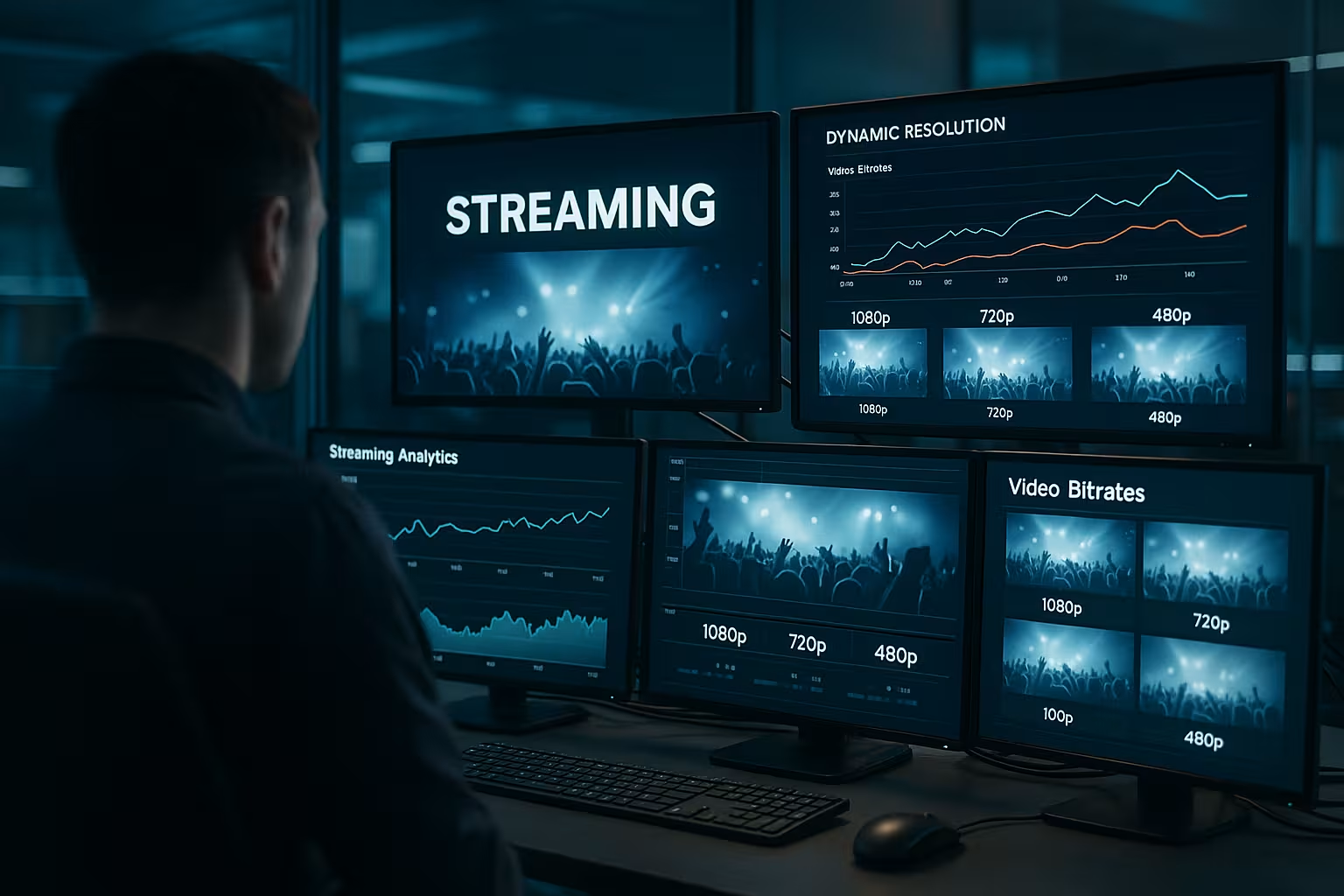
Modern streams deliver first-class media performance, when adaptive bitrate in hosting dynamically adjusts quality per viewer and actively prevents buffering pauses. I'll show you step by step how ABR makes delivery efficient, reduces costs, and future-proofs video workflows. Formats such as 4K, 8K, and low latency.
Key points
To help you immediately understand the most important advantages, I will briefly summarize the core aspects of ABR in hosting and highlight the key points. Lever for better performance.
- Less buffering and lower dropout rates for higher watch time.
- Dynamic quality per user instead of fixed bit rates.
- CDN efficiency and lower traffic costs through targeted delivery.
- Variety of devices From smartphones to smart TVs with matching profiles.
- Future-proof for 4K/8K, VR, and low-latency scenarios.
Why adaptive bitrate is essential in hosting
Ideally, streaming starts immediately, keeps the buffer full, and continuously achieves the best quality choice. With ABR, I prevent stuttering by having the player automatically switch to a suitable level when the connection fluctuates, before the buffer runs out. Without this logic, I would have to choose between an overly cautious bitrate or a risky high-quality setting, which either sacrifices quality or causes interruptions. ABR solves this dilemma with a multi-level ladder that jumps up or down depending on the connection, thus ensuring user expectations meets fluid video. Anyone hosting media today risks shorter sessions, fewer conversions, and higher bounce rates without ABR.
What happens behind ABR
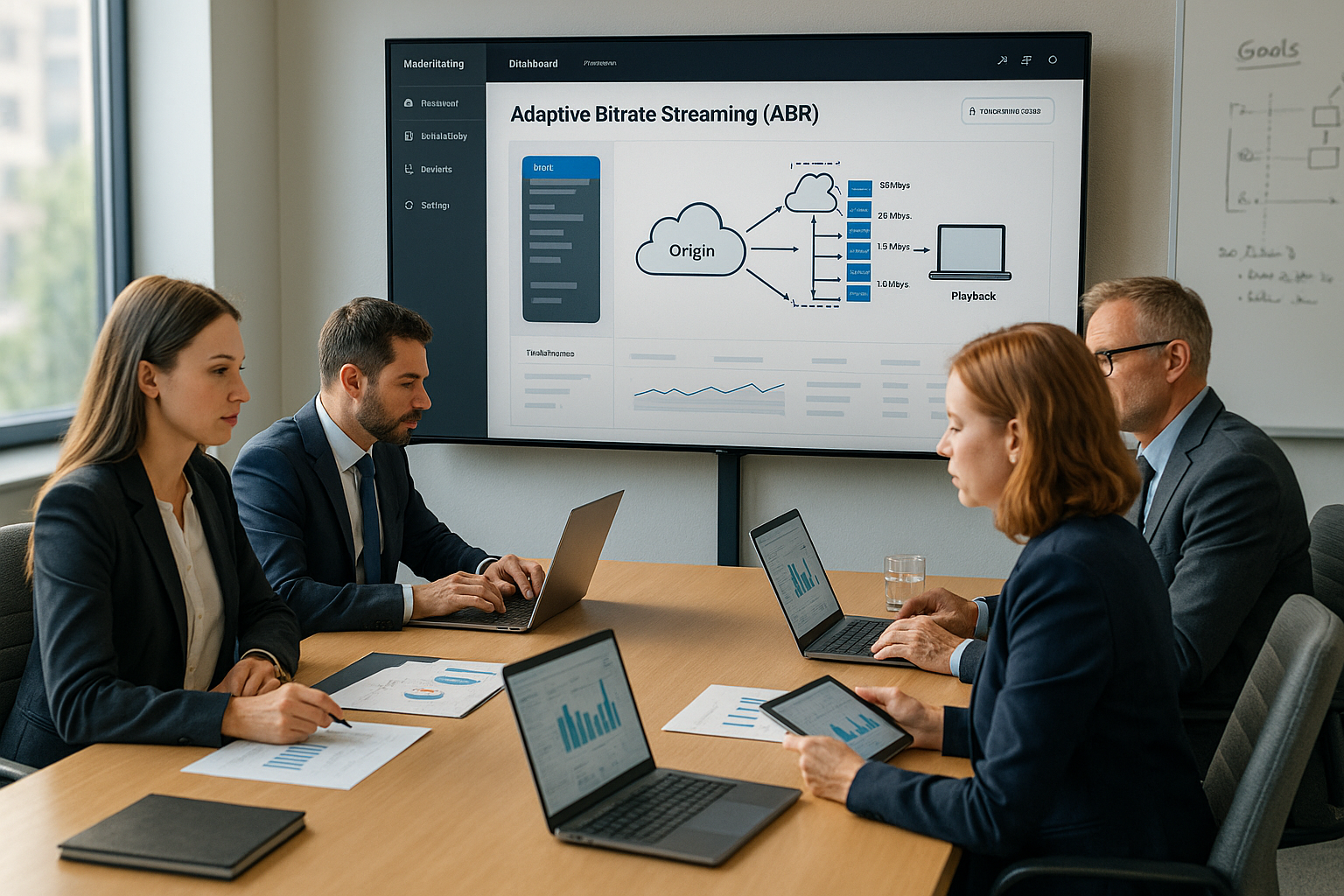
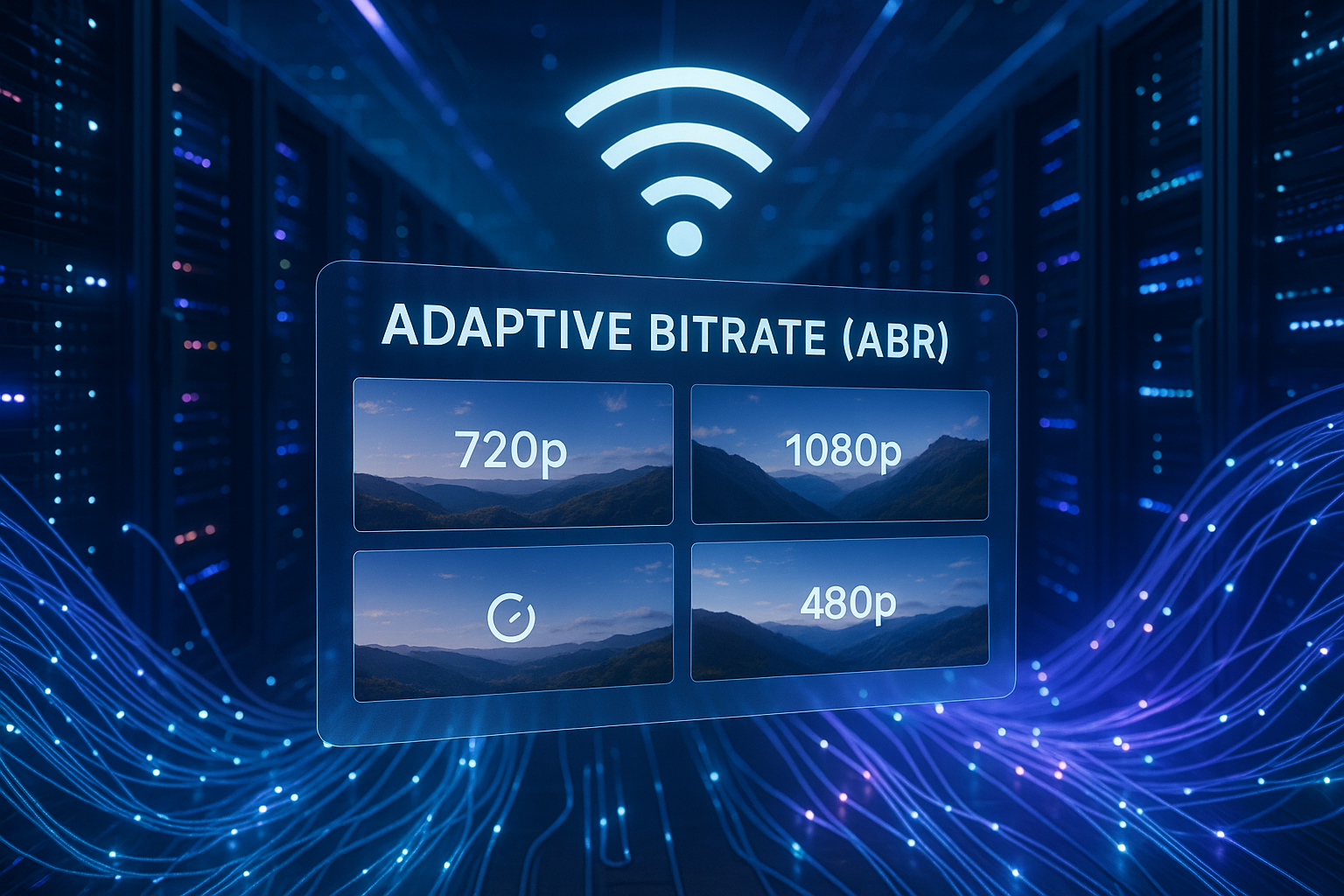
I transcode the source video into several profiles, such as 1080p, 720p, 480p, and 360p, each with graduated bit rates. I then break each variant down into short segments of usually 2–10 seconds and refer to them in a manifest file such as M3U8 (HLS) or MPD (DASH). The player measures bandwidth, latency, and sometimes CPU load, selects the next segment appropriate to the situation, and continuously corrects it. This creates a flexible „encoding ladder“ that reacts in small steps instead of producing sharp breaks in quality. This continuous tuning increases the perceived Performance clear, because the start is fast and the stream runs reliably.
Design encoding ladders and profiles
A well-balanced ladder with 4–6 steps avoids hard jumps and limits Resources for encoding and storage. I make sure there are reasonable gaps between bit rates, consistent keyframe intervals, and clean GOP structures so that transitions remain inconspicuous. For mobile viewers, I plan economical profiles that deliver solid images even on weaker networks. At the same time, I provide high-bitrate profiles for sports, gaming, or presentations with lots of detail. For data storage, I use a optimized storage strategy, so that I can implement caching, warm/cold storage, and lifecycle rules economically play out.
| Profile | Resolution | Bit rate (kbps) | Typical use | codec |
|---|---|---|---|---|
| Low | 426×240 | 300–500 | Weak networks, background tabs | H.264 |
| SD | 640×360 | 600–900 | Mobile phones on public transport, data allowance | H.264 |
| headquarters | 854×480 | 1000–1500 | Everyday life, News, Talks | H.264 |
| HD | 1280×720 | 2000–3500 | Large displays, events | H.264/H.265 |
| Full HD | 1920×1080 | 4,500–8,000 | Sports, gaming, demos | H.264/H.265/AV1 |
| ultra-high definition | 3840×2160 | 12,000–25,000 | 4K TV, Premium | H.265/AV1 |
When choosing a codec, I take into account device coverage, licensing, and Efficiency. H.264 runs almost everywhere, while H.265 and AV1 visibly reduce the bit rate but require more computing power and, in some cases, special hardware. For a broad target audience, I mix profiles: Baseline with H.264, Premium with H.265 or AV1. This allows me to achieve a good balance between quality, compatibility, and cost. The ladders thus remain transparent, maintainable, and ready for future Formats expandable.
Content-specific encoding and rate control
Not all content requires the same bitrate. I use per-title and per-scene approaches to encode complex scenes (grass, water, fast cuts) at a higher bitrate and calm or flat motifs at a lower bitrate. With capped CRF or constrained VBR, I ensure consistent visual quality. Quality, but set strict upper limits so that profiles on the network do not get out of hand. A look-ahead in the encoder, clean scene detection, and coordinated keyframe intervals (IDR frames) ensure that quality changes occur precisely at meaningful cut points. This keeps the Encoding Manager narrow, the perceived image stability increases and I save on transcoding and storage costs at the same time because fewer variants are needed.
Protocols: HLS and MPEG-DASH
HLS and DASH deliver segments via HTTP, which allows me to seamlessly CDN integration HLS uses M3U8 manifests and is widely supported on Apple platforms, while DASH scores points with MPD manifests in many browsers and smart TVs. Both transport methods work excellently with ABR because they provide small, time-stamped segments. This allows the player to switch to a different profile if necessary without interrupting the session. Extensions are available for DRM and subtitles, which I use depending on Requirement combine.
Containers and segments: TS, fMP4, and CMAF
For modern workflows, I prefer to use fMP4 because it allows me to use HLS and DASH via CMAF standardize. This reduces Origin load, simplifies caching, and is a prerequisite for low-latency variants with partial segments (chunks). Classic MPEG-TS remains compatible, but is less efficient and makes very short segments more difficult. With fMP4/CMAF, I also benefit from uniform encryption (CENC/CBCS), which simplifies multi-DRM. Consistent segment duration (e.g., 2–6 seconds) and exact timestamps are important so that players can pre-buffer precisely and ABRbe able to make clear decisions.
ABR algorithms in the player
Players measure throughput, buffer level, and errors to determine the next quality step Throughput-based methods look at the download times of the last segments, while buffer-based methods prioritize a filled buffer. Hybrid approaches combine both and reduce risk during network transitions between Wi-Fi, 4G, and 5G. Some implementations even switch to a different level during a running segment to avoid visible artifacts. I check logic and thresholds regularly because a well-tuned algorithm improves the perceived image stability strongly influenced.
Startup behavior and player tuning
For a quick start, I often deliberately begin at the bottom of the ladder and then ramp up quickly once the buffer is stable. Small initial segments, pre-fetching the next chunks, and prioritized manifest requests (HTTP/2/3) reduce the time-to-first-frame. Hysteresis prevents oscillations between two stages, and a „don't switch up on low buffer“ rule protects against rebuffering. On mobile devices, I take CPU/GPU load and battery life into account so that the Performance remains high without thermal throttling. Thumbnails/trickplay sprites and precise keyframe grids improve seek experiences and reduce skipping failures.

Accessibility, languages, and audio
I deliver several audio variants: stereo for mobile devices, multichannel for TV apps, and a low-data track if required. Loudness normalization (e.g., EBU R128) prevents jumps between contributions or commercial breaks. I maintain subtitles as separate tracks (WebVTT/IMSC1), as well as audio descriptions and multilingual audio tracks. This manifests itself as additional renditions in the manifest and remains with ABR Compatible. It is important that the segment boundaries are identical across all tracks so that switching works without desync. I enter metadata (ID3/EMSG) sparingly so that it does not interfere with caching and ABR logic.
CDN integration and edge delivery
With a well-configured CDN, I reduce latency, distribute load, and maintain segments close to the viewer. Origin shielding and clean caching of video chunks prevent load peaks at the source. I pay attention to cache keys, TTLs, and consistent paths to ensure that all profiles are available correctly. To shorten the distance to the user, I rely on Edge caching, which measurably reduces start times. This benefits ABR behavior because fast segment responses give the player more Scope for high-quality profiles.
Security, tokens, and rights management
I protect streams with signed URLs or cookies and keep the signature stable across all renditions so that the CDN does not create separate objects for each bitrate. Manifests can be short-lived, segments can be cached longer—this keeps tokens secure without destroying cache hits. For premium content, I rely on encryption and combine DRM systems depending on the target devices. Geoblocking, concurrency limits, and hotlink protection complete the setup. Important: Choose CORS headers and referrer rules so that legitimate players can access content without any problems, while scrapers are slowed down.

Scaling for live events
Live streams place high demands on throughput, control, and timing. I plan for sufficient headroom capacity, distribute viewers regionally, and test the encoding ladder in advance with realistic load patterns. ABR smooths out peaks because not every user pulls the highest bitrate at the same time. Nevertheless, I secure backups for encoders, origins, and DNS routes to avoid outages. With good telemetry, I can identify bottlenecks early on and keep the audience size reliably high.
Advertising integration with ABR (SSAI/CSAI)
For monetization, I neatly insert ad breaks into the ladders. With server-side ad insertion, segments and keyframes remain aligned so that the transition to the commercial break is smooth. I mark breaks (e.g., SCTE signals), keep the ad bitrate within the content ladder, and avoid cognitive breaks caused by loudness peaks. For client-side playback, I check the pre-fetch and caching of the advertising segments so that the Watchtime does not suffer from delays. Measurement beacons and separate QoE metrics for ads show whether monetization is affecting the experience.
Low-latency streaming with ABR
Where low latency is important, I combine ABR with LL-HLS, Low-Latency DASH, or WebRTCShorter segments and sub-segments reduce latency, but require precise caching and clean player implementations. I am testing how aggressively the algorithm can shift up when buffers are low without triggering rebuffering. For sports, auctions, or interactivity, this creates a more direct experience that still allows for quality changes. The key remains a finely tuned balance between delay, Quality and fault tolerance.
Synchronization, timecodes, and interactivity
For accompanying features such as live statistics, chat, or second screen, I consider timelines to be consistent. A reliable clock (UTC reference) and precisely timed segments prevent drift between devices and across CDNs. I define a clear DVR window with stable seek points and provide thumbnails on an IDR grid. For interactivity, I limit the variability of the Latency, so that actions remain predictable, and use markers in the manifest to play synchronized elements precisely.
Quality measurement and monitoring
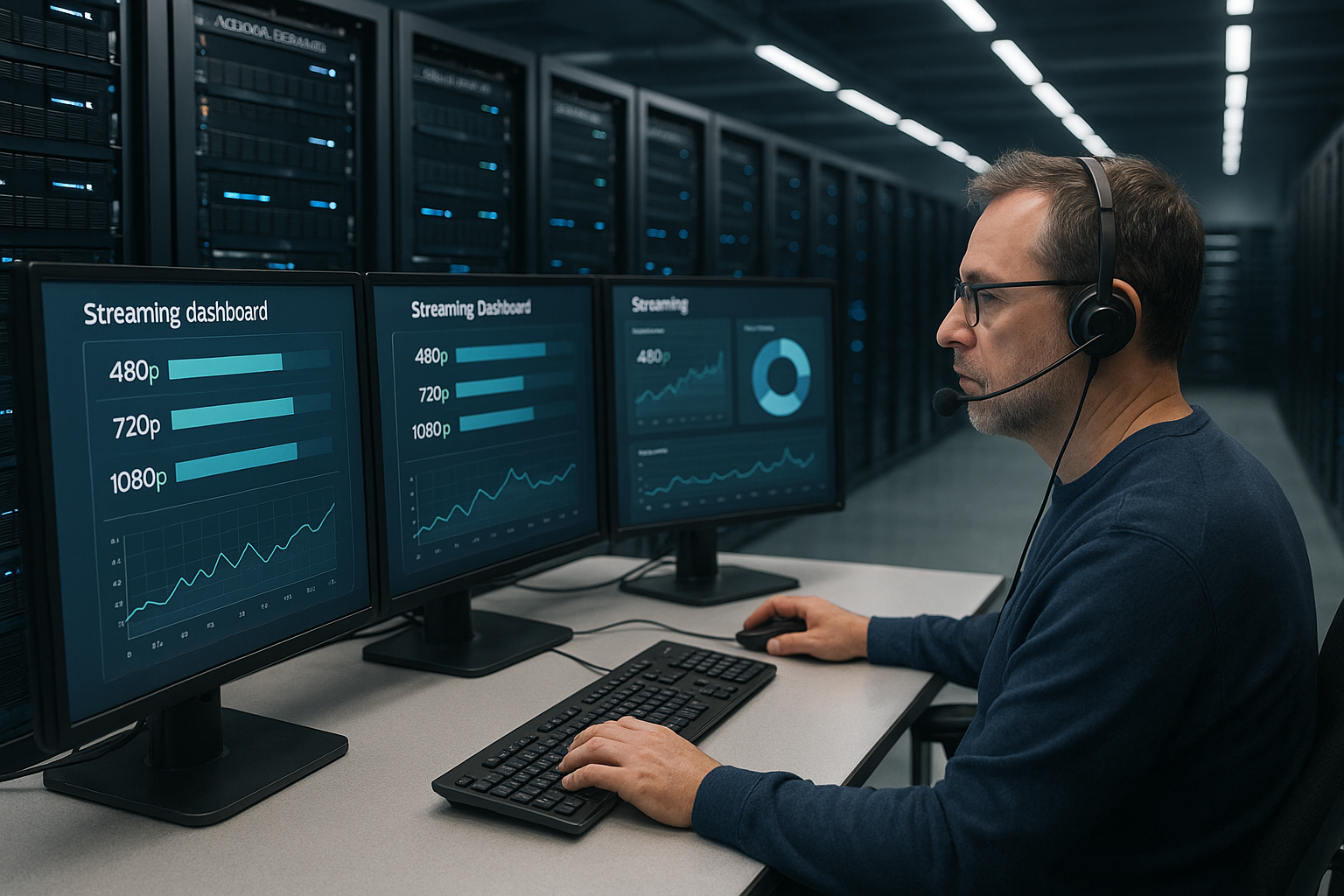
Without telemetry, I'm groping in the dark. Dark. I track start-up time, average bit rate, rebuffering rate, error rates, and target audience per device. These metrics show which profiles are effective, where bottlenecks lurk, and how I can refine the ladder. A/B testing helps me with segment lengths, keyframe spacing, and codec mix. ML-supported predictions allow profiles to be personalized, provided that the data situation and consent allow for this, which is targeted. Effects on watch time and QoE.
Objective quality and SLOs
In addition to user signals, I evaluate visual quality using VMAF, SSIM, or PSNR and target specific ranges for each profile. From this, I derive service level objectives: time-to-first-frame under 2 seconds, rebuffering rate under 0.2 %, dropout rate under a defined threshold, and minimum coverage of HD profiles for high-performance devices. I analyze P50/P95 values separately by network type and device to identify outliers. I link alerts to trend breaks, not just thresholds, so that I can identify degraded Performance stabilize early.
Costs and profitability
Traffic costs money, so I save data where I can. Quality allowed. Sample calculation: 100 TB per month corresponds to 102,400 GB; at $0.05 per GB, this results in costs of $5,120. If ABR reduces the average throughput by 15 %, the expenses are calculated to decrease by $768 without viewers losing anything. With regional caching, balanced profiles, and clean ladder selection, the savings add up even more. For global reach, I check Multi-CDN strategies, so that I can keep costs down, Availability and flexibly control performance.
Encoding and operating costs
In addition to egress, transcoding and storage costs are also significant. I choose between CPU-based encoding (flexible but power-hungry) and GPU/ASIC variants (fast and efficient, but less configurable). Per-title encoding reduces the number of profiles required and saves runtime. Just-in-time packaging reduces storage requirements, as I only generate HLS/DASH from a mezzanine set (e.g., CMAF) when requested—important for long-tail libraries. Lifecycle rules move old renditions to cheaper tiers; I keep hot titles warm at the edge. In live operation, I calculate reserve capacity, test spot/preemptible instances for cost advantages, and monitor cache fill so that origins are not unnecessarily scaled up. I link cost accounting to QoE targets: every bitrate saved that keeps VMAF stable contributes directly to the margin.
In short: ABR as a competitive lever
Adaptive bitrate makes streams start faster, more resistant to network fluctuations, and more visible in the Quality. I use ABR to provide premium viewers with 4K, while mobile users get an economical yet sharp level. This increases watch time, keeps the conversion chain intact, and makes the infrastructure predictable. Today's media hosts benefit from clean encoding ladders, strong CDN integration, and vigilant monitoring. With this setup, I ensure high Performance – from the first second to the last frame.