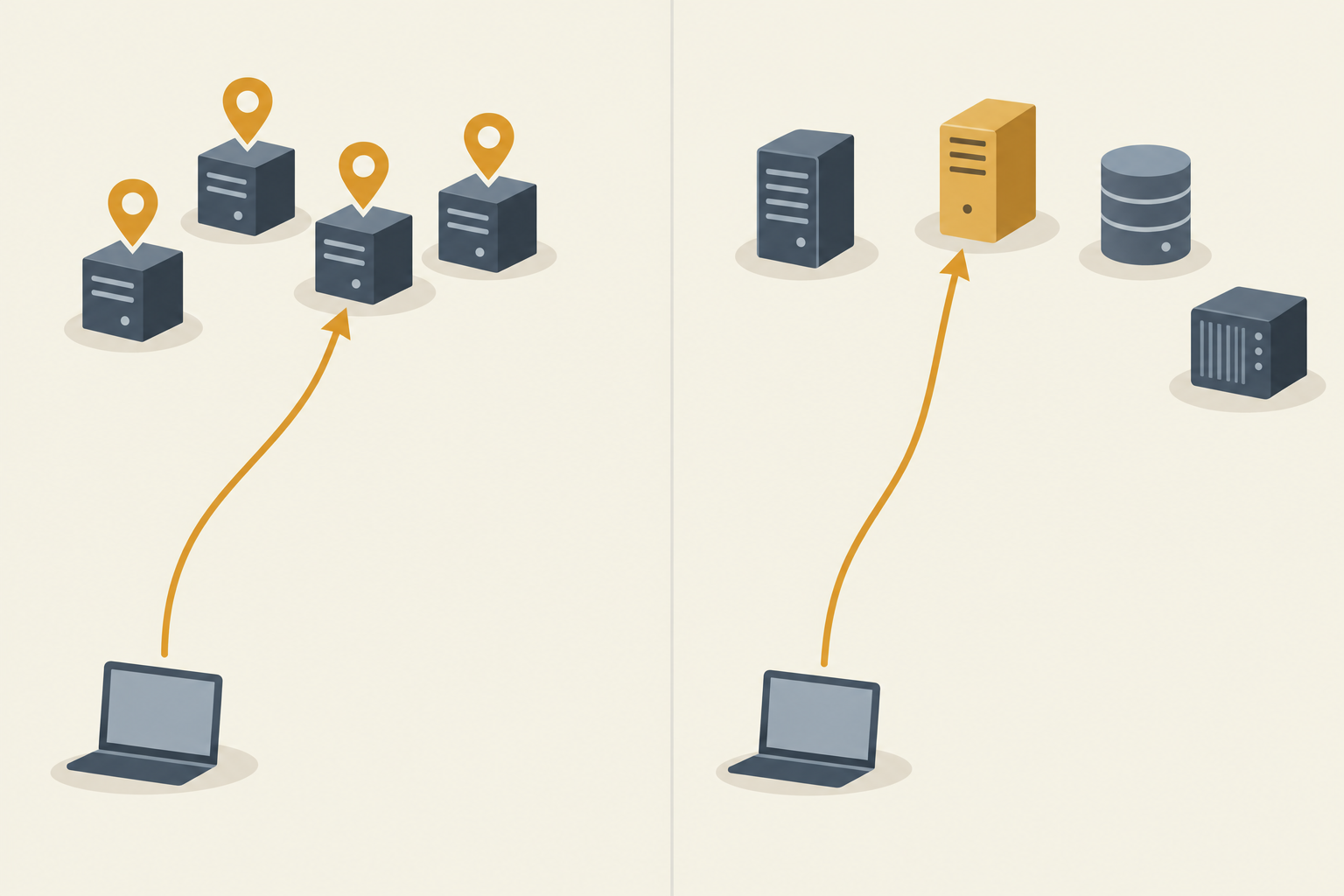
A authoritative name server provides the data for a zone; a recursive DNS resolver retrieves responses for its clients, using a cache when necessary. Both respond to DNS queries, but are responsible for different tasks. This distinction helps you make changes in the right place: website and mail records belong in the authoritative zone, while the resolver on your device influences the query path. Understanding how delegation, caching, and negative responses interact is also crucial for troubleshooting.
Two DNS roles and their data
A authoritative name server It responds to queries with data from a DNS zone for which it is responsible. For example, it can provide the stored IPv4 address of a website or indicate that a requested name does not exist in its zone. It is therefore the authoritative source for this zone data, but not automatically for the entire DNS.
A recursive resolver In contrast, it operates on behalf of a client: It retrieves the desired response by querying other DNS servers as needed and can use previously cached results. „Name server“ is a generic term; this designation alone does not indicate which of the two roles a service fulfills.
A zone is a managed section of the DNS namespace. For example, the domain example.com can be in the same zone as www.example.com. However, if shop.example.com is assigned to its own Nameserver If it is delegated, a separate zone may begin there. Therefore, a domain and a zone do not always refer to the same area.
The information in a zone is stored in records. An A record associates an IPv4 address with a name. An MX record specifies destinations for email delivery, and a CNAME record points to another name as an alias. DNS therefore provides different types of information. If you change a website address, you should not assume that this affects your email settings.
For practical administration, it is crucial to know which zone contains the name in question and which servers are actually responsible for it. An entry may exist in another, non-publicly delegated zone, but that alone does not make it a source of answers for public DNS resolution.
The Path of a DNS Query
When an application requests an address, the device often uses a stub resolver. The stub resolver forwards the request to a configured recursive resolver instead of traversing the entire DNS hierarchy itself. A forwarder may be located between the two, which forwards requests to another resolver. The components involved depend on the device and the network.
The resolver first checks whether it already has a usable response in its Cache has. If a match is found, it can return the information without querying the relevant authoritative server again. Stored information about delegations can also shorten the process; therefore, root and TLD servers are not contacted for every query.
If the necessary information is missing, the resolver can start at an entry point in the hierarchy. A root nameserver points to servers for the relevant top-level domain, such as .com. From there, the resolver may receive a reference to the authoritative nameservers for the zone being searched and queries one of them for the desired name and record type.
This interaction can be represented as a flow with branches: the client, an optional forwarder, and the resolver are positioned before the hierarchy consisting of the root, the top-level domain, and the authoritative zone. A cache hit returns a response directly; otherwise, the resolver retrieves the necessary information by following the available references. A forwarder can also pass the task on to an upstream recursive resolver.
The Recursion It describes the service to the client. The individual intermediate queries to the hierarchy are typically not recursive: the queried server returns either a response or a reference. If the resolver receives a CNAME, it may need to resolve the target name as well before returning the result.
Delegation links the DNS zones
The DNS hierarchy connects zones through delegation. The parent zone contains NS records that point to the authoritative name servers of a child zone. A resolver can use this reference to find the next authoritative server. The actual records of the child zone, on the other hand, are managed by its authoritative DNS service.
For a registered domain, delegation is managed—depending on jurisdiction—either by the registrar or by the designated administrative authority. The operator of the authoritative zone may be a different provider. Therefore, it is not enough to simply create a record with any DNS service: the publicly delegated name servers must actually provide the appropriate zone.

A particular problem arises when the name server itself is located within the delegated zone—for example, ns1.example.com for example.com. To query this server, the resolver first needs its address. However, in order to resolve the address normally, it might have to contact this very server, which is currently unreachable.
Here you can Glue Addresses enable access to the parent zone. They provide the resolver with an address to reach the specified nameserver, thereby resolving the dependency issue. However, glue records do not replace the regular address data in the authoritative zone; both sets of information must match.
If the address of such a nameserver changes, both the regular zone data and any stored glue records should be checked and updated. Likewise, the delegated server names must match the servers that are actually in operation. Otherwise, the connection to the relevant zone may fail before a website or mail record is even queried.
Compare resolvers and authoritative servers
An authoritative nameserver and a recursive resolver both respond to DNS queries, but they perform different tasks. The key distinction is whether a server provides data for a zone or retrieves a response on behalf of a client. The following comparison describes these roles; a single installation can be configured to perform both.
| Feature | Authoritative Name Server | Recursive Resolver |
|---|---|---|
| Task | Provide Data from a Managed Zone | Resolve Client Inquiries |
| Data source | Configured Zone Data | Cache or queries to other DNS servers |
| Typical answer | Record, negative response, or referral in the case of delegation | Calculated result or rounding error |
| Cache | Zone data is the primary data source | Saves useful responses and delegation information between |
| Operator Page | DNS service for the relevant zone | For example, a network operator or a resolver service chosen by clients |
If you move a website to a new server, you change its address in the authoritative zone. If the IPv4 address has changed, update the corresponding A record. Then check the relevant authoritative servers and selected recursive resolvers separately. An older cache response does not automatically indicate an error in the zone.
Another resolver on your device may return different cached data for its queries. However, it does not change either the public zone entry or the delegation at the parent DNS service. If one resolver is already showing the new address and another is still showing the old one, you should therefore distinguish between the source and the cache expiration time before editing the entry again.
Check DNS Responses Separately
To understand a DNS response, the source and the requested Record type Crucial. A resolver response shows what information the queried service provides to its client. A response from a competent authoritative server, on the other hand, describes its data for the zone in question. This comparison explains the roles in the DNS protocol. The operation of a specific query program is governed by its documentation.
Even the same full name can answer different questions depending on the type. An A record refers to an IPv4 address, an MX record to the relevant mail servers, and an NS record to the name servers. For a technical comparison, the name, type, and DNS class must match. Therefore, an existing website address does not necessarily answer a question about the mail servers for the same domain.
In the case of recursive processing, the service being queried returns a final response or reports an error. It may use data that has already been cached for this purpose. In contrast, for a non-recursive request, the server returns the information immediately available to it, such as authoritative data, existing cached data, or a reference. The destination address of a request alone does not determine this type of processing.
The AA flag Indicates an authoritative response. To determine the classification, the status, the response section, and any references must also be considered together. A server may refer to the authoritative servers of a subordinate zone, while a resolver may return a previously cached response. The information in the response packet thus helps distinguish between authority and forwarding.
A Delegation Audit Considers the relationship between the parent and child zones. The NS records on the parent page and the corresponding information from the relevant servers are decisive. An isolated NS response does not indicate whether the two pages match. Furthermore, when there are multiple authoritative servers, their respective data may differ from one another.
If a resolver response differs from an authoritative response, there are therefore several possible explanations. Data that has already been cached may still be valid, the authoritative servers may return different statuses, or the queries in question may differ in name and type. Keep these possibilities separate when analyzing the results. Only responses that match allow for a meaningful comparison.
TTL, Cache, and Negative Responses
After a website address is changed, two resolvers may temporarily return different results. If one of them cached the old record shortly before the change, it may, in principle, continue to use it until its remaining TTL Reuse it. Another resolver may already be retrieving the updated authoritative data.
The TTL limits the use of a cached record; it does not guarantee that a change will be visible everywhere at a specific time. Furthermore, a delegation change may involve multiple pieces of data stored separately. For troubleshooting, therefore, first compare the authoritative responses and then selected resolver responses along with their remaining TTLs.
Even the absence of information can be cached. If a resolver reported this before creating a subdomain NXDOMAIN, it can continue to use this negative response for a while, even though the new entry already exists as the authoritative one. NXDOMAIN generally means that the queried name does not exist; NODATA, on the other hand, means that the requested record type is missing for an existing name.

For negative responses, the cache duration is derived from the smaller of the SOA-TTL and the SOA-MINIMUM fields. Therefore, when dealing with a new subdomain, check the name, the desired type, and the responsible zone. For example, the presence of an A record does not prove that an MX record has also been set up for the same name.
A resolution error such as SERVFAIL must be distinguished from a negative response: It does not indicate that the name or type is missing. Errors can also be temporarily cached. For further information on the relationship between runtime and retrieval, see the article on Cache Optimization for DNS Resolvars An addition.
How to Safely Switch to an Authoritative DNS Service
When switching the authoritative DNS service, first prepare the entire zone with the new provider. Don't just copy the website addresses; also check the MX records, the addresses of the specified mail servers, and any required verification entries. A functioning website alone does not guarantee that email delivery will work after the switch.
Before the switchover, query the new authoritative servers directly for important names and record types. Compare their responses with the existing zone data and also verify that all intended new servers match. Only once the new zone is ready should you change the delegation through the registrar or the responsible administrative authority.
If the names of the new name servers are within the delegated zone, check the required Glue Addresses in the parent zone. They help resolvers reach the name servers in the first place; the corresponding regular address data in the zone must match. With DNSSEC, the chain of trust must also be correct when transitioning to the new service.
After making the change, check both the old and new authoritative servers and also compare responses from selected resolvers. During the transition, delegation data or responses may still be cached. Therefore, keep the previous service available with appropriate data for the time being, rather than assuming from a single new response that all queries are already being routed there.
Pinpointing DNS Errors
Start troubleshooting by specifying the exact name and record type: A query for a website address answers a different question than one for an MX record. Also, make a note of which server was queried. Only then can you meaningfully distinguish between a negative response, a resolution error, and a lack of response.
| Result | Meaning | Next step in the review process |
|---|---|---|
| NXDOMAIN | According to the response, the name you entered does not exist. | Check the name and the applicable zone; take potential negative caching into account. |
| NODATA | The name exists, but the requested record type is not available. | Check the record type and zone data; take into account the possibility of negative caching. |
| SERVFAIL | The server was unable to process the request successfully. | Compare other resolvers and authoritative servers; check for DNSSEC, among other things. |
| Timeout | No response was received within the waiting period. | Check the reachability and network path to the requested server. |
Compare the direct responses from several authoritative servers with the results from selected recursive resolvers. If the authoritative responses do not match, it is worth checking the respective zone files. If they return the same new record while a resolver still returns the old one, a cache may explain the discrepancy; other causes must also be investigated on a case-by-case basis.
A validating resolver checks using DNSSEC Signed DNS data via a chain of trust. If this chain is flawed, the resolution may fail. However, a SERVFAIL by itself does not prove a DNSSEC failure: Compare other responses and examine the validation before determining the cause. DNSSEC protects data integrity but does not encrypt the transmission of the DNS query.
A single successful test shows only the result of that particular query path at that specific time. Different caches, servers, and network paths may respond differently. For a more reliable assessment, repeat the test as needed using multiple relevant servers and resolvers, without interpreting the results as a guarantee of global availability.
Operate and Select DNS Services Separately
Choosing an authoritative DNS provider and choosing the recursive resolvers perform different tasks. The authoritative service determines who manages the public zone, how changes are applied, and whether the delegated servers respond reliably and consistently. A provider can operate both services; however, this does not mean their roles are identical.
For clients, however, you decide which resolver processes their requests. Data protection, potential filtering, and DNSSEC validation are relevant selection criteria. Changing the resolver on the device can alter its resolution path, but it does not transfer the administration of your zone or change the public delegation.
Having your own resolver gives you control over configuration and operation, but requires ongoing maintenance, monitoring, and security measures. Limit its recursion to authorized clients instead of making it publicly available. A Forwarder Forwards queries to an upstream resolver; this simplifies local resolution but makes it dependent on that service.
Plan for fault tolerance separately for both levels: Having multiple authoritative servers does not help if the resolver used by clients fails; having multiple resolvers does not replace an accessible and consistent authoritative zone. Further considerations regarding the Redundancy of resolvers and authoritative name servers Help with operational planning. While doing so, also check whether seemingly independent services share common points of failure.
Sources and Current State of Knowledge
Status of the research:
Research status: November 13, 2026. DNS roles and examples are not tied to a specific software version.
https://datatracker.ietf.org/doc/rfc1034/
https://datatracker.ietf.org/doc/html/rfc2308
https://datatracker.ietf.org/doc/html/rfc1034
https://archive.icann.org/meetings/icann67/files/static/attachments/237753/1583931464.pdf
https://www.icann.org/en/rssac/faq
https://www.icann.org/en/system/files/files/presentation-mitigating-stale-glue-records-tld-zone-files-25sep24-en.pdf
https://www.icann.org/resources/pages/dnssec-what-is-it-why-important-2019-03-05-en/