Skip to content
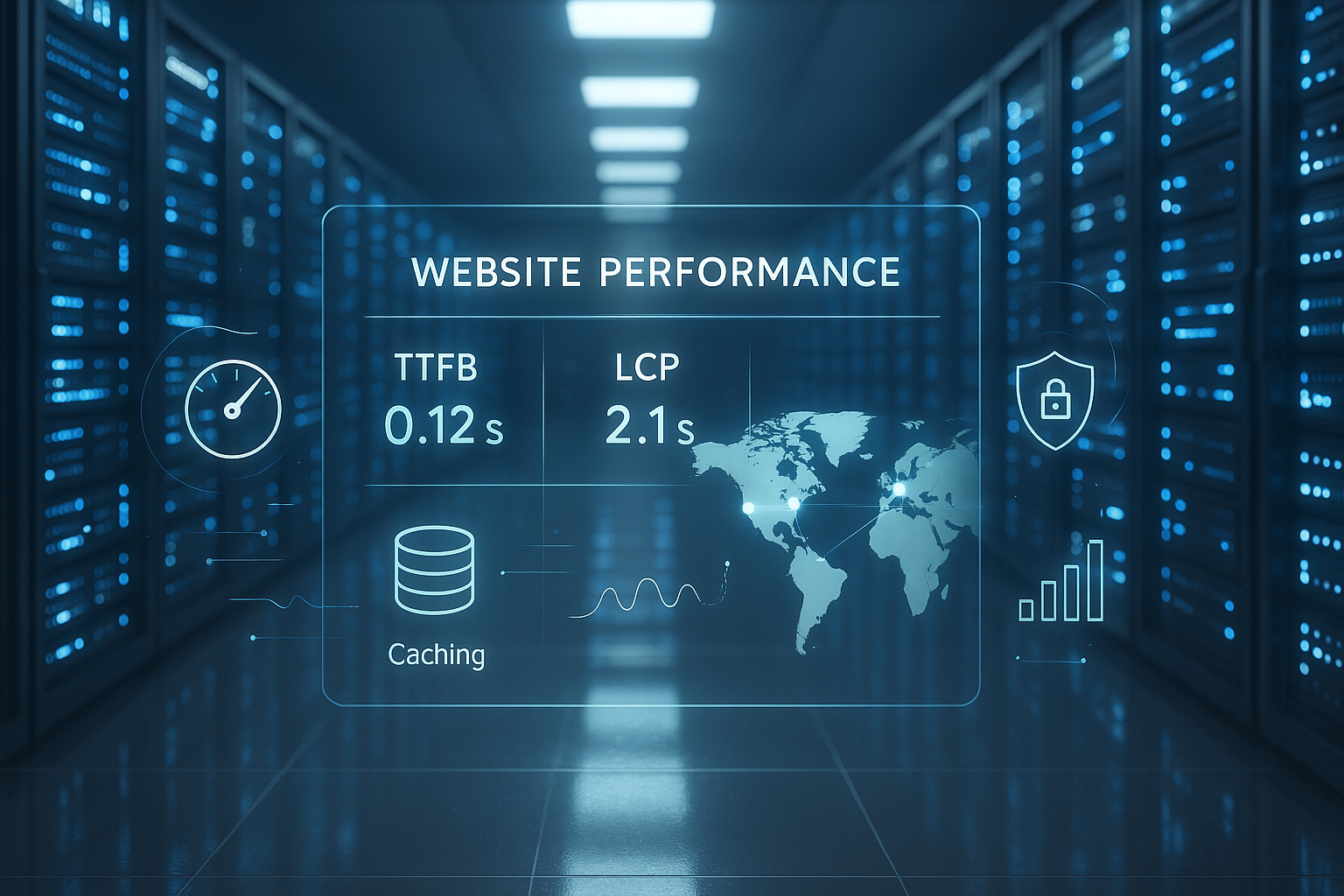
TTFB alone does not explain loading time - I prioritize cdn hosting, network paths, caching and rendering so that users around the world can see content quickly. I measure server responses, core web vitals and resilience together, because only this interaction provides real Performance supplies.
Key points
I rate TTFB as a signal, but I make decisions based on the entire delivery chain and real user data. CDN nodes, host location and DNS determine latency more than any pure server metric. Caching and a lean WordPress stack drastically reduce response times and protect against peak loads. I accelerate security with optimized TLS handshakes, not at the expense of encryption. Core web vitals count for SEO, i.e. visibility, interactivity and layout smoothness - this is possible with hosting, CDN and front-end optimization hand in hand.
- TTFB is important, but not the sole criterion
- CDN Shortens distances and distributes load
- Caching massively reduces server work
- DNS and location determine latency
- Web Vitals control SEO success
TTFB briefly explained: Measured value with limits
I use TTFB because this value bundles DNS lookup, distance, TLS handshake and server processing and thus provides a compact impression [1][3][5][8]. However, a low TTFB does not show how quickly the visible content appears or when inputs respond. Routing, peering and congested networks increase the round-trip time, even if the machine is strong [1][2]. Improper caching, sluggish database queries and suboptimal TLS settings further lengthen the first response. For the classification, I use measurement series at global locations and rely on a clear TTFB analysis, so that I can keep cause and effect apart.

Modern hosting architecture and WordPress stack
I rely on NVMe SSDs, LiteSpeed Enterprise, PHP-OPcache and HTTP/2-/3 because these components noticeably reduce latency. In current comparisons, webhoster.de delivers a very fast server response, strong CDN connection and WordPress optimization - in total, this often lowers the TTFB by 50-90% compared to older setups [3][4][5]. I plan enough RAM, process limits and workers so that spikes do not create queues. A clean stack is worthless without good network peering and edge proximity to the target group. This results in a speedy Server response, which is noticeable in all regions.
| Provider | Server response time (TTFB) | Overall performance | WordPress optimization |
|---|---|---|---|
| webhoster.de | 1 (test winner) | Very high | Excellent |
| Other providers | 2-5 | Variable | Medium to good |
CDN hosting in practice: globally fast, locally relevant
I bring resources to the edge of the network so that the physical path remains short and the RTT share shrinks [2][3][9]. A good CDN caches static objects, distributes requests across many nodes and absorbs traffic peaks without delay [7]. Failover and anycast routing keep content available even if individual sites fail [1][5]. For dynamic pages, I use edge logic, early hints and targeted BYO cache keys so that personalized content still appears quickly. If you want to dive deeper, start with CDN simply explained and then sets up tests against target regions.

Caching, edge strategies and dynamic content
I start with a clean HTML cache for public pages and add an object cache (Redis/Memcached) for recurring queries. Together with LiteSpeed cache, Brotli/Gzip and smart image delivery, response time and transfer shrink noticeably; with WordPress, reductions of up to 90% are realistic [3]. Edge-TTL and Stale-While-Revalidate deliver content immediately and update in the background without slowing users down. For logged-in users, I work with cache bypass, fragment caching and ESI so that personalization is not a brake pad. This is how I maintain fast Response times under control for all scenarios.
DNS and site selection: winning the first milliseconds
I choose data centers close to the target group because distance has the greatest impact on latency [3]. Premium DNS reduces lookup times and ensures low variance on first contact. Frankfurt am Main often provides an advantage of up to 10 ms compared to more distant locations due to the central internet node [3][4]. In addition, I ensure low TTFB values through short CNAME chains, consistent TTLs and few third-party hosts. These steps have a direct impact on the perceived Speed in.
SSL/TLS optimization without brakes
I activate TLS 1.3, 0-RTT (where appropriate), session resumption and OCSP stapling to keep handshakes short. HSTS enforces HTTPS and saves detours, which saves round trips. With HTTP/3 (QUIC), I reduce head-of-line blocking and stabilize latency on mobile networks. Short certificate chains and modern cipher suites bring additional milliseconds of security to the credit side. Encryption thus protects and at the same time accelerates the Connection setup.
Core Web Vitals in interaction with server and CDN
I measure LCP, TBT, FID and CLS because these metrics reflect usability and influence ranking [1][2][8][9]. A good TTFB is of little use if the hero image loads late or script work blocks the thread. That's why I combine edge caching, early hinting, preload/preconnect and code splitting so that above-the-fold content is visible quickly. I keep render-critical assets small, I move blocking JS parts and images are responsive. This guide helps me with prioritization Core Web Vitals, so that measures arrive in an orderly fashion.

Monitoring, metrics and tests: what I check every day
I separate synthetic checks and real user monitoring so that I can see both reproducible measurements and real user data. I run synthetic tests from multiple regions, with cold and warm cache, over IPv4 and IPv6. RUM shows me variance per country, ISP, device and network quality, which guides decisions on CDN coverage. I regularly track TTFB, LCP, TBT, error rates, cache hit rate and time-to-first-paint. Without these measurement points, any optimization remains a Blind flight.
Frontend focus: pragmatically optimizing assets, fonts and images
I start on the critical rendering path side: CSS is tight, modular and minified on the server side; I deliver critical styles inline and load the rest. I divide JavaScript into small, lazy-loaded bundles and use Defer/Async to keep the main thread free. For fonts, I use variable fonts with font-display: swap and only preload what is needed above the fold; subsetting significantly reduces transmission size. Images come in multiple sizes, with modern compression (WebP/AVIF) and correct sizes-attribute so that the browser selects the correct variant early on. Priority information (fetchpriority) control that the hero image has priority while decorative assets wait. These measures simultaneously lift LCP and TBT - a low TTFB only pays full dividends when the browser has little to do [2][8].
WordPress internal: database, PHP and background work
I clean up the database structure, create missing indexes and replace expensive LIKE-searches using specific keys. Recurring queries end up in the object cache, transients get meaningful TTLs, and I keep the number of autoload options small. I replace WP-Cron with a real system cron so that jobs can be scheduled and run outside the user paths. At code level, I measure with profilers, reduce hooks with high costs and decouple blocking tasks (image generation, import, email) in queues. This reduces the server working time per request - the first response is faster and remains so under load.
Edge compute and streaming: from bytes to visibility
I use edge functions for easy personalization, rewrites and header management to reduce the load on the origin. HTML streaming helps to send critical parts (head, above-the-fold) immediately, while downstream content flows asynchronously. In conjunction with early hints, browsers receive preload signals before the document is even complete - the perceived speed increases, even if the TTFB remains technically the same [1][9]. A coherent cache key is important here so that streamed variants remain reusable.
Cache keys, invalidation and hierarchies
I define cache strategies explicitly: Which cookies vary content? Which query parameters are irrelevant tracking and should be removed from the key? With origin shield and multi-level cache hierarchy (edge → region → shield → origin), I drastically reduce origin hits. Invalidation is done either precisely via tag/prefix or via stale-while-revalidate, so that new content appears quickly without generating cold starts. A clearly documented cache matrix per page type makes changes safe and repeatable.

Mobile network, transportation and loss tolerance
I optimize not only for fiber, but for 3G/4G with high latency and packet loss: smaller chunks, fast resumptions and HTTP/3 for robust behavior with fluctuating quality. On the server side, modern congestion control algorithms and a moderate number of parallel streams help to avoid bufferbloat. On the client side, I rely on resource-saving interactions so that inputs react immediately, even if the network is slow. This keeps TTFB and Web Vitals more stable across device classes.
Third-party scripts: Prove benefits, limit costs
I take an inventory of every third-party provider: Purpose, load time, impact on TBT/CLS and fallbacks. Non-critical tags go behind interaction or visibility (IntersectionObserver), and I proxy/edge them if needed to save DNS lookups and handshakes. I eliminate duplicate tracking, run A/B tests for a limited time, and explicitly budget third-party time. This keeps the interface responsive and prevents a third-party script from slowing down the entire site.
Resilience and safety: fast, even when there's a fire
I combine WAF, rate limiting and bot management so that expensive origin traffic is not eaten up by automated scanners. During peak loads, I switch to static fallbacks for selected paths, while transactions are prioritized. Health checks, circuit breakers and time limits ensure that slow downstream services do not delay the entire response. I set security headers hard but pragmatically - without blocking preload signals or caching. This keeps the platform fast and available, even under attack or partial disruption.

Transparency and observability: measuring what counts
I write server timing headers and correlated trace IDs in each response so that I can see exactly where time is being lost in RUM and logs. Log sampling and metrics flow into dashboards with SLO limits; if they are exceeded, a clear runbook chain kicks in. Error rates and variance are just as important to me as mean values, because users experience variance - not just average values.
Capacity planning, SLOs and profitability
I work with clear service level objectives (e.g. 95th percentile LCP < 2.5 s per region) and an error budget that controls releases. I plan capacity against real peaks, not against mean values, and keep headroom for cache miss phases. The business value is continuously offset: If 100 ms less latency lifts 0.3-0.7% conversion, I prioritize this work over cosmetic changes. In this way, performance is not an end in itself, but a profit lever.
Release culture and testing: performance as a team discipline
I anchor performance budgets in CI/CD, block builds that exceed asset sizes or LCP rules, and release in small steps with feature flags. Synthetic smoke tests run after every deploy from multiple regions, including warms and cold starts. Rollbacks are automated; canary releases check new caching or edge rules before they go live globally. This is how I keep the speed high without compromising stability.
Costs, ROI and priorities: what I focus on
I calculate investments against results, not against desired values. If a CDN reduces the average latency by 120 ms and increases the checkout finish by 0.5%, then even a plus of €50 per month quickly pays for itself. A fast WordPress host with NVMe and LiteSpeed for €25-40 per month saves on maintenance and reduces downtime, which would otherwise cost revenue. In addition, I save server resources through clean caching strategies and relieve the burden on expensive databases. This is how the Yield instead of just the technology list.
Brief summary: what matters to me
I rate TTFB as a starting signal, but I decide based on the overall impact on users and sales. CDN hosting, a strong WordPress stack, good peering and tight caching together deliver the desired milliseconds. DNS quality, site proximity and TLS optimization accelerate the first response and stabilize processes. Core Web Vitals focus on visible speed and interactivity and combine technology with SEO. If you consider this chain as a system, you will achieve noticeably faster Results - worldwide and permanently.