Skip to content
I'll show you how to find affordable domains with solid quality while realistically planning for follow-up costs. I'll explain specific price factors, sensible TLDs and how I use promotional offers with Follow-up prices check.
Key points
- Follow-up prices check carefully: Starting price vs. extension
- TLD selection Clarifies target group and costs
- Support and administration count for everyday life
- Data protection and registrar quality
- Bundles can save budget
What do domains cost - and what do the prices depend on?
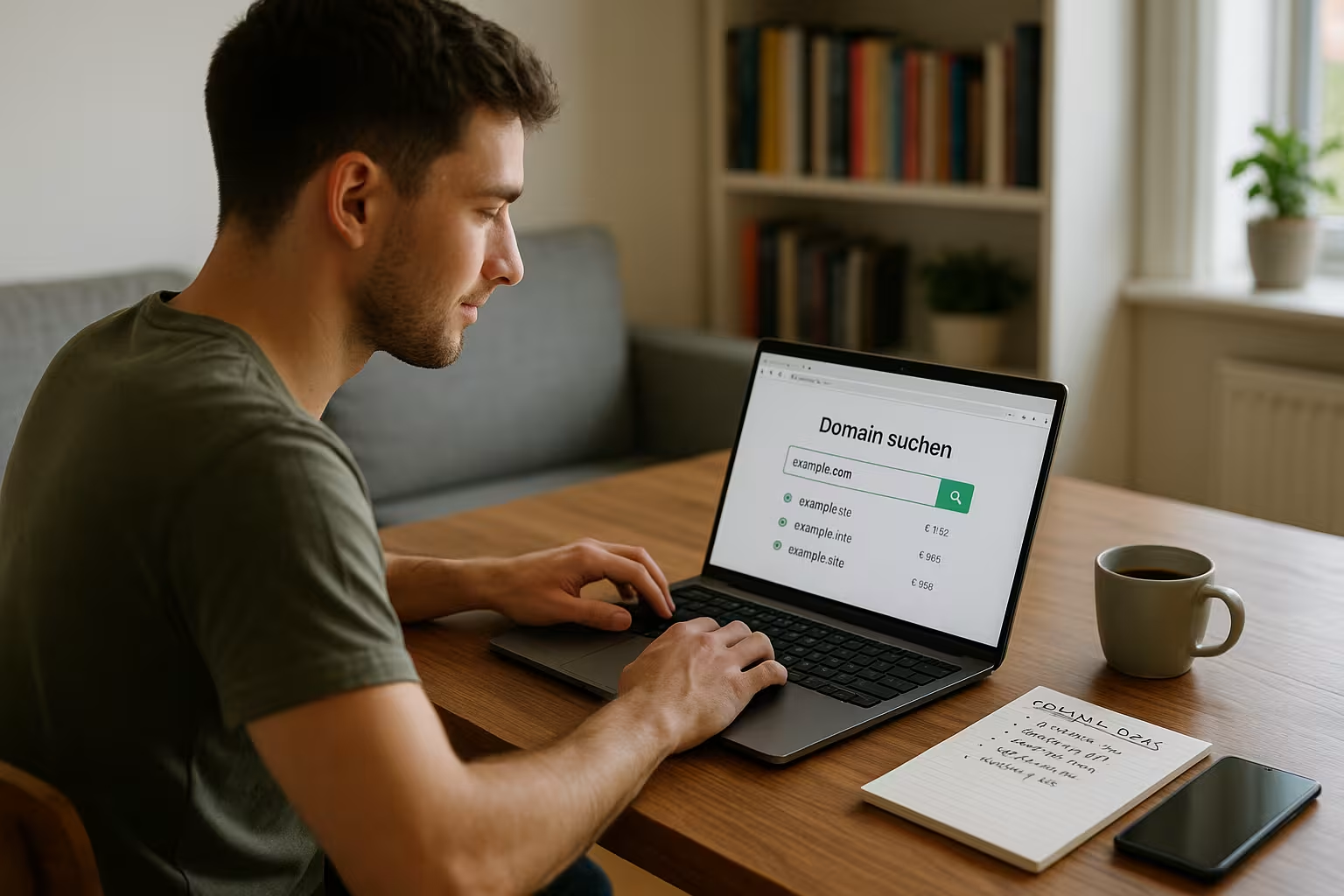
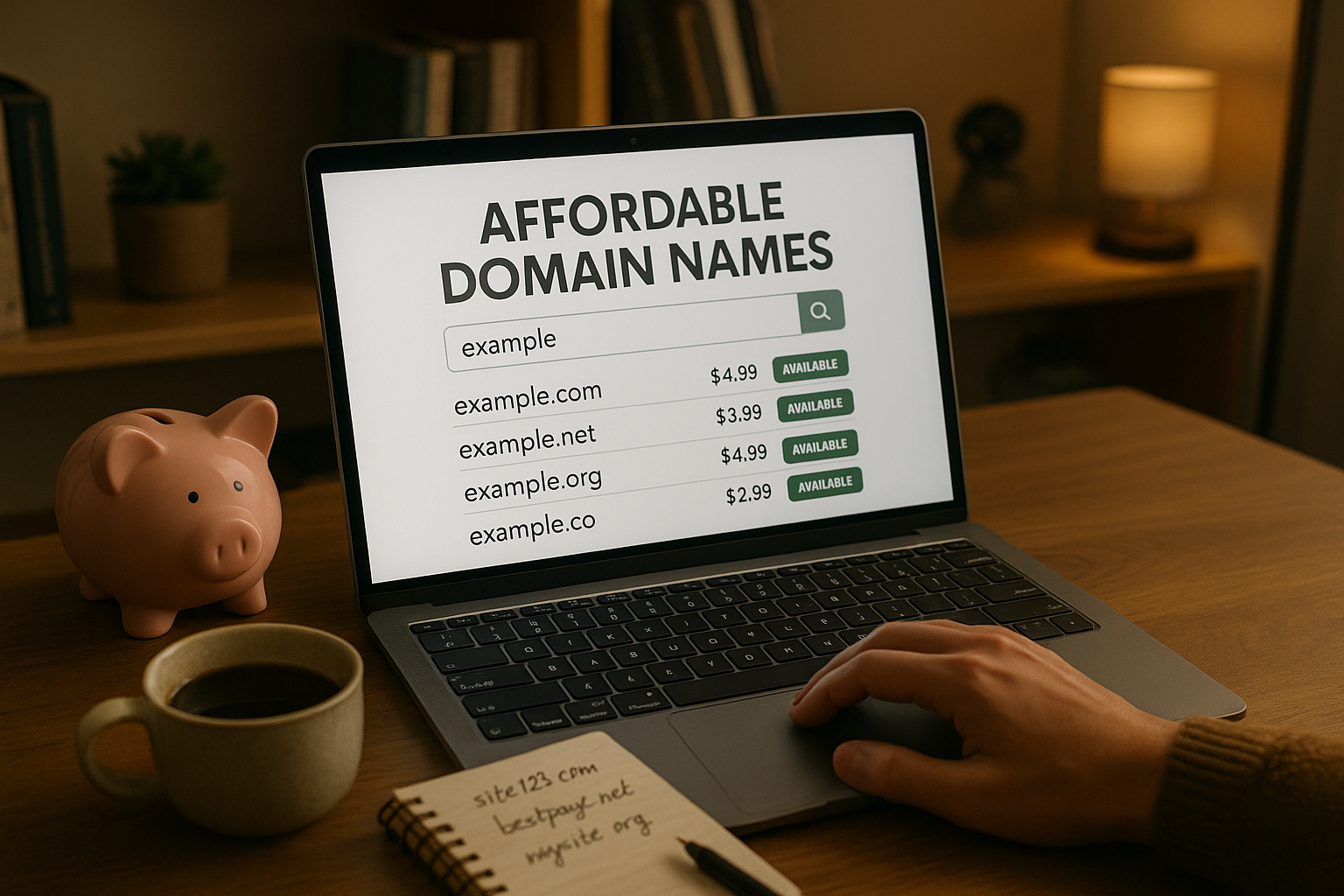
Prices vary significantly depending on the ending, provider and promotion, so I calculate the Total costs over several years. For .de I often end up with around €10 per year, while .com is usually between €12 and €24. Modern alternatives such as .store, .io or .tech often start higher and reach €15 to €100 per year, depending on demand. I find the difference between the introductory offer and the renewal particularly important, as this is where the biggest differences arise. I also check whether the registrar charges additional fees for setup, relocation or DNS features and thus ensure that I have a realistic estimate. Price range.
Premium domains, special prices and how to recognize them
There are two price categories for many new TLDs: standard names and so-called premium domains. Premium often means that not only the purchase, but also the Extension is permanently more expensive. I therefore pay attention to information such as "Premium renewal" or different renewal prices in the detailed view. I also take a close look at promotional prices to see whether discounts only apply for the first year or are linked to conditions such as duration, package commitment or certain payment methods. This way I avoid surprises and appreciate the Life cycle price realistically.
- Check premium labeling: does the surcharge also apply to subsequent years?
- Read price structure: Differentiate between start year, renewal, transfer and restore
- Compare promos: is the offer worthwhile over 2-3 years?
Expiry, grace period and redemption: how to avoid expensive restorations
If I miss a renewal, it can quickly become expensive. Many gTLDs (e.g. .com) only have a short period of validity after expiry. Grace Period for uncomplicated extension, often followed by the Redemption phase with additional restore fees. These restore fees are often significantly higher than the annual price. The processes differ for ccTLDs such as .de, so I check my provider's rules in advance. I schedule reminders, deliberately test the automatic renewal and set a lead time of 30 days to avoid stress.
- Set reminders and check auto-renew
- Don't put off renewal until the last day
- Read about recovery fees and deadlines in the customer area
Popular and affordable domain extensions
The TLD determines the price, expectations and impact on the audience, so I use an extension that suits the project and is easy on my budget. For German-language offerings, .de scores points for familiarity and cost control. International projects often benefit from .com because users quickly recognize this extension. Special endings such as .io or .store are suitable for clear positioning, but often demand more money. With a sober look at the target group, price and brand impact, I make a suitable Choice.
| Ending | Average price/year | Use |
|---|---|---|
| .de | approx. 10 € | Companies, private projects |
| .com | 12-24 € | International projects |
| .store | 15-50 € | E-Commerce |
| .io | 50-100 € | Startups, Tech |
| .info | 10-20 € | Knowledge pages |
| .net | 12-20 € | Network offers |

IDN, umlauts and spelling variants
IDN domains with umlauts are attractive for the DACH region. I evaluate readability versus technology here: Some systems and email setups do not cope well with umlauts. That's why I often plan an ASCII variant without umlauts as a redirect. I also save alternative spellings (with and without hyphens) if they prevent confusion. I keep an eye on the fact that IDNs are stored internally as Punycode and check whether my registrar correctly maps the administration and DNS entries for this.
Find cheap domains: What should I look out for?
I start with a clear overview: Which TLD fits, what promotions are available, what services are included. Without a comparison, I quickly lose money, so I check offers via a Domain price comparison and equal conditions in a structured manner. I am interested in whether DNSSEC, email forwarding, name server management and domain transfer costs are included in the price. After checking the price, I check the contract term, notice periods and automatic renewals. This is how I recognize real bargains and avoid expensive Pitfalls.
Invoices, currencies and taxes at a glance
I pay attention to currency details (EUR/USD) and whether prices are quoted net or gross. For companies, a correct invoice with tax shown, complete company data and service period is essential. For annual packages, I check whether the billing date harmonizes with my budget rhythm and whether collective invoices for several domains are possible. If I have a VAT ID number, I check that the provider is handling it correctly. This saves me time and effort in accounting later on.
A brief comparison of domain providers
Different providers focus on price, support or additional functions, so I set my priorities clearly. If I need fast support, I go for providers with good availability and short response times. If I want very low starting prices, I sometimes accept higher follow-up costs, as long as they are transparent. I check ratings for reliability, transfer processes and DNS availability to ensure that everything runs smoothly on a day-to-day basis. A clear comparison saves time and keeps the Costs in check.
| Place | Provider | .en/year | .com/year | Special features |
|---|---|---|---|---|
| 1 | webhoster.de | from 0,99 € | from 8,99 € | Good ratings, flexible packages |
| 2 | Hostinger | from 3,99 € | from 4,99 € | Data protection, fast support |
| 3 | strato | from 1,00 € | from 11,00 € | Many actions |
| 4 | united-domains | from 12,00 € | from 15,00 € | Large TLD selection |
| 5 | checkdomain | from 9,00 € | from 15,00 € | Clear search, solid support |
Domain security: Lock, 2FA and registry lock
I secure my account with 2-factor authentication and set domains to "transfer lock" so that no one can move them unnoticed. For particularly critical addresses, a Registry lock which only allows changes after an additional check. I also check how cleanly the provider issues EPP/Auth codes and whether notifications of changes to WHOIS data are reliably delivered. These basics prevent the most expensive damage: loss of the domain or unauthorized transfers.
Additional costs and pitfalls
I check offers with extremely low starting prices particularly carefully, because transfer costs and renewals drive up the bill. I pay attention to fees for domain transfer, auth code, DNSSEC or external name servers, because these points become apparent later on. Some providers charge set-up fees, others link discounted prices to longer terms. I deliberately turn automatic renewals on or off so that no surprise bookings occur. With this control, I keep my Total expenditure plannable.
Plan transfers properly
A transfer is straightforward if I work through the steps in a structured way. I unlock the domain, request the auth code, check the owner data and don't start the transfer too close to the expiration date. For many gTLDs, there is a lock period after registration or transfer during which no further transfer is possible - I take this into account in my planning. I also note that a transfer often adds another year to the term and is therefore part of the Total price calculation is.
- Unlock domain, secure auth code, test e-mail contact
- Observe deadlines (e.g. 60-day blocks for some TLDs)
- Plan a transfer window and start on time
Data protection and legal points
Domain registration involves personal data, so I check the WHOIS representation and use anonymization where it is permitted. EU requirements and clear processes at the provider give me security in my day-to-day business. For international endings in particular, I check whether the registrar reliably implements data protection standards. I check contract data, billing address and owner entries so that there are no disputes. This keeps my project legally compliant and my Data protection preserved.

Trademark and name law compact
Before buying, I check whether my desired name affects the rights of third parties. I take a look at existing trademarks, company names and the risk of confusion in the relevant market. A domain does not give me trademark rights, so I keep use and protection separate. In the case of critical terms, I avoid borderline cases in order to avoid conflicts and possible litigation. This ensures long-term peace of mind in project operations.
Tips for a strong domain choice
I keep names short, easy to remember and clearly pronounceable so that word of mouth works. I use hyphens sparingly, numbers only if they make immediate sense. For Germany I often choose .de, for global reach I often choose .com, and for tech projects I check .io or .tech. Before I buy, I do a quick Price check and compare alternatives. In this way, I ensure a clear appearance and a fair Price structure.
SEO, history and reputation
For visibility, I pay less attention to keywords in the domain and more to brand and trustworthiness. The history is important to me: If the domain was previously active, I check whether it was used for spam and whether old entries are still circulating on the net. This helps me to avoid start-up problems with email delivery or reputation values. I specifically secure variants and redirect them to my main domain via 301 redirection so that users still land correctly and no duplicate content traps are created.
Making sensible use of promotions and bundles
Many hosters bundle domains with hosting packages or email services, which significantly reduces the annual costs. If I need web space anyway, I opt for a bundle with a free domain for the first year. If I already use a server, I compare pure domain tariffs and avoid unnecessary packages. When switching, I look for simple transfers and transparent support channels. In this way, I get a practical Price advantage without compromises.

Portfolio management and monitoring
When projects grow, domains often grow too. I structure my portfolio with tags (project, customer, product) and record expiration dates centrally. I run reminders in parallel via email and calendar. With several registrars, I ensure consistent WHOIS data and set 2FA everywhere. I test changes such as name server changes outside peak times and lower TTLs in advance to speed up the changeover. For mail domains, I document SPF, DKIM and DMARC so that deliverability remains consistently high.
Where do I buy my domain?
I decide on the basis of service, price transparency and simple day-to-day management. A look at reviews helps to assess reliability and response times. If you're unsure, check first, where to buy a domain and what services are included in the package. I take into account existing systems, such as DNS setup or e-mail requirements. In the end, what counts is the combination of a clear panel, a fair price and good Support.
Multi-year terms and price hedging
Multi-year registrations ensure that I can plan ahead and reduce administrative work. Discounts are not guaranteed, but I often "freeze" the current renewal prices for the selected term. I only book multi-year periods for domains that I use in the long term and document the next review dates. If there are price increases from individual registries, an early renewal can make economic sense.
Practice checklist in 5 minutes
I start with three favorites and make a note of the initial and follow-up costs so that I can make a clear comparison. Then I check which DNS features are included and whether transfers are straightforward. Thirdly, I check the data protection options and WHOIS display to keep my data protected. Then I take a look at the terms and notice periods so that there are no surprises later on. Finally, I deliberately book the domain with the right TLD and document the access data properly.
Example: Cost planning over 3 years
To calibrate price perceptions, I calculate scenarios. Example: A .com with a high starting price (1st year € 0.99), regular renewal (from 2nd year € 14.99) and optional transfer (incl. 1 year € 8.99). Option A: I stay with the first registrar - then I pay €0.99 + €14.99 + €14.99 over 3 years. Option B: I use a transfer with a low renewal price after year 1, then I end up paying €0.99 + €8.99 + €14.99. Both options are valid; I decide according to support, functions and whether the change is worthwhile from an organizational point of view. The important thing is Follow-up prices realistically and take ancillary costs (DNS extras, restore) into account.
- Calculate 1-3 years in a block, not just the first year
- Plan for transfer as a price lever - but evaluate the effort and risk involved
- Recognize restore and special fees as a buffer
Conclusion: Save wisely, ensure quality
With a sober look at TLDs, starting prices and renewals, I can keep the costs under control. A clear comparison shows where real offers are waiting and where additional fees are lurking. Data protection, support and reliable administration ensure that the project runs smoothly on a day-to-day basis. If you make a targeted selection, you get affordable domains and avoid disappointment later on. This is how I lay the foundation for a professional appearance and a plannable Budget strategy.