A current cloud comparison for 2025 shows clear differences in performance, data protection and support - German providers deliver low latency and GDPR security, international platforms score with global scaling. I rate providers according to UptimeNVMe SSD performance, flexible scaling, German-speaking support and fair prices to keep projects stable and fast.
Key points
The following focal points help me to make decisions quickly and reliably.
- PerformanceNVMe SSDs, 2-16 vCPU, 4-20 GB RAM, 99.99% Uptime
- Data protectionGDPR, ISO 27001, encrypted storage
- Support24/7 helpdesk, fast response times, German-speaking
- Scalingvertical, horizontal, hybrid models, auto-scaling
- Cost controlEntry from 1 €, clear tariffs, demand-based billing
I prioritize performance, security and service over pure price signals. A structured comparison reduces downtime and unnecessary costs. This creates a clearer Decision-making framework without surprises. If you know your own load profiles, you can make targeted choices. In the following, I will show you which options will really work in 2025 and Scale.

Performance and technical infrastructure 2025
I measure performance NVMe SSDscurrent CPU generation, RAM allocation and network latency. NVMe SSD storage noticeably shortens access times and accelerates data-intensive workloads such as stores, analytics or APIs. Common profiles are between 2 and 16 vCPU and 4 to 20 GB RAM, which is sufficient for most business websites up to high-traffic platforms. A guaranteed uptime of 99.99% keeps downtimes in the range of minutes per year and ensures reliable availability. German data centers provide short distances to European users and improve Loading timesA global CDN can also increase the speed of 40%, for example, because the content is closer to the visitor.
Measurement methodology: How I validly assess performance
I compare providers with reproducible benchmarks instead of individual measurements. For I/O tests, I use sequential and random read/write patterns (4k/64k blocks, mixed R/W profiles) to represent real database and file system workloads. At the application level, I test p50/p95/p99 response times under load (e.g. 200-2,000 concurrent users), throughput in requests per second and error rates. Network measurements include latency to peering nodes in Frankfurt/Amsterdam/Paris as well as jitter and packet loss. Consistency is also important to me: good platforms keep performance stable even during longer load peaks, without "noisy neighbor" effects.
Network architecture and latency
Short response times are not only achieved through fast hardware, but also through Peering and routing. I prefer providers with a direct connection to large Internet nodes (e.g. DE-CIX), dual-stack support (IPv4/IPv6) and modern protocol stack (TLS 1.3, HTTP/3/QUIC). Anycast DNS accelerates name resolution, while regional edge locations bring static content close to users. Internal networks should provide at least 10-25 Gbit/s per host so that storage and service traffic do not compete. QoS policies and dedicated backup VLANs prevent bottlenecks during backup windows.
Webhoster.de: Test winner in cloud hosting comparison
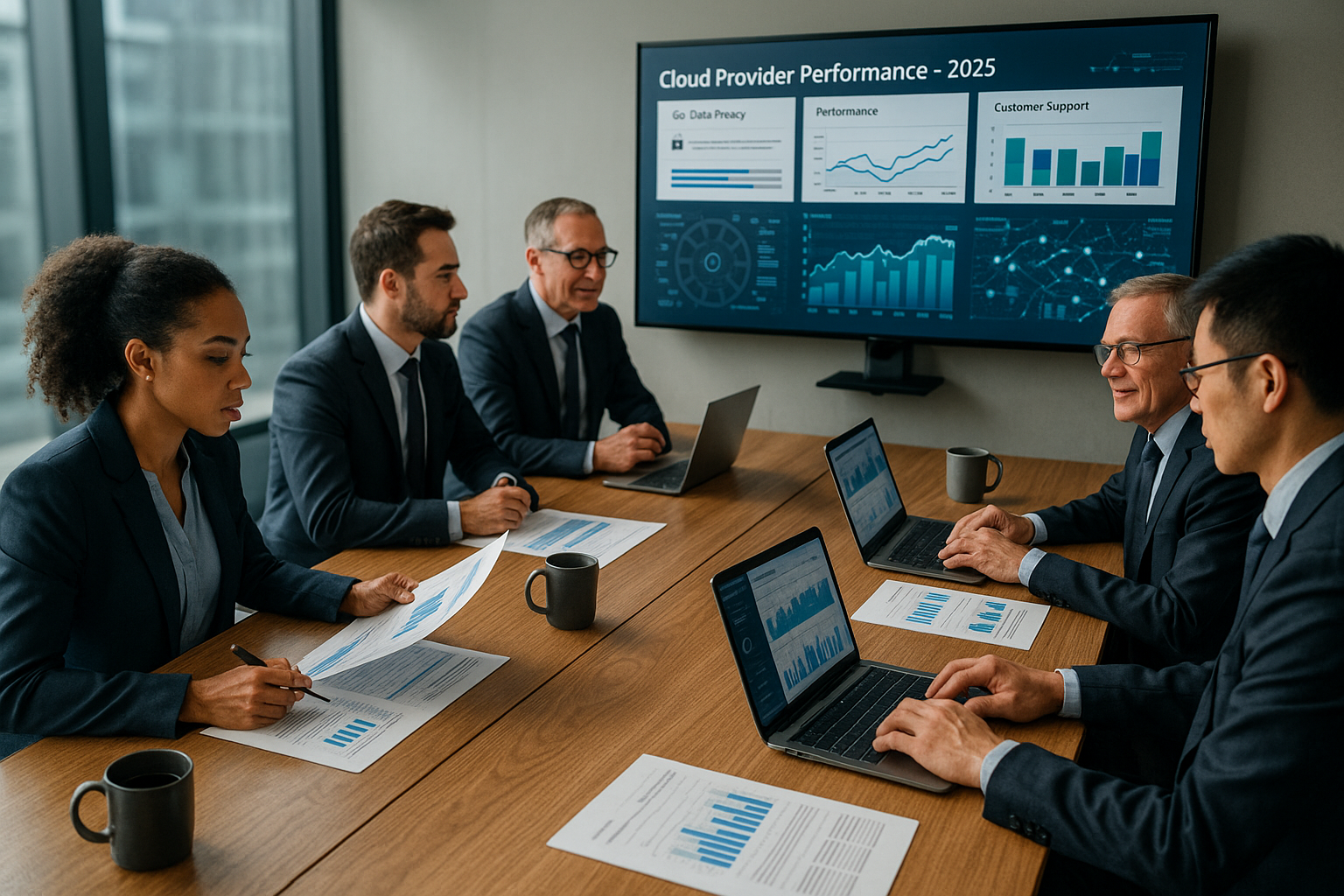
I put webhoster.de in first place because UptimeNVMe SSD performance, GDPR compliance and support together. ISO 27001 certification creates traceable processes, while data remains in German data centers. Tariffs can be scaled flexibly and billing is based on actual consumption - keeping budgets predictable. When it comes to business-critical projects, it's the fast line that counts: 24/7 support responds quickly and resolves technical issues directly. A compact overview is provided by the Cloud hosting test 2025which I use as an introduction to the selection.
Price comparison of German cloud providers
I classify tariffs according to their purpose and Cost framework so that price and performance match. Entry-level offers from €1 per month are sufficient for projects with low traffic and provide basic resources. Balanced packages for company websites and stores, including 4-6 vCPU and 8-12 GB RAM, are between €10 and €30 per month. From €50, premium solutions provide additional vCPU, up to 20 GB RAM, extended protection and prioritized support. This means that every load level can be covered, from small start-ups to high-traffic platforms, and steer.
| Segment | Monthly price | Typical resources | Use |
|---|---|---|---|
| Beginner | from 1 € | 2 vCPU, 4 GB RAM, 10-40 GB NVMe | Landing pages, small blogs |
| Middle class | 10-30 € | 4-6 vCPU, 8-12 GB RAM, 100-200 GB NVMe | Corporate websites, medium-sized stores |
| Premium | from 50 € | 8-16 vCPU, 16-20 GB RAM, up to 300 GB NVMe | large stores, APIs, peak traffic |
I recommend planning load peaks and growth realistically instead of saving every euro in the short term. Scaling in a predictable way prevents bottlenecks and keeps the user experience constant. For many companies, the mid-range delivers the best Mix from speed and budget. Premium pays off as soon as transaction volumes or traffic increase the risk of a bottleneck. This keeps the cost curve controllable and transparent.
Cost control and FinOps in practice
I establish budget and alarm limits per project, tag resources consistently and create cost reports by team/product. I limit auto-scaling with upper limits so that peaks do not lead to "bill shock". Caching and a CDN reduce egress costs, while compression (Brotli) and image optimization save traffic. Reserved capacities are worthwhile for predictable workloads; variable loads benefit from usage-based billing. Important: Egress and managed options (e.g. databases) are included in the TCO, not just the pure vCPU/RAM prices.
Storage space and resources in detail
I size storage and computing power according to measurable key figures, not according to gut feeling or maximum values. 100 GB NVMe is typically enough for a company website with a blog, image gallery and backups; I calculate 200-300 GB for data-intensive stores and media archives. The following applies to CPUs: small sites get by with 2 vCPU, data-heavy applications benefit from 8 to 16 vCPU. I roughly plan with 2 GB RAM per vCPU in order to sufficiently buffer caches and databases. Agencies also pay attention to the number of possible projects per account - tariffs with up to 300 websites give a good indication here. Scope and facilitate the hosting of many customer projects without increasing the complicate.
Databases and caching
For relational data, I rely on Managed MySQL/PostgreSQL with automatic backups, point-in-time recovery and read replicas for scaling. An in-memory cache (e.g. object cache) noticeably reduces the database load; I adapt TTLs and cache invalidation to the CMS/shop system. For large media objects, I use object-based storage as a backend and connect it via a CDN to reduce the load on application servers. As data volumes grow, I plan sharding or partitioning at an early stage to avoid migration pressure.
GDPR compliance and data protection
I prioritize German data centers because DSGVO and short paths that ensure legal clarity and speed. ISO 27001 demonstrates active information security management with audits and documented processes. I encrypt data transfer via SSL/TLS as standard, data at rest remains encrypted on NVMe volumes. Providers with additional hard disk encryption close gaps in physical access. If you have to meet compliance requirements, consistently choose certified platforms and reduce legal risks. Risks.
Compliance in depth
I review order processing contracts (Art. 28 GDPR), technical and organizational measures (TOMs) and audit reports (e.g. ISAE). For international clouds, I assess data transfers with standard contractual clauses and rely on strict data localization when personal data is involved. Deletion concepts, retention periods and audit-proof logging are mandatory. For sensitive sectors (healthcare, finance), segmented networks, hardening and clearly regulated administrator access with the dual control principle are important.
Support quality and service level
I test support on real scenarios and pay attention to Response time and solution expertise. 24/7 availability by phone, email and live chat is a standard feature of business tariffs. Critical inquiries should be escalated in minutes, standard tickets should be dealt with in a few hours. Local contacts avoid language barriers and are familiar with typical requirements in the German-speaking market. A good knowledge database complements the personal contact and saves time on recurring topics, which is beneficial for operations and the customer. Team relieved.

Monitoring, observability and SLIs
I establish metrics (CPU, RAM, I/O), logs and traces centrally and link them to alerts. Key service level indicators are p95 latency, error rate and availability per endpoint. I define SLOs for each application and "burn rate" alerts provide early warning of target violations. Synthetic monitoring checks login, checkout and API flows from the outside - not just the page view. Dashboards for team and management ensure that technical signals are interpreted for business purposes.
Scalability and flexibility of modern cloud solutions
I prefer setups that Resources in minutes, without downtime. Vertical scaling increases vCPU, RAM and storage on one system, horizontal scaling distributes the load across multiple instances. Hybrid models combine both methods and are suitable for projects with changing profiles. Auto-scaling reacts to metrics such as CPU and RAM utilization so that systems automatically increase and decrease capacity. Those who want to use hybrid architectures will find Hybrid cloud solutions a practicable path to keep flexibility and costs in balance and Peaks cushioning.
Containers, Kubernetes and PaaS
I use containers for reproducible deployments and Kubernetes for elastic workloads. Horizontal pod autoscaling reacts to load, while vertical autoscaling allocates resources at a fine granular level. I connect stateful workloads with persistent NVMe volumes, rolling updates and pod disruption budgets ensure availability. Where PaaS makes sense (e.g. Managed Runtimes or Functions), I reduce operating costs - but I still check portability to avoid lock-in.
Cloud storage versus cloud hosting
I make a strict distinction between Cloud storage for files/backups and cloud hosting for runtime environments. Storage solutions offer many terabytes for teams, versioning and sharing, but do not perform any computing operations. Hosting platforms provide CPU, RAM and databases for websites, stores and APIs. In projects, I combine both: productive services in hosting, daily backups in storage, separate and auditable. If you want to weigh up the options, take a look at the compact Cloud storage comparison and quickly finds a suitable Solution for data backup and collaboration.

WordPress optimization and specialized hosting solutions
With WordPress I rely on Managed-environments that perform updates, backups and security scans automatically. Caching, object cache and database tuning reduce response times to less than one second. NVMe SSDs accelerate query-heavy pages, while a CDN distributes static assets globally. Staging environments allow secure testing before rolling out to live systems. This allows me to concentrate on content, while technology and security work reliably in the background. run.
High availability and release strategies
I design systems across at least two zones, connect an L7 load balancer upstream and keep health checks closely timed. Rolling and blue/green deployments reduce risk; I use canary releases for critical changes. I replicate databases synchronously/semi-synchronously depending on latency requirements, read replicas decouple reporting. Feature flags enable fast rollbacks without redeployment and keep RTO targets low.
Migration process and onboarding
I plan moves in such a way that users don't notice anything and Risks remain minimal. The process starts with an inventory and ends with the DNS changeover after successful testing. Providers with a free migration service transfer files, databases and email accounts in a time-saving manner. Temporary access URLs enable approvals before the go-live and prevent unpleasant surprises. Maintenance windows outside of core hours minimize the impact and ensure a smooth transition. Start on the new platform.

Zero-downtime relocations and tests
I synchronize data incrementally in advance, freeze write operations shortly before the switch and perform a final delta synchronization. Smoke tests and UAT on staging URLs secure functions; I lower DNS TTL in advance so that the changeover takes effect quickly. After the go-live, I closely monitor error budgets and have a quick rollback script ready. I check e-mail, cronjobs and webhooks separately, because silent failures often occur here.
Backup strategies and disaster recovery
I rely on automatic daily Backups with several storage levels. I combine short-term backups for quick rollbacks with weekly and monthly long-term backups. Geographically separated copies protect against regional failures due to power, network or natural events. Clear recovery targets (RTO/RPO) define how quickly systems are ready to start up again and the maximum amount of data that can be lost. Premium tariffs guarantee recovery in just a few hours, making business-critical services reliable. secures.
DR exercises and runbooks
I test restores regularly: spot checks of individual files, complete system restores and "game days" with simulated failures. Runbooks document step sequences, roles and escalation paths. Only tested backups are reliable backups - test checksums and restore logs are part of this. PITR tests are mandatory for databases so that error-free versions are also available during the course of the day.
Security features and attack protection
I build up protection on several levels so that Attacks from penetrating in the first place. DDoS filters stop volume attacks early on in the network, while IDS/IPS detect and block suspicious patterns. A restrictive firewall only allows necessary ports; a web application firewall filters SQLi, XSS and other exploits. Regular malware scans and quarantine keep infected files away from productive operation. Hardening, patching and monitoring continuously close gaps and keep the attack surface small.
Identity & Access Management
I rely on role-based access with least privilege, mandatory MFA and optional SSO (SAML/OIDC). I manage API keys and secrets centrally, rotate them regularly and encrypt them at rest. I log administrative actions in an audit-proof manner so that changes can be traced. For deployments, I use short-lived, limited tokens - not personal admin accounts.
Decision-making aid: The right provider for different requirements
I advise solo self-employed people and small companies to Managed-tariffs with a simple dashboard and capable support. Developers and admins benefit from root access because custom packages, services and tuning remain possible. E-commerce requires reliable uptime, scaling in sales phases and PCI DSS compliance so that the checkout and checkout can withstand. Those who deliver throughout Europe choose German data centers for latency and legal security. All in all, I often rely on webhoster.de for business projects because performance, GDPR and service are a coherent package. come together.
Exit strategy, portability and sustainability
I pay attention to standardized interfaces (e.g. images, snapshots, terraform providers) and clear data exports so that a changeover remains smooth. Transparent egress costs and bandwidth limits are part of the planning. For sustainable infrastructures, I check PUE values, renewable energies and certifications - efficient operation not only saves CO₂, but often also costs. If you think about portability and efficiency from the outset, you will remain flexible and economical in the long term.
Final thoughts 2025: My shortlist and criteria
I make the final selection based on a few clear Criteriameasurable performance (NVMe, vCPU, RAM), guaranteed uptime, GDPR/ISO 27001, response time in support, flexible scaling and a price that matches the load. For company websites and stores, mid-range tariffs offer the best ratio of speed to cost, while premium is worthwhile for predictable peaks. German locations shorten loading times in Europe and avoid legal uncertainties. Separating hosting and storage increases security and keeps audits simple. With this checklist, projects in 2025 will land reliably on a platform that is fast today and will be fast tomorrow. grows with you.