 Skip to content
Choosing the right CMS for online store is crucial for your digital success. While some systems are particularly impressive for their simplicity and speed, others stand out for their flexibility, scalability or data-based control.
Key points
- User friendlinessSimple operation without programming knowledge
- Scalability: Efficient even with a growing product portfolio
- ExtensibilityPlugins, integrations and additional functions
- Design freedom: Customizable and responsive store layout
- SecurityGDPR-compliant data processing

Precisely because the CMS is both the foundation and interface for your online shop, it is worth analyzing the various requirements. For beginners, quick setup and an intuitive backend are often crucial. Advanced projects place more value on technical details such as multichannel marketing, elaborate design layers or connections to external systems such as ERP and accounting. The focus should also be on security, as sensitive customer data is processed in online retail. It is therefore important to consider which digital processes will be required in the future at the planning stage. This is the only way to ensure that your CMS forms an optimal basis in the long term.
WooCommerce vs Shopify - two popular options
WordPress in combination with WooCommerce offers maximum customizability, ideal for individual store concepts. The system can be started free of charge, but is more maintenance-intensive as the scope increases. Particularly advantageous: the strong community provides solutions for almost every requirement - from SEO to accounting. If you want maximum control over your online store, WooCommerce is a reliable tool.
Shopify impresses with its intuitive usability. Setup, design and payment processing take place in just a few steps. The support is considered one of the best on the market. Thanks to the app store, additional functions can be easily integrated. Shopify is a fast and powerful solution for growing brands that want to simplify their sales processes. Are you interested in a more in-depth comparison of these two systems? Then you can find a practical overview here: Compare Shopware vs WooCommerce.
While WooCommerce is primarily recommended for users with at least a basic technical understanding who want to use customizable themes or plugins, Shopify scores with a convenient overall package that is ready to use without a great deal of specialist knowledge. The question of running costs is also often decisive: while WooCommerce is basically free, there are costs for hosting, updates and individual premium plugins. Shopify, on the other hand, offers various tariffs that require a monthly basic fee, but enable rapid scaling and fast support.
Especially if your growth is unpredictable, Shopify offers a certain degree of security, as it can handle an increasing number of orders and you only have to adjust your tariff and any transaction fees. With WooCommerce, on the other hand, you have the option of flexibly selecting different hosting packages. Technical resources such as RAM or CPU can be adjusted depending on the load. This freedom is an advantage, but it also requires some knowledge or good cooperation with a hosting provider who can provide support and maintenance.
CMS systems for smaller companies and start-ups
Beginner-friendly CMS solutions such as Wix or Shopify offer a clearly structured concept with a focus on user guidance and efficiency. With Wix's drag-and-drop construction kit, you can have a fully functional store live within a few hours. Payment integration, shipping solutions and SEO features are already available. Wix is perfect for initial online projects with a limited number of products.
Small companies benefit from fast workflows and a short training period. Long tutorials or prior technical knowledge are not required. In addition to Wix, you can also consider Shopify as an inexpensive entry point, especially if you want to scale flexibly. You can find a compact overview of suitable systems on CMS platforms for small businesses.

Especially if you have a limited budget, as is the case with many start-ups or local retailers, tools such as Wix or Shopify can keep costs low and at the same time enable a professional appearance. However, even if you don't have a large budget, you should still attach importance to technical stability. Smaller stores in particular don't want to constantly struggle with outages or long loading times - this has a negative impact on customer confidence. With Wix, you therefore have the opportunity to quickly generate your first online sales at a manageable cost. Later, as your business grows, you can always switch to more complex solutions.
The community factor is often underestimated in this context. While Wix has a rather small user community, with Shopify and WordPress/WooCommerce in particular, you benefit from a huge network of developers, agencies and forums. This can quickly prove to be an advantage, especially in the event of questions or problems. Planned technical extensions can be implemented more easily as a result. It is therefore worth paying attention to the sustainability and potential of a platform in addition to the pure figures and fees.
Shopware, PrestaShop & TYPO3 for professional requirements
Shopware is aimed at medium-sized to large stores with an e-commerce focus. The platform leaves nothing to be desired in terms of design and functionality. You control worlds of experience, individual home pages and multichannel-capable marketing measures directly via the system. The expandability via interfaces and APIs is particularly helpful for advanced projects.
PrestaShop offers you great flexibility with its open source principle, but also a certain learning curve. If you want to manage multiple languages and payment methods or set up your store internationally, PrestaShop is a solid basis. You have full control over data and interfaces - and pay no license fees. Technical understanding and a certain amount of training time are required.
TYPO3 provides the best control over user rights, approval processes and content, especially for demanding requirements. It is particularly worthwhile if your store requires strong content marketing or integrates additional editorial content. With professional agency support, you can expand with TYPO3 in the long term.
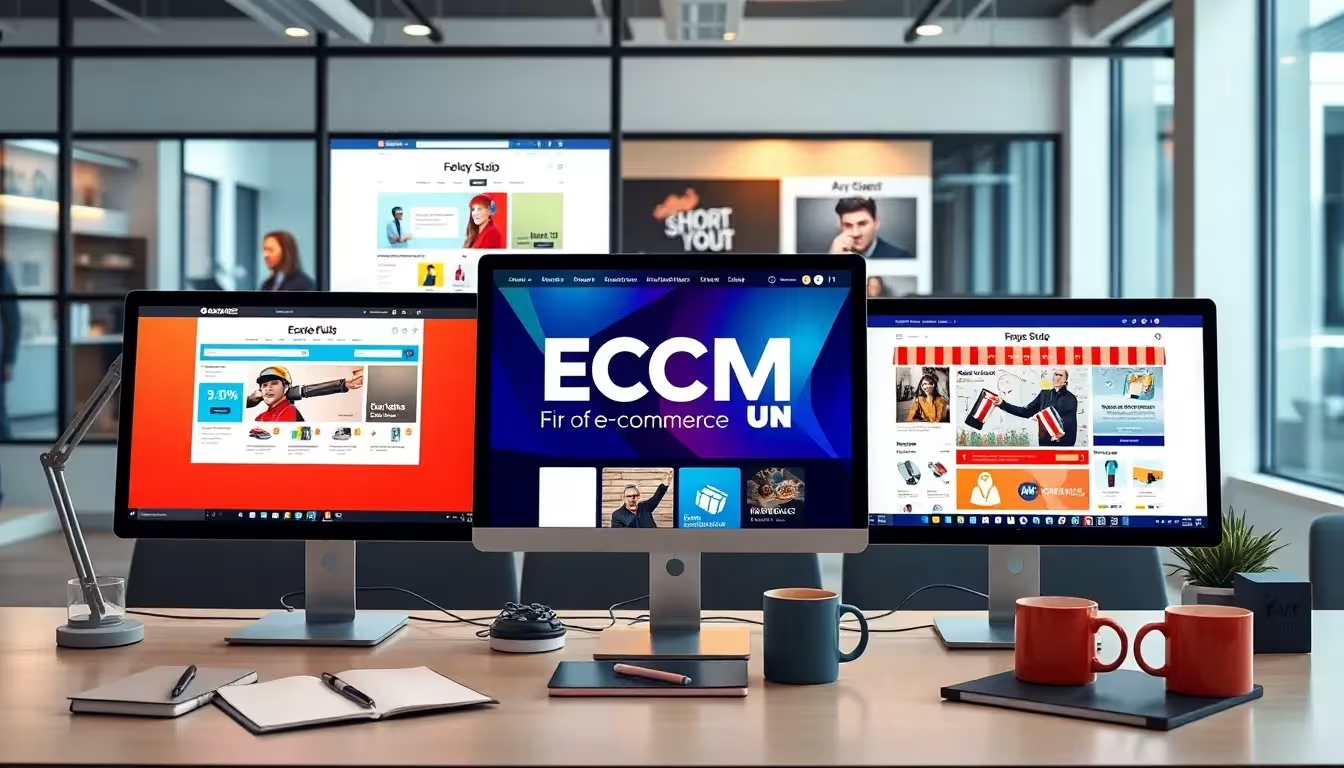
If you opt for Shopware or PrestaShop, you have extensive options for professionalizing your own store in terms of performance, design and marketing. Both systems can be expanded with a variety of plugins and impress with regular updates. Especially in the European market, Shopware and PrestaShop are considered reliable solutions thanks to a stable developer community.
With TYPO3, on the other hand, the e-commerce extension is not quite as central as with Shopware or PrestaShop, but at the same time you have extensive options for content structures, multi-level workflows and multilingualism. One of TYPO3's strengths lies in its granular rights management modules, which makes the platform interesting for companies that use personnel or agency teams with different responsibilities. This allows complex approval processes and editorial workflows to be mapped cleanly.
It should not be forgotten that these professional systems often require thorough planning and intensive configuration. For a medium-sized project with hundreds or thousands of products, this makes sense and pays off in the long term. However, if you only sell a few products and do not focus on marketing complex content pages, it is better to opt for a less complex solution. This is because a CMS such as TYPO3 without sufficient technical resources often means high barriers to entry.
OpenCart - lean and functional for small to medium-sized stores
OpenCart is one of the lightweight open source CMS. This system is particularly worth a look if you are looking for lean administration. Despite the low entry threshold, it comes with numerous modules for payment processing, warehousing and inventory. Over 13,000 extensions make OpenCart a flexible, yet clearly structured system. Even if it is not a CMS with a prominent name, its functionality is impressive.
OpenCart offers you the control you need for stores with a clearly structured product range or a special niche - without mandatory monthly fees. You can rely on solid loading times and simple operation. Thanks to the developer community, you can quickly find help if extensions are required.
OpenCart is also a recommended option for merchants who only have a small team or minimal technical capacity, but still want to offer a serious shopping experience. The administration is reduced to the essentials, which keeps the learning curve moderate. Nevertheless, you can use modules or themes to customize the store according to your wishes. Image material, product descriptions and SEO elements can be entered efficiently, so that even smaller marketing teams can cope well.
Thanks to the functions already integrated in OpenCart, you can contact customers, monitor orders or even manage simple voucher systems. OpenCart is a reliable middle ground solution, especially for niche products where a high degree of customization is not absolutely necessary. This means you don't have to manage a comprehensive framework, but you can trigger additional features at any time if required.
Table: Comparison of leading CMS solutions
| CMS | License type | Suitable for | Scalability | Setup effort |
|---|---|---|---|---|
| WooCommerce | Open Source | Flexible, growing | High | Medium |
| Shopify | SaaS | Startups, SMEs | High | Low |
| Wix | SaaS | Small stores | Limited | Very low |
| Shopware | Open Core | Middle class | Very high | High |
| PrestaShop | Open Source | Internationalization | High | Medium |
The choice between these systems depends heavily on your individual needs and technical resources. For Shopware and PrestaShop in particular, you should definitely keep an eye out for reliable hosting offers as the number of products or marketing measures increase. Powerful servers are crucial here in order to cope with growth and keep loading times in the green zone. With Shopify or Wix, the platform provider takes care of hosting and updates, which is a huge relief for beginners or small teams in particular. However, you also pay higher monthly fees for this convenience and have slightly less control over the infrastructure.
Further tools: Marketing, SEO and customization
Almost every CMS today comes with basic SEO functions. The decisive factor is how easily you can influence meta data, canonical tags, loading speed and user guidance. WooCommerce and PrestaShop score particularly well here with extensions such as Rank Math or modules for structured data maintenance. Shopify also offers solid starting values in terms of SEO - albeit with less depth than open source solutions.
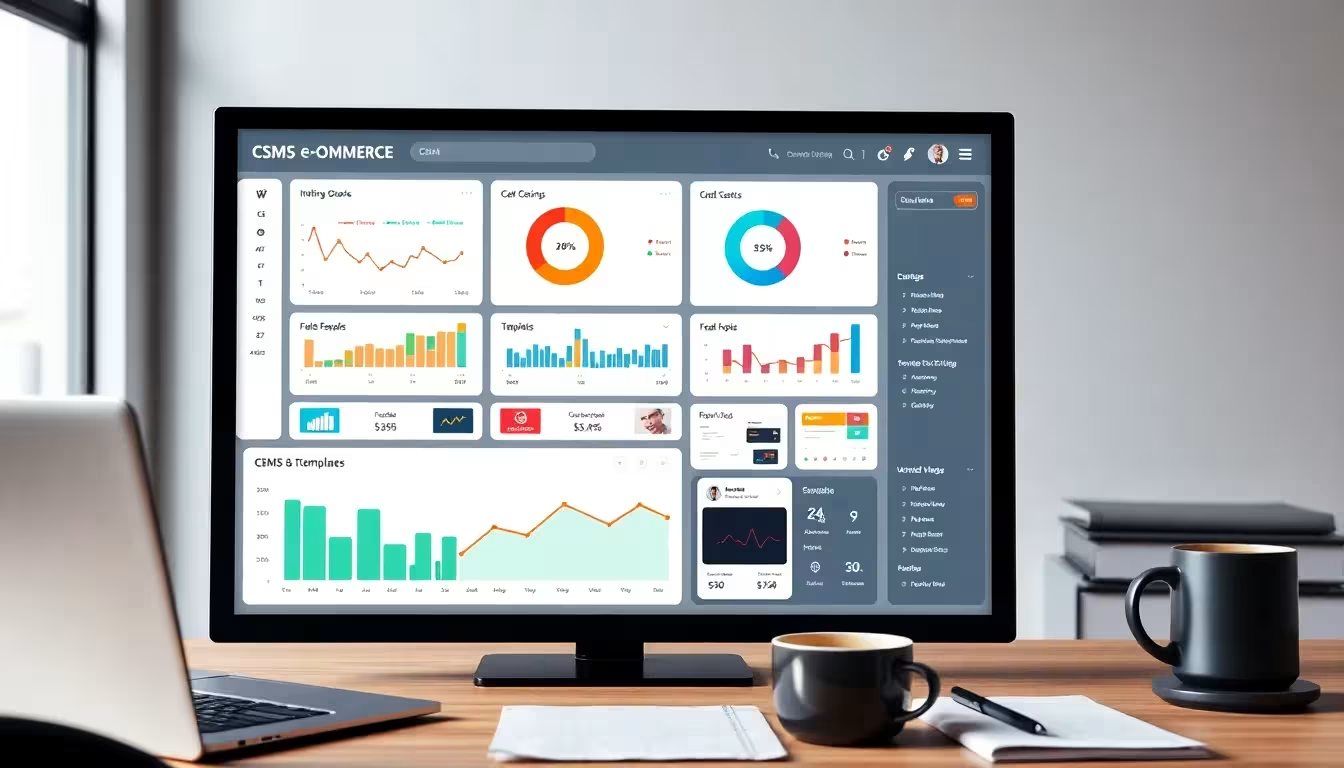
If you want to market products internationally or focus on regional search engine optimization, it is advisable to choose a CMS with flexible SEO functions. PrestaShop is particularly strong here, as it allows you to manage different languages and currencies with ease. However, Shopware or WooCommerce also integrate corresponding tools and plugins that allow you to publish country and language-specific content.
Another aspect when choosing a CMS is the integration of marketing and sales tools. Whether newsletter providers, CRM systems or social media tracking - open interfaces are worth their weight in gold today when it comes to effective marketing and building customer relationships. Systems such as Shopify score points with a huge app store that provides you with many ready-made solutions. WooCommerce, on the other hand, allows you to integrate practically any service via a plugin - or, if in doubt, a custom development. Wix is more limited in some areas, as certain integrations exist but are not as extensible as in open systems.
In the long term, the update policy also plays an important role. With open source systems such as WooCommerce or PrestaShop, you have numerous plugin providers, some of which have different update cycles. Here, you need to keep a regular eye on incompatibilities and version conflicts in order to keep your store stable at all times. With SaaS solutions such as Shopify or Wix, updates are rolled out automatically, which reduces the maintenance effort. However, you are dependent on the pace and decisions of the provider and cannot control major changes in the platform architecture yourself.
Hosting as an often underestimated success factor
Efficient Hosting determines the speed, security and availability of your online store. Especially with growing traffic, SSD servers, caching technologies and data centers close to your location are crucial. A provider such as webhoster.de offers scalable packages specifically for e-commerce with strong performance and German data protection standards.
Both open source systems such as WooCommerce and cloud solutions such as Shopify benefit from a reliably dimensioned infrastructure. A suitable hosting contract is a key factor, especially for systems such as Shopware or TYPO3. You can find an up-to-date overview of hosting and systems here: CMS systems in comparison.
The choice of your hosting provider is often determined by factors such as location, performance parameters and security standards. Fast server response times are essential for a high conversion rate: studies show that just a few seconds of loading time can cause a considerable number of potential buyers to bounce. Especially if you are active in several countries, it is worth using a hosting provider with globally distributed data centers so that your site visitors enjoy short loading times everywhere. Make sure that the legal situation regarding data storage is correct - strict regulations apply in Germany or the EU, which you should adhere to in order to avoid the risk of warnings.
It also makes sense to ask about expansion options such as content delivery networks (CDN) or firewall solutions. A CDN not only helps you to deliver content faster, but can also mitigate DDoS attacks. Unfortunately, the risk of being targeted by hackers increases with the growing success of your online store. However, with the right hosting partner, you can take precautions and minimize potential downtimes. A professional security concept can strengthen your reputation as a reputable online retailer in the long term.
Summary: Choosing CMS 2025 with foresight
Every company has its own priorities. If speed and ease of access are important to you, choose Shopify or Wix. If you need full control and customization options, systems like WooCommerce or PrestaShop will convince you. If you have the technical capacity in your team, you can grow in the long term with Shopware or TYPO3 and take a professional approach to store architecture.

It remains important: Your CMS is never a one-off decision. It should be able to grow with your store, expand flexibly and be open to new requirements - be it marketing, internationalization or additional sales channels. Strong providers such as webhoster.de provide the necessary foundation for your digital success.

Looking to the future - especially to the year 2025 and beyond - the demands on e-commerce solutions will continue to increase. Customers expect personalized shopping experiences, smooth payment connections and fast loading times. How your store develops during this time is closely linked to your ability to adapt to upcoming trends and technical innovations. Whether you prefer an open system that offers you maximum customization freedom or a SaaS solution that does a lot of the work for you is a question of priorities and resources. But regardless of the specific choice, you should always make sure you remain flexible and maintain your system regularly. Only then will your online business have a solid foundation - for 2025 and far beyond.


