Skip to content
I see DDoS mitigation in web hosting as a practical toolbox: I combine network protection, application controls and processes so that websites, stores and APIs remain accessible even under attack. Anyone who takes DDoS mitigation hosting seriously orchestrates layers of protection from upstream to the application and anchors monitoring and response processes in daily operations.
Key points
I focus on the building blocks that work reliably in the hosting environment and reduce outages in the long term. Each measure addresses specific types of attack and ensures that legitimate users receive quick responses. Priority is given to mechanisms that intercept attacks at an early stage and keep false alarms to a minimum. I also show how to define processes and responsibilities so that no incident gets lost in the noise.
- upstream-Defense with scrubbing centers, anycast and BGP mechanisms
- Traffic-Filter at router, firewall and provider level
- WAF and Layer 7 controls including rate limits
- Hardening of servers, services and configurations
- Monitoring, alarms and incident response plans
In this way, I bring structure to the topic, prioritize measures according to risk and effort and derive concrete steps for today, tomorrow and the next attack. With this roadmap, I keep Availability and performance.

DDoS basics in hosting
An attack often starts in botnets that generate masses of requests and thus Resources devour. Volumetric waves on layer 3/4 target bandwidth or network devices; protocol attacks such as TCP SYN floods exhaust stateful firewalls and load balancers. On layer 7, HTTP or API floods force expensive database or PHP operations until sessions are aborted and shopping carts remain empty. In shared environments, the risk is exacerbated because multiple projects share nodes and bandwidth and a single hit takes neighbors with it. If you understand the vectors, you'll be able to judge more quickly where to block first and where to increase capacity so that legitimate Users do not block.
DNS and Edge: Secure authoritative and resolver
I see DNS as a critical gateway and secure it in two ways. I distribute authoritative zones anycasted over several PoPs, enable DNSSEC, limit response sizes and eliminate open zone transfers. Rate limits per source rate and response caching at the edge prevent NXDOMAIN or ANY floods from choking my name servers. On the resolver side, I do not tolerate open recursions, but restrict requests to trusted networks. For large zones, I work with split-horizon DNS and dedicated endpoints for API customers so that I can throttle specifically under attack without affecting other users. Depth TTL strategies (short for dynamic entries, longer for static entries) balance agility and relief.
Multi-layered defense in web hosting
I combine layers of protection that are effective at network, infrastructure and application level and mutually support each other. supplement. Upstream filters take the pressure off the line, local rules on routers and firewalls sort out packets, and a WAF slows down faulty HTTP patterns. Rate limiting protects bottlenecks such as login, search or APIs, while hardened servers offer less attack surface. Monitoring closes the loop because I can only react early and tighten rules if I have reliable key figures. This compact overview provides a good introduction to DDoS protection in hosting, which I use as a starting point for my own checklist and apply quickly in projects.

Upstream protection: scrubbing, anycast, BGP
I pull volumetric traffic out of the line of fire before it reaches my own Connection saturated. Scrubbing centers pick up suspicious traffic via redirection, clean packets and return only legitimate flows. Anycast distributes heavy requests to multiple edge locations, which relieves the load on individual PoPs and keeps latencies stable. With BGP FlowSpec and RTBH, I specifically discard patterns or zipcodes of the attack and gain time for finer filters at deeper levels. One Multi-CDN strategy complements this layer for highly distributed users, because I fan out attacks such as legitimate peaks more widely and failover takes effect more quickly.
IPv6, RPKI and signaling
I treat IPv6 as a first citizen: filters, ACLs, Rate limits and WAF rules apply dual-stack, otherwise incorrectly configured v6 paths secretly open the floodgates. RPKI signatures for my prefixes reduce the risk of hijacks; with blackhole communities, I can selectively relieve targets without sacrificing entire networks. I use FlowSpec in a controlled manner: change controls, timeouts and a dual control principle prevent incorrect rules from cutting off legitimate traffic. With standardized BGP communities, I clearly signal to my upstream when scrubbing, RTBH or path preferences can be activated. This means that escalations remain reproducible and can be executed quickly in the NOC.
Traffic filtering without collateral damage
At the router and firewall level, I use access lists, port limits and size filters to minimize harmful patterns. computational effort to block. IP reputation helps to temporarily exclude known bot sources, while geo or ASN filters further reduce the surface area if no customers are located there. Outbound controls prevent your own systems from becoming part of a botnet and later discrediting your own origin. I reject rigid block-all rules, because otherwise legitimate campaigns or media peaks will face a closed door. I am better off with gradual tightening, telemetry per rule and dismantling when key figures show that real Visitors suffer.

Kernel and host tuning
I harden the network stack so that favorable operations ward off attacks. SYN cookies, shortened TCP times, appropriate somaxconn- and backlog-values and conservative conntrack-sizes prevent queues from filling up. I use eBPF/XDP to drop patterns before the kernel, for example via packet sizes, flags or offloading heuristics. I set keep-alive time and idle timeouts so that idle connections do not get out of hand while legitimate long polls continue to function. I document the tuning parameters for each host role (edge, proxy, app, DB) and test them using load profiles so that legitimate users are not unintentionally slowed down by peak traffic.
UDP and non-HTTP services
Many amplification vectors target UDP services. I disable unnecessary protocols, harden DNS/NTP/Memcached and block reflections with BCP38-egress filters. For DNS, I limit recursion, reduce EDNS buffers and respond minimally. For VoIP, gaming or streaming, I check whether protocol extensions such as ICE, SRTP or token-based join mechanisms make abuse more difficult. Where possible, I encapsulate services behind proxies with rate and connection controls or use datagram gateways that reject anomalies early on. Logging at flow level (NetFlow/sFlow/IPFIX) shows me whether unknown ports suddenly fail.
WAF and Layer 7 strategies
A WAF sits in front of the application and checks HTTP/HTTPS requests for patterns that could indicate bots and abuse. betrayed. I start in monitoring mode, collect hits, analyze false positives and then gradually activate rule sets. Rate limits per IP, IP range, session or API key protect login, search, registrations and sensitive endpoints. For CMS and stores, I create profiles that recognize typical paths, headers and methods and differentiate between genuine use and attack. Anyone who runs WordPress will benefit from this guide to a WAF for WordPress, which I use as a blueprint for similar setups with other frameworks.
HTTP/2/3, TLS and handshake floods
I pay attention to protocol details: HTTP/2 streams and Rapid reset-patterns can put a heavy load on servers, so I limit simultaneous streams, header sizes and GoAway behavior. With HTTP/3/QUIC, I control initial tokens, retry mechanisms and packet rate limits. TLS costs CPU - I use modern ciphers with hardware offload, stack the certificate chain efficiently and monitor handshake rates separately. I only activate 0-RTT selectively to prevent replay abuse. A clean separation of edge termination and origin keeps the app free of expensive handshakes and allows granular throttling on the edge.
Rate limiting, captcha, bots control
I throttle requests before application servers or databases under Load buckle. I define limits per endpoint per time window and make sure that spikes do not bounce falsely due to marketing actions. Connection limits block excessive parallel connections that exhaust idle states and tie up resources. Captchas or similar challenges make automated form submissions more difficult without pointlessly hindering people. Bot management that evaluates behavior and fingerprints separates crawlers, tools and malicious sources better than long blacklists and noticeably reduces false positives.

APIs, GraphQL and WebSockets
I secure APIs via keys, scopes and per customer-limits. For GraphQL, I limit query depth and costs (fields/resolver budget) and cache results via persisted queries. WebSockets and SSE are given tight idle timeouts, connection budgets and backpressure rules so that long lines do not block everything. Faulty clients are slowed down with 429/503 plus retry after. I separate internal and external traffic via separate gateways or paths so that I can throttle hard outside without affecting internal systems.
Harden infrastructure: servers and services
I switch off unnecessary services, close ports and keep the operating system, web server and CMS with Updates up to date. TLS with HSTS protects sessions and makes it more difficult to read sensitive cookies. Segmented networks separate publicly accessible systems from databases and admin accesses, which prevents attackers from gaining access. I enforce strong passwords, two-factor procedures and IP sharing for admin paths and SSH. Regular backups with tested restore processes safeguard business operations in case an attack does get through and damages data or configurations.
Monitoring and incident response
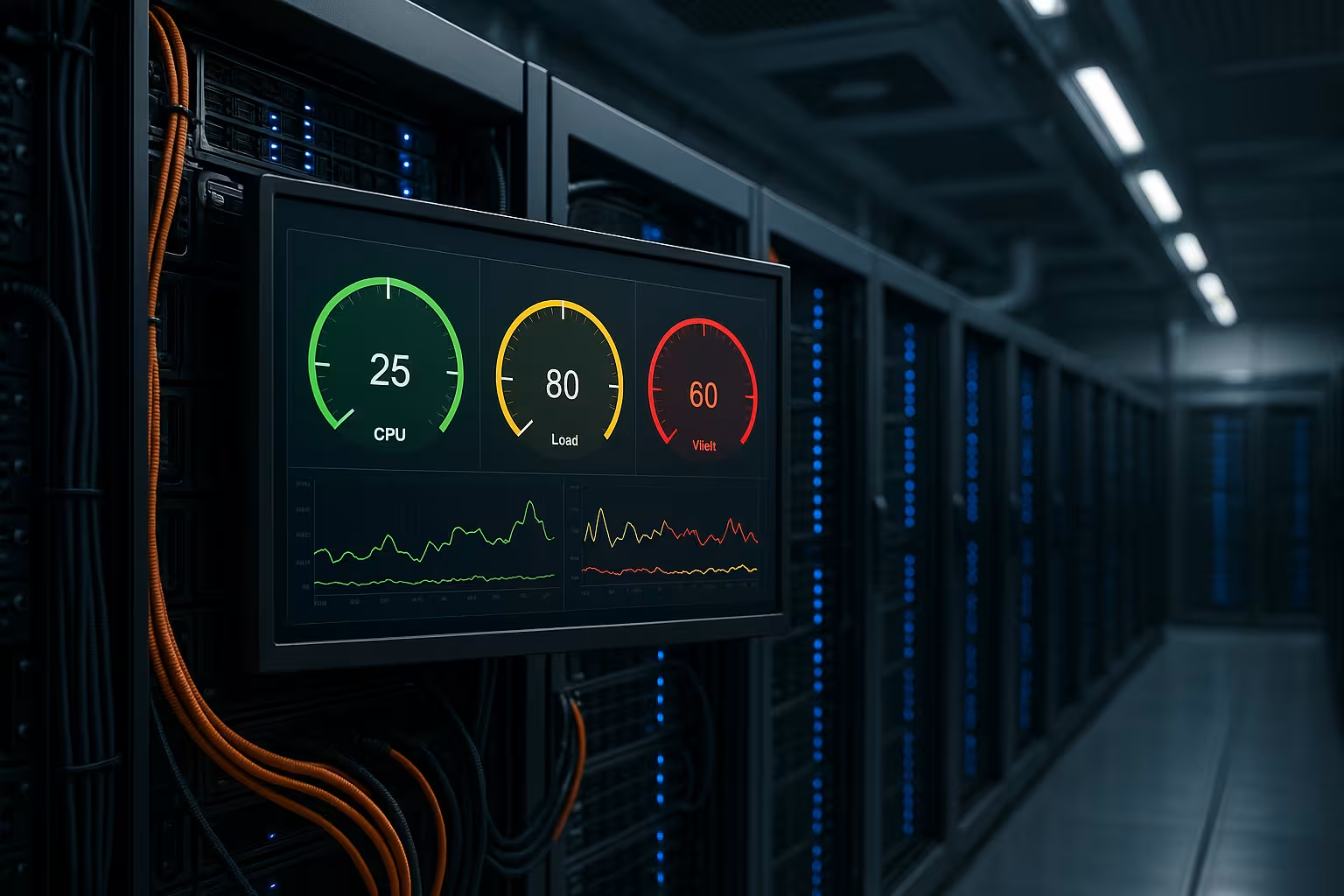
Without good telemetry, every defense remains blind. I measure bandwidth, connection numbers, requests per second and error rates in real time and set alarms for anomalies. Log data at network, web server and application level show me vectors and sources, which I translate into filter rules. At threshold values, playbooks automatically activate DDoS rules or direct traffic to the scrubbing center. After each incident, I adjust thresholds, rules and capacities so that the next attack is shorter and no pattern surprises twice.
Log pipeline, telemetry and forensics
I standardize log formats (JSON), enrich events with Meta data (ASNs, geo, bot scores) and feed them into the SIEM via a robust pipeline. Sampling and dedicated PII redaction protect data privacy without paralyzing the analysis. I synchronize timestamps via NTP to make correlations across systems reliable. For forensics, I briefly retain flows and relevant raw packets, increase retention for aggregated metrics and document each mitigation step with ticket/change ID. KPIs such as MTTD, MTTR and false positive rate show me whether I need to tighten up.

Role of the customer: Architecture and configuration
Operators also bear responsibility and shape the Attack surface active. An upstream reverse proxy or a CDN with DDoS protection protects origin servers and disguises the origin IP. In the DNS architecture, I avoid entries that give away origin systems and rely on resolvers with solid defenses against misuse. At application level, I cache expensive responses, optimize database queries and ensure that static content comes from edge nodes. I keep plugins, themes and modules lean and up-to-date so that no known vulnerability paves the way for downtime.
Capacity planning and autoscaling without exploding costs
I am planning Reserves conscious: Burst capacity with upstream partners, warm pools of instances and preheated caches prevent scaling from taking effect too late. I slow down horizontal autoscaling with cooldowns and error budgets so that short-lived spikes do not drive up costs. For stateful components (DB, queues), I define scaling limits and offload strategies (read replicas, caching layers) so that the bottleneck is not just postponed. I regularly run capacity tests with realistic sample replays so that I know what 95th/99th percentiles can withstand. I store Guardrails (max. nodes/region, cost alarms) and a manual kill switch if autoscaling takes on a life of its own.

Degradation strategies and fallbacks
I define how the application under fire worthy Error provides: Read-only mode, simplified product listings, static checkout hints or maintenance pages with caching headers. Circuit breakers and bulkheads separate expensive paths (search, personalization) from core services so that partial functions continue to run. I use queueing and token buckets as buffers to cushion peaks and rely on feature flags to quickly switch off load generators. I design error codes and retry afters in such a way that clients do not inadvertently become retry spirals. This keeps the Accessibility noticeably higher than with a hard off.
Exercises, playbooks and communication
I'll try the real thing: Game Days with synthetic attacks, clear on-call roles, escalation matrices and runbooks with screenshots. Decision logs define who triggers RTBH, tightens rules or directs scrubbing and when. A communication plan with a status page, predefined customer texts and internal updates prevents information from trickling out. I document every learning, adapt playbooks and train new team members. I practice the interfaces (tickets, BGP signaling) with suppliers so that no time is lost during onboarding in the event of an incident.
Practical check: Which key figures count?
I make data-based decisions on whether to tighten rules, expand capacity or relax filters so that Accessibility and user experience are right. Central key figures reveal early on whether a peak feels normal or whether an attack is starting. Thresholds that match the traffic profile, time and campaign calendar are important. I document baselines, update them quarterly and define a clear action for each metric. The following table shows practical metrics, starting values and typical reactions that I adapt as a template.
| Metrics | Starting threshold | Test step | Typical action |
|---|---|---|---|
| Bandwidth In (Gbit/s) | +50 % above baseline | Comparison with campaign plan | upstream mitigation, Scrubbing activate |
| Conn. per second | +200 % in 5 min. | Check port/protocol distribution | Sharpen ACL, RTBH for source |
| HTTP RPS (total) | 3× Median time of day | View top URLs and headers | WAF rules and Rate limits set |
| 5xx error rate | > 2 % in 3 min. | Check app logs, DB waits | Scaling capacity, caching increase |
| Outbound traffic | +100 % atypical | Inspect host flows | Switch egress filter, cleanup Host |
My quintessence
DDoS mitigation works reliably in hosting if I treat the network, systems and applications as a coherent whole. Chain consider. Upstream defense and intelligent filtering take the pressure off the line, while WAF, rate limiting and bot controls protect applications. Hardened servers and clean configurations reduce the attack surface and shorten outages in an emergency. Monitoring with clear thresholds, playbooks and follow-up ensures that each round ends better than the last. Consistently combining and regularly practising these building blocks keeps websites, stores and APIs available even when under attack and prevents costly Downtime.