Skip to content
DDoS protection determines accessibility, load time and revenue in web hosting: I show how hostings recognize attacks early, filter them automatically and keep legitimate traffic available. I classify techniques, provider options, costs and limits so that your website can absorb the attack load and keep your traffic available. business-critical Systems stay online.
Key points
The following overview summarizes the most important insights for your planning and implementation.
- Recognition and filtering stop malicious traffic before it hits applications.
- Bandwidth and Anycast distribute load and prevent bottlenecks.
- Automation reacts in seconds instead of minutes and keeps services accessible.
- Choice of provider determines range, response time and costs.
- Fine adjustment reduces false alarms and protects productivity.
DDoS protection in web hosting: briefly explained
I summarize DDoS like this: Many distributed systems flood your service with requests, real users go away empty-handed, and you lose Turnover and trust. Hosting environments therefore rely on traffic analysis at the network edge, scrubbing-capable infrastructures and rules that block malicious patterns. I make a strict distinction between volume attacks at network/transport level and application-related attacks that overload HTTP and API routes. What counts for beginners: Early detection, fast filters and sufficient fallback capacity are crucial. Those who plan deeper use DDoS protection in web hosting as a combination of Prevention and reaction.
Recognize attack types: Volume, protocol, application
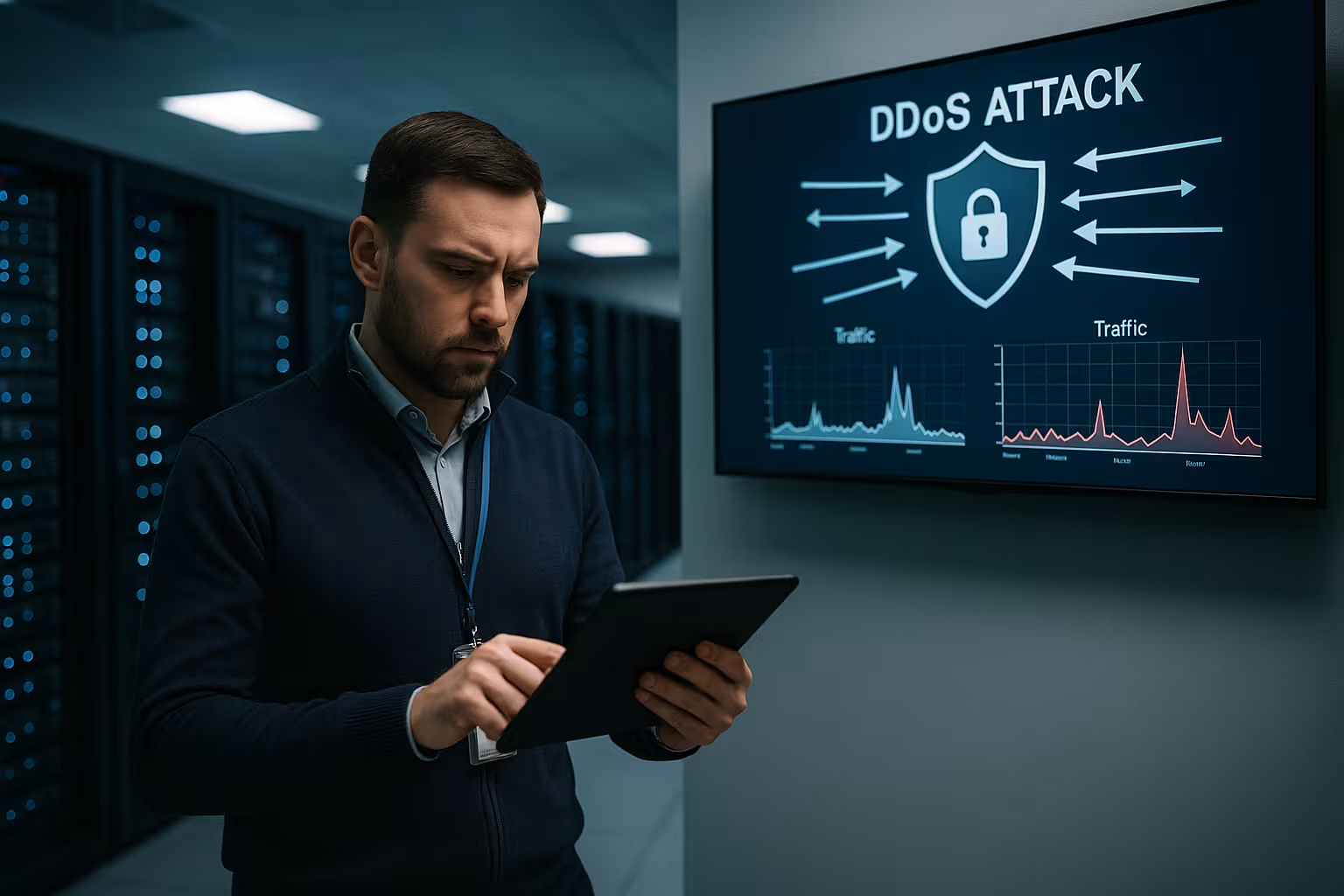
I differentiate between three families: volume attacks (e.g. UDP floods) target lines and routers, protocol attacks (SYN, ACK) exhaust state tables, and layer 7 attacks flood HTTP endpoints or APIs. Capacity plus anycast distribution helps against volume, stateless filters and SYN cookies help against protocol attacks. At application level, I rely on rate limiting, bot detection and caches that deliver identical requests. I recognize patterns via base lines: anomalies are immediately apparent in metrics such as requests/s, error rates or latencies. Correlation remains important: a single metric is deceptive, several sources together result in a clear Image.
New attack vectors: HTTP/2/3, TLS and Amplification
I take current trends into account: HTTP/2 variants such as Rapid Reset can trigger an extremely large number of requests with just a few connections and tie up server workers. I therefore limit streams processed in parallel, set conservative defaults for prioritization and temporarily disable problematic features in the event of incidents. With HTTP/3 via QUIC, attacks are increasingly migrating to UDP - I check anti-amplification mechanisms, limit initial packets and set stricter defaults. Rate limits for connecting superstructures.
TLS handshakes are also a goal: short session resumption times, preferential use of 0-RTT only if risks are acceptable, and hardware acceleration for cryptography relieve the origin. I intercept reflections/amplifications via open resolvers, NTP or CLDAP upstream: I require anti-spoofing (BCP38), response rate limiting on DNS and filter signatures for known amplifiers from the provider. In this way, I noticeably reduce the impact of botnets and spoofed traffic.
Defense techniques: monitoring, bandwidth, automation
Good defense starts with continuous monitoring: I collect traffic data, learn normal values and automatically activate countermeasures in the event of deviations. Bandwidth management distributes the load and prevents individual links from closing down. Automated reactions prioritize legitimate sessions, block signatures and forward suspicious traffic to scrubbing centers. For Layer 7, I rely on WAF rules, captchas only selectively and API keys with rate limits. Without a playbook, you lose time, so I keep escalation paths, Contacts and threshold values.

Always-on or on-demand: choose operating models realistically
I make a conscious decision between always-on protection and on-demand scrubbing. Always-on lowers the Time-to-mitigate to seconds, but costs additional latency and ongoing fees. On-demand is cheaper and suitable for rare incidents, but requires well-rehearsed switching processes: BGP diversion, GRE tunnels or provider-side anycast switching must be tested regularly so that seconds rather than minutes pass in an emergency.
I also have options such as Remote Triggered Blackhole (RTBH) and FlowSpec available to relieve the pressure on specific targets in the short term without shutting down entire networks. Important: These measures are a scalpel, not a sledgehammer. I document criteria for when I use blackholing and ensure that I have back-up plans as soon as the legitimate Traffic prevails again.
Comparison of providers: capacity, automatic and range
I pay attention to filter performance, global reach and response time with hosters. OVHcloud publishes a defense capacity of up to 1.3 Tbit/s; this shows how much volume some networks can handle [4]. United Hoster offers basic protection in all packages, which recognizes and blocks known patterns [2]. Hetzner operates an automated solution that detects attack patterns at an early stage and filters oncoming traffic [6]. webhoster.de relies on continuous monitoring with modern technology to ensure that websites remain accessible and can be accessed. Traffic flows cleanly. If you need to be close to your location, check latencies to target groups and consider DDoS-protected hosting with regionally matching knots.
Realistically classify costs, false alarms and limits
More protection costs money because scrubbing, analytics and bandwidth tie up resources [1]. I plan budgets in stages: Basic protection in hosting, additional CDN features, and a higher package for risky phases. Misconfigurations lead to false positives that slow down legitimate users; I therefore test rules against real access patterns [1]. Sophisticated attacks remain a risk, so I combine several layers and train processes regularly [1]. Transparency is crucial: I demand metrics, logs and comprehensible Reportsto refine measures.

Budgeting and capacity planning
I calculate with scenarios: What peak traffic is realistic, what is the worst case, and what volume can the provider safely filter out? I take burst models into account (e.g. billed clean traffic gigabytes) and plan reserves for marketing campaigns, releases or events. For decision-making rounds, I quantify risks: expected damage per hour of downtime, frequency per year and cost benefit of a stronger package. This turns a feeling into a reliable Planning.
I also check whether capacity can be increased quickly: Upgrade paths, minimum runtimes and whether test windows can be agreed. A small surcharge for short-term scaling is often cheaper than additional days of downtime. The balance between fixed costs (always-on) and variable costs (on-demand), tailored to the business profile and season, remains important.
Network architecture: anycast, scrubbing, peering
I plan networks in such a way that attacks do not even reach the origin server. Anycast distributes requests to several nodes, scrubbing centers clean up suspicious traffic, and good peering shortens paths. The closer a filter is to the attacker, the less load reaches the host. I check whether the provider supports BGP-based redirection and how quickly switchovers take effect. Without a clear architecture, an attack hits the narrowest point first - often the narrowest Management.
IPv6, peering policy and edge strategies
I make sure that protection mechanisms for IPv6 have the same priority as for IPv4. Many infrastructures today are dual-stack - unfiltered v6 is a gateway. I verify that scrubbing, WAF and rate limits are consistent on both stacks and that extension headers and fragmentation are also handled properly.
At the Edge, I use temporary geoblocking or ASN policies when attacks are clearly defined. I prefer dynamic, time-based rules with automatic reset so that legitimate users are not permanently blocked. A good peering policy with local IXPs also reduces the attack surface because shorter paths offer fewer bottlenecks and Anycast works better.
Technology overview in figures and functions
The following table organizes methods, goals and typical implementation in hosting. I use this overview to identify gaps and close them in a prioritized manner.
| Technology | Goal | Implementation in hosting |
|---|---|---|
| Rate limits | Limit requests | Web server/WAF regulate requests per IP/token |
| Anycast | Distribute load | DNS/CDN nodes worldwide for shorter distances |
| Scrubbing | Filter malicious traffic | BGP redirection through cleaning center |
| WAF | Protect Layer-7 | Signatures, bot score, rules per route |
| Caching | Relieve the origin | CDN/reverse proxy for static/partially dynamic content |

Practical hardening: server, app, DNS and CDN
I set sensible defaults on the server: SYN cookies active, connection limits set, logging throttled to conserve I/O. In the application, I encapsulate expensive endpoints, introduce tokens and use circuit breakers to prevent internal bottlenecks. I secure DNS with short TTLs for fast redirects and with anycast for resilient Resolution. A CDN buffers peaks and blocks obvious bots at the edge of the network. Those who use Plesk integrate features such as Cloudflare in Pleskto use caching, WAF and rate limits effectively.
Targeted protection of APIs and mobile clients
I regulate not just per IP, but per identity: rate limits per API key, token or user reduce false positives in mobile networks and behind NAT. I differentiate between read and write operations, set stricter limits for expensive endpoints and use idempotence to safely repeat requests. For critical integrations, I use mTLS or signed requests and combine bot scores with device signals to detect automated queries without using real Customers to disturb.
Where it makes sense, I decouple work with queues: the edge confirms quickly, while backends process asynchronously. This smoothes load peaks and prevents a layer 7 attack from exhausting immediate resources. Caches for GET routes, aggressive edge caching for media and a clean cache invalidation plan are crucial for surviving under pressure.
Measurement and testing: KPI-based decision-making
I control DDoS protection with clear key figures: Time-to-mitigate, peak throughput, error rate, latency under load. Before live operation, I test with synthetic load profiles to adjust threshold values. During an incident, I log measures so that I can derive improvements later. After the incident, I compare target and actual values and adjust rules. Without metrics, any defense remains blind - with measurement it becomes controllable.

Observability, logs and data protection
I combine metrics (requests/s, PPS, CPU) with flow data (NetFlow/sFlow) and sample packets. This allows me to recognize signatures and prove countermeasures. At application level, I use tracing to localize bottlenecks - important when traffic appears to be normal but certain routes collapse. I also monitor RUM signals to keep an eye on the user perspective.
Data protection remains mandatory: I minimize personal data in logs, mask IPs, set short retention periods and define purpose limitation and role rights. I agree clear limits for access and storage with processors. Transparent Reports to stakeholders contain metrics, not raw data, and thus protect privacy and compliance.
Legal, compliance and communication in incidents
I have contact chains ready: Hosting support, CDN, domain registrar, payment provider. Internal communication follows a plan so that sales and support inform customers without disclosing confidential information. Data to disclose. Depending on the industry, I check reporting obligations, for example in the event of availability incidents, and document events in an audit-proof manner. I check contracts with providers for SLAs, fault clearance times and escalation paths. Good documentation reduces response times and protects you from misunderstandings.
Exercises and incident readiness
I practise regularly: tabletop scenarios, gamedays with synthetic load and planned switches to scrubbing. This is how I validate alarms, thresholds and on-call procedures. I define clear roles (incident commander, communication, technology) and stop exercises as soon as real users would be affected. Every exercise ends with a post-mortem and concrete actions - otherwise learning remains theory.
Checklist for choosing a provider
I first ask about capacity and global locations, then about automation and human-to-human escalation. Transparent metrics and a dashboard that shows load, filter hits and remaining capacity are important. I require testing options, such as planned load peaks outside of business hours. Contractual clauses on false positives, support channels and extended scrubbing options should be on the table. If you work through these points, you reduce risk and win Plannability.

Typical mistakes and how to avoid them
Many rely on just one layer, such as the WAF, and are surprised by failures during volume attacks. Others use captchas across the board and lose real users, although targeted rate limits would have sufficed. Some underestimate DNS: without short TTLs, redirection takes too long. Playbooks are often missing and teams improvise under pressure instead of taking defined action. I address all of this with layers, tests and clear Processes.
Special scenarios: E-commerce, games, public authorities
In e-commerce, I plan for sales peaks: preheating caches, isolating inventory and pricing services, prioritizing checkout endpoints and activating queues before limits break. In gaming environments, I protect UDP traffic with rate-based edge rules, session pins and close collaboration with upstreams. Public authorities and media companies secure election or crisis periods with pre-booked capacity and clear lines of communication - downtime has a direct impact on trust and Reputation.
Abridged version for those in a hurry
DDoS protection in hosting is based on three pillars: detection, filtering, distribution. I combine monitoring with automated rules and scale via anycast/CDN and scrubbing-capable networks. I select providers based on capacity, reach, metrics and direct support. I openly calculate costs, false alarms and residual risks and adapt rules to real access patterns [1]. If you implement this consistently, you keep services reachable and protects sales and reputation.