Skip to content
I will show you specifically how you can DE domain cheap without compromising on service, technology and data protection. You will learn how I evaluate offers, calculate follow-up costs and take advantage of large price differences with small steps.
Key points
- Total price instead of bait offer
- Support and DNS functions
- Extension and additional fees
- TLD fit Select target group
- Bundles Use for SSL and e-mail
Understanding costs: Starting prices, renewals and real annual values
I rate Starting prices just as an introduction, because the music starts with the renewals. Many registrars lure you in with cents in the first year, but then raise the price to 10-20 €; I therefore always calculate the costs over 24-36 months. This is how I recognize the Total value and avoid expensive surprises. I also check setup fees, transfer costs, redemption fees and services such as DNS tools or whois privacy. Only with this full-cost view do I realize whether an offer is really cheap.
| Provider | .de/year (start) | Extension | Whois Privacy | Support |
|---|---|---|---|---|
| webhoster.de | from 0,99 € | from 10 € | free of charge | German |
| Strato | from 0,05 € | 12-15 € | free of charge | German |
| IONOS | from 0,99 € | 15-20 € | free of charge | German |
| united-domains | from 3 € | 12-18 € | free of charge | German |
| GoDaddy | from 7,98 € | 12,99-18 € | with costs | German/EN |
For clear decisions, I use a Domain price comparison over several years and compare the benefits with my needs; a quick starting price is often deceptive, a transparent comparison brings clarity. Read my brief overview in the Domain price comparison.
Transparent overall calculation: example calculation over 3 years
To make the cost side more tangible, I'll calculate a realistic scenario: Let's assume that the starting price is €0.99, renewal is €12 per year, Whois Privacy is included, email forwarding is free, a mailbox costs €1 per month and there are no setup fees.
- Year 1: 0.99 € domain + 12 € e-mail = 12.99 €
- Year 2: 12 € domain + 12 € e-mail = 24 €
- Year 3: 12 € domain + 12 € e-mail = 24 €
The 36-month value here is € 60.99. If the registrar later increases the renewal to €15, the three-year price immediately shoots up by €6; if you add a one-off €10 for a transfer or €20-40 for a restore, the supposed bargain is over. I therefore take into account all dependenciesEmail inboxes, DNS functions, SSL, possible add-ons and price adjustments. If you are planning several domains, multiply the bill and also evaluate discounts for volume packages or portfolios.
TLD choice: Why .de scores for Germany
For German-language projects I rely on .debecause trust, local relevance and recognition are directly noticeable. Users type .de intuitively, search engines assign content more easily to the German-speaking market. I also cover international ambitions with .com, but in everyday life .de often delivers the best cost-benefit ratio. Modern extensions such as .store or .io have their place, but often cost significantly more. I decide on the basis of target group, budget and brand strategy, not out of curiosity about new endings.
| Ending | Average/year | Intended use |
|---|---|---|
| .de | approx. 10 € | Private, Company |
| .com | 12-24 € | International |
| .store | 15-50 € | E-Commerce |
| .io | 50-100 € | Tech, Startups |
| .info | 10-20 € | Knowledge platforms |
| .net | 12-20 € | Networks |
For projects with a German focus .de the best mix of cost, acceptance and findability; I only add further endings when there is a clear benefit.

Check provider quality: Support, technology, data protection
I first test the SupportHow quickly does help arrive, how solution-oriented are the answers, are there German-language channels? I then look at DNS management with A, AAAA, CNAME, MX and TXT records, DNSSEC and reliable name servers. I also evaluate management convenience such as zone templates, API, mass updates and clear protocols. Data protection remains mandatory: GDPR compliance, correct whois privacy and careful data processing must be in place. Only when the technology, service and data protection fit together do I book the domain.
DNS performance and security in detail
For stable accessibility, I pay attention to Anycast nameserver with good global coverage and comprehensible SLAs. I use TTL-I deliberately keep the MX/NS values low (300-900 s) for frequent changes and higher (1-24 h) for stable MX/NS entries. DNSSEC I activate, if possible automatically; it is important that the registrar activates the DS-Record correctly and key changes run smoothly. Those with higher demands benefit from Secondary DNS and zone backups in order to be able to react quickly in the event of failures. I also secure the domain with Locks against unwanted transfers or updates (ClientTransferProhibited, Update-Lock) and check whether the registrar has a Registry Lock for sensitive projects. This combination of performance and protection pays direct dividends in terms of uptime and trust.
IDN, umlauts and variants: Smart accessibility protection
I register the Main domain without umlauts, so that every keyboard and every system can reliably reach the address. If it makes sense, I also save the umlaut variant as a redirect so that users arrive with the usual spelling. Alternatives with and without hyphens help to catch typos and protect the brand. I keep the collection lean, because every additional domain causes follow-up costs. With targeted variants, I increase reach without dispersing the costs.
Email deliverability: SPF, DKIM and DMARC right from the start
So that mails arrive, I set up SPF (permitted dispatch servers), DKIM (signed mails) and DMARC (guideline, reporting). For new projects, I usually start with p=quarantine and evaluate reports before switching to p=reject. If several systems (e.g. store, CRM, newsletter) are sent, I document the Sender domains and ensure clean alignment values. I avoid umlauts in the E-Mail-Local-Part (before the @), test reverse DNS for outgoing servers and keep the SPF records lean so that they do not exceed the 10 DNS lookups. These basics increase deliverability and noticeably reduce support costs.
Smart time to buy: take advantage of promotions, avoid traps
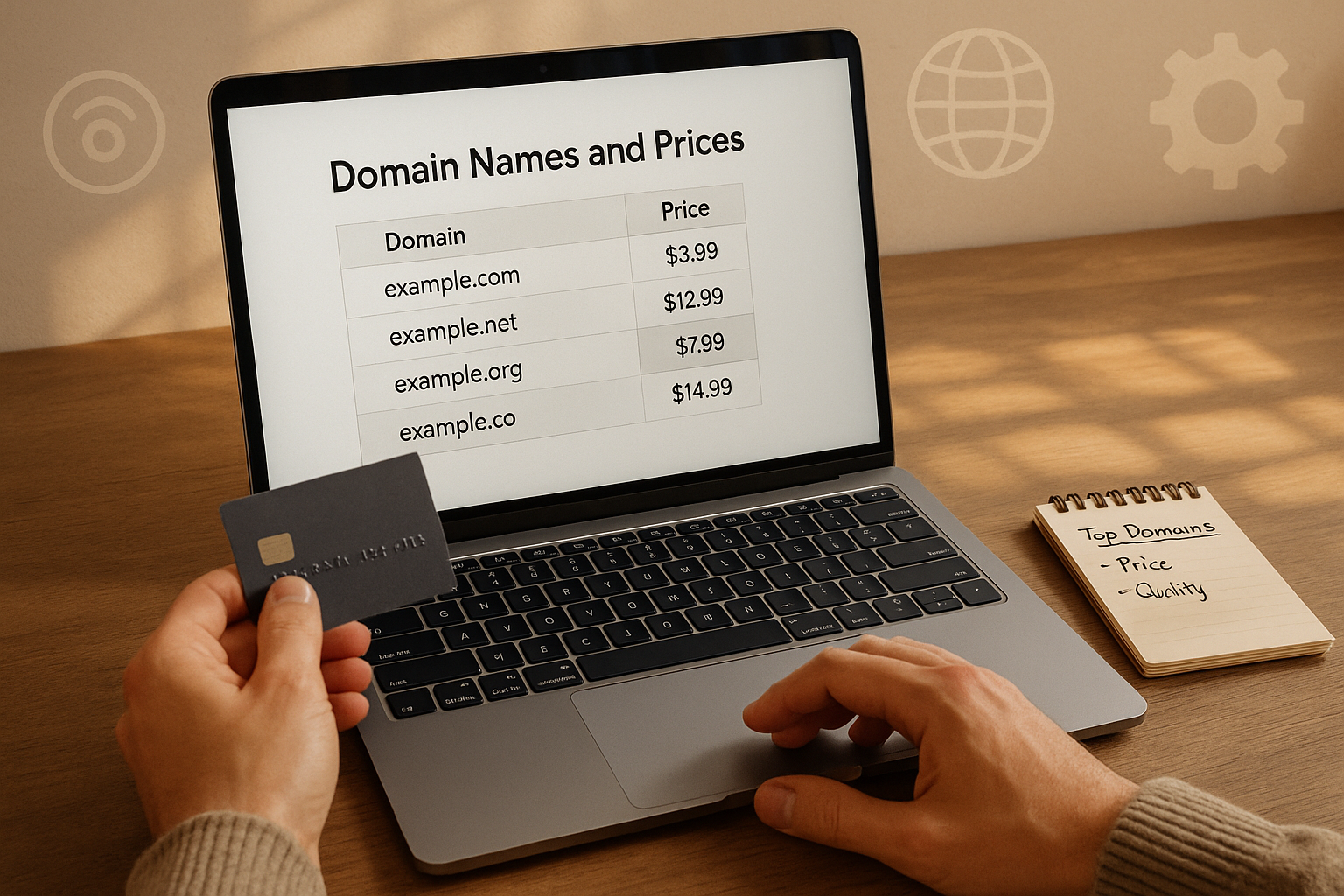
I am on the lookout for Actionsbut I always check the extension over several years. There is potential for savings if bonuses such as Whois Privacy, DNS tools or email forwarding are included in the price. I avoid offers with high setup fees or sharply rising follow-up prices. If I pay several years in advance, I compare the effective annual price carefully. This allows me to save in the long term and remain flexible if my project planning changes.
Keeping contract and billing under control
I activate Auto-Renew only if the invoice data is clean, and also set calendar entries 30-60 days before expiry. I check Notice periodsseparate charges for change of owner and invoice fees (paper invoice, dunning costs). For teams, I define roles in the customer account and separate Technical users from legally binding contacts. I export invoices on a monthly basis, note Cost centers and match VAT details. This order saves me discussions and prevents interruptions when a card expires or an account changes.
Bundles, SSL and e-mail: Clever use of synergies
I combine domain, SSL and e-mail if the package offers a clear price advantage. In many setups, one provider takes care of everything, which simplifies setup and support. Included DV SSL certificates are sufficient for many sites; for e-commerce, I plan to use higher-quality certificates if necessary. High-performance web hosting with NVMe SSD and high availability has a direct impact on loading time and ranking. If you want to delve deeper into the evaluation, you will find practical tips in these cheap domain tips.
Website migration without downtime: transfer and DNS plan
When moving house, I lower the TTL of the DNS entries 24-48 hours in advance, mirror the site on the target system and test it using a staging domain or hosts file. SSL I provision in advance (e.g. via DNS-01 challenge) so that there is no certificate gap after the switch. The actual Transfer I start when everything is ready; with .de, provider changes are often quick. I then switch the A/AAAA records, monitor log files and raise the TTL again as soon as everything is stable. For e-mail I plan a MX-Cutover with a short TTL and intercept old mail with temporary redirects. This keeps the project accessible while I change the infrastructure.

Avoid cost traps: Transfers, redemption, add-ons
I check Transfers In advance: Are there any fees, how does the authcode process work, are there any lock-in periods? There is a risk of redemption fees for missed renewals, so I activate reminders and plan to pay on time. Additional services such as e-mail mailboxes, forwarding or DNSSEC should be clearly priced. I read the price lists carefully and check the end of the contract in the customer account. This allows me to keep costs predictable and remain capable of acting at all times.
.de specifics: DENIC, TRANSIT and restoration
.de domains are registered by the DENIC managed. A Provider change is carried out using an AuthInfo code and is usually completed quickly, provided no blocks are active. If a domain is deleted or expires, depending on the registrar, a Restoration (Restore/RGP) - separate fees are often charged for this. If the so-called TRANSIT-procedure, DENIC takes over temporary support and contacts the holder directly to clarify further use. I keep my contact details up to date, maintain the domain handles and check status flags (e.g. transfer/update lock) so that I can react at any time and no unwanted deletions occur.
Data protection and law: Whois, GDPR, sender details
I keep Whois-Privacy with Private projects as protection against spam; for business pages I check the mandatory information separately. I ensure a complete legal notice, a clean privacy policy and cookie settings in accordance with the use of tools. The following applies to sensitive data: hosting location, order processing and log rotation must be traceable. I only choose providers who explain data protection clearly and secure it contractually. Those who document clearly and communicate transparently save time and nerves later on.
Realistically classify Whois privacy for .de
Through the DSGVO personal data in the public .de Whois is greatly reduced. Nevertheless, many registrars list "Whois Privacy" as a feature - in practice, .de is mainly about Correct owner data in the registry and diligence in data processing. For companies, I deliberately separate imprint/sender details from domain management: what has to be published legally has only a limited connection with Whois masking. I make sure that support tickets, backups and log data economical and earmarked are stored and that the registrar clearly regulates processes for deletion and information.

From check to registration: secure registration step by step
Before registering, I test the AvailabilityI write down spellings and check the brand. I then define DNS records, plan email routing and set redirects for variants. For a transfer, I get the authcode, remove any registrar lock and make sure the owner data is correct. After booking, I check the zones, activate DNSSEC and set up SSL. You can find compact instructions for price, process and timing in the guide Domain favorable 2025.
Checklist before going live: DNS, SSL, forwarding
Before I go live, I check a short list: HTTPS enforced, certificates valid, HSTS set (with caution), www or non-www clearly decided and 301 redirects clean. IPv6 is active (AAAA), CDN/proxy entries are correct, robots and sitemaps point to the main domain. For e-mail, I test SPF/DKIM/DMARC, SMTP-Auth and inbox. In the DNS zone, I document TTLs, remove legacy data and archive a Zone export. This is how I make sure that users and crawlers find the right address from day one and that the infrastructure runs smoothly.

Take away: Register price-consciously, ensure quality
I focus on Total prices over 24-36 months, not on conspicuous entry values. .de usually delivers the best mix of cost, trust and findability in the German-speaking context. A good registrar shows clear price lists, strong support, solid DNS features and respects privacy. I combine domain, SSL and email when packages really help save money and keep variants lean. If you compare in a structured way, you can book your .de domain at a reasonable price - and at the same time maintain security, performance and an overview in everyday life; a brief look at a compact Price comparison rounds off the planning.