 Skip to content
Domain redirect or external landing page? I show how this decision is influenced by SEO signals, technical Speed and the user experience - including clear criteria, hosting factors and setup steps. I explain when a permanent redirect bundles reach, when a standalone page drives conversion and how I can combine both variants. measurable control.
Key points
- 301 forwarding confers authority; wrong methods cost rankings.
- Landing pages deliver keyword focus, better control and higher conversion.
- Performance decides: fast servers, optimized assets, little ballast.
- Tracking and A/B tests show which variant really sells.
- Hosting with NVMe, caching and uptime boosts SEO success.
Domain forwarding: basics and typical scenarios
I use a Forwarding, if old domains are to point to the new main address after a rebranding or if campaign URLs direct to a target page in an uncomplicated way. I consistently choose the status code 301, so that backlinks, authority and signals reach the target page [1][7]. I keep the setup lean: I set the rule in minutes at the registrar or in the hosting panel and thus reduce effort and sources of error [5]. I avoid frames or masking because the original URL remains and tracking and indexing can suffer [11]. I set clear goals for each campaign, otherwise I distribute traffic uncontrollably and lose Data.

Correctly implement the SEO effects of redirection
I make sure that the target page contains correct Canonical-tags, updated sitemaps and - if international - appropriate hreflang pairings [1][7]. I check the indexing regularly, because incorrect canonicals or old URLs can reduce visibility. cost. I only set redirects on the server side, ideally via 301 in the web server configuration, to send clear signals to Google [7]. I document every rule so that I can quickly find and remove conflicts or chains later. In case of uncertainty, I recommend a technical check with „DNS forwarding explained“ so that the setup and timing fit perfectly.
External landing page: Control, conversion and keyword focus
I set an independent Landing page when I align content, design and conversion elements specifically for a search intent. I often position the page within the main domain (e.g. /offer) so that all backlinks and signals are directly linked to the Authority benefit [3]. I optimize headlines, media and internal linking to a core keyword set so that the page has a clear thematic focus [3][10]. I activate trust elements, social proof and clear call-to-actions to reduce the bounce rate [4][6][8]. I also use A/B tests to sharpen forms, prices or hero elements based on data - this noticeably increases conversion.
I ensure that I make rapid progress by using targeted Landing page SEO-tactics that pay off in terms of reach and completion rate. I provide a good overview in my note on Landing page SEO, which shows how keywords, UX and measurement interact. I consistently stick to clear target metrics, otherwise the Traffic. I integrate forms in a lean way, reduce fields and test contact variants. I make sure that the page remains readable even without scripts if a user blocks scripts.

Performance: Redirect vs. landing page in practice
I keep redirects short: None Chains, no intermediate stops, otherwise the latency increases. I trim landing pages for speed: image compression, modern Format (WebP/AVIF), „preload“ for critical CSS, lazy loading. I remove unnecessary plugins, as each script costs bytes and CPU time [2][12]. I use servers with NVMe, HTTP/2 or HTTP/3 and edge caching to keep time to first byte low. I start every optimization with metrics like LCP, CLS, INP and fix the biggest brakes first [2].
Technical checklist for a clean migration
I move in first Crawl of the old domain so that I forward every relevant URL correctly. I set 301 rules at path level so that I don't push everything to the start page - relevance remains the same receive. I update internal links, sitemaps, hreflang references and structure data so that no outdated reference remains in the system [1][7]. I check log files and Search Console for error codes and chains after the go-live. I fix frame or JavaScript redirects because they can worsen tracking, indexing and loading time [11].
Comparison at a glance
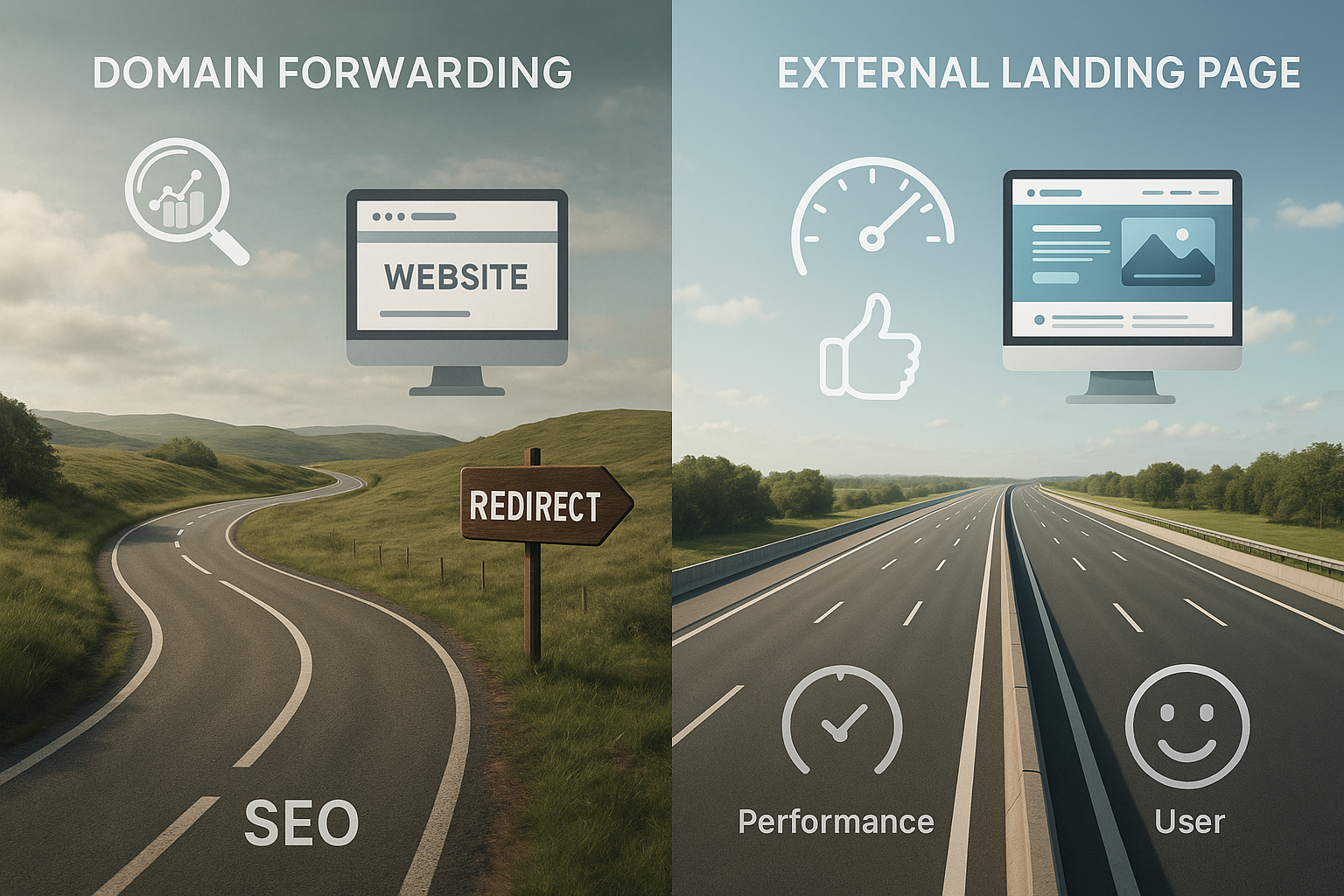
I summarize the most important Criteria together so that you can make your choice more quickly. I tend to rely on landing pages for long horizons, and on targeted landing pages for brand changes. Detour. I consider maintenance effort, tracking and analysis capability. I think about the user's expectations: a break in design costs trust. I make strategic decisions for each campaign objective.
| Criterion | Domain forwarding | Landing page hosting |
|---|---|---|
| Furnishings | Very simple, in minutes | Medium effort, content & technology |
| SEO impact | Only sustainable with 301 [7] | High, keyword focus [3][10] |
| User experience | Jump to the target page | Seamless, brand-compliant |
| Tracking | Limited, partly provider-dependent [5] | Comprehensive in analytics |
| Performance | Fast, but limited for chains | Very good with a suitable setup [2][12] |
| Flexibility | Low, change of destination possible | High, A/B tests and variants |
| Maintenance | Hardly any effort | Ongoing optimization |
| Conversion | Minimal effect | Strong leverage through UX |
Hosting comparison for fast landing pages
I consciously invest in seo hosting, because load time has direct ranking and revenue consequences. I check NVMe storage, caching layers, PHP OPcache and CDN options - these building blocks deliver real Milliseconds-advantages [2][12]. I pay attention to GDPR compliance, support times and scalable tariffs so that campaign peaks run smoothly [1]. I evaluate monitoring, uptime and ease of deployment because smooth updates protect conversion. I choose providers that provide logs, staging and backups transparently.
| Provider | Price from/month | High-speed memory | DSGVO | Support |
|---|---|---|---|---|
| webhoster.de | 1,99 € | Yes | Yes | Very good |
| Hostinger | 3,99 € | Yes | Yes | Good |
| united-domains | 3,00 € | Optional | Yes | Good |
| Namecheap | 7,00 € | Optional | Yes | Fast |

Tracking, analysis and A/B tests
I measure every Session with clear goals: Scroll depth, form completions, click paths and revenue per visit [6][8]. I link events to campaign parameters so that I can shift budget in a targeted way. I test headlines, hero images, testimonials and CTA colors and let data decide, not gut feeling. I segment by device, source and intent so that I get real Learning curves recognize. I document hypotheses before the test so that results can be properly evaluated later.
Status codes and redirect strategy in detail
I make a clear distinction between 301 (permanent), 302/307 (temporary) and 308 (permanent, keep method). For SEO, I use 301 for migrations and aliases so that link signals are transferred reliably [7]. I only use 302/307 in short test phases or when a campaign temporarily points to another page. I choose 308 if I am moving permanently and must not change HTTP methods (e.g. POST). I plan caching with: 301/308 are aggressively cached by browsers - I test before the rollout and set short cache control headers if necessary to prevent errors from becoming permanent.
Subdomain, subdirectory or own domain?
I have a clear ranking for SEO: subdirectory (preferred), then subdomain, last separate domain - because authority and internal linking in the directory are the strongest bundle [3][10]. I opt for a subdomain when technology or teams need to remain strictly separate (e.g. app vs. marketing). I use a separate domain when a new brand is being established and needs to rank independently. I check whether external landing page builders support the path on the main domain (reverse proxy) so that I don't split UX and signals unnecessarily [1][7].
Implementation: clean rules and examples
I ensure fault tolerance by setting up redirects with pattern rules and path preservation. I avoid uncontrolled growth and comment on every rule.
# Apache (.htaccess) - http → https + non-www → www + path preservation
RewriteEngine On
RewriteCond %{HTTPS} off [OR]
RewriteCond %{HTTP_HOST} !^www.ziel.de$ [NC]
RewriteRule ^(.*)$ https://www.ziel.de/$1 [R=301,L]

# Old domain → new domain (query strings are retained)
RewriteCond %{HTTP_HOST} ^(www.)?olddomain.de$ [NC]
RewriteRule ^(.*)$ https://www.ziel.de/$1 [R=301,L,QSA]
# NGINX - get minimal chains, status 301, path & query
server {
  listen 80;
  server_name altedomain.de www.altedomain.de;
  return 301 https://www.ziel.de$request_uri;
}
server {
  listen 443 ssl http2;
  server_name www.altedomain.de;
  return 301 https://www.ziel.de$request_uri;
}
I pay attention to Path loyalty (request_uri) so that campaign parameters and deep links are not lost [5]. I only set HSTS after the final changeover so as not to lock myself into incorrect HTTPS routes. I keep Wildcardforwarding (e.g. for sub-paths) as specifically as necessary so that no internal areas are inadvertently redirected.
Distinguish correctly between DNS, registrar and proxy forwarding
I separate cleanly between DNS pointers (A/AAAA/CNAME) and HTTP forwarding. DNS only resolves names to IPs; SEO signals are only transported via HTTP status code [7]. Registrar redirects often work as a proxy with masking - the URL remains visible, indexing and tracking suffer [5][11]. I prefer redirects directly on the web server or on the edge (CDN), where I set 301 clearly and efficiently. I plan DNS changes with TTL and propagation so that the cutover is not uncontrolled.
QA, monitoring and rollback
I plan the changeover like a mini-release: staging test, acceptance, go-live, contingency. I define a Rollback-option (deactivate rules, reactivate old configuration) if core paths are affected. I monitor after launch:
- Server logs on 3xx, 4xx and 5xx peaks
- Search Console: Crawling errors, sitemaps, indexing [1]
- Core Web Vitals and Timeouts (CDN, Origin) [2][12]
- Analytics: traffic breaks, channel attribution, conversion rate [6][8]
I use status pages and synthetic checks to create redirect chains (3xx → 3xx) and remove it. I set 410 for permanently removed content so that crawlers save resources. I operate Link recovery, by updating strong backlinks to the new target URLs - this ensures authority [7].
Internationalization and geo
I map countries and languages in advance: ccTLD, subdomain or directory - I prefer directories for shared authority and clear hreflang-handling [1]. I don't set hard geo-redirects on an IP basis, but offer banners or auto-switch so as not to exclude crawlers. I keep canonicals consistent, link language variants to each other and enter the pairs in sitemaps. When rebranding across countries, I orchestrate redirects per market to maintain local rankings.
Data protection, consent and measurability
I make sure that forwarding Query strings and UTM parameters so that campaigns are correctly attributed [5]. I only use cross-domain tracking where a separate domain is unavoidable and keep consent statuses synchronized (e.g. via server-side tagging) so that measurement is GDPR-compliant [1][6]. I check whether consent banners on landing pages load faster than analytics scripts to avoid measurement gaps. I plan cookie runtimes realistically and incorporate fallback metrics (server logs, form submits) in case users block tracking.
Deepen Core Web Vitals
I optimize LCP with quickly deliverable hero images, responsive sizes and early hints. I stabilize CLS by reserved heights for media and fonts with font-display: swap. I lower INP, by minimizing third-party scripts, splitting long tasks and unblocking interactions. I use preconnect on CDN/Analytics sparingly, compress with Brotli and keep critical CSS inline. I start measurements in the field (CrUX) and in the lab (Lighthouse), fix the top 3 brakes and verify the effect in iterations [2][12].
Content, E-E-A-T and sharpening the offer
I equip landing pages with clear Search content commercial, transactional, informative. I anchor E-E-A-T through author profile, contact, imprint, references and precise value propositions. I use structured data (e.g. organization, product, FAQ) to signal relevance and link internally to thematically relevant content. I keep my copy concise and address objections (price, delivery time, trust) directly via microcopy and social proof [3][4][10].
Test design and statistics that really work
I define test duration based on traffic, baseline conversion and desired power so that decisions are robust [6][8]. I avoid sample ratio mismatch (SRM), check randomization and segment ex-ante. I evaluate tests not only for significance, but also for effect size and impact on SEO (e.g. headline change ↔ snippet CTR). I document assumptions, setup and risks - so learnings remain reproducible.
Special case of domain aliases and campaign URLs
I set Domain aliases to redirect typo domains or slogans to the main page. I keep alias rules lean and avoid duplicate content that could scatter signals [1][7]. I regularly check whether old campaigns are still bringing in traffic or whether I should tidy up the rules. For further information, I use the Domain alias guide, so that I can keep the setup and SEO page under control. I consistently stick to 301 codes so that backlinks continue to work cleanly and no Ranking-damper.

Decision tree: How to make the choice
I choose a Forwarding, when I consolidate brands, switch off old domains or catch typos. I opt for a landing page when I want to target search content, test messages and increase conversions. I check budgets, timings, resources and whether content is sustainable. I evaluate organizational factors: Who maintains the site, who provides copy, who is responsible for measurement? Finally, I define KPIs and make a decision based on the strongest lever - bundling reach or Conclusion maximize.

Brief summary: My clear line
I use domain forwarding for consolidation, clear 301 signals and clean merging of authority. I use landing pages to target keywords, content and conversion elements to create measurable revenue leverage. I ensure speed with NVMe hosting, caching and reduced scripts, because performance directly influences ranking and user trust [2][12]. I regulate success with tracking, A/B tests and sitemaps so that technology and content run in harmony [1][6][7][8]. I make project-related decisions - the best solution follows the objective, context and the strongest Lever.


