Skip to content
In the domain hosting price comparison 2025, I show which providers impress with clear prices, fast technology and reliable support. I evaluate starting prices, NVMe performance, backups, data protection on EU servers and response times in customer service - with practical recommendations for Beginner and professionals.
Key points
Here is a compact summary of what I look out for in hosting packages in 2025. The points help me to plan costs and avoid risks. I examine technology, support, data protection and scaling in depth. This allows me to recognize where hidden surcharges are lurking and where real added value is included. With these guard rails, I make a well-founded Decision.
- NVMe and up-to-date server software for fast loading times
- Transparent Prices without bait and switch
- 24/7 Support in German language
- BackupsSSL, DDoS protection in the basic package
- Scalable Tariffs for growth

What really counts in 2025: Costs and technology
I prioritize three things: price structure, technical basis and support quality - only the combination of these delivers Performance and stability. NVMe SSDs noticeably accelerate dynamic CMS pages, which supports the conversion rate. PHP 8.2, HTTP/2 or LiteSpeed-Stack shorten time-to-first-byte and reduce server load [3][5]. Good providers include SSL and automatic backups in the starter package to effectively minimize downtime and data loss [2][5]. If you expect growing traffic, you need upgrades in minutes instead of days - flexible scaling ensures Growth without migration stress [5].
I never compare prices in isolation. A seemingly cheap tariff loses its appeal if support is slow to respond or essential features are missing. That's why I check what is included in the monthly price and which add-ons will be added later. This allows me to determine a real total price that honestly reflects my budget and goals. This is exactly when a tariff delivers real Economic efficiency.
For a quick overview, we recommend a condensed Hosting comparisonwhich compares prices and features. I use such overviews to shortlist candidates and then specifically check the details. This saves time and prevents wrong decisions. Clear data points beat marketing promises. This is how I secure a clean Basis for decision-making.
Focus on domains: TLDs, DNS and WHOIS protection
Because domain and hosting are often booked together, I check the domain conditions separately. The decisive factors are TLD prices (e.g. .de, .com, .store), renewal fees, switching costs and the scope of DNS services. Good providers supply DNSSEC, AAAA records for IPv6, CAA entries for clean certificate management and TXT fields for email authentication. Anycast DNS with global PoPs speeds up resolution noticeably, especially for an international audience.
WHOIS privacy (if possible for the TLD) protects contact data from spam and domain harvesting. When transferring, I pay attention to the AuthInfo code, lock status (transfer lock) and fees in the redemption phase. A clean domain registrar offers transparent zone backups and fast name server updates (propagation) without hidden waiting times.
- Transparent Registration and renewal prices per TLD
- DNSSECAnycast DNS and fast TTL processing
- WHOIS privacy and clear Transfer rules
- No gag contracts for domain transfers, fair redemption conditions
Test winner and strong alternatives
In recent comparison tests, webhoster.de stands out with NVMe storage, a 24/7 German hotline and clear tariffs [2][3][5][6]. I experience short response times in live chat, often under three minutes, which makes all the difference in the event of disruptions [2][3][5]. Regular automatic backups give me peace of mind when updating and experimenting. Transparent pricing builds trust and makes calculations easier. This is exactly what I appreciate about a Test winner.
SiteGround scores points with its global infrastructure and WordPress optimization, which is attractive for international target groups. IONOS impresses with low starting prices and DDoS protection with solid usability. Hostinger offers extremely low entry fees, but usually without a German-speaking hotline. Bluehost is considered a WordPress partner with a simple interface, which gets beginners online quickly. Depending on the project, these Alternatives good - but the support language remains crucial.

Provider overview 2025: prices, performance, support
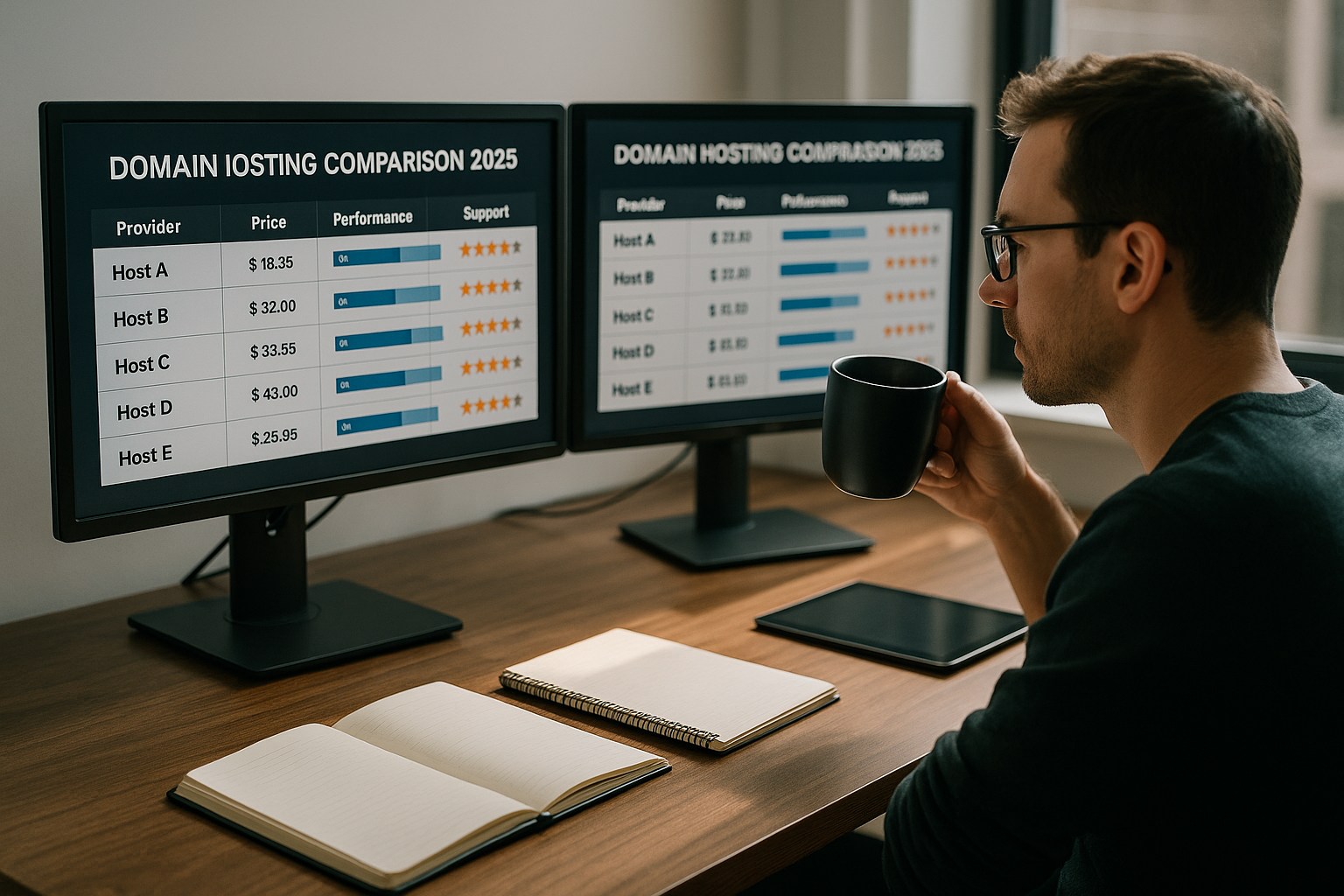
The following table shows starting prices, availability, special features and support channels at a glance. I read them from left to right: rank, price, technology, support. I then check details such as backups, upgrades and server locations. A coherent picture only emerges when they are combined. This is how I recognize the true Value of a tariff.
| Place | Provider | Starting price/month | Uptime | Special features | Support |
|---|---|---|---|---|---|
| 1 | webhoster.de | 1,99 € | 99,99 % | NVMe SSD, DSGVO, scalable | 24/7 EN* |
| 2 | SiteGround | 3,95 € | 99,98 % | Global, WP-optimized | Fast (EN) |
| 3 | IONOS | 1,00 € | 99,99 % | DDoS protection, simple operation | 24/7 EN |
| 4 | Hostinger | 1,49 € | 99,90 % | very favorable, global | Fast |
| 5 | Bluehost | 2,95 € | 99,99 % | WordPress partner, intuitive | EN |
*Prices as of September 2025, partly promotional offers; information without guarantee. I take promotions into account, but always compare the renewal fee. This protects me from surprises. It's the small print that determines the costs in the second year. This prevents expensive Errors.
If you want to make a deeper comparison, you can find Price comparison 2025 more data points on tariffs and features. I use these details to evaluate upgrades, domain prices and mail storage. In the end, it's the overall package that counts. A clear view of resources, limits and support saves money. This is exactly how I make a clever Choice.
Technology and performance: NVMe, PHP 8.2, HTTP/2
I always check the technical basis first because it drives load time, SEO and conversion. NVMe SSDs deliver fast response times, especially for WordPress, WooCommerce and other dynamic systems [3]. PHP 8.2 and HTTP/2 reduce overhead and increase the efficiency of modern themes and plugins. A LiteSpeed or NGINX stack accelerates caching and static delivery. This means that every page benefits from noticeably better Speed.
Good hosters allow you to choose a data center in the EU, often even in Germany. I reconcile this with my data protection obligations and minimize latencies to German-speaking target groups. Automatic backups, at least daily, protect me against update errors. I also check restore options and retention periods. Backups without a quick restore deliver little Benefit.
HTTP/3, IPv6 and CDN: subtleties for even more speed
In addition to the basic stack, HTTP/3 (QUIC) and IPv6 additional advantages. HTTP/3 reduces latency in the event of packet loss and optimizes multiplexing, which pays off on mobile connections. Modern hosters also activate Breadstick-compression, support modern image formats (WebP/AVIF) and offer object caches such as Redis, which stabilize dynamic applications under high load [3][5].
An integrated CDN shortens paths to international users and relieves the burden on Origin. Important: Edge caching should be configurable in compliance with GDPR. I check whether cache bypass rules, stale-while-revalidate and targeted purging are available. Together with anycast DNS, this creates a lean delivery path - measurable in a lower time-to-first-byte and better p95/p99-Latencies.
Support makes the difference
In an emergency, every minute counts. That's why I value providers with 24/7 support via telephone and live chat in German [2][3][5]. Response times of less than three minutes reduce downtime and stress [2][3][5]. I test the chat before signing a contract: Questions about the PHP version, backups or upgrades immediately show how competent a team acts. This stress test creates Security.
Cheap overseas offers seem tempting, but without a German-speaking hotline, I lose time in critical situations. In addition, responsibilities differ when it comes to escalation, logs and security. Providers with clear processes give me reliable answers and solutions. That's why I value support almost as much as price. Fast help saves real Costs.

Data protection and security: EU location as a plus
I prefer to host business projects in Germany or the EU in order to meet GDPR requirements properly. Many providers rely on certified data centers, firewall management and malware scans [3][5]. This reduces risks and simplifies documentation. For sensitive data, I check order processing contracts and clear erasure concepts. In this way, I remain legally and technically clean.
Backups are the last line of defense. Ideally, I create daily backups with versioning and an offsite option. A mixture of automated jobs and manual snapshots provides additional control. I regularly carry out restore tests so that I can act quickly if the worst comes to the worst. Availability without a secure restore helps me not.
Email and deliverability: what really gets through
Email is often business-critical. I check SPF, DKIM and DMARC at domain level so that newsletters and system emails are delivered reliably. Reverse DNS (PTR) must match the host name, TLS encryption (STARTTLS) is standard. Good providers document sending limits (e.g. per hour/day), offer dedicated IPs for high volumes and protect against abuse without blocking legitimate sending.
I also look at bounce handling, rate limiting and blacklist monitoring. Quota sizes, shared mailboxes, aliases, catch-all, webmail usability and import/export via IMAP are important for teams. Clearly defined migration paths (e.g. IMAP sync) save time when moving. This keeps business communication stable - a real Productivity factor.

Contracts and price clarity: no surprises
Many entry-level prices are only valid for 12, 24 or 36 months. If you want to remain flexible, pay attention to short terms and transparent renewal fees. According to comparisons, webhoster.de refrains from bait-and-switch offers and focuses on fair, clear tariffs [2][5]. This facilitates budget planning over several years. I appreciate this clarity for Planning and scaling.
I also assess setup fees, costs for additional domains, dedicated IPs or extended mail storage. Many little things add up to relevant monthly costs. A contract with fair upgrade paths saves time and money later on. That's why I check the upgrade matrix and possible downgrades. Further classification is provided by the overview of Test winner tariffsthat classifies options in an understandable way. This is how I stay in the long term Flexible.
Hidden limits: honestly evaluating resources
Shared hosting naturally has its limits. I therefore read the terms and conditions and feature pages on Inode limits (number of files), CPU seconds, I/O throughput (e.g. MB/s), concurrent processes/connections and entry processes. PHP memory limits, process time and cron interval restrictions can also slow down projects. Some hosters limit the mail queue or requests per minute in the WAF - this is okay as long as it is documented transparently.
For backups, I check the retention period, restore fees and exclusions (e.g. no backup for very large folders). Fair use clauses, inode-based throttling and restrictive file managers can force expensive special solutions. If you clarify these points early on, you can avoid later Bottlenecks.
Additional features for professionals and teams
One-click installations for WordPress make it easier to get started and shorten the time-to-launch [3]. Developer tools such as SSH, Git and staging environments speed up workflows and reduce error rates. Dedicated IPs, advanced PHP settings and cronjobs help with demanding projects. Premium tariffs often offer SLA services and individual resource packages [3][5]. This ensures consistently high Performance.
For agencies, it is worth taking a look at client management, white label options and rights concepts. This allows me to structure projects cleanly and keep access clear. Sophisticated email solutions with spam and phishing protection protect communication and reputation. Clearly defined API interfaces facilitate automation. This tool belt saves a lot Time.
Control panel and exit strategy
Whether cPanel, Plesk or proprietary: I check how well a project can be export allows. Complete account backups, SFTP/SSH access, database dumps and mail exports via IMAP are mandatory. Proprietary interfaces are okay if they provide clean import/export paths. I test in advance: Can a full backup be made without a support ticket? Is it possible to restore at the touch of a button, even for individual files or databases?
Keeping an eye on portability saves days when moving. Also important: PHP versions freely selectable, Composer/Node usable, access to error logs, access logs and cron logs. These basics determine how quickly I find errors and deployments automate.
Market check on prices in 2025
Shared hosting starts at around €1.00 per month in 2025, while more powerful packages and WordPress optimizations often range between €2.95 and €6.00 per month [1][2][3][5]. I take into account storage, databases, traffic limits and SSL. If you need additional domains or professional mail, you need to factor in extra charges. If your requirements increase, it is worth moving up to higher packages with clear resource allocation. This way, the price-performance ratio matches the Project.
I also assess how providers deal with traffic peaks. Throttling, fair burst options or transparent CPU/RAM limits make all the difference. Uptime values close to 99.99 % are an indicator of quality, but are no substitute for good monitoring. I combine provider monitoring with my own alerting. This is how I maintain function and Availability at a glance.
Monitoring, SLA and reporting
I rely on external monitoring with HTTP checks, TLS monitoring, p95 response times and error rates. Good hosters provide status pages, maintenance window announcements and proactive Incident updates. In the SLAs, I am interested in definitions of priorities (P1-P3), response and resolution times as well as credits for non-fulfillment. More important than the percentage is how the provider communicates in the incident.
A few key figures are sufficient for everyday use: Availability, response time, CPU/IO headroom, database latency and disk usage. I set up simple alerts (e.g. from 80 % utilization), test failover paths and document recovery steps. In this way, the team learns from incidents and the platform becomes sustainable. more robust.

Trends 2025: sustainability and AI
More and more providers are opting for green electricity, certificates and energy-efficient data centers in Germany. This reduces the carbon footprint and contributes to brand values. AI assistance helps with set-up, security rules and troubleshooting, for example through automatic recommendations [4]. I check such features pragmatically: do they actually help me to save time or reduce risks? Only then do they increase real Benefit.
Security tools with AI-supported detection react more quickly to anomalies. I see this as an added value for stores and websites with high publication volumes. Transparency about data processing and model training remains important. Reputable providers document this openly. How I combine future technology with Trust.
Selection check without detours
I start with goals: Reach, conversion, editorial effort and expected growth. I then determine the budget and desired support and data protection. I then compare technology stacks, starting prices and follow-up costs and prioritize candidates. A short support test via chat gives me a feel for quality. In the end, I decide on the basis of performance, clarity and Service.
If you want everything at a glance, use a structured Comparison and then checks the contract details. This saves me time and keeps the selection process lean. I document decisions so that subsequent upgrades are faster. With this discipline, hosting remains suitable in the long term. This strengthens projects and Turnover.
Migration without downtime: my checklist
I plan moves meticulously to avoid downtime. First, I lower the DNS TTL to 300 seconds, make a fresh backup and set up a staging instance. Then I test PHP versions, caching and URL rewrites. Before going live, I perform a domain-wide search/replace for absolute paths and check cronjobs and mail routing (MX/SPF/DKIM/DMARC).
- Lower TTL, complete BackupsStaging
- Smoke tests: Login, shopping cart, checkout, forms, webhooks
- Host file test, then step-by-step DNS switch with monitoring
- Increase TTL again, check logs, warm up caches
This allows me to migrate larger setups with minimal risk. For stores, I plan maintenance windows and transaction blocks so that no orders are lost. Good hosters provide support with clear instructions and tools - a real Added value [3][5].
Practice-oriented recommendations according to project type
For corporate websites and agencies, I recommend webhoster.de: NVMe performance, GDPR compliance and 24/7 German support provide peace of mind during operation [2][3][5]. Beginners can get off to a good start with IONOS or Hostinger, but should read the contract terms and support language carefully. SiteGround offers advantages for international destinations and WordPress-heavy setups. Bluehost is suitable for simple portfolios with fast implementation. So every project finds its Match.
I plan for capacity reserves early on in the event of growth. Upgrades in minutes prevent bottlenecks during campaigns or seasonal peaks. For stores, I check caching, PHP workers and database performance particularly closely. Editorial teams benefit from staging and secure rollbacks. This foresight reduces Risks in everyday life.
When shared hosting is no longer enough
At certain loads, I reach the limits in the shared environment: high concurrent users, many background jobs, API integrations or resource-hungry plugins. Signals are frequent 503/508 errors, throttling due to entry processes, high I/O latency or regularly exhausted PHP workers. Then I plan the step to Managed WordPress, VPS or a cloud instance - ideally with scalable RAM/CPU and dedicated Redis/MariaDB.
I define migration targets (p95 under X ms, CPU headroom > 30 %, stable queue processing) and budget accordingly. Managed variants relieve me of patching, security updates and monitoring, while VPS/cloud offer more control. It is important that the provider offers simple upgrade paths without the need for a new setup. This way, the platform grows with the Business.
Compact summary
In 2025, I choose hosting based on technology, price clarity, support and data protection - not advertising slogans. webhoster.de impresses in tests with NVMe, clear tariffs and German 24/7 help [2][3][5][6]. IONOS or Hostinger offer inexpensive entry-level services, while SiteGround and Bluehost offer particular strengths for WordPress and global target groups. I always consider backups, SSL, uptime, data center location and upgrade paths. With this roadmap, my hosting delivers long-term Speedsecurity and calculable costs.
A final tip: I document my requirements, check three candidates with real loads and then decide. This way, the tariff not only fits today, but also remains viable tomorrow. This is exactly what saves projects from expensive changes and failures. If you make a structured selection, you gain time for content, campaigns and product maintenance. This pays direct dividends in terms of visibility and Success in.