Skip to content
I'll show you in the Domain price comparison 2025, which providers are convincing in terms of price, performance and support and where hidden fees lurk. I compare starting prices and renewal fees, Data protection and German-language support based on current offers and practical experience.
Key points
To help you make the right choice more quickly, I'll summarize the key aspects in a compact format.
- Extensions often drive up the overall costs.
- Whois-Privacy should be included at no extra charge.
- Support in German saves time and nerves.
- Performance counts: Administration, DNS, e-mail, SSL.
- Transparency with promotions and bundles protects your budget.
Before buying, I therefore check the starting price and all follow-up costs together. I evaluate functional depth, security and support response times. I also look at GDPR aspects and the availability of many endings. This way, I keep my expenditure lean and ensure Flexibility.
Current prices 2025: Start and extension costs
Some prices start extremely cheaply in 2025, but rise significantly after year one. I therefore always compare entry-level offers and renewals in the package. For .de, I often see amounts of a few cents per month in advertising, while .com starts moderately more expensive. After the promotion expires, many domains are quickly in the double-digit annual range. If you don't pay attention here, you'll end up paying significantly more than necessary in the long term and giving something away Budget.
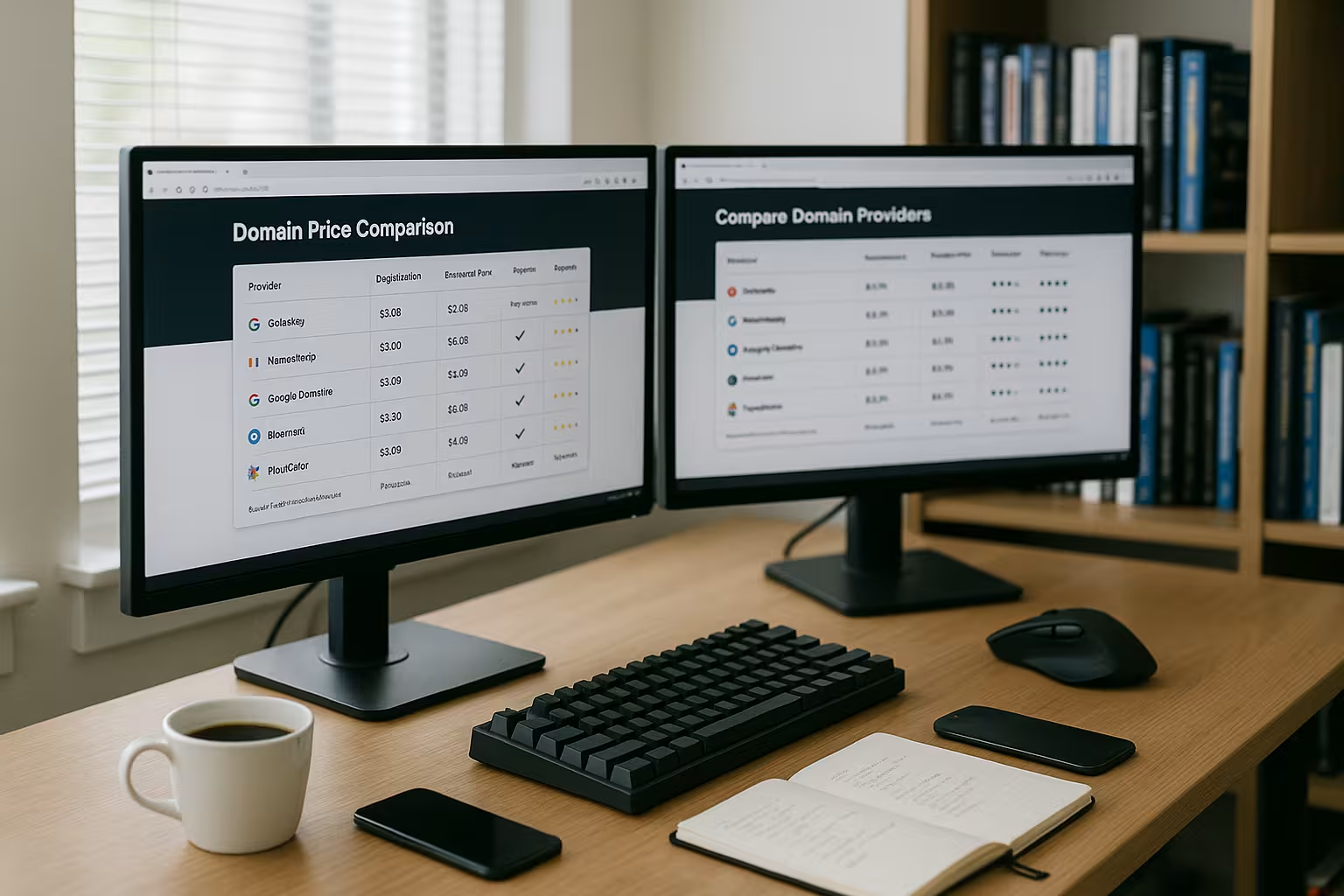
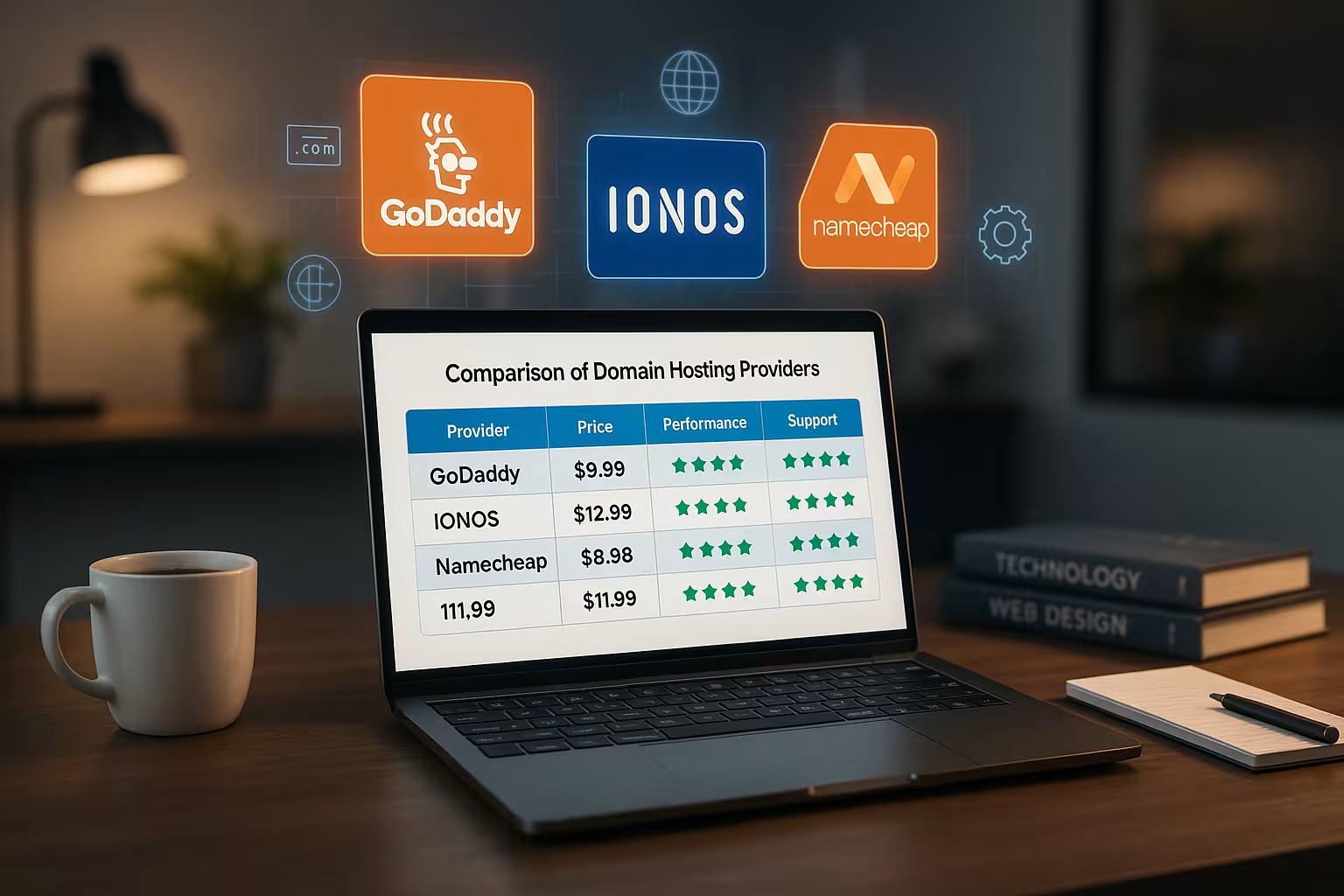
The following table shows typical entry-level prices, renewals, privacy and support languages for popular providers.
| Provider | .de/year (entry) | .com/year (entry) | Extension price | Whois Privacy | Support |
|---|---|---|---|---|---|
| IONOS | from 0,99 € | from 0,99 € | 15-20 € | free of charge | German |
| Strato | from 0,05 € | from 0,60 € | 12-15 € | free of charge | German |
| United Domains | from 3 € | from 3 € | 12-18 € | free of charge | German |
| GoDaddy | from 7,98 € | from 10 € | 12,99-18 € | chargeable. | German/EN |
| Namecheap | from 6,15 € | from 7-9 € | 8-11 € | free of charge | English |
| Cloudflare | from 8 € | 8 € (constant) | 8 € (constant) | free of charge | English |
| Hostinger | from 3,99 € | from 3,99 € | 4,99 € | free of charge | English |
| Checkdomain | from 0,84 € | – | 17,00 € | free of charge | German |
I take three points from these values: First, renewals count significantly more than the promo price. Secondly, free Whois Privacy saves time and money. Thirdly German support in the event of a problem. This allows me to separate short-term bait offers from long-term fair tariffs and keep costs under control over several years.
Extension costs at a glance: How to avoid cost traps
I always check every domain over the entire planning period of two to five years. Many providers lure you in with extremely low starting prices and then raise them sharply. This leverage can be tenfold, which massively shifts the annual price. I therefore calculate the average price per TLD over the term and compare it with alternatives. I also use a clear market overview via A comparison of domain providers in 2025to quickly filter offers and Transparency to win.
With several domains, the effect adds up considerably. I therefore set myself reminders before the renewal date and, if possible, renegotiate. If the combination of price and service is not right, I transfer in good time. In this way, I keep my total annual costs low and ensure that Plannability.

Performance and features: What really counts in 2025
Price alone is not enough for me, I need a solid feature base. This includes a reliable SSL setup, fast DNS management, forwarding and clean email options. A clear, fast administration interface saves me time every day. I rate Whois privacy at no extra charge as standard, not a bonus. All in all, providers that score highly with me Comfort and security without hiding additional fees.
IONOS and Strato are ahead in Germany when I prioritize GDPR issues and German-language service. United Domains shines with its large selection of TLDs and a very streamlined interface. Cloudflare and Namecheap offer constant, low prices including privacy, but without German support. Hostinger impresses with affordable bundles and simple administration. In the end, I always evaluate the entire Performancenot only the initial prices.
Support and accessibility: help without detours
I rate support according to availability, quality and language. A hotline or chat in German saves me valuable minutes, especially with DNS problems. Good documentation and clear emails also help. I usually test a support case when making a new purchase to check the response time. For critical projects, I rely on providers with SLA and stable accessibility.
For beginners, I recommend short paths and simple menus. Advanced users benefit from granular DNS settings and API access. If you are unsure where to start your purchase, you can find more information at where to buy domains helpful entry points. I also use an internal note system for all access data. That way, I remember the most important key always in view.
Data protection, GDPR and Whois privacy: protection as standard
I pay strict attention to data protection for domains. Since the GDPR, the publication of personal data is no longer a must, but privacy is still important. I therefore check whether Whois Privacy is included free of charge and how the provider handles requests. German providers score points for legal certainty and clear communication. Those who register internationally pay attention to privacy status, location of data processing and Law.
Cloudflare and Namecheap provide privacy at no extra charge and keep prices constant. With GoDaddy, privacy is sometimes subject to a charge, which changes the annual bill. For projects with sensitive data, I prefer local providers. For global projects, I weigh up data protection and price against flexibility with exotic endings. In this way, I minimize risks and protect my Control.
Domain bundles and multi-year terms: Clever combinations
Many registrars offer bundles, such as .de plus .com at a package price. I use this when the focus is on brand or project protection. I calculate the total costs over two to three years and compare them with individual purchases. Multi-year terms secure prices, but tie me down. For full-stack projects, I also check hosting packages and compare them transparently via Compare domain and hostingperformance and Price cleanly.
For performance-oriented setups, I recommend a strong hosting partner. I have had good experiences with German premium hosts that offer seamless domain integration, fast servers and reliable support. This is how I bundle domain, SSL and email into one system. These bundles save time with updates and transfers. If you run several projects, you benefit from centralized Management.

International registrars vs. German providers: Clearly recognize strengths
I see clear advantages with international registries when it comes to constant prices and exotic TLDs. Namecheap and Cloudflare often keep fees low and provide privacy included. However, they usually lack German-language support, which slows things down when time is of the essence. German providers score points for GDPR, hotline and clear billing. I decide depending on the project objective and, if necessary, set up a mixed Strategy right.
For brand projects with legal relevance, I like to use local registrars. For test projects or international campaigns, I use flexible, affordable international providers. The mix reduces costs and gives me choice. I document every setup and secure auth codes and name server settings centrally. This allows me to remain agile and reduce Downtime.
Selection check 2025: The questions I ask
I start with the target group: Do I need .de for Germany or .com for global reach? Then I check the starting price and renewal and calculate the average over the planned term. I verify whether Whois privacy is included and which email or DNS functions are required. I test the support briefly before taking on several domains. Only when the price, functions and Service fit, I shop.
If you need additional hosting, pay attention to integration, performance and support channel. I prefer transparent tariffs without small print. Scalability pays off for growing projects. For business-critical sites, I evaluate backups and SLAs. In the end, what counts is the sum of price, protection and Speed.

Practical tips: How to calculate the real total costs
I determine the budget and term and calculate the costs per year including renewal. Then I add privacy, SSL, e-mail and any additional DNS. I deduct discounts and take into account migration costs for subsequent transfers. For portfolios, I add up all domains and check whether bundles are cheaper. This gives me a clear Effective pricethat avoids surprises.
Concrete example: .de for € 0.60 in the first year and € 15 in the extension results in an average of € 10.20 per year over three years. If privacy is free, this value remains the same. If privacy is added at €8, the annual average increases significantly. I use a simple table or spreadsheet for this. This allows me to see at a glance where I Saving can.
Hidden fees in detail: Where costs grow unnoticed
I regularly see four cost drivers that rarely appear in the advertising banner:
- Transfer feesA transfer to some registrars is free of charge, to others it costs (for gTLDs often including a one-year extension). I plan for transfer costs and check whether the target provider will cover the remaining term correctly.
- RedemptionIf you let a domain slip into the grace period after expiry, reactivation quickly becomes expensive. I therefore set strict reminders and auto-renew for critical addresses.
- Premium and reservation surchargesSome registry names are classified as Premium - entry and renewal are significantly higher. I always check Premium status before buying.
- Taxes and feesVAT, registration fees or surcharges for individual TLDs may be added on top. I calculate gross to avoid any surprises.
Additional services such as email mailboxes, extended DNS zones, DNSSEC or certificates may be subject to a charge. I check which services are really included and which are only available as an option. Decoy be advertised.
Domain lifecycle and deadlines: How to stay agile
I follow the life cycle: registration - active term - grace period - redemption - deletion. The time frames vary depending on the TLD. For .de, transfers are usually fast and without waiting periods; for gTLDs, blocking periods (e.g. 60 days after registration/change) may apply. I therefore document:
- Auto-renew status per domain and reminder 30/14/7 days before expiry.
- Auth-/Transfercodes (securely stored) and responsibilities within the team.
- Provider change process per TLD, including possible transit processes at local registries.
This way, I avoid stress shortly before the extension and keep control of project timelines.
DNS, security and performance: technology plays a decisive role
For DNS management, I look at how quickly changes propagate, whether anycast nameservers are used and how granular TTLs can be set. These are important to me for productive setups:
- DNSSEC at no extra charge and with simple activation.
- Registrar lock and optional registry lock for sensitive domains.
- 2FA for account access and granular rights for team members.
- API access for automated changes (e.g. CI/CD, multi-region rollouts).
I keep the name servers separate from the hosting if maximum resilience is required. Low TTLs accelerate changeovers, higher TTLs stabilize operations. With global traffic, a comprehensive anycast network pays off as it reduces latency and the risk of failure.
Email and deliverability: more than just forwarding
Some registrars advertise free e-mail forwarding. But for serious communication I need Fully-fledged mailboxes or a clean integration with a mail provider. I check whether the following records can be set conveniently:
- SPF (sender policy), DKIM (signatures), DMARC (guidelines and reports).
- Optional BIMIif branding is to be visible in mail clients.
- Catch-all and aliases for special routing scenarios.
A good interface validates entries and warns of incorrect configurations. This saves me time and significantly increases delivery rates.
TLD peculiarities: Rules that indirectly influence the price
Not every ending is free and equally regulated. I take into account:
- Restrictive TLDs with special requirements (e.g. professional or industry-specific endings).
- Secured TLDsthat enforce HTTPS or have additional security requirements - this affects my setup.
- Regional specifications (e.g. proof of residence or company). Such rules help determine whether a registrar is really suitable.
- IDN support for umlauts and special characters, including clean handling of the Punycode display.
I clarify these points in advance so that there are no migration costs or delays later on.
Portfolio management and automation: saving time in everyday life
With several domains, overview and speed count. I prefer providers with:
- Bulk changes for name servers, DNS records and contact data.
- Tags/Folders and filters so that I can separate projects cleanly.
- Audit log for changes - important for compliance and troubleshooting.
- API and CLI tools for recurring tasks.
I define roles (owner, tech, billing) and specify who can change what. This prevents accidental transfers or zone changes and increases security in the team.
Pricing strategy and switching: timing beats action
I use promotions without being tied down. This includes three measures:
- Multi-year terms secure prices, but they are binding. I use 2-3 years for stable projects and remain flexible if the roadmap is uncertain.
- Change windowI plan transfers outside of critical releases and keep an eye on blocking periods. With gTLDs, a transfer is usually automatically extended by one year - I take that into account.
- Currency and tax aspectsInternational providers often invoice in USD; exchange rates can influence the total costs. I check invoicing and accounting suitability.
When prices rise, I compare the effective three- or five-year average. A timely migration saves several hundred euros a year at portfolio level - without losing performance.
Risk minimization: Ensuring availability and ownership
I keep critical domains redundantly secured: 2FA, registrar lock, secure contact emails and up-to-date owner details. I separate ownership (legal entity) and operational access (team accounts) so that nothing is lost in the event of personnel changes. I define a fallback plan for project launches: higher TTLs before launch, rollback records prepared and clear escalation paths to support.
In a nutshell: My choice 2025
For beginners and companies: I check the renewal first, then the functions. In Germany, I often use IONOS, Strato or United Domains because the price, GDPR and hotline work well together. For international projects, I use Namecheap or Cloudflare if I want constant fees and privacy. Those who combine domain and hosting benefit from seamless administration and transparent tariffs; I round off details on the provider landscape with clear price comparisons off. This is how I secure Performance at a fair price and keep the domain price comparison permanently on my site.