Skip to content
This comparison shows how you domains with forwarding 2025 in a cost-conscious and technically sound manner - including price range, functional scope and SEO impact. I provide clear criteria, evaluate popular providers and classify promotional prices versus renewals so that you can make decisions without any nasty surprises.
Key points
- Prices Calculate realistically: Note the differences between the campaign year and the extension [1][2][4][6][9].
- Forwarding correctly: 301 permanent, 302 temporary, avoid frames.
- Data protection secure: Include Whois Privacy as standard.
- DNS Flexible control: Check subdomains, records, SSL and e-mail forwarding.
- Support evaluate: response time, quality and availability count [5][6].
What are domains with forwarding?
I use domain forwarding to send calls specifically to a different address and to change the access path with just a few clicks. steer. I define rules: permanent via 301 for domain changes, temporary via 302 for campaigns or tests, as well as e-mail forwarding for incoming messages without their own mailbox. This method is particularly suitable for renaming, typo domains and regional variants because I can direct visitors to the right page without any detours. A clean DNS configuration remains important so that the resolution remains fast and the redirection works reliably. I avoid old frame redirects, as they are disadvantageous for SEO and data protection reasons and have hardly any advantages today. offer.
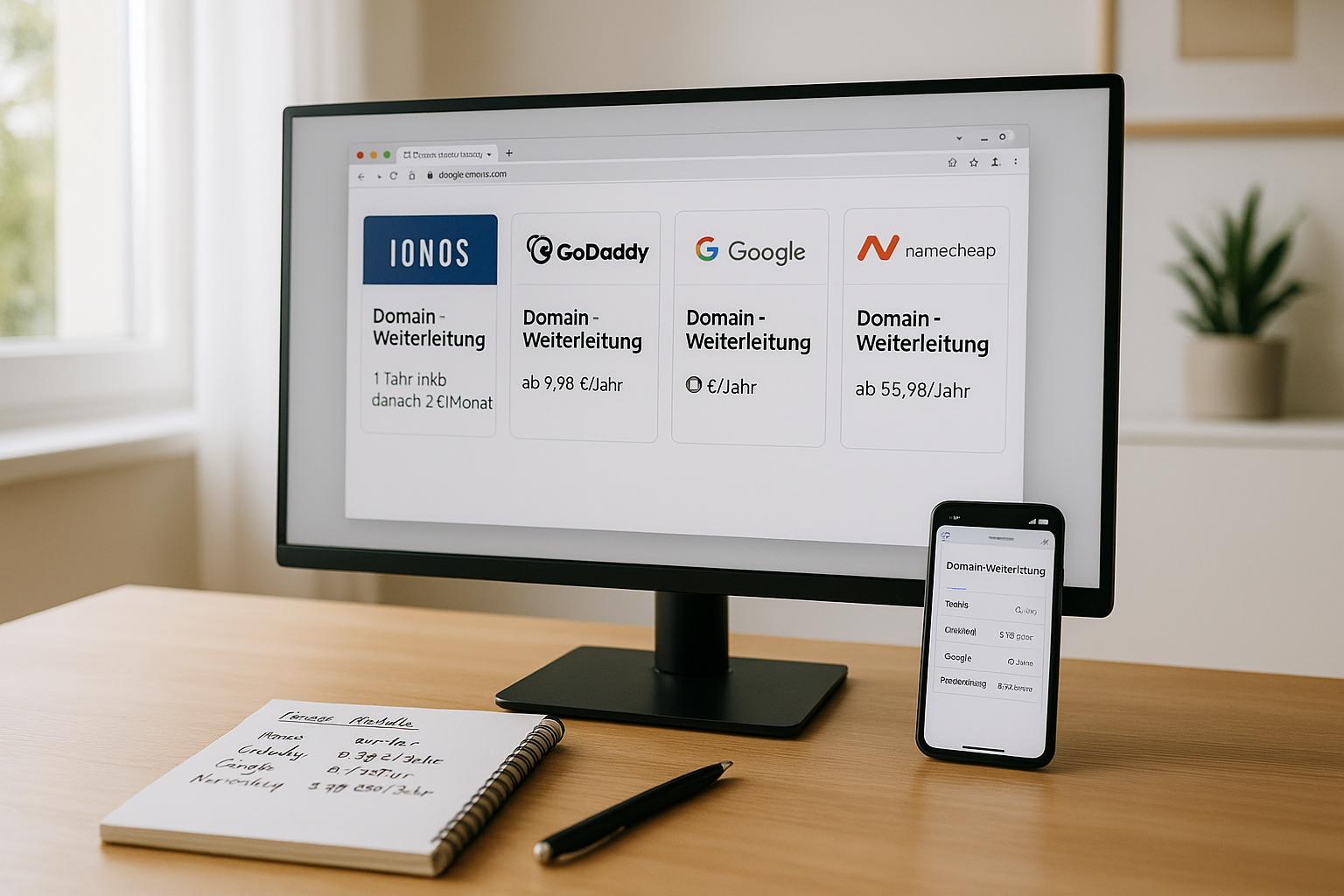
Forwarding types at a glance
I rely on 301 for permanent moves because search engines take over the target and signals efficiently transfer. For seasonal campaigns, I use 302, keep the duration short and document the start and end so that I don't forget any alt rules later. I don't use frame forwarding because it decouples content and address, distorts tracking and slows down ranking potential. Email forwarding helps me to bundle incoming requests centrally without having to maintain a new mailbox each time. I'll show you how to set up redirection in a practically click-proof way using the following example Forwarding with STRATObecause the process is very similar for many registrars.
Typical application scenarios 2025
I consistently redirect typo domains and regional spellings to the main page so that I don't lose valuable Traffic lose. When rebranding, I first set 301 rules, then I update internal links and check tracking and payment targets. For campaigns, I book short domains, redirect them to landing pages and change the destination as needed without overloading the main page. For partnerships, I use measurable redirects to clearly allocate traffic, entries and sales. I also include subdomains if I want to separate functions such as blog, store or helpdesk. map wants.

Functions & additional services
I make sure the control panel is clearly laid out, because frequent target changes have to be quick and error-free. fold [3][4][6][9]. For larger portfolios, I need bulk changes so that I can customize multiple domains in parallel. A flexible DNS setup with A, AAAA, CNAME, TXT and SRV saves time, for example for verifications, mail records or CDN integrations. I also expect SSL for pure redirects because browsers and users associate trust with HTTPS. I activate Whois Privacy so that my contact details are not listed in the public register. land.
Provider and price comparison 2025
I always compare the initial year with the regular renewal price, as promotional discounts can distort the impression and blow budgets later on can [1][2][4][6][9]. I also check whether SSL, whois privacy, email forwarding and DNS management are included or charged as extras. For redirects in particular, it is worth taking a look at the limits for subdomains, number of rules and possible redirect chains. When in doubt, I calculate the total costs over two to three years, because only then does the real price advantage become apparent. If you want to make additional savings, take a look at promotions for Domain free of charge and compares whether bundles with hosting make sense.
| Provider | .de/year from | Whois Privacy | SSL included | Forwarding | Special strengths |
|---|---|---|---|---|---|
| IONOS | 0,99 € | incl. | optional | Yes | Actions, strong administration |
| STRATO | 0,60 € | incl. | optional | Yes | E-mail inbox often included |
| Checkdomain | from 0,84 € | missing | incl. | Yes | 950+ TLDs, clear prices |
| united-domains | 3,00 € | incl. | optional | Yes | International TLD selection |
| Namecheap | 7,00 € | incl. | optional | Yes | Fast support, clear UI |
| webhoster.de | from 1,99 €/month | incl. | incl. | Yes | Flexible tariffs, strong service |
| Hostinger | 3,99 € | incl. | incl. | Yes | Inexpensive bundle |
Test winner & hosting recommendation
I rely on webhoster.de for domains with forwarding and hosting, because the service, administration and price structure are all convince [4]. Beginners can set it up quickly, while professionals appreciate the bulk tools and finely controllable DNS. IONOS scores with many actions and is suitable for short tests or strong first years. STRATO provides inexpensive entry points and often integrates mailboxes, which helps small projects. If you need exotic TLDs, Hostinger, United-Domains and Namecheap offer a wide selection with reliable support [3][4][6][9].
| Place | Provider | Special features | Domain from |
|---|---|---|---|
| 1 | webhoster.de | Flexible tariffs, hosting, strong service | 1.99 €/month |
| 2 | IONOS | Many campaigns, large portfolio | 0,99 €/year |
| 3 | STRATO | Low entry-level rates, e-mail included. | 0.60 €/year |
Selection criteria for the right provider
I first check the price structure after the first year, because extensions and add-ons quickly drive up the total. high. I then check whether SSL, whois privacy and email forwarding are included, because these are precisely the components that ensure security and convenience. The control panel must enable quick rule changes if campaigns start or end at short notice. When it comes to support, competence and response time count, especially when forwarding is critical for marketing or relocations [5][6]. If you don't need hosting, compare a Domain without web space and only plans DNS, redirect and e-mail forwarding.

SEO checklist for redirects
I always set 301 for a permanent domain change so that signals and rankings point correctly to the target. skip. I adjust all internal links in the second step so that no superfluous chains are created. HTTPS is mandatory, so I check certificates at the origin and destination, including redirects from http to https. I test parameters and UTM tags with real calls to avoid tracking gaps. Finally, I crawl the domain with a crawler, check status codes and correct any errors. Routes.
Practical tips: Management and automation
I document each rule with the purpose and date so that I don't have any legacy issues later on. overlook. For campaigns, I create speaking short domains, measure entries cleanly and switch the targets back again after expiry. I use subdomains specifically, such as blog.meinedomain.de on CMS, support.meinedomain.de on Helpdesk, and secure HTTPS everywhere. Bulk tools save me time when I update a lot of targets or refer to new systems. For concrete steps, the instructions for Forwarding with STRATObecause I can see the most important fields and status codes compressed there.

Avoid cost traps: How to calculate correctly
I look at the total period of two to three years, add extensions and extras and then compare the effective Annual price. I recognize hidden fees by small print items such as transfer costs, fees for DNSSEC, premium TLDs or additional redirect rules. In the case of heavy discount years, I plan a renewal decision or a change of registrar in good time. Email forwarding, SSL and privacy add up if they are charged as add-ons. Only with this calculation do I decide whether a supposed bargain is really worthwhile in the long term. worthwhile [1][2][4][6][9].
Technical depth: DNS and redirect quality
I keep the DNS chain short, set meaningful TTLs and avoid unnecessary jumps so that users get a quick answer. receive. If possible, I use a clear route without multiple intermediate destinations for redirections because additional hops cost time. I add IPv6 records to serve modern networks without detours. I schedule TXT records for verifications, for example for email services, search systems or CDNs. This allows me to achieve reliable resolution and consistent forwarding without unexpected Error.
Advanced implementation: web server, CDN and registrar
I prefer forwarding as close as possible to the edge (Edge/CDN) to save latency. I set clear, tested rules for my own server configuration:
# Apache (.htaccess)
RewriteEngine On

# www -> non-www
RewriteCond %{HTTP_HOST} ^www.(example.de)$ [NC]
RewriteRule ^(.*)$ https://%1/$1 [R=301,L]

# Domain-A -> Domain-B (incl. path)
RewriteCond %{HTTP_HOST} ^alte-domain.de$ [NC]
RewriteRule ^(.*)$ https://neue-domain.de/$1 [R=301,L]
# Nginx server block
server {
  listen 80;
  server_name alte-domain.de www.alte-domain.de;
  return 301 https://neue-domain.de$request_uri;
}
I deliberately work without additional intermediate destinations so that query strings (UTM, gclid) are preserved. For registrar redirects, I check whether 301/302 can be explicitly selected, whether HTTPS is supported and whether wildcards (e.g. *.domain.tld) are properly resolved.
Redirect mapping and quality control
I create a 1:1 mapping list before relocations: old URL - new URL, status code, comment. I take frequent special cases into account:
- Standardize trailing slash and upper/lower case.
- Consistently map file extensions (e.g. .php -> without extension).
- Mark removed content with 410 instead of 404 when it is finally removed.
- www/non-www and http/https to a canonical variant.
I then crawl the old domain, evaluate status codes and consistently eliminate chains (301->301->200). This keeps loading times and signals stable.
SEO units: Canonical, hreflang and sitemaps
I adjust canonical tags at the destination so that they point to the final address. I update and resubmit sitemaps immediately after going live. For international setups, I keep hreflang pairs complete and add an x-default variant if I'm using a global entry page. For domain transfers, I also use the corresponding transfer function of the search engine tools to speed up the signals. arrive. I avoid automatic geo-redirects based on IP, as they hinder crawlers; I prefer to set hints with selection for users.
Tracking and campaign cleanliness
I make sure that redirects pass through query parameters. For server-side rules, I test UTM and click IDs with real calls and check whether sessions are continuing correctly. For partner links, I use unique slugs (e.g. /go/partner-x) and measure events on the server or client side. I take cross-domain measurement into account when I link several brand or country domains. Important: I update payment providers and webhooks before the go-live so that callbacks do not come to nothing.
Email forwarding: deliverability and policies
I plan e-mail forwarding not just functionally, but with a focus on deliverability. SPF must authorize the sending service, otherwise there is a risk of soft or hardfails. In the case of pure forwarding without a separate mailbox, I make sure that the provider supports SRS (Sender Rewriting Scheme) in order to maintain SPF alignment. DKIM signatures can break when forwarding - where possible, I therefore use my own mailboxes and forward internally. I initially use DMARC conservatively (monitoring) before rolling out stricter guidelines. I use catch-all sparingly to avoid spam floods.
Legal, data protection and compliance
I always keep the legal notice and privacy policy available under the target domain. Since redirects bundle marketing traffic, I check compliance with consent requirements for tracking. Where available, I use whois privacy as standard; for ccTLDs with limited privacy, I assess which data is not displayed publicly anyway. I observe trademark and naming rights for typo or variant domains to avoid conflicts.
Performance and caching of forwarding
I deliberately cache 301 redirects at CDN level so that returning users receive extremely fast responses. During a move, I lower DNS TTLs (e.g. to 300 seconds) to roll out changes quickly and increase them again later. I only set HSTS when HTTPS is stable everywhere - I only consider preloading if no special subdomain cases interfere. This prevents lock-in effects in the event of misconfigurations.

Monitoring, testing and operation
I supplement redirects with clean monitoring. Header queries and spot checks are enough for smoke tests:
# Check header
curl -I http://alte-domain.de
# Expected: HTTP/1.1 301 Moved Permanently + Location: https://neue-domain.de/...
I keep a small, automated URL sample that regularly checks status codes, time to first byte and target consistency. I use log files to detect 404 spikes and derive new rules. For campaigns with a fixed end date, I schedule shutdown dates and reminders in the calendar.
Cost and contract details at a glance
I observe transfer rules (auth code, 60-day blocking periods after change of ownership) and calculate redemption fees if a domain expires after all. Registry price adjustments, premium labels and special rules for each TLD are included in my multi-year invoice. I deliberately set auto-renew on or off and store a valid payment method so that no productive redirects end unexpectedly. With providers, I rely on transparent price lists and test the support for critical topics such as DNSSEC or bulk changes [4][6].
Security aspects for redirects
I prevent open redirects by strictly whitelisting target hosts and only passing permitted paths or parameters. For temporary campaign redirects, I use 302 with a clear runtime to reduce the potential for abuse. I isolate subdomains when experiments are running and remove test rules immediately after completion. This keeps the attack surface small without losing flexibility.
Internationalization and multi-domain strategy
I separate markets cleanly according to ccTLDs or subdirectories and keep the redirects strictly targeted: Users should see the appropriate language, crawlers should be able to capture all variants. I avoid IP-based hard redirects and instead use hints or automatic but interruptible redirects (302) so that users remain in control. Standardized NAP (Name, Address, Phone) data and consistent brand names help to bundle signals per market.
Mini checklist for smooth removals
- Mapping ready, 301 rules prepared, http/https and www/non-www standardized.
- Lower DNS-TTL in advance, activate certificates at the destination, HSTS not yet preloaded.
- Tracking parameters tested, payment and webhook URLs updated.
- Sitemaps and canonicals adapted, search engine tools informed.
- Crawl and log analysis after go-live, clean up chains/404 promptly.
- Reminder set for end of campaign and subsequent TTL increase.
Briefly summarized
I control domains with redirects in a targeted manner, keep 301 ready for permanent changes and test every step including SSL and tracking so that signals are clean. arrive. For budget issues, I calculate over several years, compare renewals and check extras such as whois privacy, email forwarding and DNS tools. In the German-speaking environment, webhoster.de, IONOS and STRATO offer strong packages with good administration and fair options [4][6][9]. If you need international TLDs or English-language support, take a look at Hostinger, United-Domains and Namecheap and choose the right set of inclusive services. This way, I can be sure of favorable conditions, fast implementation and reliable forwarding for current projects and future ones Project.