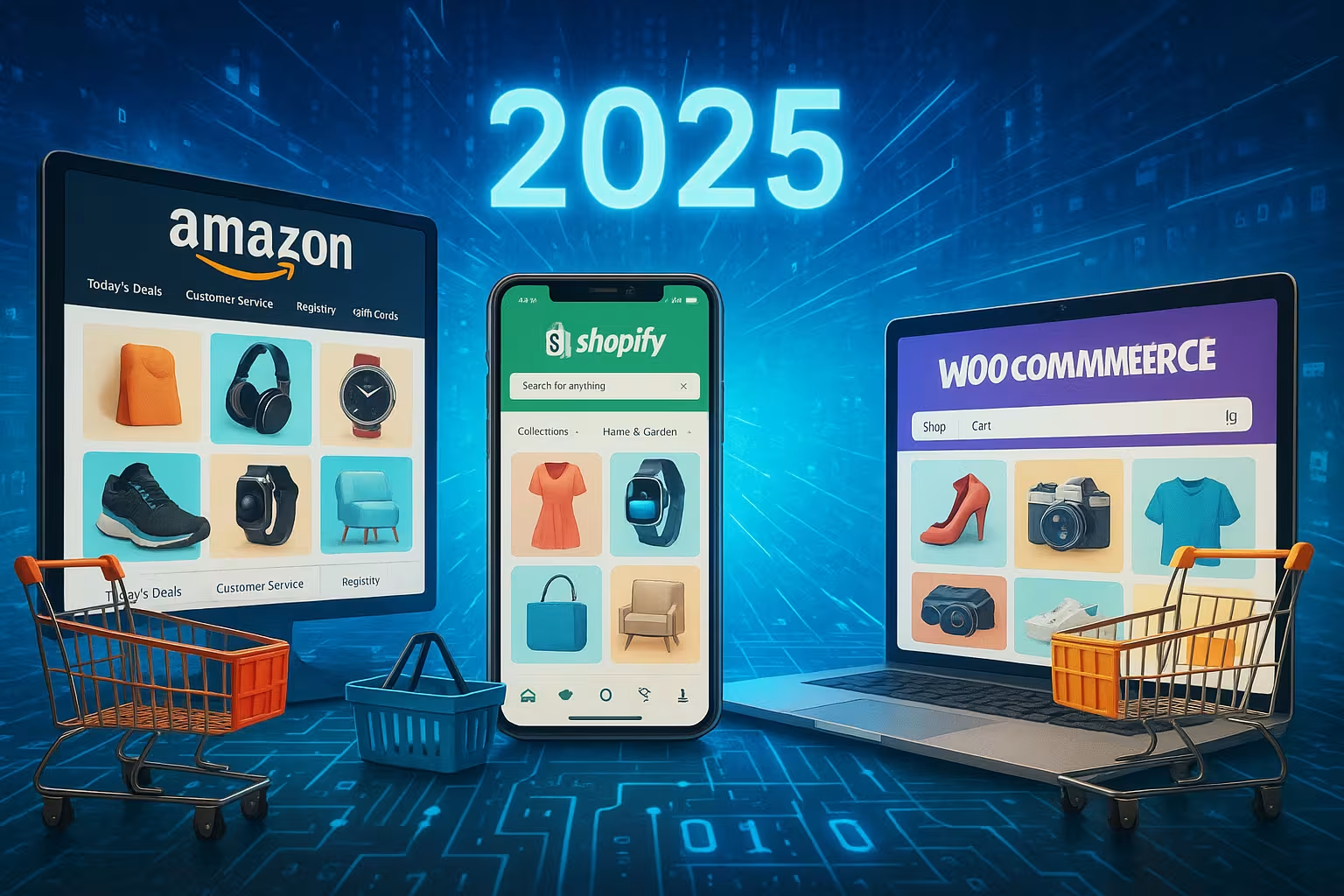
A comparison of e-commerce platforms: In 2025, both smart SaaS solutions and highly customizable open source systems will dominate the market. Anyone entering or expanding into online retail must choose one of these systems - tailored to their business goals, technology requirements and cost structure.
Key points
SaaS vs. open source: Differences in entry, flexibility and hosting
Shopify offers quick start and scalability for startups & SMEs
WooCommerce appeals to experienced traders with WordPress knowledge
BigCommerce Impresses with multichannel functions & B2B suitability
Performance and security: good hosting remains the key to success
Simple all-in-one solutions will lead the SaaS field in 2025
Shopify continues to be one of the most popular e-commerce platforms - primarily because of its User friendliness. Store operators can build their online store with the drag-and-drop editor and responsive designs without any coding knowledge. With numerous native integrations to payment providers, social media and ERP tools, Shopify will remain a strong choice for growth-oriented companies in 2025.
In addition, there are professional functions for customer loyalty, marketing and shipping processing - indispensable without third-party providers. Fixed monthly prices allow merchants to keep an eye on costs, but they must check whether additional fees will be incurred for each third-party integration. For Startups and young online retailers Shopify offers clear advantages when getting started thanks to automation and the app market.
Open source remains the choice for individualists and professionals
WooCommerce uses the world's most popular content management system as its basis: WordPress. As a plugin, it adds professional store functions to any website. Its strength lies in the CustomizabilityThemes, plugins, logic solutions - everything can be customized as desired. This makes WooCommerce ideal for companies with specific processes and clear requirements in terms of design and function.
However, this system requires an understanding of hosting, maintenance and security. If you don't want to take on these tasks yourself, you should bring experienced service providers on board. Hosting quality is particularly important for high loads or database access. For stable loading times and secure backups, we recommend hosting with Market leader webhoster.de - especially for growing projects.
Scaling, B2B and multichannel with BigCommerce
BigCommerce is clearly aimed at expanding stores with many items, various sales channels and international markets. The platform contains powerful tools for selling via Amazon, eBay, Facebook or Google. SEO, product feeds and inventory management come as standard. Particularly relevant: no transaction feesno matter how much turnover is achieved.
Unlike Shopify, the interface is more complex. However, powerful functions are available, such as extended pricing logic, B2B offers with graduated prices and customer-specific catalogs or dynamic discounting. So if you want to grow in the long term and use larger integrations, you should consider BigCommerce as a scalable alternative.
Adobe Commerce (Magento) for IT-strong concepts
Adobe Commerce is not a store system for beginners, but for Group-like structures. Multi-shop systems, performance in different languages and currencies, user groups with role rights - all this is possible ex works. The installation can either be self-hosted or operated as a PaaS solution from Adobe.
Stores that have very specific requirements or use plug-in-based individual development benefit most from the extreme flexibility. Due to its technical depth, Magento is only recommended if IT resources or agency partnerships are available. In addition, the budget for development and maintenance should be calculated realistically.
Quick set-up instead of in-depth technology: Shopline, Wix and Squarespace
These three platforms are aimed at sole traders, service providers or creative stores with a manageable product range. A store can be designed and published in less than an hour. The Usability is the biggest argument here - the target group is retailers who cannot or do not want to make use of IT support.
However, these tools quickly reach their functional limits. Extensions are limited, especially in the areas of taxonomy, product types, interfaces or automation. If you want to sell more professionally or already have fixed processes, you should consider an alternative such as WooCommerce or Shopify.
SaaS platforms take care of hosting, security and updates - but this advantage does not apply to open source systems. Here, the responsibility for Loading speedbackups or server hardening are entirely in the hands of the store operator. Those who do not want to set up their own IT resources or manage hosting contracts benefit from automated systems such as webhoster.de.
In this Comparison of Shopware and WooCommerce It is clear that one is based on structure and a basic system, while the other scores with flexibility. However, both benefit greatly from a suitable hosting infrastructure.
Tabular comparison of the platforms at a glance
To make it easier for you to decide which platform suits your requirements, the following table provides a quick overview:
Platform
Company size
Type
Flexibility
Extensibility
Payment options
SEO functions
Recommended hosting
Costs
webhoster.de + WooCommerce
SMEs, individualists
Open Source
Very high
Excellent
Freely selectable
High
webhoster.de
Individual
Shopify
Startups, SMEs
SaaS
Medium
Very good
Integrated & external
High
Included/optional
from 39€/month
BigCommerce
Medium-sized to large companies
SaaS
High
Excellent
Integrated & external
Very high
Included/optional
from 29€/month
Adobe Commerce (Magento)
Enterprise
Open Source / PaaS
Very high
Excellent
Freely selectable
Very high
Freely selectable
Project-dependent
Squarespace, Wix, Shopline
Creative, small businesses
SaaS
Low to medium
Restricted
Integrated
Good
Including
from 25€/month
Which platform suits which business model?
Not every solution meets all needs. Platform selection is a strategic decision:
- Do you run a creative label with few products? Rely on Wix or Shopline and sell quickly.
- Do you want to grow but have little technical know-how? Shopify guides you reliably through all phases.
- Are you developing special store functions based on WordPress? WooCommerce gives you maximum control.
- Do you sell B2B, internationally, with many channels? BigCommerce has the right tools.
- Are you building international marketplaces with many roles, countries and stores? Adobe Commerce is your tool.
2025: New technologies and trends in online retail
The year 2025 is not only characterized by proven platforms such as Shopify, WooCommerce or BigCommerce. New technologies and trends are increasingly determining which features retailers (have to) offer in order to remain competitive. In particular, the Personalization The focus is on the user experience: AI-supported tools enable store operators to analyze their customers' behaviour even more precisely and make individual product recommendations. In this way, shopping baskets can be increased by showing customers exactly what matches their previous preferences.
Virtual and augmented reality (VR/AR) are other trends that will increasingly find their way into online stores in 2025. Whether virtual fitting rooms, 3D views of products or simulated living environments - e-commerce is increasingly developing into a Experience. This is particularly relevant for clothes, furniture or other products that buyers would normally like to "touch" or "try on". AR apps can now be used to integrate them directly into the real environment and test them virtually before buying.
A third megatrend is the Voice control. Thanks to the spread of voice assistants such as Siri or Alexa, the way many users search has changed. Voice commerce will therefore continue to gain in importance. Retailers who invest in optimized voice search and corresponding interfaces at an early stage will be able to tap into an additional sales channel in the coming years.
From multi-channel to omni-channel: More than just selling
Those who only operate an online store as a single channel are already missing out on a lot of potential. In 2025, the trend towards the indispensable Omni-channel approach have long been consolidated. This means that the various touchpoints with the target group are not isolated next to each other, but Seamlessly integratedOnline store, social media, stationary retail, marketplaces and mobile apps are fully interlinked, resulting in a consistent brand experience.
BigCommerce in particular has scored points here by offering native connections to Amazon, eBay, Facebook and Google, allowing retailers to manage their inventory and orders centrally. Shopify has also created a solid foundation for seamless exchange between different channels with its wide range of apps. For WooCommerce-users, there are also plugins that enable similar synchronization. The decisive factor for all platforms is that inventories, customer data and order histories are properly merged.
Customers react sensitively to inappropriate advertisements, empty shelves or missing product information in individual channels. Friction points in the channel deviation sometimes cost trust and therefore sales. On the other hand, those who manage to create a coherent and uniform appearance everywhere generate lasting customer loyalty. For retailers, however, this means keeping a close eye on their merchandise management, CRM systems and marketing tools and ensuring end-to-end integration.
Automation options: time and cost savings
In order to keep the effort involved with constantly new channels and functions under control, many companies consciously rely on Automation. Chatbots are already taking the strain off customer service today, handling simple queries, providing delivery times and answering returns questions. In the coming years, AI-based support systems will be able to act even more precisely and even provide personalized product recommendations.
Logistics also benefits from automation. Automated warehouse management systems reduce stock shortages by tracking in real time which products are in stock, in what quantity and when they need to be reordered. Fulfillment providerwhich are deeply integrated into this process, also enable automated shipping processing so that retailers can concentrate more on marketing and product management.
With SaaS platforms in particular, such automated workflows can often be implemented without in-depth programming. Shopify, for example, offers numerous apps that provide returns management or newsletter automation. Who Open Source The same flexible options are available, but often require more technical expertise or the involvement of specialized service providers.
Internationalization and country-specific requirements
E-commerce knows fewer and fewer national borders. Internationalization is therefore an important step for many stores in order to continue to grow. In addition to language and currency settings, the fiscal and legal aspects are right. Different VAT rates, import duties or country-specific data protection regulations can make the process complex.
Anyone entering markets outside the DACH region in 2025 should check the selected platform for its Internationalization capability check. BigCommerce and Adobe Commerce are particularly impressive when it comes to multilingual setups and enable separate subshops for different regions. Shopify also offers multilingualism, but often requires separate extensions or different storefronts. With WooCommerce, every scenario can be realized if you add the right plugins and high-performance hosting. However, retailers should realistically factor in the associated maintenance costs for highly branched projects.
Data protection and legal certainty 2025
It is not only technological issues that determine the success of an online store. With increasing digital networking, the demands placed on Data protection and Legal certainty. While the GDPR has already been in force for several years, there could be additional regulations in 2025 that regulate AI-based processes more precisely, for example. Retailers who use tools for personalization and analytics should therefore regularly inform themselves about new legal requirements.
At the same time, the need for transparent cookie notices, consent management and clear data protection regulations must be met. Many SaaS platforms have integrated mechanisms or corresponding apps to meet compliance requirements. Those who rely on Open Source should actively use plugins or make their own code adaptations so that no legal loopholes arise. If the platform falls short of the requirements in this respect, this can lead to a loss of image or warnings.
Mobile commerce and progressive web apps
Smartphones have long been the most important end device in online retail. By 2025, the Mobile Commerce will continue to grow, which is why a mobile-optimized display on all platforms has become a must. But a purely responsive design alone is no longer enough. Stores are increasingly relying on Progressive Web Apps (PWA)which offer an app-like user experience in the mobile browser.
Some PWAs can also be used offline and can be stored on the home screen of the smartphone without the need for an app store. This lowers the threshold for spontaneous shopping, as customers do not need to install an additional app. Shopware, for example, already offers a PWA infrastructure, and WooCommerce can also provide PWAs with the help of suitable plugins. SaaS solutions such as Shopify or BigCommerce sometimes offer native support or app marketplaces that make it easy to add PWA functions.
Automated data analysis and AI-supported store optimization
The e-commerce of the future will be strongly driven by data. AI-supported analysis tools enable recommendations for action in real time, whether in relation to price changes, product placements or marketing campaigns. If you connect your platform to such tools, you can quickly identify which items are selling particularly well, where the abandonment rate is high or which products customers buy together more frequently. This results in Cross-selling and up-selling potentialwhich can be automatically integrated into the ordering process.
BigCommerce and Adobe Commerce offer some built-in analysis modules for this purpose, which enable extended evaluations of customers and order processes, especially in the B2B context. With Shopify basic analyses are already included, while additional apps or external tools can be integrated for more in-depth insights. Open source systems such as WooCommerce require their own solutions, but can be adapted very individually to the business objectives if the technical know-how is available.
Summary: Technical choice meets business strategy
Your store platform has a long-term impact on scaling, performance and operational processes. It is therefore worth looking beyond pure feature lists. Hosting, maintenance, expandability and integrations are crucial - in line with your existing infrastructure. If you want maximum control, opt for WooCommerce with a reliable hosting partner like webhoster.de.
Do you want to focus on design, products and marketing? Then the intuitive tools from Shopify or Shopline offer everything you need for a functioning day-to-day e-commerce business. The better the platform and business model fit together, the more your turnover will grow with manageable effort.
Find out why HTTP requests block even though resources are still free. The article explains causes, webserver behavior and concurrency limits and shows optimization strategies.
Many prospective website owners jump straight into the WordPress installation full of enthusiasm - only to realize later that they have missed out on important preparatory work. The result: frustration,
Find out how different compression levels affect the CPU load and how you can optimize your hosting performance with targeted tuning of gzip and Brotli.
 Skip to content