Skip to content
Before you decide on one of the many email hosting provider you should know exactly which functions you really need. The choice should be based on your usage behavior, your security requirements and the desired integration into existing systems. It is often worth making a list of the most important criteria so that you can make a targeted comparison. Not only price and range of functions play a role here, but also the provider's experience in the market. Well-established support and clear migration processes can make the difference when it comes to choosing the best service for your needs.
Key points
- Data protection and legal requirements such as GDPR are fundamental.
- Scalability of the provider in the event of increasing team or storage requirements.
- Functionality beyond pure mail services (calendar, tools, apps).
- Support quality for migration, problems and everyday issues.
- Price structure and transparency of tariff options.
When it comes to data protection in particular, in addition to GDPR compliance, you should also check whether the provider supports security mechanisms such as DKIM, SPF or DMARC. These techniques prevent third parties from misusing your domain and improve the delivery rate of your emails. The question of spam filters and automatic virus checks is also a key point, as unwanted emails can be very disruptive in everyday working life. You should also clarify whether and how two-factor authentication (2FA) is offered to protect your mailbox against unauthorized access.
Scalability is particularly relevant if your project is growing. So make sure you have flexible storage options and the ability to book additional mailboxes at short notice. Especially for creative projects, in which large amounts of data are increasingly sent via E-mail are sent or received, a small storage space is often not enough. A transparent price structure also gives you the security of knowing that you won't be pushed into expensive tariffs as your requirements increase.

Why dedicated e-mail hosting has become indispensable
Professional communication needs more than a free email account with advertising and limited control. A dedicated provider offers you own domainsadditional user mailboxes, distribution lists and administrative functions. This allows you to manage your e-mail traffic better - especially if you have several employees or customer contacts.
Companies benefit from individual scalability storage and modern security requirements. Frequently used features also include a range of calendar and task functions as well as integration into project platforms. Private users who are self-employed or work in associations also benefit quickly.
In addition, companies benefit from dedicated hosting through an improved reputation in mail traffic: your own mail server IPs or well-configured shared servers ensure that your emails end up in recipients' spam folders less often and that you appear more professional overall. In addition, many email hosting providers offer monitoring tools that allow you to keep track of sent and received messages as well as capacity utilization. For demanding use cases, it can also be useful for the provider to provide interfaces (APIs), for example to connect CRM systems or enable automation workflows.
Data protection and legal certainty according to GDPR
A serious provider must offer you Transparent data protection practices offer. This includes processing the Data in data centers within the EU and clear communication when handling user information. This is mandatory for companies with sensitive customer data.
Some providers such as All-inkl or Proton Mail pay particular attention to encryption and two-factor authentication. If you want to communicate in compliance with the GDPR, you should choose a provider with server locations in Germany or at least in the EU.
Especially in the European context, topics such as ePrivacy are becoming increasingly important. This includes the type of data storage, the logging of access and the obligation to use solutions that are as data-efficient as possible. A GDPR-compliant provider will also tell you how they deal with external service providers, for example when maintaining services or using external data centers. This shows how professional and reputable a service is, as comprehensive transparency is a decisive quality feature.
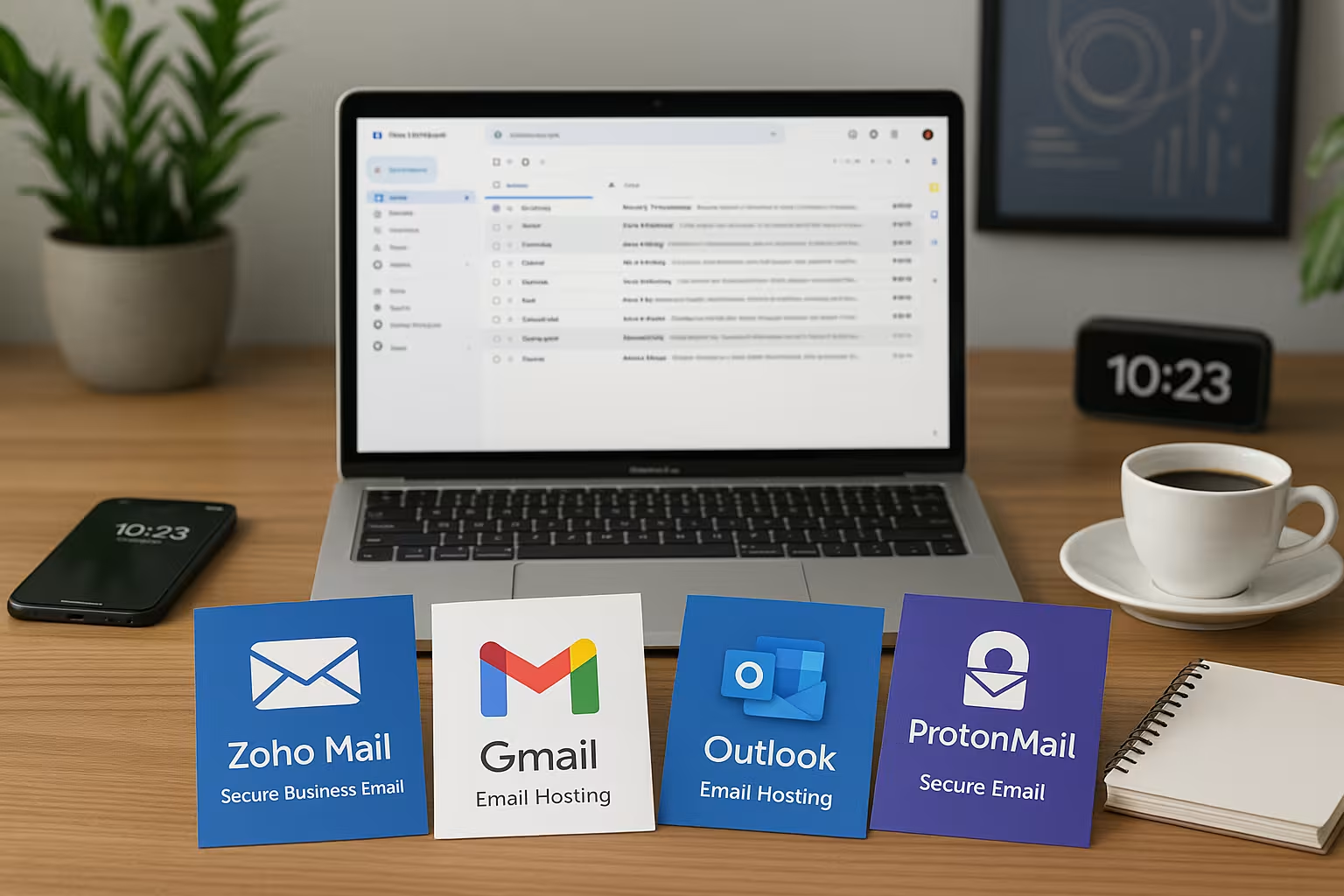
Often underestimated point: user-friendliness and interface
The best hosting is of little use if users have to struggle through menus. Therefore pay attention to a Intuitive webmail interface - even for non-technical users. Admin areas for creating, deleting and adjusting mailboxes must be operable without additional IT help.
Ask yourself: Is mobile access well solved? Is there a central point of contact for managing your alias addresses and redirects? Providers like Plesk also offer graphical interfaces for setting up more complex mail structures.
Another aspect: How quickly and smoothly do the webmail clients respond? In practice, it is enormously helpful if emails are synchronized without delay and you can quickly switch between different mailboxes, aliases or folder structures as required. A clear user interface reduces the training time for new team members. You should also check whether the provider offers apps for different platforms (Android, iOS) or whether you can flexibly integrate third-party clients (e.g. Thunderbird or Outlook).
Functional overview of the providers in direct comparison
The following table will help you make the right choice by providing a clear comparison of common providers and their conditions:
| Provider | Price/user | Memory | Own domain | Collaboration | Special features |
|---|---|---|---|---|---|
| webhoster.de | from 1,99 € | 20 GB+ | Yes | Yes | Premium support, GDPR-compliant |
| Google Workspace | from 6,00 € | 30 GB+ | Yes | Yes | AI functions, Google tools |
| Microsoft 365 | from 6,99 € | 50 GB+ | Yes | Yes | Outlook + Office integration |
| Proton Mail | from 4,00 € | 5 GB+ | Yes | No | End-to-end encryption |
| Zoho Mail | from 1,00 € | 5-100 GB | Yes | Yes | CRM and project integration |
| Hostinger | from 0,99 € | 10 GB+ | Yes | Partial | Affordable entry |
Providers that officially list collaboration functions usually offer synchronization and sharing of contacts, appointments or group drives. Make sure that such tools can be seamlessly integrated into your workflow. For some companies, a pure email provider without collaboration solutions is sufficient, while others need a comprehensive all-in-one solution.

Which functions do you really need?
Focus on the features that help your day-to-day work - not on the range of functions that only slow you down. Alias addresses and simple forwarding rules are interesting for freelancers. Small teams need Calendar functions and task lists. Large companies, on the other hand, can hardly manage without automatic signatures, group mailboxes and data protection audits.
Also make sure you can easily import existing data such as contacts and calendars. This makes it easier to migrate from old systems. In this context, you should also evaluate the migration help provided by the provider - webhoster.de is often ahead in this respect.
Various companies also want granular rights management, for example for shared mailboxes or team folders. For example, a sales employee can access certain folders, while sensitive information is only accessible to a small group of people. Setting up automatic responses and filters is also part of the standard package: anyone who travels a lot will appreciate automatic vacation notifications and spam filter rules. For higher security requirements, we also recommend a provider that explicitly uses encrypted e-mail traffic and the option of secure archiving.
Should you start for free or pay directly?
Free offers such as Gmail or Yahoo sound convenient at first - but they very quickly reach their limits. Advertising, low storage limits and above all Lack of support make professional use more difficult. For companies, it makes more sense to start with paid hosting.
Paid providers not only give you control over domains and mail flows. You also get support, backups, encrypted transmission and better recovery options - especially for Strato E-Mail Hosting or equivalent services. These services play a central role in security.
Another advantage of paid solutions lies in the dedicated infrastructure: the risk of delayed delivery or outages is lower, as professional hosting providers invest in fast servers and reliable connections. In addition, 24/7 support is often available, which can also help with technical emergencies within a short time. This minimizes downtime and secures your communication channels. If you want a serious public image in the long term, you should invest in paid email hosting right from the start to build brand trust.

Technical support and migration
Without planning, the takeover of your mail inventory becomes a stumbling block. That's why technical Support during migration a key role. Good providers not only provide help - they also provide tools for automated import. This reduces downtime and makes the transition easier for you.
Before you decide on a service, you should definitely check what migration services are included. Some services even help you to set your domain's DNS settings correctly so that you can go live immediately.
Especially with large mailboxes and many users, a smooth migration between providers can be crucial. Some email hosters offer their own migration software that transfers the content of IMAP or POP accounts to the new service. It is also important that your address remains accessible during the migration phase and that no emails are lost. Many professional email hosters have tried-and-tested step-by-step instructions so that even less experienced users can complete the process. Competent customer service reduces stress and prevents errors or downtime.
Additional functions that make everyday life easier
Current e-mail systems offer much more than just inbox and dispatch. Many providers enable direct Integration with calendarssynchronize contacts and tasks and allow you to upload files to your own cloud storage. The combination saves time and reduces the need for external tools.
Also desirable: mobile apps with push notifications and real-time synchronization. Additional functions such as these are crucial for working independently, especially in the field, with mobile teams or frequent device changes.
In addition, some providers show detailed reports and statistics on the resources used, email traffic or, for example, the top senders and recipients in their admin consoles. In the corporate context, these reports can help to make reliable statements about communication flows and, if necessary, derive new strategies for customer service. Some services also offer an integrated cloud storage solution that can be used to send large file attachments without overloading the email inbox. Collaboration tools can also often be used so that projects can be worked on together regardless of location.

What you should consider in conclusion
The right decision depends on your objectives: Do you want to grow, appear more professional or optimize data protection? Then you can't avoid a specialized provider. webhoster.de offers a convincing overall package with GDPR compliance, a good price-performance ratio and a solid range of functions.
Google Workspace and Microsoft 365 offer strong options for users with high integration requirements. Proton Mail, on the other hand, focuses on data protection. If you are looking for an affordable solution, Hostinger or Zoho Mail are the right choice. Choose wisely - your communication foundation depends on a solid provider.
To minimize potential risks, it is advisable to create a detailed checklist. Check all the important factors: support during migration, available security functions, possible scaling steps and, of course, the general user experience. Beware of only looking at the price - the supposedly cheapest solution can quickly become expensive in terms of security and functionality if you have to invest additional work through manual configuration or a lack of expert knowledge. Also consider whether your email provider can facilitate a long-term partnership if you continue to expand or have special requirements. These considerations will help you make an informed decision that will support your business or self-employment in the long term.