Skip to content
2025 brings clear differences in the professional e-mail inbox: I compare Email hosting by storage, price, security and team functions for webhoster.de, Google Workspace, Microsoft 365, Zoho Mail and ProtonMail. You can quickly see which packages start at €1.00, where 50 GB per mailbox awaits you and which solutions are available at Data protection and admin convenience.
Key points
The following key data will help you to make a quick preselection and find the right Provider to narrow down.
- PriceStart at €1.00 to €6.99 per user, differences in memory and tools
- Memory10-50 GB per mailbox determine archiving and attachments
- SecuritySpam/virus protection, encryption, GDPR and server location
- IntegrationCalendar, contacts, office apps, WordPress and admin panel connection
- SupportResponse time, migration assistance, outages and monitoring
I focus on the differences that really count in everyday life so that you can optimize your e-mail environment in a targeted manner. select can. Price information helps with planning, but the hidden factors such as domain handling, sending via your own SMTPs and migration paths often determine satisfaction. Pay attention to backups, SLA and recovery after errors, this saves time. Also consider calendar sharing, rights concepts and mobile use, because teams need to remain flexible. A short test run quickly shows whether webmail, clients and Admin-console are coherent.

Why professional email inbox hosting matters in 2025
An e-mail address on your own domain immediately increases the Credibility and separates business from private. I control access rights, signatures and forwarding centrally, which shortens processes. Calendars, contacts and tasks reduce tool changes and keep communication flowing. If you work with catch-all, alias or functional mailboxes, you can bundle requests neatly and prevent chaos. I also bring legal requirements with archiving, deletion concepts and DSGVO-processes under one roof. My article provides a structured overview Email hosting 2025 comparisonwhich illustrates selection and hedging.
The most important criteria for email inbox hosting
I start the selection process based on demand: Number of users, storage per mailbox and future growth play a central role. Role. Anyone sending large attachments needs 30-50 GB per user or a close connection to cloud storage. Security includes TLS, SPF, DKIM, DMARC and options such as MTA-STS and TLS reporting so that spoofing and delivery problems don't stand a chance. An attractive admin panel with logs, quotas, blacklist/whitelist and quarantine saves time every day. I also check migration tools, IMAP imports and wizards, because changes have to be successful without downtime. In the end, what counts is how well webmail, mobile apps and Desktop-clients work together.

Provider comparison: services, storage, prices
The following table shows the candidates that land on my shortlist particularly often in 2025, including memory, starting price and prominent Features. In addition to the bare price, I evaluate delivery, anti-spam quality, admin convenience and integrations with calendars and office tools. Those who work internationally benefit from integrated suites, while German-language support can be valuable in critical phases. Pay attention to promotions, contract terms and whether domains and SSL are already included. As you grow, check upgrade paths so that mailboxes don't burst at the seams. In this way, you can make a choice that is right today and will still be suitable in twelve months' time. carries.
| Place | Provider | Memory/user | Price from/month | Special features |
|---|---|---|---|---|
| 1 | webhoster.de | 50 GB | from 4,99 € | Test winner in DE, strong performance, fast support, WordPress integration, very good price-performance ratio |
| 2 | Google Workspace | 30 GB (Business Starter) | 4,20 € | Gmail, Drive, Docs, Calendar & Meet, very easy to set up |
| 3 | Microsoft 365 | 50 GB | 6,99 € | Outlook, Exchange, Teams, OneDrive, Office apps, high security |
| 4 | Zoho Mail | 10 GB (Mail Lite) | 1,00 € | Ad-free, productivity suite, AI assistant Zia, very affordable |
| 5 | ProtonMail | 15 GB | 3,99 € | Strong data protection, end-to-end encryption, zero-access principle |
Deliverability and reputation: set DNS correctly and plan warm-up
I make sure early on that Deliverability is not a game of chance: In addition to SPF, DKIM and DMARC, I pay attention to clean reverse DNS entries, consistent HELO/EHLO names and sensible DNS TTLs when moving domains. I warm up new domains with moderate mailing volumes, actively respond to legitimate emails (positive signals) and keep bounces and complaint rates low. Blacklist/whitelist mechanisms and quarantine help to clear up false positives. In shared IP environments, I regularly check the IP reputation and monitor feedback and block lists. If you send transactional messages (orders, notifications), you should ideally separate mailboxes and sender domains from internal communication so that a problem does not affect all channels.
- DMARC Policy Switch hard step by step (none → quarantine → reject)
- Bounces Evaluate and cleanly separate hard/soft bounces
- Attachments compress, check file types and observe size limits
- Signatures/Disclaimers Roll out centrally to strengthen brand image
- Monitoring on delivery times and spam folder rate
webhoster.de: German all-rounder with speed and WordPress connection
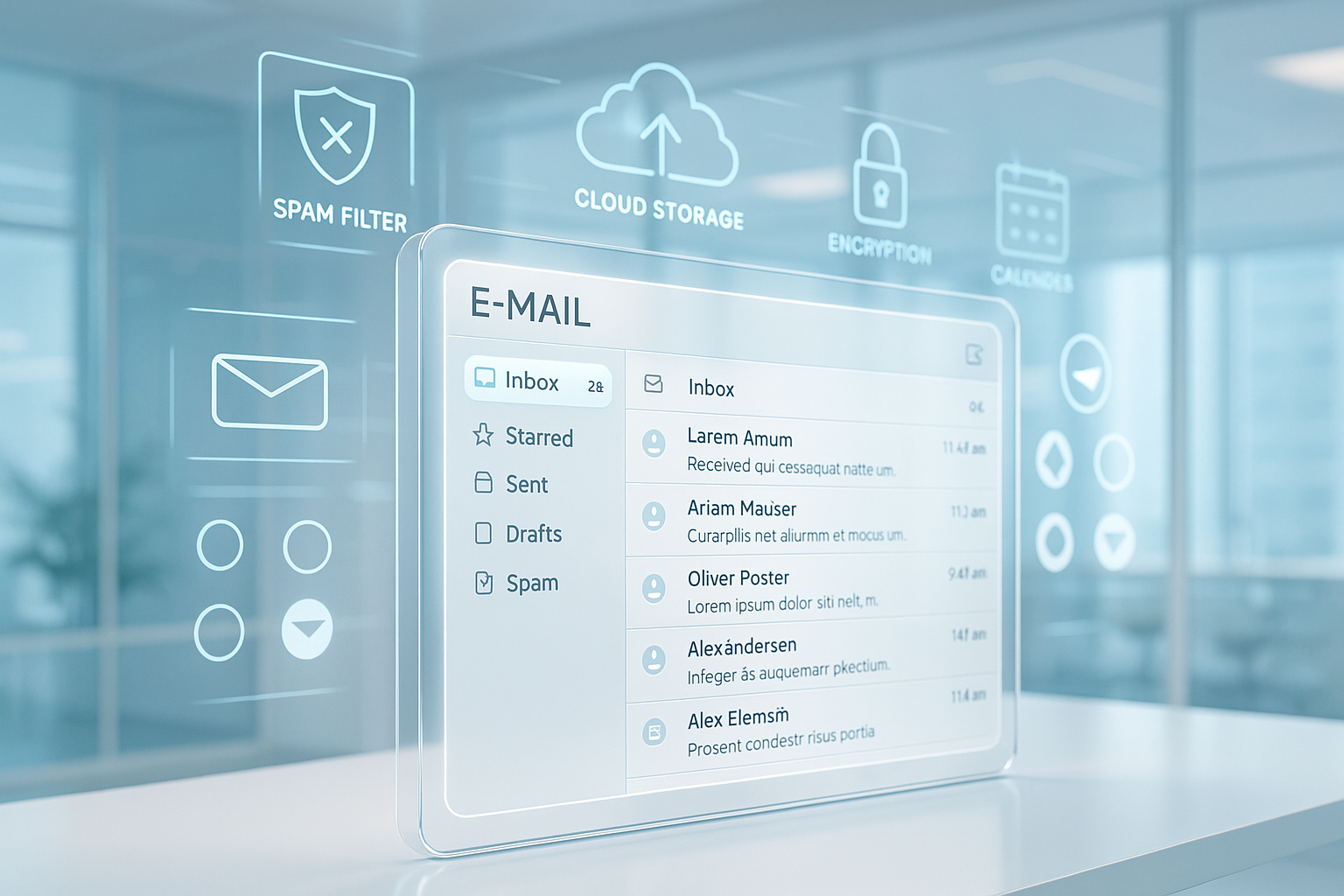
webhoster.de delivers 50 GB per mailbox, responds quickly in the Support and integrates email seamlessly with WordPress installations. I appreciate the centralized management with clear roles, logs and reliable spam filtering. DNS setup, SPF/DKIM/DMARC and migration routes are well documented, which makes switching easier. For freelancers and teams with websites, the result is a coherent package of hosting, domain and mail. Anyone who values German data protection and short paths will get a well-rounded overall picture here. Details on the trend picture can be found in the compact Comparison 2025which defines strengths and fields of application.
Google Workspace and Microsoft 365: Teamwork without detours
Both suites bundle e-mail, calendar, video meetings and Office documents in one Surfacewhich greatly simplifies processes. Google scores with quick setup and streamlined tools, while Microsoft delivers deep Outlook and Teams integration. I use central admin consoles, set up group mailboxes and regulate document sharing. You should calculate the price jumps for more memory or extended security functions in advance. If you use a lot of devices, you will benefit from cross-platform apps and solid offline work. The decisive factor remains which suite supports your processes, contacts and Files wears better.
Set up roles, delegation and team mailboxes properly
In everyday life Approvals and delegations: I set up functional mailboxes (e.g. support@, sales@), assign "Send as" or "Send on behalf of" and define quotas and retention rules. Substitutes are given clearly limited rights so that substitutions work without violating compliance. Shared calendar and resource objects (meeting rooms, devices) make planning easier. I assign standardized signatures and disclaimers by policy so that the external presentation remains consistent - regardless of the end device. In this way, the structure grows with the team and prevents shadow IT.
Zoho Mail: Affordable entry with a clear admin edge
Zoho Mail starts at €1.00 per user and allows for a low-cost Access in mailboxes on your own domain. Calendar, tasks and notes are compactly together, including AI helper Zia. I implemented the migration smoothly via IMAP Assistant and set up aliases in minutes. If you want to grow, you can later switch to larger plans with more storage and apps. This provides a solid foundation for small teams, clubs and side projects. The ad-free environment provides focus and keeps the Inbox clean.

ProtonMail: Data protection and encryption in the foreground
ProtonMail relies on end-to-end encryption and zero access, which means that even the provider cannot access the content. receives. The interface remains lean, the delivery reliable and the focus clearly on privacy. I recommend ProtonMail if journalism, consulting or sensitive data is a daily topic. The range of functions for collaboration is smaller than with Workspace or Microsoft 365, but if you don't see this as a shortcoming, you get a strong protective wall and clear processes. Important: You should document key management and recovery so that you can access the data in an emergency. Access secure
Data protection & compliance in practice
I check the following with every provider Data protection frameworkAV contract, technical and organizational measures, logging, data deletion and export options. Traceable retention periods, legally compliant archiving and clean offboarding processes are important so that mailboxes and aliases are closed on time. For sensitive industries, I rely on strict MFA, finely granulated admin roles and clear guidelines for mobile devices. If you involve external partners, it's better to work with dedicated functional mailboxes and documented approvals so that audits don't come to nothing later on.
Price models 2025: How much does a PO box cost?
The starter packages of the major providers range from €1.00 to €6.99 per user per month. Provider. Factor in domains, SSL, backup and any migration costs to see the overall picture. Annual payments attract discounts, but flexibility usually costs a little more. I check upgrade paths so that storage and functions grow with you without having to switch services. If you want to start with little money, you can start with Zoho Mail and upgrade later. A quick overview can be found in the compact cheap e-mail hoster guidethat brings cost traps to light and sorts options.

Migration without downtime: 7 steps that prove their worth
I plan changes so that mails continuous flow: First prepare the domain, mirror the user structure and aliases, then set up test mailboxes. Using IMAP or tool-supported import, I move existing mails while old MX records are still active. This is followed by a short migration window: MX changeover with low TTLs, parallel tests of sending/receiving and a clear fallback strategy.
- 1. Inventory: domains, mailboxes, aliases, distribution lists, forwarding
- 2. Prepare DNS: Create SPF/DKIM/DMARC, lower TTL
- 3. Build target structure: Mailboxes, groups, roles, quotas
- 4. Test runs: migrate pilot users, test clients
- 5. Data migration: IMAP import, export and import calendar/contacts
- 6. Cutover: Change MX, verify delivery path
- 7. Aftercare: signatures, rules, mobile setups, training
Backups, archiving and restoration
I don't rely on waste bins alone: Backup-Intervals, retention periods and restore options are mandatory. For legal requirements, I use journaling or audit-proof archives and make a clear distinction between operational backups (fast restore) and long-term archives (obligation to provide evidence). RPO/RTO definitions prevent surprises: How much data loss is tolerable, how quickly must mailboxes be back online? A regular restore test shows whether contingency plans are in place.
SLA, support and monitoring in everyday life
A good mailbox stands and falls with AccessibilityI pay attention to guaranteed SLAs, status pages, transparent incident communication and support channels (ticket, chat, telephone). For teams with 24/7 requirements, it is worth recording response times and escalation paths. Notifications in the event of quota overruns, unusual login attempts or delivery errors help to solve problems proactively. A look at planned maintenance windows also prevents frustration during peak working hours.
Setup and management: ready to go in just a few minutes
Most providers guide you step-by-step through domain verification, MX, SPF and DKIM entries so that emails can be sent correctly. delivered become. I create mailboxes, aliases and groups and test sending and receiving with different clients. I set up quarantines, filters and forwarding directly in the admin panel to automate recurring tasks. Rights and delegation models are important for teams so that substitutions work smoothly. Mobile configuration via autodiscover saves time when many devices are connected. With a migration window outside of peak times, I avoid downtimes and protect the Workflow.
Clients & mobile devices: Stable, secure, ready to use anywhere
I rely on uniform Profiles for Outlook, Apple Mail and mobile apps: Autodiscover/Autoconfig reduces typing errors, OAuth2 improves security and Push/IMAP-IDLE ensures fast delivery. For BYOD environments, I define minimum requirements (MFA, device lock, encryption) and remotely switch off lost devices. I minimize synchronization conflicts with clear rules on folder structures, labels and shared inboxes. Documented instructions for iOS, Android, Windows and macOS noticeably shorten onboarding times.
Integration and automation
If e-mail worksI link mailboxes with calendars, tasks and notes, use server-side rules to control automatic filing and rely on templates for recurring responses. In identity management, SSO/MFA strategies with clear lifecycle processes (joiner-mover-leaver) are worthwhile. For support and sales teams, I integrate functional mailboxes into ticket systems or CRM workflows - ideally without local filter acrobatics. This keeps inboxes clear and responsibilities traceable.
Security 2025: delivery, authentication, reporting
Good e-mail security starts with transport encryption (TLS) and correct SPF, DKIM and DMARC records to ensure that spoofing is ineffective. runs. I activate MTA-STS and TLS-RPT to increase delivery security and make errors visible. Phishing protection, anomaly detection and strong passwords with MFA are mandatory. Backup strategies, journaling and legally compliant archiving secure data and meet audit requirements. For corporate customers, it is worth taking a look at the Guide for companiesthat structures processes from onboarding to offboarding. This ensures that your communication remains trustworthy and comprehensible.

Selection checklist: 10 minutes to the shortlist
- DemandNumber of users, memory/users, attachments, growth
- Data protectionAV contract, protocols, storage, export
- DeliverabilitySPF/DKIM/DMARC, MTA-STS/TLS-RPT, Reputation
- AdminRoles, delegation, logs, guidelines, quarantine
- MigrationTools, IMAP import, Cutover plan, Tests
- Backup/ArchiveIntervals, RPO/RTO, restore test
- Clients: Autodiscover, MFA, mobile guidelines
- IntegrationCalendar, tasks, templates, automation
- SLA/SupportResponse times, status page, escalation
- BudgetBasic price, add-ons, upgrades, contract term
In short: The right service for your everyday life
I rank the candidates clearly: webhoster.de convinces with 50 GB mailboxes, fast help and strong WordPressConnection. Google Workspace and Microsoft 365 show their strengths in collaboration and apps when teams work together on a daily basis. Zoho Mail offers a low-cost start with a solid admin base and later upgrade options. ProtonMail delivers maximum privacy for those who communicate sensitively and prioritize encryption. The difference comes down to needs, processes and budget, not big names. With a quick test setup, you can make a safe choice and save your organization money. Team long-term effort.