Skip to content
Show file systems hosting on Linux servers EXT4, XFS and ZFS significant differences in throughput, data integrity and administration effort. I specifically compare performance, functions such as RAID-Z and snapshots as well as sensible application scenarios for web hosting and server storage.
Key points
- EXT4All-rounder with low load, fast checks and broad compatibility.
- XFSHigh throughput for large files, ideal for logs and backups.
- ZFSIntegrated Checksums, self-healing, snapshots and RAID-Z.
- RAM-Focus: ZFS benefits greatly from ARC, Ext4/XFS are more frugal.
- PracticeChoose according to workload, storage layout and recovery requirements.

Why file systems are crucial in hosting
I see file systems as an active part of the Performance, not as passive data storage. They structure metadata, control write sequences and decide how efficiently caches and I/O queues work. Under web and app load, what counts is how quickly a system processes thousands of small files and large streams in parallel. This is exactly where the paths diverge: Ext4 remains nimble with random accesses, XFS shines with sequential writing, ZFS protects data with checksums and copy-on-write. If you understand the differences, you can plan storage correctly, dimension RAM correctly and select suitable options. For a quick overview of practical values, it is worth taking a short Performance differences-check before the decision.
EXT4 in everyday hosting
Ext4 scores highly for web servers, API backends and smaller databases with low overhead and solid Journaling-properties. The extents reduce fragmentation, while fast fsck runs keep maintenance windows short. I like to use Ext4 when I need broad distribution compatibility and easy administration. Large amounts of small files, like in CMS installations with caching directories, run very smoothly on Ext4. Files up to 16 TB and partitions up to 1 EB cover typical hosting scenarios cleanly. If you mount cleanly and check I/O factory settings, you get reliable latencies without tuning fireworks.

XFS for large data streams
For many large files and long write streams, I prefer XFS for maximum Throughput. Delayed allocations and extents keep fragmentation low, which noticeably speeds up backups, video assets and log archives. Even with growing volumes, XFS scales cleanly, while shrinking remains limited, which I take into account early in the capacity plan. Databases with large sequential scans often benefit from XFS, as long as the storage layer and the scheduler play along. In high-traffic setups with heavy logging, XFS delivers consistent write rates and manageable latencies. If you have clear write patterns, XFS provides stable timing for maintenance jobs and rotations.
ZFS: Data security and features
I like to combine ZFS with RAID-Z, snapshots and copy-on-write to achieve bit-perfect consistency and fast rollbacks. Checksums detect silent corruptions, and scrubs automatically repair errors, increasing operational security. The ARC cache utilizes RAM effectively, so I plan for at least 8 GB of main memory for ZFS hosts, more for VM and container workloads. Functions such as compression (lz4) and optional deduplication reduce memory consumption, although dedupe requires a lot of RAM. In multi-tenant environments, snapshots and replication help with backups without downtime and with short RPO/RTO targets. With a clean pool layout and monitoring, ZFS delivers high data quality and predictable management.
Technical comparison
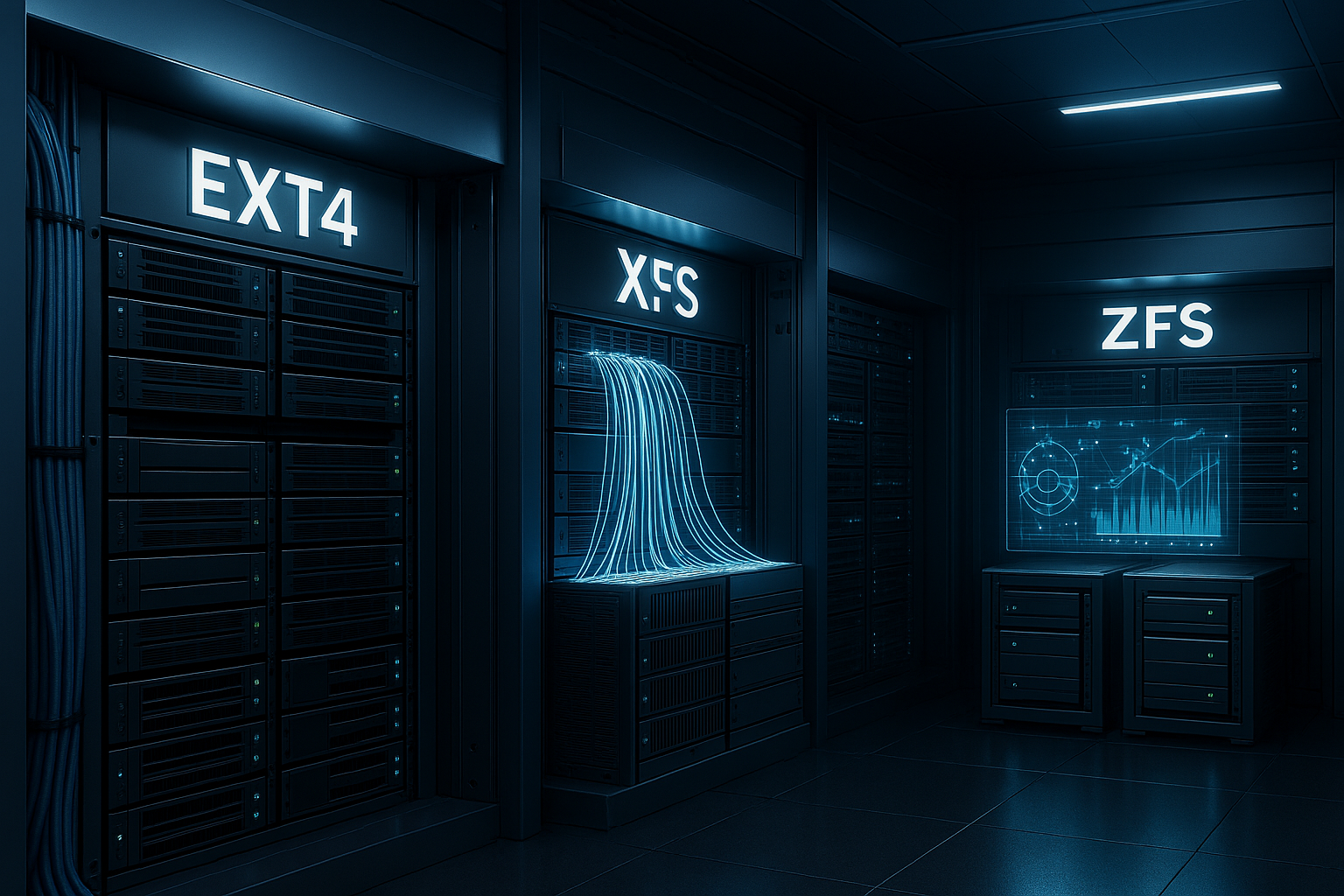
Before making decisions, I take a look at hard Key figures, because limits and features influence operating costs and recovery paths. Ext4 remains resource-friendly and fast with random access, XFS leads with sequential throughput, ZFS provides protection and enterprise functions. The differences in maximum sizes, snapshots, RAID support and RAM requirements show where each file system has its playing field. Overall, a comparison with the workload type, backup concept and hardware profile always pays off. The following table summarizes key values and helps me to make clear considerations.
| Feature | Ext4 | XFS | ZFS |
|---|---|---|---|
| Max. Partition | 1 exabyte | 8 exabytes | 256 trillion yottabytes |
| Max. file size | 16 TB | 16 exabytes | 16 exabytes |
| Journaling / Integrity | Journaling | Journaling | Checksums, self-healing |
| Snapshots | About LVM | No | Native |
| RAID support | Software (mdadm) | Yes | Integrated (RAID-Z) |
| Performance with large files | Good | Very high | High, RAM-dependent |
| RAM consumption | Low | Low | High (ARC) |
Performance tuning and mount options
With targeted options, I can noticeably raise the I/O profile without Risk to increase. For Ext4 I often set noatime, possibly nodiratime, and check commit intervals according to the application. On XFS, options such as allocsize=1M, suitable logbsize and a clear handling of discard/TRIM for SSDs are useful. On ZFS, compression=lz4, atime=off and regular scrubs provide a good mix of space saving and integrity. I remind you of the influence of the page cache: A warm cache distorts benchmarks, so I test reproducibly. If you go deeper into caching, you will benefit from a look at the Linux Page Cache and the effects on real latencies.

Hardware, write-back caches and power failures
I never plan file systems separately from the Hardware. Write-back caches on RAID controllers or SSDs accelerate, but pose risks in the event of power loss. Without battery/capacitor protection (BBU/PLP), non-persisted data can be lost even though the OS believes it is on disk. Therefore:
- Write-back only with current protection (UPS, BBU/PLP) and correct barriers/flushes.
- With ZFS, I prefer HBAs in JBOD mode instead of hardware RAID so that ZFS can manage the disks directly.
- I prefer to deactivate drive write cache without protection if consistency is a priority.
Ext4 and XFS respect barriers, ZFS uses copy-on-write. Nevertheless, power supplies, backplanes and cables remain typical sources of errors. I regularly check the firmware versions of controllers and SSDs to avoid known bugs.
Consistency: fsync, journaling modes and ZIL/SLOG
In workloads with many fsync()-In the case of data calls (e.g. databases, mail servers), sync semantics and journaling decide on latencies. Ext4 knows different data modes, which I consciously choose (ordered is standard, writeback can be faster, but risks more). XFS provides predictable fsync latencies as long as the log does not become a bottleneck. With ZFS, the ZIL (Intent Log) plays a role: For synchronous write loads, I optionally use a fast SLOG device to cushion latency peaks. I avoid Sync=disabled in productive operation - the speed gained is not worth the data loss in the event of a crash.
Quotas, ACLs and multi-client capability
Multi-tenant setups benefit from clear resource control:
- Ext4: User and group quotas are quickly set up and are often sufficient for classic web hosting.
- XFS: Project-Quotas I like to use it for directories/projects with fixed limits - practical for clients or large application data.
- ZFS: I set dataset quotas and reservations granularly for each customer/service. Snapshots and clones complete this, without additional layers.
I use POSIX ACLs for authorizations if the standard rights are not sufficient. In conjunction with SELinux/AppArmor, I plan paths and contexts cleanly so that security policies do not unintentionally slow down I/O.
Encryption and compliance
Depending on the industry Encryption of data at rest Mandatory. I usually combine Ext4 and XFS with dm-crypt/LUKS at block level - universal, proven and transparent. Ext4 also offers fscrypt for directory encryption if I want to isolate individual paths. ZFS provides native encryption at dataset level; I benefit from lean workflows for rotation and replication, but plan key management (e.g. separate passphrases, secure storage of headers) carefully. I calculate 5-15% CPU overhead for strong encryption and schedule test runs in advance.
Hosting practice: When to use which file system?
For classic web hosting servers with CMS, PHP-FPM and Nginx, I like to use Ext4, because administration and tools remain simple. For services with large uploads, object or log data, XFS regularly ends up on the shortlist. I choose ZFS if I need snapshots, replication and self-healing as an integral part of the platform. Distributions set their own defaults: Red Hat uses XFS widely, while Debian often uses Ext4, which can simplify operation. I evaluate workloads soberly according to file size, I/O mix, backup strategy and required recovery time. In the end, I save costs if the choice reflects the actual access patterns.
Virtualization and mixed operation
In virtualization stacks such as Proxmox or TrueNAS, I work well with ZFS as the host pool and Ext4/XFS in the guests. This is how I combine data security, snapshots and replication in the host with lean, fast guest file systems. I take care to avoid overheads, e.g. through sensible block sizes and the use of VirtIO controllers. For backup strategies, I use host snapshots for crash consistency and application-side dumps for logical consistency. The storage driver plays a role in container setups, which is why I plan path structures and quotas properly. With clear responsibilities between host and guest, I/O paths remain short and latencies can be calculated.

ZFS layout: vdevs, ashift and recordsize
With ZFS, layout and parameters determine performance at an early stage:
- vdev typeMirrors give me the best IOPS and rebuild performance, RAID-Z saves more capacity. For VM/DB loads I prefer mirrors, for archive/backup rather RAID-Z2/3.
- ashiftI set ashift to match the physical sector size (often 4K) and do not change it later. Incorrect values permanently cost throughput.
- recordsize128K is a good default. For databases and VM disks I choose 16-32K, for large media files 1M. I keep recordsize to the dominant I/O pattern.
- ARC/L2ARC/SLOGMore RAM strengthens the ARC. I use L2ARC specifically for repeated reads of large data sets; a fast SLOG reduces latency during synchronous writes.
I measure consistently after adjustments, as every change can have side effects on compression, fragmentation and snapshots.
SSDs, NVMe, I/O scheduler and TRIM
On flash storage, the queue depth and scheduler have a noticeable effect on the latency curve. I check the I/O scheduler (none, mq-deadline, bfq) depending on workload and device. I use TRIM/Discard carefully:
- Ext4: Regular fstrim avoids unnecessary online discard load, unless I need continuous sharing.
- XFS: Online-Discard can run stable, but fstrim as periodic remains my favorite for calculable load peaks.
- ZFS: autotrim helps, I still plan cyclic shares if the SSDs benefit from it.
With NVMe devices, I utilize their strengths (high parallelism), distribute threads sensibly and pay attention to CPU topology so that IRQs and I/O queues do not collide.
Benchmarking without self-deception
I avoid benchmarks that only measure the page cache. For realistic results:
- Consider cold start vs. warm cache separately.
- Test direct I/O, but also measure real app paths (e.g. DB-WAL, static files, log rotations).
- Simulate mixed workloads: small random reads/writes and large sequential streams in parallel.
- Prioritize constancy and tail latencies (p95/p99) over throughput when user response times are critical.
I document exactly: block sizes, queue depths, thread numbers, mount options, kernel version - only then are results reproducible and decisions reliable.
Migration paths and fallback options
A file system change is a Operating project. I plan it with clear time windows, consistent data collection and fallback options. I usually migrate Ext4/XFS with rsync in several waves (initial, delta, final freeze). With ZFS I use send/receive for fast, differential transfers. After the migration, I validate checksums, compare file counts and briefly keep old volumes in the read-only fallback. I adapt naming, mount points and service units in advance so that switchovers remain scriptable and reversible.
Typical pitfalls in practice
- Inode exhaustionMillions of small files can exhaust inodes - I plan inode density on Ext4/XFS accordingly or equalize structures.
- Snapshot proliferationToo many ZFS snapshots without a retention concept put a strain on performance and capacity. Cleanup plans belong in operation.
- Dedupe on ZFSI avoid them for no compelling reason - RAM hunger and management effort are rarely in proportion.
- FragmentationInappropriate block sizes and many parallel writers cause fragmentation. Periodic rewrites/packing of large archives help.
- Incorrect block sizesRecordsize/Blocksize that do not match the workload cost IOPS. I match them to DB/VM profiles.
- Hardware RAID under ZFSAvoid hidden errors through controller logic - I rely on passed-through disks.
Error patterns and maintenance
I plan regular Scrub-runs on ZFS to detect silent corruptions early and fix them automatically. On Ext4, scheduled fsck checks remain important, especially after unexpected power events. On XFS, I rely on xfs_repair and consistent log strategies to speed up restores. Monitoring for SMART, I/O wait times, fragmentation and spacemaps indicates bottlenecks in good time. If you suddenly see 404 errors or empty directories, you should Inode problems and caching effects. Clean maintenance windows and tests reduce the risk of long-running jobs and shorten recovery paths.

Checklist for selection
- Clarify workload profile: small files vs. large streams, sync share, metadata load.
- Define recovery targets: RPO/RTO, snapshots, replication, offsite backups.
- Fix hardware: HBA vs. RAID, PLP/BBU, SSD/NVMe properties, UPS.
- Set RAM budget: ZFS-ARC vs. frugal Ext4/XFS setups.
- Quotas and multi-tenancy planning: project quotas, ZFS datasets, ACLs.
- Consciously select tuning options: atime, commit/log sizes, TRIM strategy.
- Establish monitoring & tests: Scrubs, SMART, latency metrics, reproducible benchmarks.
- Document migration and rollback paths.
What I take with me
I make decisions based on data and set clear targets. PrioritiesData security, throughput, latency, maintenance effort. Ext4 gives me lean management and good all-round performance for web, APIs and smaller DBs. XFS accelerates large sequential jobs, such as backups, media workloads and log pipelines. ZFS protects content with checksums, snapshots and RAID-Z and is suitable for pools with high protection requirements. Good mount options, reliable monitoring and reproducible tests make the difference in day-to-day operations. Those who measure workloads honestly save resources and achieve noticeably better response times.