Skip to content
Would you like to host your website in Germany? Then you should take a close look at the advantages German hosting offers - from GDPR compliance to fast page loading for your target group.
Key points
- Data protection and GDPR security through server locations in Germany
- Performance due to low latency times and solid infrastructure
- Flexibility for hosting models such as shared, VPS, cloud and managed hosting
- customer support in German with clear availability and response times
- Cost structure No hidden fees and transparent tariffs

Why server locations in Germany are crucial
German hosting providers operate their infrastructure in Germany - often in certified data centers with state-of-the-art technology. This means shorter data paths, faster response times and fewer attack surfaces. Especially if your website is aimed at visitors from Germany or the EU, this noticeably improves the loading time. Another advantage: the processing of personal data is regulated by German law. Access by foreign authorities is significantly more restricted than with providers with servers outside the EU. Data protection is therefore not a promise here, but a legally secured obligation.Data security through strict laws
German legislation is one of the strictest in the world when it comes to data protection. Companies and private webmasters benefit massively from this. If you collect personal data - whether through a contact form, customer account or newsletter - you must ensure that it is not sent abroad. With German hosting, you generally meet the requirements of the GDPR. You avoid additional requirements, such as standard contractual clauses or authorizations for data transfers. Response times in the event of data breaches or support requests are also improved because no third-party system is involved.Which hosting models are available and which one suits you?
The following table shows you the strengths and limitations of the most popular hosting models in Germany:| Hosting model | Strengths | Restrictions |
|---|---|---|
| shared hosting | Very affordable, low-maintenance, ideal for blogs & portfolios | Share resources with other users |
| VPS Hosting | Dedicated performance, expandable, root access | Technical knowledge required |
| cloud hosting | High scalability, reliability | Billing can be confusing |
| managed hosting | Maintenance, updates, backups by provider | Less control, expensive |

What I look for when choosing my German hoster
The choice of the right provider clearly depends on your project and your technical interests. I first check the availability of support - because nothing is worse than a problem without a contact person. German-speaking support with fixed service times gives me peace of mind - you can find more information here: German support for hosting. The tariff structure also plays a major role. Providers with clearly calculable monthly fees, including services such as SSL or backups, give me a better overview. I don't have to constantly check whether additional costs are incurred due to traffic or plugins.Added value from the customer's perspective: Hosting according to German standards
For many self-employed people and SMEs, data protection is the most important criterion. Depending on the sector - such as law firms, doctors, schools or online stores - there is a risk of high penalties for data protection violations. This risk is significantly lower with hosting in Germany. What many people overlook: Google also prefers websites with good loading speed and legally compliant implementation. German hosting providers make it easier for you to achieve this. Especially if you want to rank regionally, this pays off.
Value for money and contract design
Transparent pricing models are a must for me. Many German hosters do not have minimum contract terms or offer monthly cancelable subscriptions. This allows me to react flexibly when I expand or need less performance. Automatic upgrades or tools such as 1-click installers for WordPress, Joomla & Co. are also value-added factors that I look out for. They save me time and nerves. Particularly practical: many providers do not immediately charge extra for increased consumption, but throttle the bandwidth fairly - as with a flat rate on a DSL basis.Security features in server operation
You can recognize a good data center by certificates such as ISO 27001, emergency power supply and a redundant network connection. I always compare the location of the server farms when looking at hosting offers. I am only really GDPR-compliant if they are located in Germany - more on this at GDPR-compliant web hosting. Automatic backups, DDoS protection and web application firewalls (WAF) are now standard. A provider that does not mention these points is immediately out of the running for me.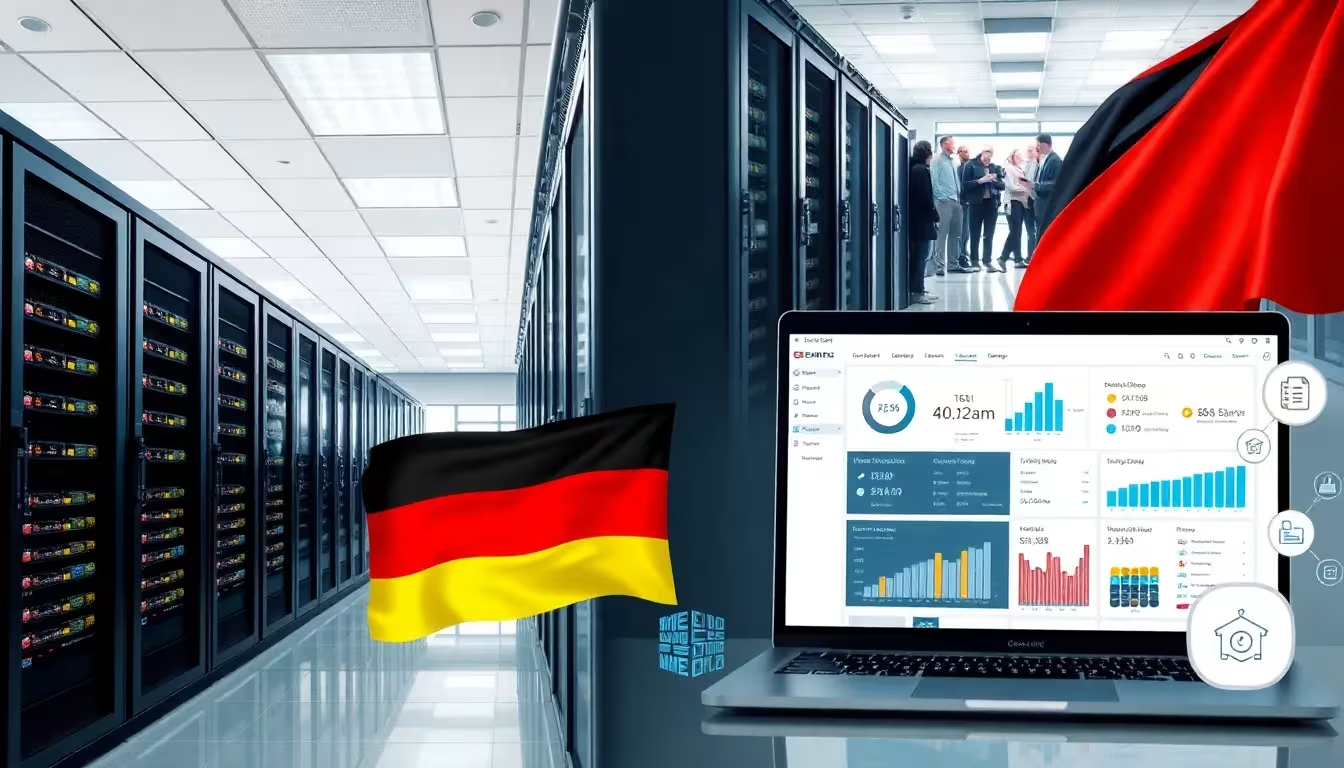
How German hosters fare in everyday life
I have tested with several providers. In fact, many smaller providers score points with personal service and short response times. Large hosting providers, on the other hand, usually offer better prices and tools - for example, intuitive administration interfaces, app support and cronjob management at the touch of a button. Recommended: Secure hosting from Germany with user-friendly features that do the work for you instead of overwhelming you with technology.What convinces me about German hosts
I particularly appreciate the Stability and Availability. Many providers guarantee up to 99.99 % uptime on an annual average. And if something does go wrong, support often gets back to you within a few minutes - via chat, email or hotline. Technical innovations such as HTTP/3 or PHP 8.2 are now also standard in many German hosting packages. Some even offer their own CDN integration or malware monitoring directly in the customer area.
Criteria for the decision - my personal view
Before I decide on a hosting tariff, I go through these questions:- Where is the server physically located?
- How transparent are the costs - including domains, SSL and e-mails?
- Does the provider offer German support with emergency contact?
- Can the package be expanded later, e.g. in the event of growth?
- Are regular backups created automatically?

Further best practices and tips from the field
Especially if you are starting your project from scratch or switching from another provider to a German host, precise preparation can save you a lot of time and trouble. In my projects, I always start by planning which applications or CMS (WordPress, Joomla, Magento, etc.) will be used. Then I check whether they meet the technical requirements such as PHP versions and MySQL versions of the hoster. This helps to avoid compatibility problems later on. Another important point is choosing the right PHP settings. Some providers offer you a separate configuration file or an administration interface in which you can adjust the PHP version and certain values such as memory_limit or max_execution_time. This is particularly relevant if you are running computationally intensive applications or expect many simultaneous visitors. In terms of performance, you can go one step further and integrate a content delivery network (CDN) if your host supports this or offers it itself. German providers with data centers in different regions enable fast delivery of static content, which reduces the server load and further optimizes the loading speed for visitors.Example scenarios for German hosting
1. local blogs and news portals: The main target group here is often Germany or German-speaking countries. Hosting in Germany minimizes latency times and meets a basic expectation of performance and security. 2. e-commerce stores with sensitive customer data: Anyone who stores customer accounts, payment data or address information must pay particularly meticulous attention to data protection. A server in Germany makes it much easier to prove GDPR compliance. 3. institutions such as schools or associations: They also benefit because the legal requirements are handled particularly strictly in the case of public institutions. Local hosting makes it easier to deal with data protection officers and supervisory authorities. 4. private community projects or forums: Even if the visitor group is manageable, it is a bonus not to have to constantly worry about international data transfers. This is a decisive trust factor, especially for forums in which personal topics may be discussed. 5. agencies and resellers: Those who resell hosting for their own customers usually want to offer a reliable, fast and data protection-compliant service. The German market often provides high-performance complete solutions that can be expanded without major organizational effort.Scaling and resource planning
One of the most common mistakes I observe is calculating the required resources too tightly. People often only think about current requirements and not about possible future growth. With shared hosting in particular, a growing website can quickly reach its limits as the number of visitors increases. VPS or cloud offers, on the other hand, allow you to flexibly increase RAM, CPU cores or storage space. However, it is also important here not to lose sight of the price models so that you are not caught unprepared by increased requirements. For data-intensive applications, such as streaming or large media files, a dedicated or virtual server may be the best choice. Monitor the load regularly so that you can react in good time and scale up if necessary. Many German hosters proactively inform you by email when certain limits are reached or upgrades are due.Sustainability and ecological aspects
The issue of green electricity and energy-efficient use of hardware is also increasingly coming to the fore. Some German providers operate their data centers in a climate-neutral manner or use heat exhaust air to supply neighboring buildings. If environmental aspects are important to you, it is worth taking a look at the relevant certifications or communicating these measures publicly. Bear in mind that a data center with green energy does not automatically have to be more expensive. On the contrary: modern construction methods, efficient cooling systems and optimized hardware often make sustainable hosting cost-effective. This also allows you to give your customers or visitors a good feeling because you are opting for an ecological approach.Avoiding mistakes when moving
If you already have an existing website or online project that you want to transfer to a German host, careful planning of the move is crucial. This includes:- A complete backup of the current databases and files
- Check whether special configurations (e.g. own PHP modules, CRON jobs) can be transferred 1:1
- Set up the domain with your new provider and test it on a temporary subdomain before you change the DNS entries
- Synchronize all e-mail inboxes including passwords so that nothing gets lost