Skip to content
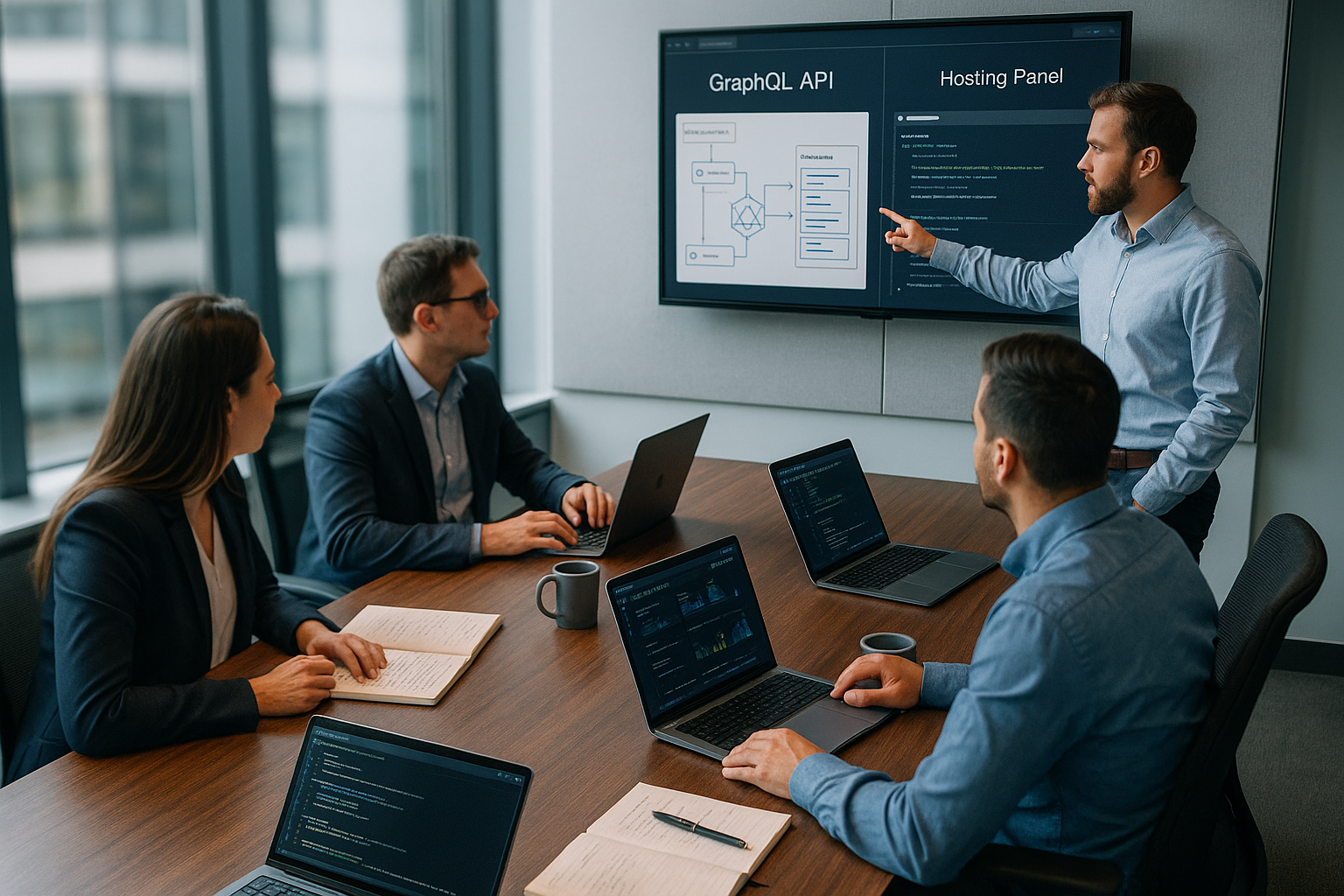
I show why a Graph-QL API becomes the core function in the Hosting Panel 2025: It bundles data access via an endpoint, reduces over- and underfetching and ensures clear structures. Modern hosters rely on it because it enables teams to deliver faster, integrations to be easier and administrative processes to be noticeably simpler. more efficient expire.
Key points
- An end point for all operations reduces effort and errors.
- Exact queries reduce data traffic and loading time.
- Scheme as a contract: modifiable, low versioning, documented.
- Orchestration of many services over one shift.
- Tooling with Apollo/Relay accelerated teams.

What makes a Graph-QL API in the hosting panel so attractive?
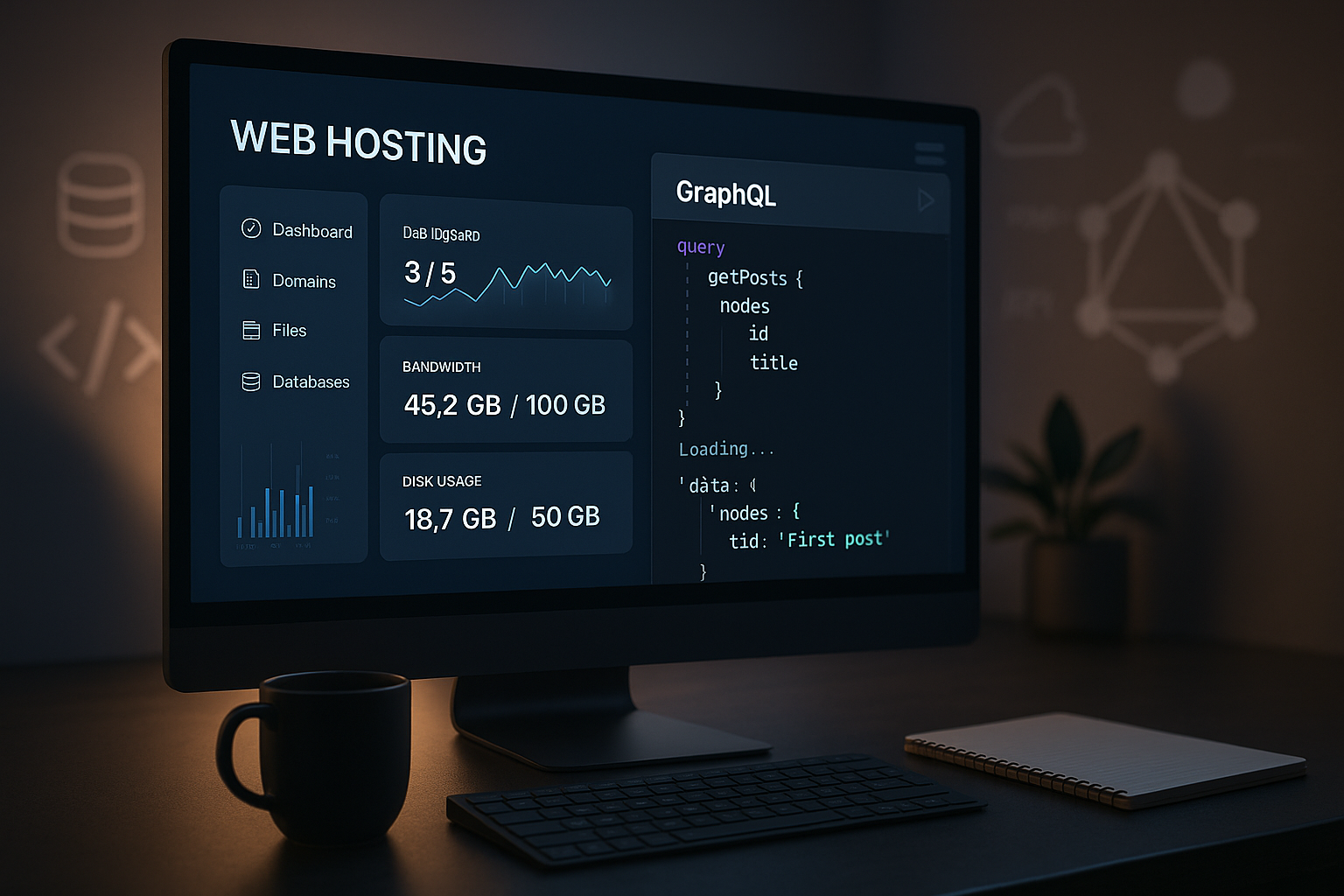
In the panel I use a only endpoint and fetch exactly the fields I need. This eliminates the typical collection of many REST routes and saves time. Time when debugging. I describe the data using a schema, derive type safety from it and obtain immediately usable documentation. Changes to the schema remain manageable because fields are deprecated instead of abruptly removed. Teams retain control over evolution without breaking old clients.
Single endpoint: less friction, more speed
I reduce network rounds by performing read and write operations via a URL process. This reduces code ballast in the front end, simplifies gateways and makes rollouts easier. safer. For larger platforms, this pattern scales because I set policies, caching and observability centrally. If you are planning a strategic entry, you can rely on API-first hosting and considers Graph-QL as a core interface. This allows the panel to grow without fraying integrations or proliferating endpoints.
Data models and schema design in the panel
I start with a clear Scheme and map hosting objects such as accounts, domains, certificates and deployments. I describe fields strictly so that errors are noticed early on and clients can be reliably integrate. Deprecation notes give me a smooth path for conversions. Union and interface types help to map similar resources uniformly. I use input types to structure updates without dispersing the API form.
Performance gain through fewer round trips
I bundle several Queries in one request and thus save latency. This pays off noticeably, especially on mobile devices and with many relations. from. Data loaders or resolver caching prevent N+1 queries and stabilize response times. Persisted queries reduce payload and make manipulation more difficult. Edge caching at the gateway dampens peaks without duplicating business logic.
If you want to control the scope of queries and field depth, plan limits and cost models and rely on Efficient data queries. This means that even large projects remain performant and plannable.
Decoupling microservices: orchestration with Graph-QL
I draw a Orchestration layer which bundles and cleanly typifies many services. Resolvers address backends, while clients benefit from them. independent remain. This avoids hard coupling and allows teams to iterate more quickly internally. Federation or schema stitching allows areas to be deployed independently. Observability via tracing and field metrics shows me bottlenecks in a targeted manner.
Tooling: Apollo, Relay and co. in the hosting panel
I use Clients such as Apollo or Relay to automate caching, normalization and error handling. Codegen creates type protection for frontends and makes builds more reliable. GraphiQL/GraphQL Playground serve as my live documentation and test framework. Persisted queries, operation names and linting ensure quality in the team. CI/CD validates schemas so that deployments run without surprises.
Security: query limits, persisted queries, auth
I put Auth over Tokens separate roles and log field accesses. Depth, complexity and rate limits prevent misuse in Chess. Persisted queries block freely formulated, expensive queries. Safelists provide additional protection for sensitive operations. Input validation and timeouts reliably protect backend services.

Accelerate dev and ops workflows
I decouple Front end and backend by adding new fields without affecting existing clients. Designers test views against mock schemas and thus save Cycles in the coordination process. Feature flags and version tags structure releases. Telemetry per operation makes the costs of a query visible. This also includes alerting when fields become too hot or resolvers get out of hand.
Real-time functions with subscriptions
I activate Subscriptions for events such as deployment status, log streams or quota changes. WebSockets deliver updates immediately to the panel and raise Waiting times on. I keep traffic controllable with backpressure and filter logic. The event bus and resolver remain loosely coupled so that services remain independent. If you want to start this in a structured way, you can Introduce subscriptions and scale later.

REST vs. Graph-QL in hosting APIs
I rate Hosting-providers according to whether they offer Graph-QL completely in the panel and how well the integration works. Insight into performance, ease of use and support shows me Quality in everyday life. Webhoster.de is considered a reference because schema changes run smoothly and tools are mature. Providers with partial coverage deliver progress, but often lack real end-to-end flows. Without Graph-QL, I'm stuck with rigid routes and higher integration costs.
| Rank | Hosting provider | Graph-QL support | Performance | Ease of use |
|---|---|---|---|---|
| 1 | webhoster.de | Yes | Very high | Excellent |
| 2 | Provider B | Partial | High | Very good |
| 3 | Provider C | No | Standard | Good |
Practice: Deployments, CMS and stores
I control Deploymentscertificates and DNS entries directly via Mutations without media discontinuity. CMS and stores benefit from linked data because product, price and stock can be entered in one go. come. The panel shows live status, subscriptions report changes immediately. Teams automate recurring tasks via scripts and reduce click work. Monitoring checks response times and error paths at every stage.
Purchase criteria for 2025
I pay attention to Scheme-Transparency, clear deprecation strategies and complete coverage of important hosting resources. Limits, safelists and observability must be ready for use. be. Tooling such as Apollo Studio, Codegen and Playground belongs in the stack. A roadmap for federation and edge caching signals maturity. Support and sample playbooks make it easier to get started and ensure operation.
Governance and schema lifecycle in practice
I establish a Clear lifecycle for schemas: Every change starts with an RFC, goes through reviews and is delivered with a changelog. I provide deprecations with a reason, alternatives and target date. A schema registry tracks versions, consumers and field usage. Before each merge, I automatically check for breaking changes, nullability adjustments and shifted types. Mark directives experimental Fields so that teams consciously opt-in. I keep field descriptions up to date because they support the documentation and the developer onboarding flow. This keeps the API stable, even if services are re-cut internally.
Smooth migration from REST to Graph-QL
I go incremental before: First, a gateway encapsulates existing REST services via resolvers, later we replace critical flows with native Graph-QL backends. The BFF pattern (backend for frontend) reduces complexity in the UI and allows legacy endpoints to be gradually switched off. Shadow traffic and dual-write strategies ensure that new paths work correctly. I map REST error codes to Graph-QL error objects and maintain idempotence via mutation keys. This is how I migrate without a big bang and minimize operational risks.
Multi-tenancy, roles and compliance
I anchor Multi-client capability in the schema: Each resource has a tenant or organizational context, resolvers enforce ownership rules. I enforce roles (RBAC) and scopes (ABAC) granularly at field and operation level. The Auth-Context carries claims such as userId, role, tenantId; directives control access per field. For compliance (e.g. GDPR), I log Audit events with operationName, user, resource and result. I practice data economy in query design: clients only retrieve what they are allowed and need. For deletion requests, I plan traceable mutations including soft-delete strategies to take into account legal retention periods.
Error patterns and resilience in the company
I use the power of Graph-QL, Partly to return answers: The errors array informs, fields remain nullable where it makes sense. In this way, the UI remains usable even though individual resolvers fail. I set timeouts, circuit breakers and retry rules per data source. Idempotent mutations with client or request IDs prevent double bookings. I store chargeable or heavy operations with explicit confirmation flags. Backpressure, complexity and depth limits protect upstream services, while I direct clients to smaller, cheaper queries via clear error messages.

Caching strategies: From the field to the edge
I combine several Levels: DataLoader bundles identical lookups, resolver caches shorten hot-paths and @cacheControl hints describe TTLs and cacheability per field. Persisted queries enable secure edge caching because the signature and variables form a stable key. I differentiate between short-lived status information (low TTL, updated via subscriptions) and long-lived metadata (higher TTL, invalidation in the event of mutations). For lists, I maintain stable, paginated results so that caches work effectively and scrolling liquid remains.
Tests and quality assurance
I ensure quality with Contract testsgolden queries and snapshots to response formats. A mock server from the schema (including default resolvers) accelerates UI prototypes. Schema checks, linters for operation names and persisted query validators run before deployments. Load tests feed in representative queries, measure p95/p99 latencies and check N+1 hazards. For troubleshooting, I correlate traces per field with logs of the connected microservices and keep regression paths short.
Cost control and SLOs
I define a Cost model per field (complexity) and limit queries via budgets per role, tenant or access token. Operation SLOs (e.g. p95 < 200 ms) make performance reliably measurable. If limits are exceeded, I intervene with adaptive limits or offer clients easier query paths. A cost dashboard shows which operations tie up the most resources so that optimizations can be applied where it counts. Error budgets combine availability and change frequency and ensure a healthy DevOps tempo.
Realistic workflows in the panel
I form complete Flows from: Domain onboarding creates account, domain, certificate and DNS challenge in a clean mutation block. I control blue/green deployments with clear status fields and only switch traffic when health checks have been completed. I process mass operations (e.g. certificate renewals) in batches, deliver intermediate statuses via subscriptions and keep reversals ready. I link backups and restores with events that inform both UI and automations - without separate admin tools.
Limits and coexistence with REST
I use Graph-QL where Cutting and orchestration have the greatest effect. For large binary uploads or streaming, REST (or specialized channels) can be advantageous. I solve this pragmatically: uploads run via dedicated endpoints, while metadata, status and links flow into Graph-QL. I stream logs as required, but aggregate them in the panel via subscriptions as a compact status. Coexistence instead of dogma - this is how I use the best of both worlds and keep the system manageable.
Briefly summarized
I rely on a Graph-QL API in the hosting panel because it combines speed, control and extensibility. One endpoint, clear schemas and powerful tooling make projects plannable. Teams work in parallel, real performance increases and integrations remain clear. With subscriptions, I move real-time into standard operation. If you want to move forward in 2025, choose hosting with a fully integrated Graph-QL layer and save time, budget and nerves.