Skip to content
Green Hosting will decide in 2025 which providers deliver real climate benefits and which merely display pretty labels. In this comparison, I show which certifications have substance, how I expose greenwashing and which providers convince with measurable evidence.
Key points
I summarize the most important findings Green hosting-certifications in brief. The list serves as a compass for choosing a provider with real impact. I focus on auditing, origin of electricity, efficiency and transparency. I then list specific certification marks that have proven themselves in projects. This allows me to make an informed decision and save time and effort during the audit.
- ISO 14001Systematic environmental management with annual auditing [5]
- ISO 50001Energy management with a measurable increase in efficiency [2]
- Green Web Foundation: Proof of genuine use of green electricity [5]
- REC & Guarantees of origin: Allocation of renewable electricity volumes [3]
- CO₂ offsetCertified compensation project-based [3][7]
I value independent reviews more highly than marketing claims with weak evidence and rely on Transparency. I also check efficiency metrics and technical measures in the data center.
What does green hosting actually mean?
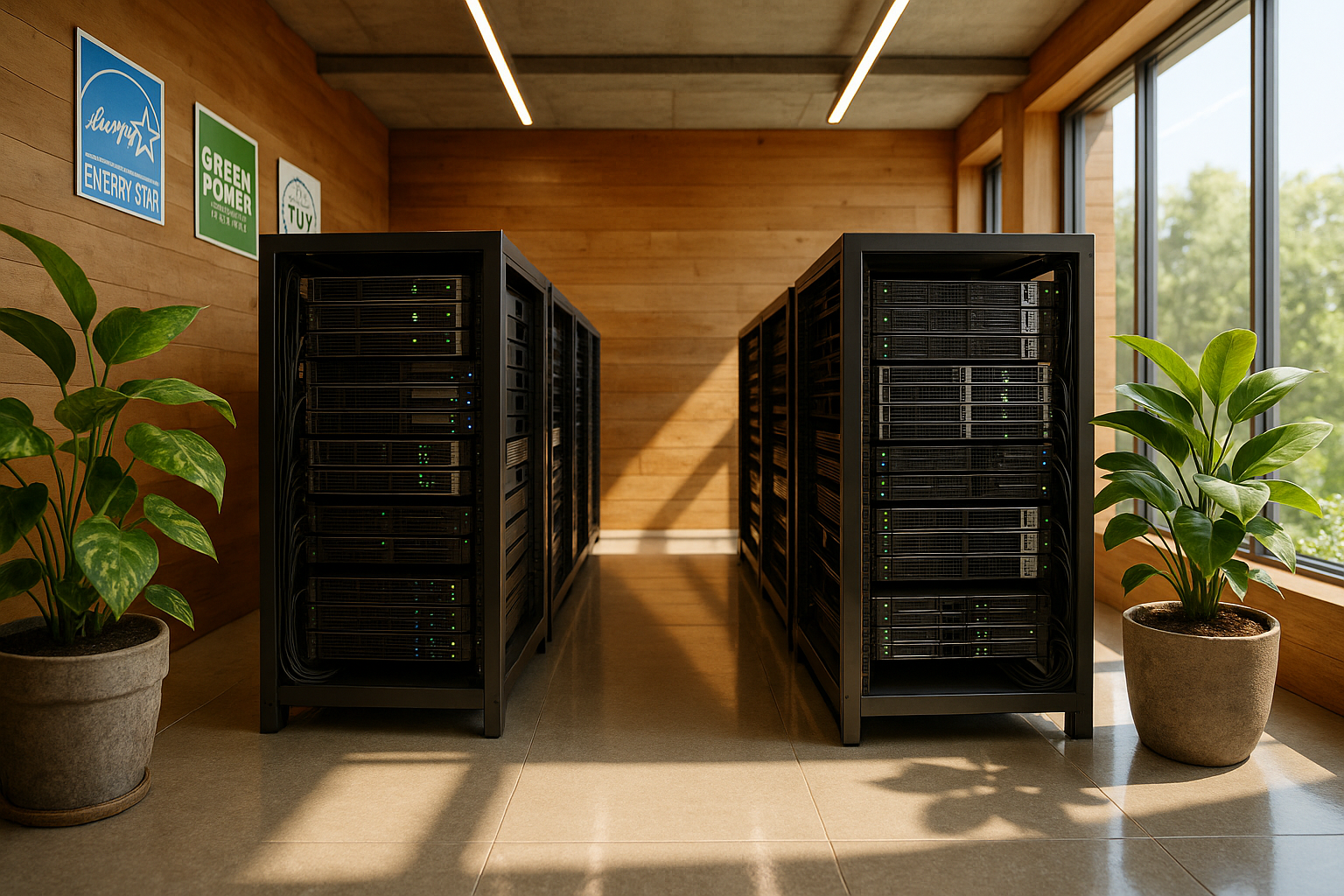
I rate Green Hosting along three levels: Electricity origin, IT efficiency and offsetting unavoidable emissions. Credible providers demonstrably source electricity from wind and solar energy instead of camouflaging the gray grid mix with vague promises [1][5]. Efficient hardware, smart cooling and documented energy management significantly reduce demand [2]. I use certified offsets for residual emissions, but only after reduction - not as a free ride [3][7]. Transparent reports, audit logs and publicly accessible labels provide me with hard evidence instead of appeals to trust.
Which certificates really count?
I separate strong labels from weak labels using the criteria Independence, audit interval and data quality. ISO 14001 and ISO 50001 show me that a provider systematically manages environmental and energy issues and updates them annually [2][5]. The Green Web Foundation label confirms the actual origin of electricity from renewable sources and lists compliant providers in an open database [5]. REC certificates of origin are useful if they take effect in the same market area and are issued close to the time of consumption [3]. I accept CO₂ offsets if projects are certified and also bind or avoid real emissions [3][7].
| Certificate/Label | Content | Test interval | Awareness | Independence |
|---|---|---|---|---|
| ISO 14001 | Environmental management system | yearly | high | high |
| ISO 50001 | Energy management system | yearly | high | high |
| Green Web Foundation | Green electricity certificate | current | rising | high |
| REC | Renewable energy allocation | Ongoing | medium | medium |
| CO₂ offset | Project-based equalization | project-based | medium | variable |
Limits and side effects of certificates
I see certificates as Instruments, not as an end in itself. ISO 14001/50001 do not guarantee a certain level of efficiency, but require a documented improvement process. Without concrete targets, baselines and KPI series, they remain toothless. That's why I always demand: target paths, measurement concepts and verified progress per year. With the GWF label, I check whether it applies to all relevant locations - not just selected products. RECs are useful, but they are no substitute for physical efficiency measures. The further apart origin and consumption are, the lower the system impact. Offsets may mitigate residual emissions, but they are not a license to fail to achieve reductions.
I also pay attention to Double counting and gray areas: Are the same quantities of green electricity or bound emissions counted multiple times? Are „carbon neutral“ claims made on the basis of one-off offsets, even though the energy purchase remains unchanged? Such constellations indicate whitewashing - here I call for clear system boundaries in accordance with the GHG Protocol (Scope 1-3) and a clear separation of location-based and market-based accounting.
Key figure set: CFE, CUE, WUE and Scope 2 methods
In addition to PUE, I extend the consideration by additional Impact indicators:
- CFE share (24/7)How much of the consumption is covered hourly by renewable generation in the same grid area? Annual averages are good, simultaneous coverage is better.
- CUE (Carbon Usage Effectiveness)CO₂ intensity per IT load. Reduces both fossil-based electricity mix and efficiency measures.
- WUE (Water Usage Effectiveness)Water requirement per IT load - relevant for locations with scarce water availability and for cooling technology comparisons.
- Scope 2: location vs. market-basedI require both representations in order to assess network reality and certificate effect separately.
In addition, I request information on REC qualityVintage (time reference), regionality (same network region), volume matching (100% coverage?), as well as the question of whether bundled PPAs (with electricity supply) are used. PPAs with a new-build character often have higher Additionality than unbundled certificates.
How to check providers for authenticity
I start with the Electricity mixCertificates of origin, contract details and publications must match. I then check whether certified data centers are named and whether audit reports are freely accessible [1][5]. I look for continuous efficiency programs instead of one-off measures, such as regular server refresh cycles and heat management [2]. A good place to start is to take a look at Sustainable data centers, because this is where electricity, cooling and management come together. I only accept information on CO₂ offsetting with quantities in tons and clear project standards [3][7].

Recognizing greenwashing: Questions and red flags
I become skeptical when providers only offer colorful Labels but do not provide any test reports. Vague statements such as „green for years“ without key figures or annual comparisons are a warning signal. Missing information on the data center location, the grid region of the RECs or the lifespan of offsets reduces credibility [1][4]. I rely on recurring audits, measurable efficiency paths and comprehensible time series [2][5]. As soon as marketing texts replace technical standards, I ask in detail about power sources, cooling technology, IT utilization and reporting cycles.
Regulation 2025: reporting and verification obligations
I refer to regulatory Drivers into the assessment. Companies are increasingly subject to reporting obligations on environmental indicators, including energy and emissions. For hosting providers, this means providing reliable data on electricity consumption, emission factors (location- and market-based), offsets and progress targets. Those who have already established structured reporting cycles, audit trails and responsibilities here reduce my risk in compliance and due diligence. I ask specific questions: Data formats, audit depth, data center coverage and for clear governance with escalation paths.
Technology that works: efficiency, cooling, PUE
I focus on technical levers with direct Effect. A low PUE indicates efficient infrastructure; I only count values that are consistently measured and published [2]. Modern free cooling, hot/cold aisle containment and speed-controlled fans reduce demand. Server virtualization and workload optimization avoid idling and save energy without compromising quality. If you want to understand key figures, you can find background information on the PUE value and its classification for data centers.

Waste heat, lifecycle and Scope 3: the often overlooked lever
I look at Waste heat utilizationIs heat fed into the local or district heating network, what is the usable temperature and what annual amount of energy is actually purchased? Reliable reports quantify kWh, consumption levels and seasonal fluctuations. I also evaluate Hardware life cyclesExtended use through refurbishment, modular repairability, spare parts strategies and proper recycling reduce embedded emissions (Scope 3). Those who align their own purchasing with efficiency and repair criteria reduce emissions, waste and procurement risks at the same time.
I demand a transparent process for my decisions. Scope 3 approachHardware emissions (procurement), logistics, disposal and service providers. Measurement concepts with clear system boundaries, conservative assumptions and comprehensible emission factors create trust. The same applies here: reduction before compensation.
Market overview 2025: certificates and performance
I combine Certificates with measurable measures and a degree of transparency. ISO and GWF labels form the basis, while efficiency programs and reports provide the depth [1][2][5]. Providers with full green electricity procurement, documented cooling concepts and regular offsets demonstrate a mature approach [3][7]. I particularly value public sustainability reports with key figures over several years. This creates reliable comparisons instead of advertising promises.
| Provider | Certification | Green electricity share | CO₂ compensation | Transparency | Test winner |
|---|---|---|---|---|---|
| webhoster.de | ISO 14001, GWF, REC, Offset | 100% | Yes | Very high | 1st place |
| GreenGeeks | EPA Green Power, REC, Offset | 300% comp. | Yes | high | 2nd place |
| HostEurope | ISO 14001, green electricity | 100% | no | high | 3rd place |
| SiteGround | GWF, REC | 90% | Yes | high | |
| DreamHost | REC, Offset | 100% | Yes | high | |
| A2 Hosting | REC, Offset | 100% | Yes | high |
Methodology of the market comparison
I build comparisons on a uniform data basis The criteria are based on: publicly available reports, certificate registers, provider information and - where possible - audit confirmations. Electricity origin (including market and time reference), efficiency indicators (PUE, CFE, ideally CUE/WUE), transparency (depth of reporting, audit intervals) and credible compensation are evaluated. Weightings prioritize hard evidence over marketing. I point out limitations: Not all sites report at the same granular level; some values are snapshots. That's why I value time series over several years and consistent measurement methods.
Provider ranking: strengths at a glance
I see webhoster.de GreenGeeks is at the forefront, as it combines green electricity, ISO certificates, independent verification and regular offsets, including open reports. GreenGeeks scores with 300% energy compensation and additional tree planting, which has a signal effect [3][7]. HostEurope impresses with 100% green electricity and ISO 14001 as well as investments in economical cooling [1]. SiteGround, DreamHost, A2 Hosting, HostGator and InMotion also deliver solid programs with a focus on efficiency and carbon offsetting [3][7]. For my selection, I prioritize transparency and recurring auditing over individual actions with a show effect.

Application scenarios: Which requirements suit whom?
I differentiate between Workloads and operating models. For traditional websites and CMSs, clean green energy procurement, solid PUE values and stable caching are particularly important - shared and managed offerings with documented efficiency are often ideal here. For compute-intensive projects (databases, analytics, AI), scalable resources, peak load management and detailed energy reports are important in order to increase the CFE share and avoid inefficiencies. Edge workloads benefit from locations with low network intensity and good free cooling.
I ask myself: Do I need 24/7-CFE for regulatory targets? Then I choose providers with granular energy tracking and hourly balancing. Standing Water shortage or local environmental requirements, I give more weight to WUE and cooling technology. For globally distributed target groups, a regional combination with transparent reporting per location is worthwhile.
What companies should look out for
I first check Location data, power sources, audit reports and the history of key figures. Then I look at efficiency paths: server refresh, cooling concept, PUE documentation and utilization management [2]. I require insight into REC strategy, time reference, grid region and offsets with quantity data [3]. Compact guidelines help to get started; I like to use short Green hosting tips as a check aid. Finally, I compare contract terms, reporting cycles and possible migrations with my roadmap horizon.
Migration without regrets: step by step
I migrate to Pilots, before I make a large-scale move: A representative application moves, including monitoring of performance, availability and energy key figures. I define measurement windows before and after the migration in order to evaluate effects in isolation (same load profiles, same test cases). Findings are incorporated into tuning and contract fine-tuning. Only then do other systems follow in waves, with clear rollback plans.
I am planning Downtime window conservative and check exit scenarios before signing the contract. Data portability, bandwidth costs and API compatibility should be on the checklist. It makes sense to set up a parallel observability set (logs, metrics, traces) so that efficiency gains are not wasted due to misconfigurations.
Costs, contracts, risk: pragmatic checks
I always evaluate price quotations with a view to Energy-risks and save money in the long term through efficiency. Runtimes must not slow down technological renewal, otherwise indirect emissions from old hardware will increase. I ask for exit conditions and data transfer costs in advance so that a later migration can be planned. Subsidies or internal budgets for sustainability can offset additional costs if this reduces emissions. In this way, I ensure climate benefits and economic viability at the same time.

Business case and measurement plan: How to demonstrate impact
I combine Opex-savings with avoided emissions and risk reduction. Efficiency lowers electricity costs, less overprovisioning reduces hardware requirements and support costs. I quantify CO₂ effects with conservative emission factors and document assumptions. I use a compact KPI set for my steering: PUE (monthly), CFE (hourly or at least quarterly), power consumption per productive instance, utilization (CPU/RAM/storage) and downtimes. A clear measurement plan prevents Cherry picking and enables progress reports to be sent to internal stakeholders.
Checklist: How to make the right choice
I take a structured approach and start with certificatesISO 14001 and ISO 50001 plus Green Web Foundation are my mandatory set [2][5]. I then check electricity contracts, REC details and reports with annual comparisons. I require clearly documented efficiency programs with PUE targets and measurable milestones [2]. For offsets, I ask for project standards, quantities and durations [3][7]. In the end, I test support, monitoring and migration paths with a pilot project before planning major moves.

Summary in brief
I rely on hard Evidence instead of advertising promises: ISO 14001, ISO 50001 and Green Web Foundation create trust [2][5]. I consciously use REC and CO₂ offsets, but only after consistent reduction [3][7]. Efficiency drivers such as PUE optimization, modern cooling and capacity management have a direct impact [2]. In the 2025 market comparison, webhoster.de impresses with a well-rounded set of green electricity, certificates, offsets and transparency; GreenGeeks and HostEurope also have strong profiles [1][3][5][7]. Anyone who applies these guidelines will reliably find a host that demonstrates climate benefits and supports a sustainable digital presence.