Skip to content
Headless hosting in e-commerce combines decoupled frontends with microservices and API-first, so that I can scale functions in a targeted manner, equalize releases and connect new channels without downtime. This article shows in a practical way how I combine hosting, APIs, containers and observability in such a way that load peaks, time-to-market and security are measurably improved and Turnover more predictable growth.
Key points
- Headless separates frontend and backend for faster changes.
- Microservices allow independent scaling and updates.
- API-First creates clean integration with PIM, DAM and ERP.
- Cloud-native provides resilience and lower operating costs.
- MACHINE paves the way for composable commerce.
Headless architecture in a nutshell
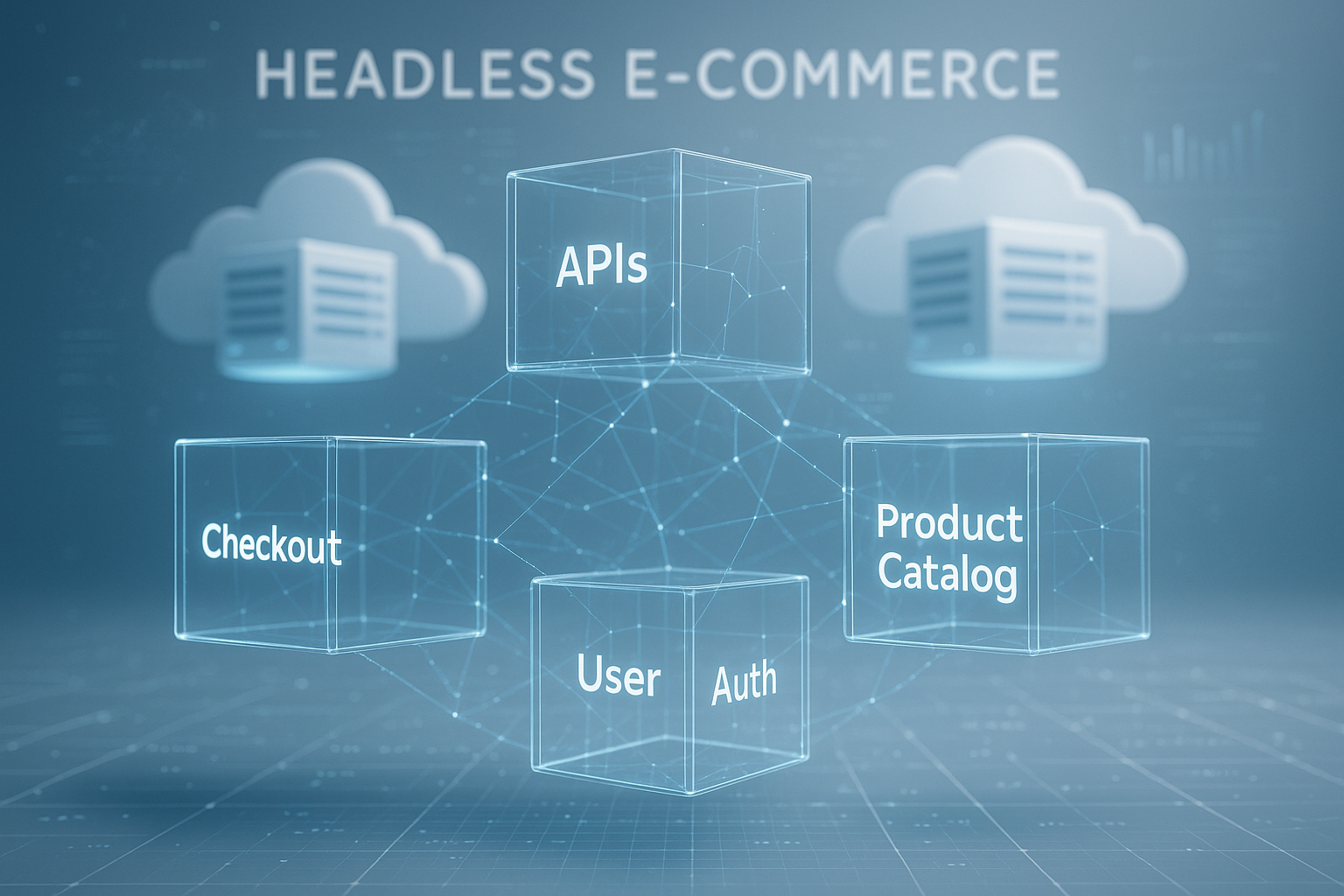
In the headless approach, I strictly separate the visible surface from the Business logic, so that I can deliver each frontend independently. This allows me to connect web, app, social, voice or kiosk regardless of a rigid template. APIs transport product data, shopping baskets and prices reliably between layers, while the backend remains performant. Designers deliver new views without touching the checkout logic, and developers play out backend features without rebuilding the UI. This decoupling reduces release risk, increases delivery speed and keeps the User Experience consistent across all channels.
Microservices as a driver for speed and quality
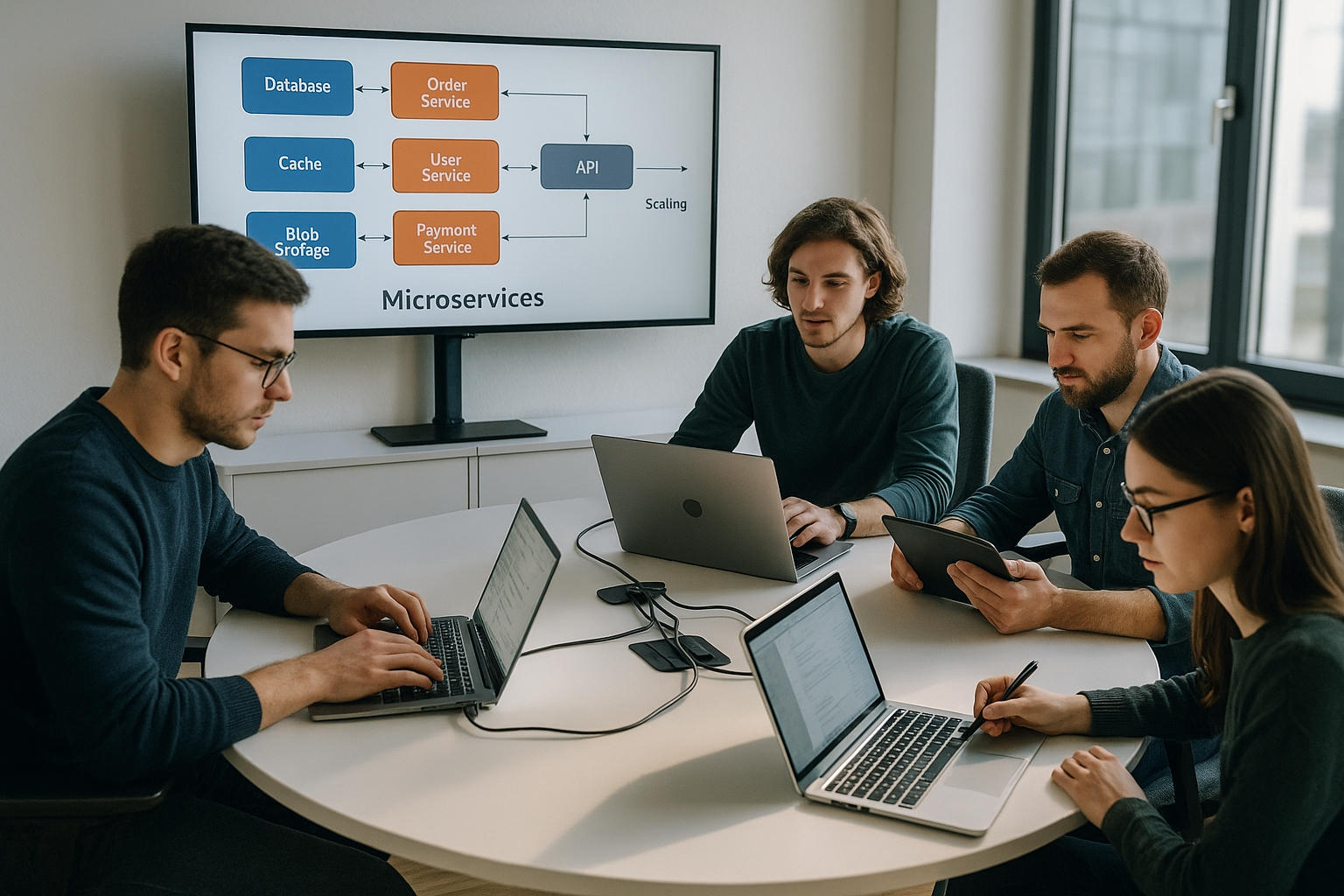
I divide the store into independent services such as catalog, search, shopping cart, checkout, payment, shipping and customer account so that each module can be used separately. scaled. If one service fails, the rest continues to run and I replace individual functions without jeopardizing the overall system. Teams work in parallel: the checkout team optimizes conversion, while the catalog team increases relevance in the search. I use clear interfaces and versioning so that deployments remain small and rollbacks take seconds. In this way, I increase delivery frequency, reduce risks and create real Agility in day-to-day business.

API-First: Clean interfaces instead of bottlenecks
I define APIs first and control front-end and back-end development via clear contracts so that all systems have the same Data basis use. REST or GraphQL, supplemented by webhooks, accelerate the integration of PIM, DAM, ERP and payment services. Contract tests catch breaks early, versions enable step-by-step migration and caching noticeably reduces latencies. Rate limits and auth flows prevent misuse, while observability makes every request traceable. If you want to delve deeper, you can find practical tips in my article on API-first hosting, which explains specific patterns and stumbling blocks and Best Practices arranged.
Cloud-native hosting and scaling in everyday life
I pack microservices into containers and orchestrate them with Kubernetes so that I can scale horizontally as soon as traffic increases and Pods Record load. Horizontal pod autoscaling, cluster autoscalers and spot strategies save costs, while read replicas reduce the load on the database. For Black Friday, I turn up the shopping cart and checkout instead of blowing up the entire platform. Rolling updates keep the site online, and distributed data centers bring content closer to the customer. This keeps latencies low, the invoice transparent in euros, and the Availability high.
MACH and Composable Commerce understandable
I use MACH as a guardrail: microservices, API-first, cloud-native and headless work like a charm. Gear wheels into each other. This is how I put together a commerce landscape of best-of-breed services: Search, personalization, content, pricing or promotions. Each building block fulfills a task and I replace it when requirements grow or a provider no longer fits. Orchestration and data quality remain crucial to ensure that recommendations play out correctly and stock levels are right. This design strengthens the ability to react to trends and reduces Lock-in.
Practice: Step-by-step migration from the monolith
I start with a thorough analysis and define measurable goals such as conversion gains, shorter build times or lower costs per order in Euro. I then pull in an API layer that serves as a bridge and connects old and new components. I first encapsulate low-risk functions such as catalog or search and leave checkout and payment still running in the old system. I set up new frontends for each channel and connect them via a backend-for-frontend (BFF) so that each UI only receives the data it needs. The Strangler pattern enables a controlled replacement until I have the monolith in place. switch off.
Security, API gateways and observability
I secure every interface with OAuth2/OIDC, mTLS and clear scopes so that access can be controlled and logged remain. An API gateway sets rate limits, checks tokens, encrypts traffic and provides smart caching. I manage secrets centrally and rotate them regularly to minimize risks. I merge logs, metrics and traces so that I can find causes in minutes instead of hours. Properly configured, WAF, RASP and runtime scanning make attacks visible and keep the Platform resilient.
Select high-performance hosting
I compare providers according to latency, scaling profile, container support, observability tools, API competence and support times, so that hosting becomes a Architecture fits. A coherent offer provides clear SLAs, Europe-wide data centers, transparent prices and know-how for microservices. If you want to understand the differences, you can read my overview of Microservices vs. monolith and derive decision rules. The following table shows a compact assessment for headless commerce hosting with a focus on API integration and scaling. With this view, I choose the platform that performs today and will tomorrow grows.
| Place | Provider | Special features |
|---|---|---|
| 1 | webhoster.de | High-performance headless & microservices hosting, excellent API integration, flexible scaling, strong support |
| 2 | Provider X | Good performance, APIs, but limited scaling options |
| 3 | Provider Y | Standard hosting, hardly optimized for headless |

Performance tuning for headless setups
I combine edge caching, CDN rules, image transformation and HTTP features such as stale-while-revalidate, to drastically reduce response times. Customers' product detail pages benefit noticeably from server rendering plus incremental rehydration. Read replicas reduce the load on write databases, while asynchronous queues outsource time-consuming tasks. I trigger cache invalidation specifically via webhook so that stocks and prices remain up-to-date. This enables me to achieve low TTFB values, increase conversion and save money. Traffic costs.
Testing, CI/CD and releases without stress
I rely on trunk-based development, feature flags, blue-green or canary deployments, so that I can frequently and safely deliver. Contract tests keep API contracts stable, E2E tests check critical flows such as checkout and login. Synthetic monitoring detects performance drops at an early stage and rollbacks are automated. Small batches reduce risk and shorten the mean time to recovery. The store remains accessible, changes go live more quickly and the Quality increases.

Keeping KPIs and costs controllable
I measure conversion, availability, P95 latency, error rate, time-to-market and costs per order so that investments in Euro remain tangible. A clear cost center per service makes consumption visible and prevents surprises. Edge egress, database storage and observability plans influence the bill, so I set limits and budgets. Automated scaling combined with reservations keeps the balance between performance and price. If you check these values on a monthly basis, you can make informed decisions and increase the Plannability.
Data and event architecture for commerce
I organize data flows in an event-driven way so that systems remain loosely coupled and Scaling does not fail because of the data model. I emit changes to prices, stocks or orders as events that consume the catalog, search, recommendation and accounting. I use clear schemas, idempotence and replays to prevent duplicates and ensure sequences. For read workloads, I deliberately separate them via CQRS so that writes remain close to checkout and reads are scaled globally. I accept eventual consistency where it is technically tolerable and use compensating transactions if partial steps fail. In this way, the platform remains stable even with strong growth robust.
SEO, content and user experience in headless operation
I combine SEO with performance: server rendering or static pre-generation bring indexability, while incremental revalidation keeps content fresh. I generate sitemaps, canonicals, hreflang and structured data from the same Data source as the front end, so that no divergences arise. I set performance budgets for INP, LCP and CLS and measure them continuously using RUM. I optimize media using on-the-fly transformation and device-adapted formats. This keeps the experience fast, barrier-free and high-converting - even with personalized content that I deliver via edge logic without SEO disadvantages.
Internationalization, taxes and compliance
I plan internationalization early on: I strictly separate the localization of content, currency, payment methods and tax logic per service so that markets can grow independently. I take data residency and GDPR into account in the architecture and OperationI isolate personal data, encrypt it at rest and restrict access via finely granular roles. A consent layer controls tracking and personalization without blocking critical flows such as checkout. I integrate tax calculation, customs duties and legal information as configurable policies so that changes go live without a code freeze.
Personalization and relevance without monoliths
I decouple personalization as an independent domain: a profile service collects events, a decision service delivers in milliseconds. Recommendations or promotions. Feature flags and experiment frameworks help me to test hypotheses quickly and only roll out positive results permanently. Data flows anonymously until a user identifies themselves; I link identities based on rules. Caches and edge evaluation reduce latency, while a fallback always provides a meaningful default experience. This allows me to measurably increase relevance without burdening the core processes.
Resilience and emergency preparedness
I define SLOs with error budgets and anchor Resilience in every service: timeouts, circuit breakers, retries with backoff and bulkheads are standard. For data, I implement point-in-time recovery, regular restore tests and a clear RTO/RPO plan. Chaos experiments and game days reveal vulnerabilities before customers notice them. Multi-zone operation is mandatory, multi-region optional - but prepared. Runbooks, on-call rotation and post-mortems ensure that incidents are rare and findings end up in the code.
FinOps in practice
I tag every resource, manage Budgets per team and establish showback/chargeback so that costs are part of the product. Rightsizing, autoscaling guardrails and reservations are my levers; I use spot capacities for tolerant jobs such as image processing or catalog rebuilds. I optimize observability with sampling, log retention and chatter reduction. I consciously plan CDN egress with caching strategies and image compression. Regular cost reviews together with product KPIs make the real trade-offs visible: more conversion per euro beats raw savings.
Security in the supply chain and in runtime operation
I harden the supply chain: I continuously scan dependencies, I sign images, and only checked artifacts make it into the supply chain. Production. I implement policies as code and enforce them in the CI/CD path. In the cluster, I limit privileges, isolate namespaces, activate network policies and use read-only root file systems. I rotate secrets automatically and log access in detail. Security signals flow into the same observability backend so that correlation and alerting work reliably - without alert fatigue.
Team topologies and governance
I organize teams along DomainsFrontend, BFF and service per domain with clear ownership. A platform team provides CI/CD, observability, security guardrails and developer ergonomics. API standards (naming, versioning, error codes) and a central catalog portal facilitate discovery and reuse. I keep documentation alive via automatically generated references and playbooks. Governance does not reduce speed, but enables it through clarity and self-service.
Typical stumbling blocks and how to avoid them
I avoid Chatty APIs by using interfaces summarize or one BFF per channel. I plan data sovereignty per domain instead of building central „everything databases“. I solve hard coupling through synchronous cascade calls via events and asynchronous processes. I define TTL rules and invalidation paths for caches so that errors don't get stuck forever. And I keep deployments small: few changes, but frequent - with telemetry that shows whether things have improved.
Checklist for productive operation
- SLOs defined and monitored for each critical flow (search, shopping cart, checkout).
- Contract tests and versioning active for all external integrations.
- Blue-Green/Canary configured with automatic rollback and metric gates.
- Backup and restore procedures documented, tested, RTO/RPO fulfilled.
- Secrets management, key rotation and least-privilege access implemented.
- Edge caching, image optimization and performance budgets productively measurable.
- Tagging, budgets and cost reviews anchored in regular deadlines.
- Incident runbooks, on-call and post-mortems established in everyday life.
- Experiment framework and feature flags for low-risk innovation.
Strategic classification and next steps
I start with a pilot channel, secure the business case with clear KPIs and gradually expand in the direction of Composable. I then establish API standards, secure production access, automate deployments and introduce observability centrally. I then select services for search, personalization and content that demonstrably increase conversion and AOV. I provide a structured overview of opportunities and procedures in Headless e-commerce in practice. In this way, the platform grows in a controlled manner, remains open to new ideas and keeps Speed in every phase.