Skip to content
IoT hosting will determine in 2025 how quickly, securely, and reliably companies collect, process, and evaluate billions of device signals. I will show what requirements must be met for Memory, network, and security now matter, and how I plan suitable hosting architectures.
Key points
I will summarize the following key points briefly before going into more detail.
- MemoryScalable data lifecycle management with hot/warm/cold strategy
- Network: 5G, NB-IoT, IPv6, QoS, and segmentation for low latency
- Security: mTLS, PKI, firmware signing, zero trust, and monitoring
- ScalingContainer orchestration, auto-scaling, multi-region failover
- Standards: MQTT, OPC UA, API-First, and schema governance

Storage and data management in 2025
I am planning Memory Along the data value chain: Telemetry first lands on NVMe SSDs for fast ingestion, then moves to object storage, and finally to long-term archive classes. For device time series, I use time-series databases that compress, aggregate, and strictly apply retention policies. Edge nodes filter, normalize, and consolidate data before it goes to headquarters, reducing latency and traffic. For peaky loads, I rely on elastic object and block backends that can be expanded within minutes via API. If you want to delve deeper into the implementation, you will find practical guidelines at Edge computing advantages, that I take into account in hybrid designs.
Network infrastructure and connectivity
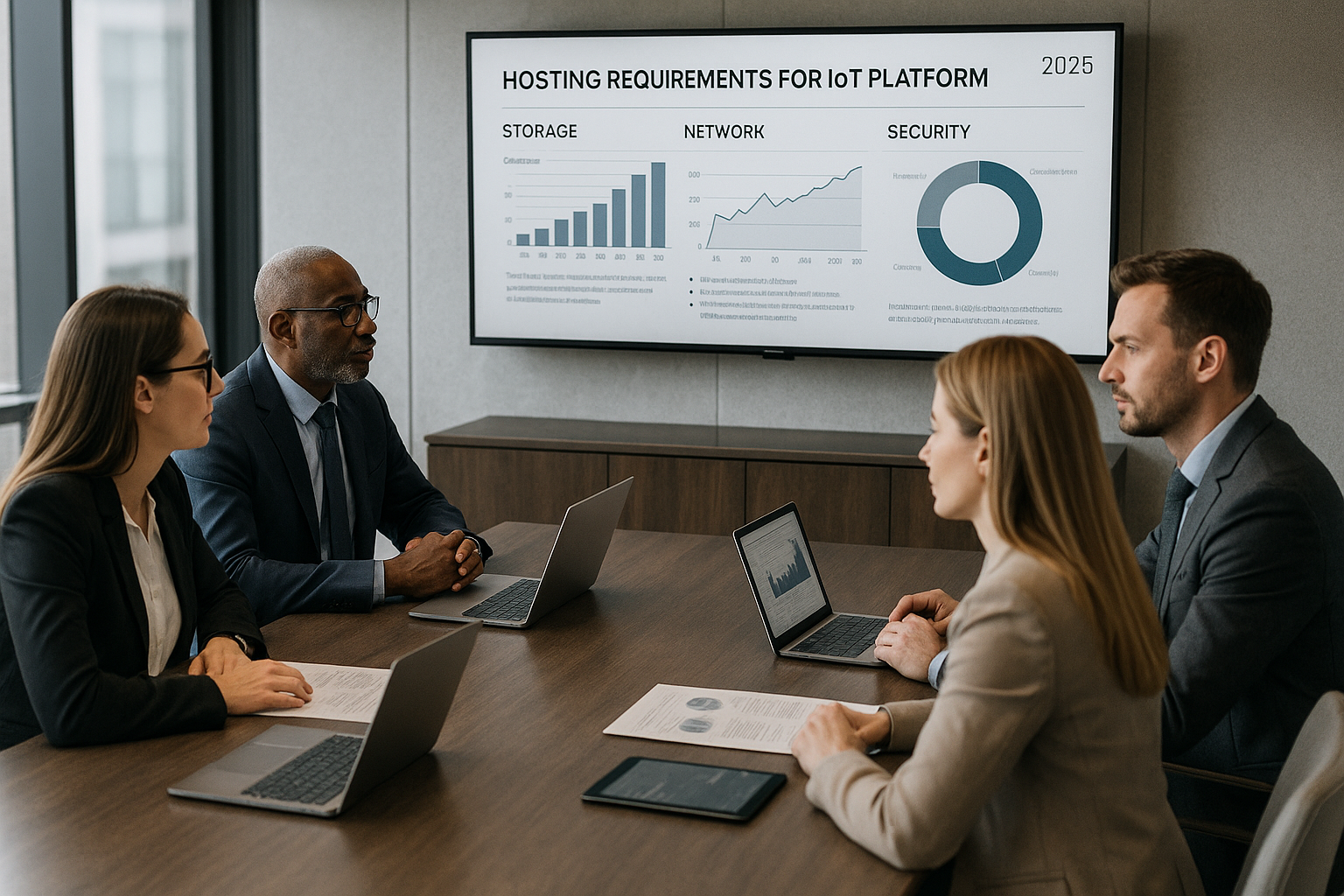
I combine NetworkTechnologies depending on device type: 5G for mobile machines, NB-IoT for economical sensor technology, Industrial Ethernet for deterministic latency. IPv6 ensures addressable device fleets and simplifies routing and segmentation across locations. For messaging, I use MQTT with QoS levels and session resumes to cushion dead spots and control backpressure cleanly. I strictly separate VLANs, VRFs, and SD-WAN according to zones for production, administration, and guests, while IDS/IPS monitors east-west traffic. The compact IoT web hosting comparisonwhich I use as a checklist.
Security requirements for IoT platforms
I start with ZeroTrust principles: Each device authenticates itself via mTLS, certificates come from a managed PKI with a short runtime. Hardware-based roots of trust and secure elements protect key material, firmware signing prevents manipulated images. I consistently encrypt data in transit and at rest, and manage keys in HSM-supported services with rotation. Network segments limit the spread of incidents, while IDS/SIEM reports anomalies early. Regular firmware updates, SBOMs, and automated tests keep the attack surface small and ensure ongoing operations.
Scalability and high availability
I orchestrate services with dumpster diving and auto-scaling rules that respond to latency, queue depth, and error rates. I scale stateless services horizontally and handle state via replicated databases, Raft clusters, and asynchronous replication. For reliability, I plan zone and region redundancy, health checks, and traffic failover via Anycast or DNS. Backups follow the 3-2-1 rule and meet defined RPO/RTO targets, and I regularly verify restore tests. Predictive maintenance models analyze logs, SMART values, and metrics to identify and resolve issues before they affect the user.
Interoperability and standardization
I rely on open Protocols: MQTT for lightweight telemetry, OPC UA for industrial semantics, LwM2M for device management. An API-first strategy with versioned schemas and contract tests reduces integration efforts. A schema registry prevents uncontrolled growth of topics and payloads, which accelerates data quality and analytics. Digital twins standardize device states and allow simulation runs before rolling out new logic. Governance committees and automated compatibility checks ensure that new devices can be connected without rewrites.
Architecture with Edge and Micro Data Centers
I plan in three stages: Edge at the location for preprocessing, regional nodes for aggregation, and a central cloud for analytics and training. Micro data centers close to production reduce latency, keep data local, and enable operation despite WAN failure. Caches and rulesets run offline, and events synchronize after the connection is restored. Security stacks at each tier consistently check identity, integrity, and policies. Those who need more flexibility at the location level should Micro Data Center check, which I scale modularly.

Monitoring, logging, and incident response
I measure Metrics, Traces and logs consistently, aggregate them in a time series and search platform. Service level targets define when I scale, alert, or throttle workloads. Synthetic checks examine endpoints and MQTT brokers from a device perspective to reveal latency and packet loss. Playbooks and runbooks describe steps for dealing with disruptions, including rollback and communication. I keep post-mortems blameless and derive concrete measures that I prioritize in backlogs.
Data management, governance, and compliance
I note Data protection and data locality right from the design stage, so that transfers across national borders remain legally compliant. I separate keys from storage and use HSM-supported management that supports rotation and access separation. I automatically comply with retention and deletion rules, and anonymization and pseudonymization protect personal references. I control costs via storage classes, lifecycle rules, and compression without losing evaluability. I regularly check audits against ISO 27001 and SOC reports so that evidence is available at all times.
2025 provider comparison for IoT hosting
I equalize Requirements with platform strengths: Performance, security, support quality, and global availability are my main criteria. According to independent comparisons, webhoster.de leads the way thanks to its strong scalability, security level, and reliable support. AWS IoT, Azure IoT, and Oracle IoT score highly with their ecosystems, analytics, and breadth of integration. ThingWorx IIoT addresses industrial scenarios and existing automation technology. I make my selection based on the number of devices, latency windows, compliance goals, and existing integrations.
| Rank | Platform | Special features |
|---|---|---|
| 1 | webhoster.de | Scalability, security, support |
| 2 | AWS IoT | Market leader, global infrastructure |
| 3 | Microsoft Azure IoT | Multi-cloud, data analytics |
| 4 | Oracle IoT | Business Solutions, Integration |
| 5 | ThingWorx IIoT | industrial solutions |
I test proofs of concept in advance with real data and load profiles to identify bottlenecks and avoid surprises later on. I review contract details such as SLAs, exit strategies, and data portability early on so that projects remain plannable and changes are possible.
Migration plan in 90 days
I start with Inventory And the target vision: I capture device classes, protocols, data flows, and security gaps in their entirety. In the second phase, I migrate pilot workloads to an isolated staging environment and collect metrics on latency, costs, and error rates. I then scale up to an initial device group, harden security controls, and ensure observability. Next, I transfer data pipelines, set lifecycle rules, and check backups and restore processes. Finally, I go live, monitor closely, and learn lessons for the next wave.
Device onboarding and lifecycle
I plan the entire Device lifecycle From production to decommissioning. Devices are already provided with unique identities, keys, and initial policies via secure provisioning at the factory. Upon initial contact, gateways enforce just-in-time registration with attestation, ensuring that only verified hardware is granted access. Offboarding is equally important: as soon as a device is decommissioned, I automatically revoke certificates, delete residual data in accordance with retention policies, and remove permissions from all topics and APIs.
- Onboarding: Centrally record serial numbers, hardware IDs, certificates, and profiles
- Policy design: Least privilege scopes per device category and environment
- Deprovisioning: certificate revocation, topic blocking, data deletion, inventory update
OTA updates and maintenance security
I design Firmware and software updates Robust: A/B partitions enable atomic rollouts with fallback, delta updates save bandwidth, and staggered canaries reduce risk. I strictly authenticate update servers, and devices verify signatures before installation. I control rollouts by region, batch, and device health; I roll back faulty versions with one click. Service windows, backoff strategies, and retry policies prevent overload on brokers and gateways.
- Pre-checks: Battery status, power quality, minimum storage space
- Progress tracking: Telemetry on download time, apply time, error codes
- Recovery: Automatic reboot to previous state in case of health check failure
Stream processing and edge AI
For Near-real-time requirements I combine MQTT with stream processing. Window aggregations, enrichment from digital twins, and rule-based alarms run close to the source to keep response times in the double-digit millisecond range. I distribute edge AI models for anomaly detection or quality testing as containers or WASM modules; I keep model versions synchronized, and telemetry feeds continuous retraining at headquarters.
MLOps is part of operations: I version features and models, track drift, and use shadow deployments to passively evaluate new models first. I dimension inference engines according to the CPU/GPU profiles of the edge nodes and measure latency budgets to ensure that control loops remain deterministic.

Cost and capacity planning (FinOps)
I anchor FinOps in design and operation. Cost centers and clients are tagged and labeled throughout the entire pipeline. I simulate load scenarios with realistic message rates, payload sizes, and retention to plan broker sizes, storage classes, and egress costs. Auto-scaling and tiered storage reduce peak costs, while commitments make base loads calculable.
- Transparency: Unit economics per device, per topic, per region
- Optimization: Compression, batch sizes, QoS mix, aggregation levels
- Control: Budgets, alerts, weekly showbacks, and monthly chargebacks
Multi-tenancy and client separation
Many IoT platforms serve multiple business areas or customers. I separate Clients via dedicated projects/namespaces, strictly segmented topics, and separate secrets. I isolated data paths and observability so that no side effects or insights between tenants are possible. For shared brokers, I enforce rate limits, quotas, and ACLs per tenant to avoid noisy neighbor effects.
- Data isolation: Encrypted buckets, separate keys, separate retention
- Rights: RBAC/ABAC with fine-grained roles per team and region
- Scaling: Dedicated pools for latency-critical clients
Resilience tests and emergency drills
I test resilience Not just on paper. Chaos experiments simulate broker failures, packet loss, clock skew, and storage degradation. Game days with operations and development validate runbooks, communication channels, and escalation chains. I correlate failover time, data loss windows, and rebuild duration with RTO/RPO targets; only what has been tested is considered achievable.
- Disaster recovery drills: region failover, restore exercises, audit logs
- Performance tests: Soak tests over days, burst tests for 10× peaks
- Health budgets: Error budgets control release speed
Data quality and schema evolution
I prevent schema drift with validated contracts, compatibility rules (forward/backward), and declared deprecations. Idempotent consumers process duplicate messages correctly, and I correct out-of-order events with timestamps, watermarks, and reorder buffers. For analytics, I separate raw data, curated datasets, and feature stores so that real-time and batch run cleanly side by side.
- Quality: Mandatory fields, units, limit values, semantics per topic
- Traceability: End-to-end lineage from device to dashboard
- Governance: Approval processes for new topics and payload versions
Legal framework 2025
In addition to data protection, I take industry-specific and country-specific requirements into account. For critical infrastructures, I plan for increased Verification and curing requirements, including continuous vulnerability scans, penetration tests, and change traceability. In the industry, I follow relevant standards for network segmentation and secure software supply chains. I maintain audit-proof and tamper-resistant logging and audit trails.
Sustainability and energy efficiency
I optimize Energy consumption on devices, at the edge, and in the data center. At the device level, I save energy through adaptive sampling rates, local compression, and sleep modes. On the platform, I rely on energy-efficient instance types, workload consolidation, and time slots for computationally intensive batch jobs when green energy is available. Metrics on carbon footprint and kWh per processed event are incorporated into my FinOps view.
Business organization and SRE
I anchor Reliability In teams: SLOs for latency, availability, and data freshness form the guidelines. Error budget policies define when I pause features and prioritize stability. I roll out changes via blue/green or progressive delivery, with telemetry determining the pace. On-call plans, handoffs, and joint post-mortems strengthen learning curves and reduce time-to-repair.
In summary: Hosting decision 2025
I prioritize Latency, reliability, and security along the entire chain from device to analysis. Edge processing, scalable storage, and clean segmentation deliver measurable effects on performance and costs. Certificates, mTLS, and signed firmware protect identities and updates, while monitoring reports incidents early. Open standards and API-first reduce integration efforts and secure future enhancements. With a phased migration plan, clear SLAs, and robust testing, I will bring IoT platforms into operation quickly and reliably in 2025.