Skip to content
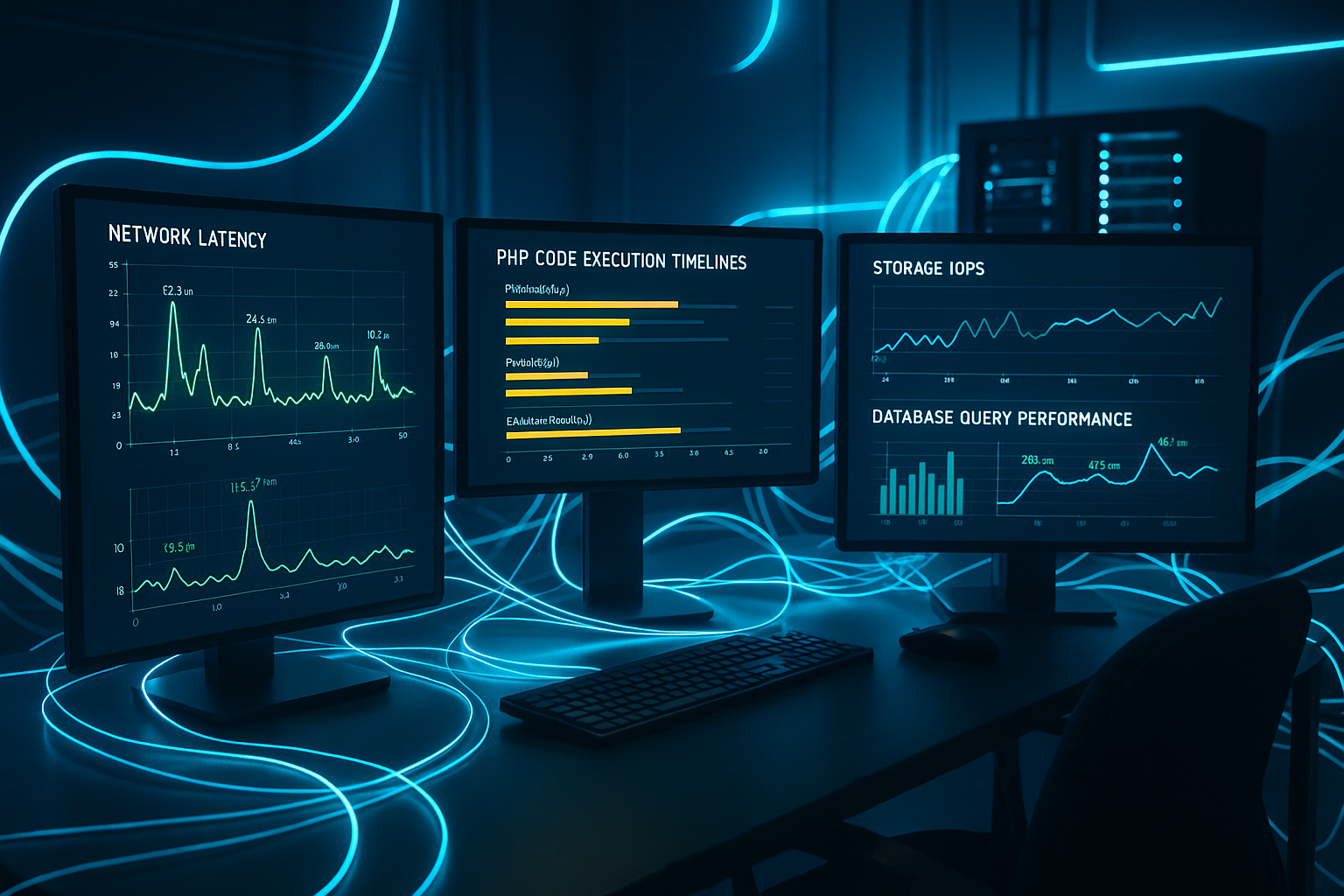
A hosting latency analysis shows me how much time the network, storage, PHP and database consume per request and where delays occur. This allows me to identify bottlenecks along DNS, TCP/TLS, I/O, PHP workers and queries and take targeted measures to reduce them. Server time.
Key points
The following core statements form the framework for my investigation and optimization.
- NetworkRTT, TLS and jitter determine the first hurdle for TTFB.
- StorageI/O wait and HDDs drive waiting times for dynamic accesses.
- PHPFPM Workers, OPcache and plugins characterize the dynamic response time.
- DatabaseIndices, locks and caching determine query latencies.
- MonitoringServer timing, APM and P95 ensure sustainable control.

Correctly measure and reduce network latency
With every page request, DNS lookup, TCP handshake, TLS negotiation and first byte delivery add up to my RTT. I measure these levels with server timing headers and compare them with client timings in the browser to separate causes cleanly. High round-trip times or packet losses drive up the TTFB, while additional hops due to load balancers add a few milliseconds per request. A CDN, aggressive edge caching and a clean TCP/TLS configuration help against congestion, but cache misses bring the origin back into play. For unstable connections, I analyze Jitter and spikes, to expose bursts and dissolve limits.
Storage I/O: when waiting times explode
Slow hard disks shift the load to I/O queues during peak times and increase IOwait. I check whether HDDs are still in use, because SSDs and even better NVMe reduce access times to microseconds and limit queue depth problems. Monitoring with system metrics shows me whether backups, cron jobs or viral traffic are driving the latency peaks. File systems such as XFS often deliver better throughput with parallel access, while outdated structures and fragmentation dampen performance. If throttling occurs in mass hosting, I migrate to dedicated resources or a VPS to permanently alleviate the bottleneck.

Targeted optimization of PHP workers and FPM settings
Each dynamic request occupies a PHP FPM worker and thus temporarily blocks a Process. In load situations, queues are created that drive up the TTFB and total load time, although the network and storage still have room to grow. I define the number of workers according to the real peak load and RAM, measure process runtimes and scale horizontally when child processes put pressure on the memory. I use APM traces to find long-running processes, while I mitigate problematic hooks in CMS and store systems. Details like pm.max_children, request termination and max requests, I decide on the basis of profiling data instead of gut feeling.
OPcache, autoloader and framework costs
An activated OPcache reduces compilation times and noticeably lowers the CPU-load per call. I make generous use of the cache (e.g. 128-256 MB), set revalidate_timings sensibly and prevent constant invalidation due to unnecessary deploy hooks. Autoloaders in modern frameworks cause expensive file stat checks, which can be significantly reduced with classmaps and preloading. Composer optimizations, JIT settings and economical third-party libraries streamline the code paths. I prefer to replace bloated plugins with lean alternatives that load fewer functions per request.
Database latency: indexes, locks, caching
Unindexed filters, N+1 read orgies and lock conflicts often delay responses by Seconds. I start with slow query logs, check explain plans and set missing indexes before I think about hardware. For frequent reads, I bring object caching with Redis or Memcached into play and outsource expensive results to the working memory. I equalize critical write paths using queueing and execute expensive operations asynchronously so that the web request is completed quickly. I also increase the read capacity using read replica and sharde when tables grow excessively or hotspots occur; I collect additional information here via Accelerate DB queries.
Query design: Avoid N+1 and plan joins
Many ORMs generate N+1 accesses unnoticed, which can be used for increasing Use explode. I reduce round trips with eager loading, sensible joins and lean SELECT lists instead of SELECT *. I separate time-critical paths into compact queries that make perfect use of the index instead of forcing universal queries. I update statistics regularly so that the optimizer chooses the best plan and does not fire off full-table scans. For reporting jobs, I duplicate data to an analytics instance so that the transactional node does not block.

End-to-end view: server timing and golden signals
A holistic measurement combines client metrics with server timings for DNS, TCP, TLS, app, DB and Cache. I write server timing headers for each critical phase and read them in the DevTools Network panel to identify gaps in the flowchart. The Golden Signals help me to separate the causes: Latency, Traffic, Error and Saturation. For TTFB spikes, I correlate 5xx errors with worker queues and IOwait to isolate the real bottleneck. This way I avoid bad investments and stay close to the actual bottleneck instead of belly theories.
Waterfall analysis and TTFB targets
In Waterfalls I check the order of DNS, Connect, SSL, Request and TTFB and recognize waiting times immediately. For HTML responses, I aim for less than 180-200 ms so that downstream requests have sufficient buffering. I interpret high variability as a capacity problem, while constant additional costs tend to indicate architecture hops or distant regions. I compare P50, P90 and P95 in order to quantify outliers and recognize the need for horizontal scaling in good time. The following table summarizes typical causes and appropriate levers.
| Component | Typical additional latency | Common cause | Direct lever |
|---|---|---|---|
| Network | 20-120 ms | High RTT, additional hops | CDN, TLS tuning, edge cache |
| Storage | 5-40 ms | HDD, IOwait, Throttling | NVMe, XFS, I/O monitoring |
| PHP | 30-200 ms | Worker queue, no OPcache | FPM tuning, OPcache, profiling |
| Database | 40 ms - 1 s | Missing indices, locks | Indexing, caching, read replicas |
| Architecture | 10-60 ms | Load balancer, internal hops | Hop reduction, keep-alive, reuse |
Scaling: sensibly combining CDN, cache and autoscaling
A CDN mitigates distance, but in the case of cache misses, the Origin-performance. I combine edge cache with full page cache (e.g. Varnish) to serve HTML responses statically and only use PHP for real changes. If a lot of dynamic traffic arrives, I temporarily scale up application servers and keep sessions shareable via tokens or Redis. For seasonal campaigns, I plan rules that automatically switch on additional workers or nodes when P95 increases. After the event, I turn capacities down again so that costs and performance remain in balance.
Measurement plan for the next 30 days
At the beginning I fix base values for TTFB, LCP, error rate and P95 and save them for comparison. In week one, I set server timing headers, activate OPcache and remove the three slowest plugins. In week two, I tune FPM workers, analyze slow queries and add indexes for the top endpoints. In week three, I migrate to NVMe-based storage or increase IOPS limits and check the effect on IOwait and TTFB. In week four, I roll out CDN rules and full-page cache, compare P95 before and after the rollout and document each change with date and metric value.

Practical diagnosis: this is how I proceed
First I use server timing to record the times for DNS, TCP, TLS, app, DB and Cache in the HTML request. I then place APM trace points on the slowest controllers and measure script, query and template shares there. In parallel, I check the system metrics for CPU, RAM, IOwait and network to find correlations with P95 peaks. I then test the effect of individual measures in isolation: OPcache size, number of FPMs, query index, CDN rule. I prioritize the biggest effect immediately and save the small stuff for quiet hours so that users can benefit from it.
HTTP/2, HTTP/3 and connection management
I assess whether the transport level meets my TTFB supports or slows down. HTTP/2 classically reduces the head-of-line overhead through multiplexing only at TCP level, while HTTP/3 (QUIC) is less affected by lost packets, especially in poor networks. I measure connect, TLS and first byte time separately, check ALPN negotiation and use session resumption and 0-RTT where idempotent requests are possible. OCSP stapling and modern ciphers (ECDSA) shorten handshakes, while excessive header sizes and many small requests eat up multiplexing advantages. I adjust connection reuse, keep-alive timeouts and limits per origin so that burst traffic does not immediately force new handshakes.
Cache strategies: TTL, invalidation and stale options
A cache is only as fast as its Invalidation. I define TTLs in a differentiated way: short for personalized content, longer for static assets and semistatically rendered HTML pages. With cache control (s-maxage), I separate edge and browser strategies, use ETag/Last-Modified for conditional requests and use Vary as sparingly as possible to avoid fragmentation. A stale-while-revalidate strategy is particularly effective: users immediately see a slightly outdated but fast response while the cache updates in the background. For large sites, I organize invalidation via surrogate keys so that I clear trees instead of the whole forest. Warmup jobs fill critical routes before launches so that the first rush doesn't hit Origin cold.
Reverse proxy and web server fine-tuning
Between client and PHP there is often a Proxy, which determines success or failure. I check buffer sizes (FastCGI/Proxy), header limits and timeouts so that large responses don't get stuck in small packets. I set keep-alive parameters (timeout, requests) so that connections are reused without tying up workers excessively. Compression brings noticeable savings with HTML/JSON; I activate it selectively and set a sensible minimum size so that the CPU is not wasted on small responses. Early hints (103) help the browser to load assets faster, while I dispense with outdated push mechanisms. With heavy traffic, I separate serving and rendering: Nginx serves caches and assets, PHP-FPM concentrates on dynamic routes.
Operating system and kernel tuning
Under the application, the Kernel about scheduling and buffers. I set appropriate socket backlogs, increase rmem/wmem buffers for high bandwidths and keep FIN latency low without sacrificing stability. I deactivate transparent huge pages if they lead to latency peaks and set swappiness low so that hot RAM does not slip into swap. For I/O, I use the appropriate scheduler on NVMe instances and monitor queue depths. In multi-tenant environments, I ensure reliable reserves via cgroup quotas and NUMA affinity so that scheduler jumps do not create micro-pauses in critical paths.

Queues, jobs and bypasses
I relieve the web request by using expensive Background jobs outsourced: image processing, e-mail dispatch, exports. I measure the queue latency separately so that latency does not shift invisibly. I plan worker capacities using throughput formulas (jobs/s) and SLA targets (P95 wait time) and separate critical from non-critical queues. Idempotent processing and clear retry behavior prevent duplicates in the event of network flutter. If the queue itself becomes a brake (lock retention, view window too small), I scale horizontally and optimize payloads to reduce serialization costs. This keeps the HTML request lean, and peaks are smoothed out without any user effect.
Time limits, retries and protection against cascades
Time-outs are my Safety rope. I set clear upper limits per layer: shorter limits for cache/DB lookups, longer limits for external integrations. Retries only where they make sense - with exponential backoff and jitter so that waves don't build up. Circuit breakers protect downstream systems: if an integration fails repeatedly, I deliver a degraded but fast response (e.g. without recommendations) instead of blocking the entire request. Bulkheads isolate resources so that a slow service does not paralyze the entire platform. These guard rails reduce variance in P95 and prevent outliers in P99.
Deepening observability: RUM, synthetics and long tail
I connect RUM (real users) with synthetic tests (controlled measurements). Synthetics reveal baseline latency and regressions; RUM shows me real networks, end devices and browser situations. In addition to P95, I consciously look at P99 to keep an eye on the long tail and correlate spikes with logs and traces. I use sampling adaptively: I capture hotpaths more completely and filter out noise. Exemplar links between metrics and traces make waiting times directly clickable in dashboards. This gives me a complete picture from the click to the database and I don't lose any time analyzing the cause.
Set up realistic load tests
A good load test reflects User behavior again. I model conceivable scenarios (login, search, checkout) with realistic think times and data volumes. Instead of just increasing concurrency, I control requests per second and ramp-up phases in order to monitor overload cleanly. I strictly separate cold and warm cache tests so that results remain comparable. Test data must reflect the cardinality of real production, otherwise indices look better than they are. I don't abuse load tests as stress tests: the goal is to understand curves for latency, errors and saturation and to derive clear scaling points - not to whip everything until it drops.
Avoid deployment hygiene and cold starts
Any Deployment must not allow the latency curve to shoot up. I roll out gradually, preheat OPcache/preloading and warm up critical caches via warmup routes. I run PHP-FPM in a mode that suits the workload (dynamic for peaks, static for predictability) and control max requests so that memory leaks do not lead to drift. Blue/green or canary approaches prevent all users from hitting cold nodes at the same time. I document configuration changes with timestamps so that every P95 change can be assigned to a specific cause.
Geography, anycast and data locality
For global traffic proximity to the user via TTFB. I place origins in the main regions, use anycast DNS for fast lookup and ensure that stateful components (sessions, caches) work across regions. I scale write-intensive databases carefully across regions; for read paths I use replicas close to the edge. I limit chatty protocols between regions and bundle replication windows so that not every byte becomes RTT-critical. Where legally possible, I move static and semistatic responses completely to the edge and keep the origin RTT out of the critical path.
Security layers without latency shock
A WAF, rate limits and bot protection are necessary, but must not slow you down. I set up rules in stages: first monitor, then soft block, then hard block. I check for frequent false positives and tighten signatures so that legitimate traffic is not slowed down. At TLS level, I consistently use session tickets and resumption and choose modern ciphers that are accelerated on the latest hardware. I also measure here: each additional inspection layer is given its own server timing stamp so that I can see improvements or false alarms immediately.
Combining costs, reserves and SLOs
I link latency targets with Budgets. A clear SLO (e.g. P95-HTML < 200 ms) shows how much reserve is required. I define capacity reserves as a percentage above normal operation and write a playbook when I automatically scale. Rightsizing follows the profile: IO-heavy services benefit more from faster volumes than from more CPU; I scale CPU-heavy workloads horizontally to avoid queues. I quantify the benefit of each optimization in milliseconds saved per request and in compute time saved - this makes priorities measurable and investments justifiable.
Results-oriented summary
A focused hosting latency analysis breaks down each request into manageable Sections and shows me crystal clear where time is lost. Network optimizes the start, storage keeps I/O peaks in check, PHP delivers dynamic output faster and the database provides answers without detours. With server timing, P95 and waterfalls, I measure transparently and make decisions that sustainably reduce TTFB and LCP. The mix of CDN, full-page cache, OPcache, FPM tuning, indices and object caching provides the greatest leverage with manageable effort. This enables me to achieve stable response times, secure reserves during traffic peaks and a noticeably reactive user experience.