Skip to content
HTTP Keep-Alive reduces handshakes and keeps connections open so that multiple requests can run over the same socket and the Server load decreases. With targeted tuning, I control timeouts, limits, and workers, reduce Latencies and increase throughput without code changes.
Key points
- Connection reuse Reduces CPU overhead and handshakes.
- Short Timeouts prevent idle connections.
- Clean Limits for keepalive_requests stabilize load.
- HTTP/2 and HTTP/3 bundle even more strongly.
- Realistic load tests Save settings.
How HTTP Keep-Alive works
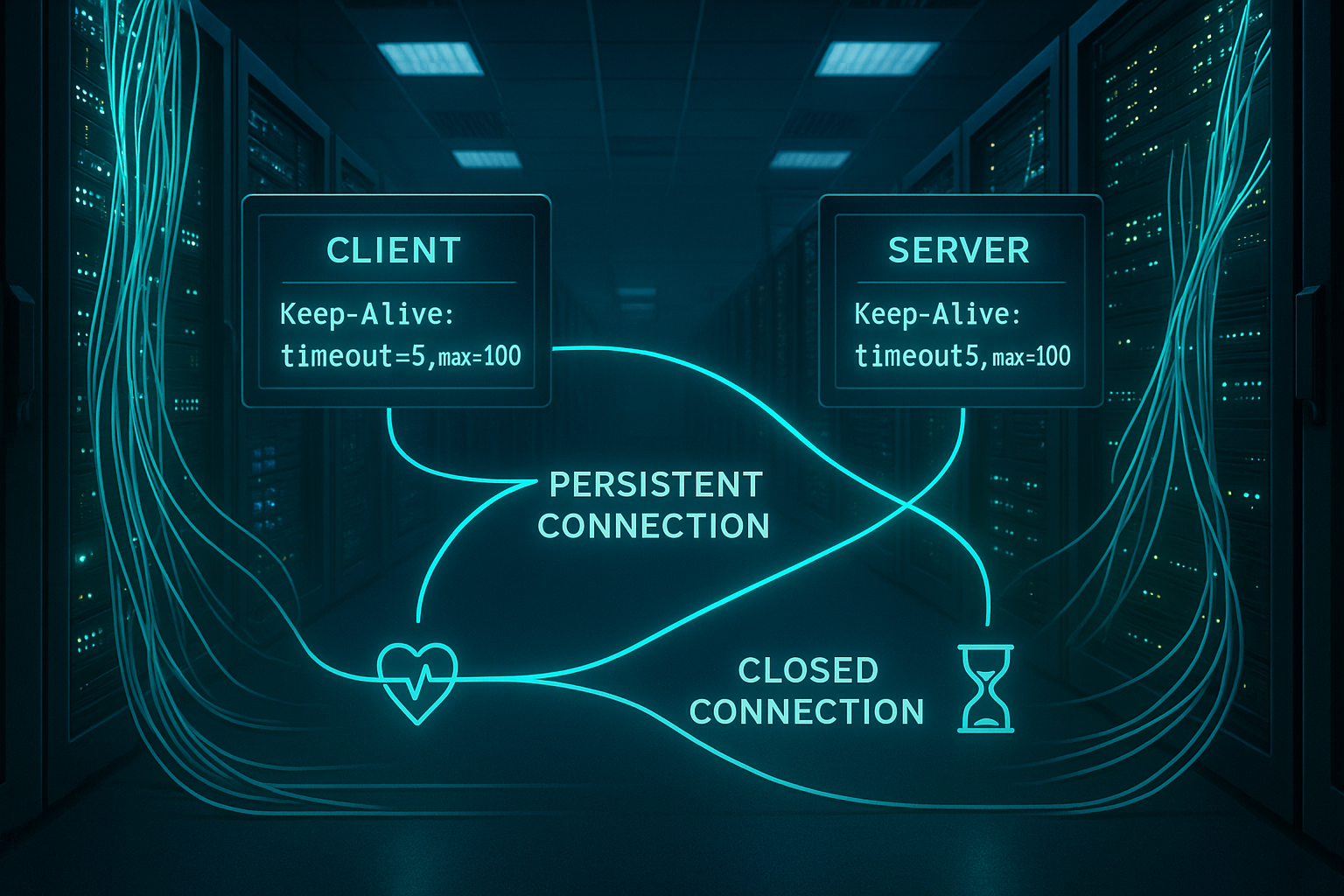
Instead of opening a new TCP connection for each resource, I reuse an existing connection and thus save Handshakes and round trips. This reduces waiting times because neither TCP nor TLS setups need to run continuously and the pipeline responds quickly. The client recognizes via header that the connection remains open and sends further requests one after the other or with multiplexing (with HTTP/2/3) via the same socket. The server manages the idle phase via a keep-alive timeout and terminates the connection if no request is received for too long. This behavior noticeably speeds up pages with many assets and reduces the load on the CPU, as fewer connections need to be established.

Connection reuse: Effect on server load
Every new connection avoided saves CPU time for kernel and TLS work, which I see as a smoother load curve in monitoring. Data shows that reusing existing sockets can increase throughput by up to 50 percent when there are many small requests. In benchmarks with many GET requests, the total duration is sometimes reduced by a factor of three because fewer handshakes and fewer context switches occur. The network load also decreases because SYN/ACK packets occur less frequently and the server has more budget left for the actual application logic. This interaction results in faster responses and more stable Response times under load.
Risks: Excessively long timeouts and open connections
A keep-alive timeout that is too generous leaves connections idle and blocks Worker or threads, even though there are no requests pending. During high traffic, open sockets grow, reach file descriptor limits, and drive up memory consumption. In addition, inappropriate client timeouts create „dead“ connections that send requests to already closed sockets and produce error messages. Ingress and NAT gateways can close idle lines earlier than the server, leading to sporadic resets. That's why I deliberately limit idle times, set clear limits, and keep the opposite side (clients, proxies) in view.

HTTP Keep-Alive vs. TCP Keepalive
I make a strict distinction between HTTP Keep-Alive (persistent connections at the application level) and the TCP mechanism „keepalive.“ HTTP Keep-Alive controls whether further HTTP requests run via the same socket. TCP Keepalive, on the other hand, sends test packets at long intervals to detect „dead“ remote stations. HTTP Keep-Alive is primarily important for performance tuning. I use TCP Keepalive specifically for long idle phases (e.g., for edge connections or in enterprise networks with aggressive firewalls), but set the intervals defensively so that no unnecessary network load is created.
Special cases: Long Polling, SSE, and WebSockets
Long-lived streams (server-sent events), long polling, or WebSockets conflict with short idle timeouts. I separate these endpoints from standard API or asset routes, assign them higher timeouts and dedicated worker pools, and limit the number of concurrent streams per IP. This prevents long-running processes from blocking resources for classic short requests. For SSE and WebSockets, it's better to have clear limits, read/write timeouts, and a clean heartbeat or ping/pong interval than to increase all timeouts globally.
Central keep-alive parameters in the web server
I almost always enable keep-alive, set a short idle timeout, and limit the number of requests per connection to conserve resources. recycle. I also regulate the worker/thread pools so that idle connections do not occupy too many processes. The following table shows typical directives, purposes, and starting values that I regularly use in practice. Values vary depending on the application and latency profile, but they provide a solid basis for initial testing. I then gradually refine timeouts, limits, and Threads based on real measurement data.
| Server/Component | directive | Purpose | starting value |
|---|---|---|---|
| Apache | KeepAlive | Enable persistent connections | On |
| Apache | KeepAliveTimeout | Idle time until connection ends | 5–15 s |
| Apache | MaxKeepAliveRequests | Maximum requests per connection | 100–500 |
| Nginx | keepalive_timeout | Idle time until connection ends | 5–15 s |
| Nginx | keepalive_requests | Maximum requests per connection | 100 |
| HAProxy | option http-keep-alive | Allow persistent connections | active |
| Kernel/OS | somaxconn, tcp_max_syn_backlog | Queues for connections | adapted to traffic |
| Kernel/OS | FD limits (ulimit -n) | Open files/sockets | >= 100k for high traffic |
Apache: Startup values, MPM, and worker control
For highly parallel sites, I rely on the MPM in Apache. event, because it handles idle keep-alive connections more efficiently than the old prefork. In practice, I often choose 5–15 seconds for KeepAliveTimeout so that clients can bundle resources without blocking workers for long periods of time. With MaxKeepAliveRequests set to 100–500, I enforce moderate recycling, which prevents leaks and smooths out load peaks. I reduce the general timeout to 120–150 seconds so that stuck requests do not tie up processes. If you delve deeper into threads and processes, you will find important information on Thread pool settings for various web servers.
Nginx and HAProxy: Practical Patterns and Anti-Patterns
With reverse proxies, I often observe two errors: Either Keep-Alive is globally disabled for „security reasons“ (causing massive handshake load), or the idle timeouts are set high while there is little traffic (tying up resources). I keep front-end timeouts shorter than back-end timeouts so that proxies can remain open even when clients close the connection. I also separate upstream pools by service class (static assets vs. API) because their request sequence and idle time depend on the profile. It is also critical to ensure correct Content-Length/Transfer encoding-Handling: Incorrect length specifications prevent connection reuse and trigger „connection: close“ – resulting in unnecessary new connections.
Nginx and HAProxy: Using upstream pools correctly
With Nginx, I save a lot of handshakes when I keep upstream connections to backends open and use keepalive Adjust pool sizes. This reduces TLS setups to application servers and significantly lowers CPU load there. I monitor the number of open upstream sockets, reuse rates, and latency distributions in the logs in order to increase or decrease pool sizes in a targeted manner. On the kernel side, I increase FD limits and adjust somaxconn and tcp_max_syn_backlog to prevent queues from overflowing. This keeps the proxy responsive under high concurrency and distributes traffic evenly across the backends.
TLS and QUIC optimization for less overhead
To ensure that Keep-Alive is fully effective, I optimize the TLS layer: TLS 1.3 with resumption (session tickets) shortens handshakes, OCSP stapling shortens certificate checks, and a lean certificate chain reduces bytes and CPU. I only use 0-RTT for idempotent requests and with caution to avoid replay risks. With HTTP/3 (QUIC), this is idle_timeout Crucial: too high costs memory, too low breaks streams. I also test how initial congestion window and amplification limits affect cold connections, especially over long distances.
Targeted use of HTTP/2, HTTP/3, and multiplexing
HTTP/2 and HTTP/3 bundle many requests over a single connection and eliminate Head-of-LineBlocking at the application level. This benefits keep-alive even more because fewer connections are established in the first place. In my setups, I make sure to configure priorities and flow control so that critical assets run first. I also check whether connection coalescing is effective, for example, when multiple host names use the same certificate. A look at HTTP/3 vs. HTTP/2 Helps you pick the right protocol for global user profiles.

Clients and app stacks: Configuring pooling correctly
The client and app side also determine reuse: In Node.js, I activate the keepAliveAgent with a limited number of sockets per host. In Java, I set reasonable pool sizes and idle timeouts for HttpClient/OkHttp; in Go, I adjust MaxIdleConns and MaxIdleConnsPerHost gRPC clients benefit from long connections, but I define ping intervals and keepalive timeouts so that proxies do not flood. Consistency is important: overly aggressive client reconnects undermine any server optimization.
Load tests and measurement strategy
Blindly rotating on timeouts rarely produces stable results. Results, so I measure systematically. I simulate typical user paths with many small files, realistic parallelization levels, and geographically distributed latency. Meanwhile, I log reuse rates, average connection duration, error codes, and the ratio of open sockets to the number of workers. Then I vary KeepAliveTimeout in small steps and compare the curves of response times and CPU consumption. Only when the metrics remain robust over several runs do I transfer the values to the Production.
Observability: Which metrics matter
I monitor specific metrics: new connections per second, reuse/rebuild ratio, TLS handshakes per second, open sockets and their dwell time, 95th/99th percentile latency, distribution of status codes (including 408/499), and kernel states such as TIME_WAIT/FIN_WAIT2. Peaks in handshakes, increasing 499s, and growing TIME_WAIT buckets often indicate idle timeouts that are too short or pools that are too small. Cleanly instrumented logic makes tuning reproducible and prevents optimizations from merely delivering placebo effects.

Timeout coordination between client and server
Clients should close idle connections slightly earlier than the server to avoid „dead“ connections.“ Sockets arise. In front-end apps, I therefore set lower HTTP client timeouts than on the web server and document these specifications. The same applies to load balancers: their idle timeout must not undercut the server. I also keep an eye on NAT and firewall idle values so that connections do not disappear in the network path. This clean interaction prevents sporadic resets and stabilizes Retransmissions.
Resilience and safety under load
Persistent connections should not be an invitation for Slowloris & Co. I set short header/body read timeouts, restrict header sizes, limit simultaneous connections per IP, and ensure backpressure in upstreams. In the event of protocol errors, I consistently close connections (instead of keeping them open), thereby preventing request smuggling. I also define meaningful grace-Times when closing, so that the server cleanly terminates open responses without connections remaining open indefinitely. lingering-conditions.
Hosting factors and architecture
Powerful CPUs, fast NICs, and sufficient RAM accelerate handshakes, context switching, and encryption, which fully exploits keep-alive tuning. A reverse proxy in front of the app simplifies offloading, centralizes timeouts, and increases the reuse rate to backends. For more control over TLS, caching, and routing, I rely on a clear Reverse proxy architecture. It remains important to lift limits such as ulimit -n and accept queues early on so that the infrastructure can handle high parallelism. With clean observability, I can identify bottlenecks more quickly and can Limits fasten securely.

Deployments, Drain, and OS subtleties
For rolling deployments, I let keep-alive connections expire in a controlled manner: I no longer accept new requests, but existing ones may be served briefly (drain). This way, I avoid connection interruptions and 5xx spikes. At the OS level, I keep an eye on the ephemeral port range., somaxconn, SYN backlog, and tcp_fin_timeout, without using outdated tweaks such as aggressive reuse of TIME_WAIT. SO_REUSEPORT I distribute it across multiple worker processes to reduce Accept concurrency. The goal is always to handle many short-lived connections stably without causing congestion in kernel queues.
Summary: Tuning as a performance lever
Consistent use of HTTP Keep-Alive results in fewer connection establishments and lower CPU load and noticeably faster responses. Short idle timeouts, clear limits per connection, and sufficiently dimensioned workers tame idle sockets. With HTTP/2/3, upstream pools, and coordinated OS limits, I scale parallelism without losing stability. Realistic load tests show whether settings really work and where the next percentage points lie. Combining these building blocks increases throughput, keeps latency low, and utilizes existing Resources to the maximum.