 Skip to content
I compare HTTP/3 Push and Preload on the basis of real measured values and explain when which technology is the best. http3 performance noticeably ahead. To do this, I analyze QUIC advantages, loading priorities and typical implementation errors that affect the First Paint and the Render brake.
Key points
I have summarized the following key points so that you can quickly make the choice between push and preload. categorize can.
- HTTP/3QUIC eliminates head-of-line blocking and keeps streams afloat in the event of losses.
- PushProactive delivery helps with highly probable core assets, but involves overhead.
- PreloadDeclarative, controllable, low-risk with prioritization of critical resources.
- Measured values: Advantages of HTTP/3 are clearly evident with packet loss and many assets.
- StrategyCombination of preload and HTTP/3 often achieves the best results in practice.

HTTP/3 Push and Preload briefly explained
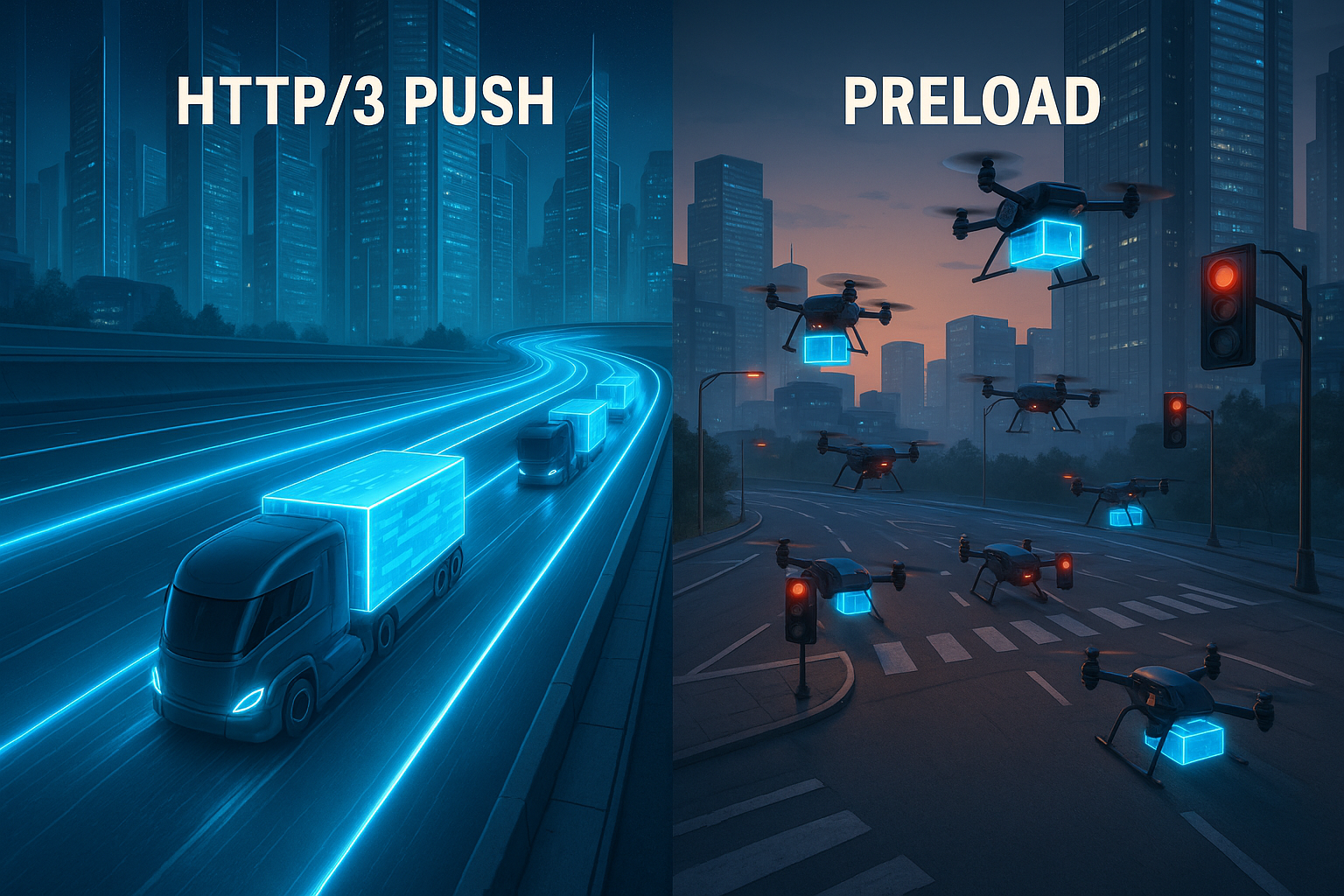
I set Server Push when the server delivers files before the browser requests them, for example CSS, JS or web fonts that are needed directly for rendering. This tactic puts resources into the cache early on, saves round trips and can noticeably bring forward the First Contentful Paint. Preload on the other hand, I use link tags in the markup so that the browser knows exactly which file it should load first. This creates clear priorities, reduces duplicate transfers and works equally well with HTTP/1.1, HTTP/2 and HTTP/3. Because HTTP/3 is based on QUIC, it is worth taking a look at the QUIC protocol, which treats streams separately and thus avoids congestion at line level.
How HTTP/3 influences the loading time
With QUIC, HTTP/3 lifts the Head-of-Line-blocking, which means that individual packet losses no longer slow down the loading of all files. Multiple streams run in parallel, and losses only affect the affected stream, which is especially helpful with many assets. 0-RTT can speed up connections if there is already a history, allowing early requests to flow faster. The control of transmission power and error correction is also adaptive, which keeps the clock rate high under load. Those who appreciate direct comparisons will find the HTTP/3 vs. HTTP/2 Performance comparison additional perspectives on latency and transfer behavior.

Push vs. preload: Decision logic
I use Push, when an asset is very likely to be needed immediately, such as the central stylesheet or an above-the-fold script. In these cases, proactive delivery can bring visible time savings, especially on mobile networks. However, if the file is pushed even though the client already has it in the cache or does not need it at all, this wastes bandwidth and extends queues for really important data. Preload when I want to control exactly what starts with priority and when the parser should see the request. This keeps control in my hands, avoids duplicate transfers and minimizes mistakes when selecting resources.
Performance comparison in figures
In measurement environments with many simultaneous downloads, HTTP/3 remains significantly more efficient with noticeable losses of over 8%. responsive, while HTTP/2 drops [4]. For 1 MB files and 2% loss, tests showed load times of around 1.8 seconds with HTTP/1 compared to 1.2 seconds with HTTP/3 [5]. These differences have a direct impact on LCP, TTI and TBT, especially when a page initially requests many separate files. For single-page apps and media pages, stream separation pays off in particular, because one faltering asset no longer holds up the others. I always evaluate the figures in the context of resource types, priorities and cache hits, because this is where the greatest leverage for Speed.
| Criterion | HTTP/3 Push | Preload | Effect on metrics |
|---|---|---|---|
| Control system | Server-side, proactive | Client-side, declarative | Early start vs. clear prioritization |
| Risk of double transfers | Increased if cache already filled | Low, as precisely addressed | Influence on bandwidth and TBT |
| Network load/packet loss | QUIC buffers losses per stream [4] | Profit through HTTP/3 transport level | Advantages of LCP/INP under load |
| Cache hit rate | Pushed assets can fizzle out | Targeted use of existing caches | Reduced waiting times for returning customers |
| Implementation effort | Logic required on the server | Markup adjustments in the head | Quick profit with clear dependencies |
Browser status 2025: Push realistically categorized
When planning, I take into account that many browsers severely restrict or completely ignore push in practice. This applies in particular to scenarios in which double transfers are imminent or caches are already full. As a result, push remains a special weapon for clearly defined cases - such as initial visits on new connections - and not a panacea. In my setups, I therefore calculate push as an optional booster and rely primarily on preload and clean prioritization at transport level. Where clients do not use push, I automatically fall back on preload and early hints without destabilizing the pipeline. This sober approach prevents disappointments and keeps the roadmap realistic.

Early hints (103) and preload in the team
Instead of pushing blindly, I send the right setups Early Hints (103) with link: rel=preload before the actual HTML. This allows the browser to start critical files while the server is still rendering the page. This reduces the time to the first byte of the assets and at the same time gives the client control. In practice, this works reliably with HTTP/3 and offers many of the advantages of push - without the risks of duplicate transfers.
HTTP/1.1 103 Early Hints
Link: ; rel=preload; as=style; fetchpriority=high
Link: ; rel=modulepreload

HTTP/1.1 200 OK
...
I use Early Hints mainly for the main CSS, critical web fonts and initial modules. Important: The as-types must match exactly so that no duplicate requests are triggered. I also make sure that CORS specifications and cache headers are set correctly. This allows me to realize most of the advantages of an early start without the server guessing too much.
Fine control of priorities: Priority header and fetchpriority
In addition to Preload, I rely on Priority signals on two levels:
- In HTML via
fetchpriority, e.g.fetchpriority="high"for critical styles or images in the viewport andfetchpriority="low"for decorative assets. - On the response via a priority header, which gives the transport clear indications as to which responses should flow preferentially. This harmonizes with HTTP/3 and reduces the load on the line with many parallel streams.
This is how I work together on the client and server side: The browser makes the right decisions quickly and the server delivers them with the appropriate weighting. In combination with QUIC, this reduces the pressure on bottlenecks and prevents insignificant files from blocking the critical path.
Specify preload precisely
Many problems with preload are caused by small inconsistencies. I avoid them with clean, explicit markup:
I consistently check that the as-values correspond to the actual resource types. For fonts crossorigin Mandatory, otherwise there is a risk of double downloads. For scripts I pay attention to the mode (type="module" vs. classic) and set defer, so that the parser does not block. I see preload as a supplement to the render path, not as a replacement; regular integration remains necessary.
QUIC details that count in practice
I plan HTTP/3 with a view to properties that can be felt in the field:
- Connection MigrationIf a device switches from WLAN to mobile radio, the QUIC connection is maintained. This avoids new handshakes and protects long transfers from being interrupted.
- QPACKHeader compression without global head-of-line risk. This speeds up pages with many small requests, especially on CDNs with many recurring headers.
- 0-RTTI allow early accelerated requests only for idempotent resources and evaluate the security situation. Where 0-RTT takes effect, I gain noticeable time during the warm start.
- Adaptive Congestion Control: The throughput remains more stable in lossy networks. Together with prioritization, this results in robust behaviour when it matters.
These features only take full effect with a clean server and CDN configuration. I ensure TLS 1.3, short certificate chains, stacking status information and coherent fallbacks so that older clients can also be served with high performance.
Using resource prioritization correctly
I define Core assets clearly: the critical CSS, fonts for visible text, and scripts that affect the above-the-fold area. These files are given the highest priority via preload or are pushed in special cases. I move image files for content that will be visible later down the list or via lazy loading so that the render path and interaction are available early. For third-party resources, I carefully weigh up the benefits and set preconnect if necessary so that the handshakes start on time. This keeps the line free for really important data and prevents deco assets from blocking the start.
In practice, I stick to a short decision-making routine:
- Is the asset critical for FCP/LCP and almost always necessary? → Preload, optional early hints; selective push only if measurably superior.
- Is usage variable or user-dependent? → No push; at most preload according to tested heuristics or load downstream.
- Is the asset large? → Prefer preload; push only if bandwidth is secured and cache hits are unlikely.
- Are there alternatives such as inline critical CSS or code splitting? → Preferable; they shorten paths and reduce overall risk.
Implementation: Checklist from practice
I start with a Audit of the start page and the most important templates and mark all files that are required for the first visible area. I then create preload entries in the head, test priorities and check whether duplicate requests occur. Where an early transfer is very worthwhile, I consider selective push and measure the effect on LCP and TTI. For QUIC/HTTP-3, I activate support on CDN or server and compare the prioritization rules with the critical paths. For step-by-step help, I use a practical HTTP/3 implementation, so that configuration, tests and rollout are structured.
I also establish the following routines:
- Early Hints and feed it with the same link entries as the final HTML head.
- Cache strategy with versioning:
app.abcdef.css, longmax-age,immutable, so that returning customers benefit. - Service Worker to preload flows to avoid duplication of work in the network and in the SW cache.
- Priority header on the Origin/CDN so that HTTP/3 prioritizes the really important responses.
- Feature flags for push/preload to run A/B tests quickly and risk-free.
Typical mistakes and how to avoid them
I do not push Assets, that the browser may already have in its cache, as this wastes bandwidth. Instead, I check cache headers, versioning and validity so that returning users benefit from fresh hits. I don't overload Preload, because a dozen critical entries can clog up the line and dilute priorities. With fonts, I pay attention to suitable formats and unicode ranks so that the transfer remains lean and visible text appears quickly. I also test on different devices and wireless networks, because the true effect only becomes visible under real conditions.
I have a particular eye on these traps:
- Mismatch between
asand resource type (e.g.as="script"for modules) → leads to unnecessary secondary requirements. - Missing crossorigin for fonts → double downloads or blocking errors.
- Preload lists too wide → undermine priorities; I limit to core assets.
- Unclear roles of Inline-Critical-CSS vs. Preload → I decide per page and avoid mixed forms that burden both ways.
- Blind pushing without cache knowledge → Push remains a bet; I measure and secure with Early Hints.
Monitoring and measurement methods
I measure LCP, TTI, TBT and INP with Lighthouse, add runtime data via RUM and compare variants using A/B tests. WebPageTest or similar tools help me to evaluate waterfall diagrams and recognize whether preload and push are working as planned. The combination of lab and field data shows whether optimizations are viable or generate side effects. I regularly check how browsers handle server push, as some user agents restrict or ignore pushed assets [8]. Based on this data, I decide which technology to roll out further and which to withdraw.
I differentiate for reliable statements:
- Cold vs. warm: Evaluate first visit without cache separately from return visits.
- Network profilesSimulate 4G/5G with realistic losses, high-RTT scenarios and heavily loaded cells.
- Number of requests: View pages with a few large vs. many small files separately.
- Device mix: Mid-range mobile devices with a weaker CPU, because parser and decompression costs weigh more heavily there.
I document each experiment exactly: build versions, preload entries, priority headers, push rules, early hints status. This allows me to reproduce effects and quickly reverse them if necessary.

Hosting and infrastructure as leverage
I pay attention to Server with up-to-date HTTP/3 support, solid TLS configuration and clean prioritization. A high-performance CDN with good PoP coverage reduces latencies to mobile users and makes the benefits of QUIC more tangible. Clean configuration of TCP fallbacks for older clients also plays a role so that nobody is disadvantaged. For budgets, I calculate the effect first, as the smallest CDN adjustments or HTTP/3 activations are often sufficient without high additional costs in the low double-digit euro range per month. The stronger the basis, the clearer the effects of push and preload become in everyday life.
I also check whether the infrastructure supports the following points:
- Early Hints from the Edge so that preloads start before the HTML.
- Extensible Prioritization or priority headers that are respected by the proxy.
- Fine-grained rules per path/file type to push only selected assets or to highlight them via preload.
- Transparent metrics at edge level (hit rate, RTT, loss, reprioritizations) to make the causes of deviations visible.
Final classification
I see HTTP/3 with QUIC has an advantage as soon as wireless networks, many parallel streams or loss situations come into play [4][5]. In controlled setups, preload provides reliable prioritization because I determine exactly what should really run first. I use Push specifically for indispensable resources whose benefits are consistent and whose size remains within limits. I achieve the best effect when I combine preload for priorities, HTTP/3 for transport and carefully dosed push. If you proceed in this way, you noticeably reduce loading times, protect the user's bandwidth and significantly increase the perceived quality of the page.


