Skip to content
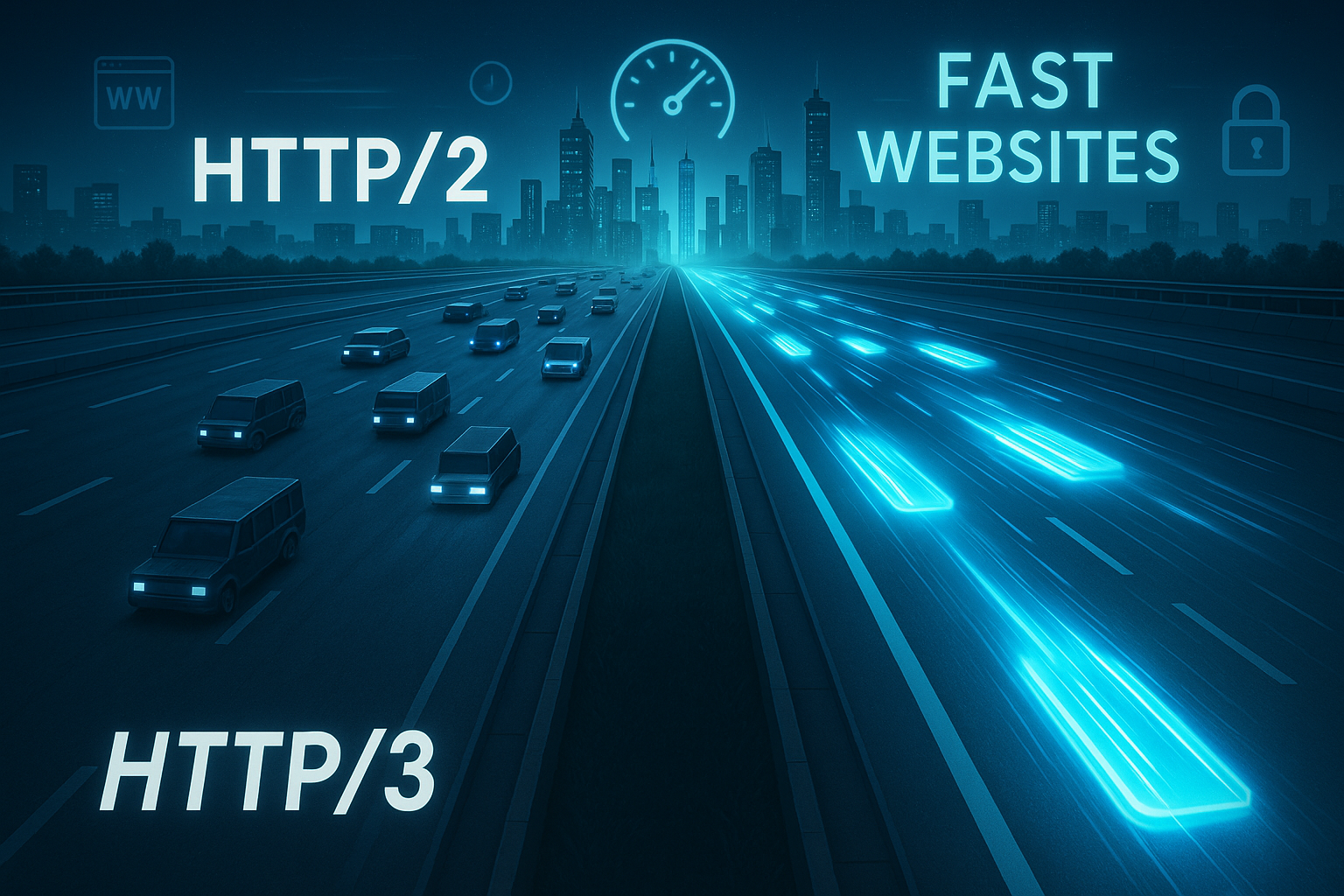
http3 vs http2 today has a noticeable impact on loading time, stability for mobile access and security in web hosting. I will show you specifically how QUIC in HTTP/3 circumvents the TCP-related brakes of HTTP/2, where measurable advantages arise and when HTTP/2 is more convincing.
Key points
- QUIC Eliminates head-of-line blocking and reduces latency
- 0-RTT noticeably shortens the connection setup
- Connection Migration keeps sessions stable during network changes
- TTFB decreases, charging time benefits especially with 4G/5G
- TLS is mandatory and modern in HTTP/3

HTTP/2 briefly explained
I'll summarize HTTP/2 briefly so that you can clearly classify its strengths: Multiplexing loads multiple streams in parallel over a TCP connection, header compression reduces overhead and server push can deliver resources in advance. The biggest obstacle remains the Head-of-Line-Blocking at transport level: If a packet is lost, it slows down all streams on this connection. Under clean lines, HTTP/2 works quickly, but if packets are lost or latency is high, the flow drops noticeably. I therefore plan optimizations such as prioritization, clean caching strategies and consistent TLS configuration in order to use the full potential. For many websites today, HTTP/2 delivers solid results as long as the network doesn't interfere and the server settings are right.
HTTP/3 and QUIC in practice
HTTP/3 relies on QUIC over UDP and releases the central brakes of TCP. Each stream remains independent, packet loss no longer affects the entire connection, and 0-RTT reduces handshakes. I experience faster first bytes, better page consistency for mobile access and fewer drops when switching networks. Connection Migration keeps sessions active when the phone jumps from Wi-Fi to LTE. I recommend running initial tests with static and dynamic pages to measure TTFB, LCP and error rates in direct comparison.

Loading time, TTFB and real effects
I turn my gaze first to TTFBbecause this is where users feel the biggest difference. The faster handshake of HTTP/3 noticeably reduces the start of the response, which is particularly important for many small requests. Under real conditions with packet loss and high latency, HTTP/3 significantly accelerates test pages, in some cases up to 55 % compared to HTTP/2 [6]. Global measuring points confirm the picture: In London, differences were up to 1200 ms, in New York 325 ms [5]. I measure such values with synthetic runs and verify them with real user data in order to separate marketing effects from hard facts.
0-RTT: Opportunities and limits
I use 0-RTT specifically to speed up reconnections: After a successful initial contact, the client can send data on the next call without having to wait for the complete handshake. This saves round trips and results in noticeably earlier rendering. At the same time, I rate the Replay risk realistic: 0-RTT data can theoretically be repeated. I therefore only allow idempotent requests (GET, HEAD) and block mutating methods (POST, PUT) or mark them as not 0-RTT-capable on the server side. I log 0-RTT parts and failed attempts separately to avoid misinterpretations in the metrics.
Mobile performance and connection migration
On smartphones, I observe the largest Advantage through connection migration and efficient loss recovery. HTTP/3 maintains the connection even if the device changes networks, reducing visible hangs. HTTP/2 has to reconnect in many cases, which extends the timeline and delays interactions. Those who have a lot of mobile traffic benefit disproportionately and see content appearing faster, fewer dropouts and better interactivity. I therefore prioritize HTTP/3 when target groups are surfing on 4G/5G networks or are on the move a lot.
Congestion control, pacing and large files
I look beyond the protocol to the Congestion control. QUIC implements modern loss detection and timers (PTO) in user space and paces packets more finely. In well-maintained stacks, CUBIC or BBR deliver stable throughputs with simultaneous latency protection. For large downloads, I sometimes see similar values between H2 and H3, depending on pacing, initial window and path MTU. I test with different object sizes: Many small files benefit from independent stream progress, very large objects benefit more from clean pacing and CPU efficiency. It is crucial to keep the congestion control consistent on all edges so that results remain reproducible.
Implementation in web hosting
I rely on providers who HTTP/3 natively, deliver H3 Alt-Svc and maintain modern TLS stacks. At edge level, I pay attention to properly configured QUIC, up-to-date cipher suites and clearly defined priorities. For a practical introduction, it is worth taking a look at these compact tips on HTTP/3 hosting advantages. I run rollouts step by step, start with static assets, then activate for API and HTML and monitor metrics. If the error rate drops, I've set the switch correctly and can leave the HTTP/2 fallbacks controlled.
Security: TLS by default
HTTP/3 brings Encryption directly and enforces a modern TLS standard. This saves me inconsistent setups and reduces attack surfaces thanks to consistent protocols. The early negotiation and the lower number of round trips also improve startup performance. I combine this with HSTS, strict cipher policies and clean certificate management to meet audit requirements. This is how I ensure performance and protection without compromise.
Compatibility and server setup
I first check the browser and CDN support, then I adjust the Server and reverse proxies. NGINX or Apache require the latest builds; a front proxy such as Envoy or a CDN often provides the H3 capability. Anyone using Plesk will find a good starting point here: HTTP/2 in Plesk. I keep HTTP/2 active as a fallback so that older clients remain served. Clean monitoring remains important in order to keep an eye on protocol distributions and error codes.

UDP, firewalls and MTU
I consider network environments that UDP restrictively. Some firewalls or carrier-grade NATs limit UDP flows, which lowers the H3 rate. That's why I keep port 443/UDP open, monitor the proportion of H3 handshakes and measure fallback rates to H2. I check the MTUQUIC packets should get through without fragmentation. In tunneling scenarios (e.g. VPN), I reduce the maximum payload or activate Path MTU Discovery so that no inexplicable retransmits occur. If regions throttle UDP more, I deliberately route more traffic there via robust H2 edges.
Benchmark overview: HTTP/3 vs HTTP/2
I summarize the key characteristics and effects in a compact Table together so that you can weigh things up more quickly. The values serve as a guide for your own tests. Vary latency, packet loss and object sizes to visualize differences. Also check First Contentful Paint (FCP) and Largest Contentful Paint (LCP), as they better reflect user impact. Use both protocols in parallel until your measured values are clear.
| Feature | HTTP/2 | HTTP/3 | Practical effect |
|---|---|---|---|
| Transportation | TCP | QUIC (UDP) | Latency decreases with H3 at loss/latency |
| Handshake | TLS via TCP | 0-RTT possible | Faster first byte, earlier interaction |
| Head-of-line blocking | Available at connection level | Pro Stream isolated | Less congestion with parallel requests |
| Connection Migration | Reconstruction necessary | Seamless | Better Mobile use without tear-offs |
| TTFB | Good with clean grid | Often noticeably lower | Clearly with 4G/5G, roaming, Wi-Fi handover |
| Total charging time | Constant with low latency | Up to 55 % faster (difficult networks) [6] | Clear advantage for international users |
| Security | TLS optional | TLS mandatory | Uniform Protection |
HTTP prioritization in H2 vs. H3
I set the prioritization cleanly because it has a strong influence on the perceived speed. HTTP/2 uses a tree structure, which is often ignored in practice or distorted by middleboxes. HTTP/3 relies on Extensible Priorities with simple urgency values and incremental hints. In my setups, I prioritize HTML, then critical CSS/JS, then fonts and images. Long JS bundles run incrementalso that render-critical assets don't wait. I test variants: hard priorities for above-the-fold assets, softer ones for lazy content. This allows me to achieve low LCP percentiles without losing throughput.
Resource strategy without server push
I do not use classic H3 Server Push and instead rely on preload and 103 early hints. Early hints warm up the fetch path before the final response is available. This fits in well with the faster handshake of H3 and avoids overfetching. I keep preload headers lean and consistent so that caches are not confused. In HTML, I optimize the order of critical resources so that priorities take effect. This gives me the advantages of "push-like" behavior without the known disadvantages of H2 push.

Tuning tips for both protocols
On the optimization side, I always start close to the server: current OpenSSL/boringssl stacks, consistent ciphers and HTTP priorities. I then optimize HTML structures, reduce the number of requests, minify assets and set sensible cache headers. Image formats such as AVIF and WebP save bytes, while Brotli with quality 5-7 often hits the best sweet spot. I delete superfluous redirects, reduce DNS lookups and keep third-party scripts to a minimum. So HTTP/2 is already a clear winner, and HTTP/3 sets the next standard on this basis. Boost on top.
Cost-benefit analysis for operators
I assess conversions soberly: How many users surf on mobile, how high is the international latency, and which page areas suffer? If your monitoring shows a lot of packet loss, does HTTP/3 bring fast Success. If the target group remains local and wired, HTTP/2 is often sufficient for the time being. License and infrastructure costs remain manageable because many hosters have already integrated H3. Even small stores see advantages when checkout and API calls respond more quickly, which boosts conversions and sales in euros.
CPU and cost effects during operation
I plan capacities with a view to CPU profile and encryption overhead: QUIC encrypts every packet header and often runs in user space. This increases the CPU load compared to TCP with kernel offloads - in return, better loss recovery and fewer retransmits reduce the network load. On modern NICs, I use UDP segmentation offload (GSO/TSO equivalents) to send packets efficiently. I measure requests per second, CPU wait and TLS handshake costs separately so that no bottleneck goes undetected. If CPU pressure occurs under H3, I scale edge nodes horizontally and keep H2 fallbacks ready until the load curves are stable.
Decision support: When which protocol?
I decide based on clear signals: high mobile usage, large international reach, noticeable error rate - then I activate first HTTP/3. If the focus is on large downloads in the internal network, HTTP/2 can keep up. For proxies and CDNs, I check the QUIC implementation to exploit priorities and loss recovery; the basics of QUIC protocol help with the categorization. I roll out step by step, log everything and keep fallbacks active. This way I minimize risk and achieve fast learning curves.
Edge cases: When HTTP/2 continues to convince
I deliberately leave HTTP/2 active when environments throttle UDP, when older enterprise proxies are in play or when workloads consist of a few, very large transfers. In such scenarios, H2 can catch up due to stable kernel offloads and established paths. I separate application areas: Interactive HTML pages and APIs benefit more often from H3, pure download hosts or internal artifact repos stay on H2. This clarity avoids overengineering and keeps operations simple.
How to test sensibly and comparably
I separate laboratory and field: first I measure synthetically with controlled Latency and defined losses, then I document effects with real user monitoring. I compare TTFB, FCP, LCP, INP and error codes and check the effects of network changes. An A/B approach delivers statistically clean statements if I route half of my traffic via H2 and half via H3. I pay attention to identical servers and identical caches so that no side effects distort the figures. Only then do I make decisions about expansion or fine-tuning.
Monitoring, logs and qlog
I make H3 visibleso that I can optimize in a targeted manner. I record the following in logs: protocol shares (H1/H2/H3), handshake success, 0-RTT rate, average RTT, loss rate and error types. With qlog or suitable exporters, I can see retransmits, PTO events and prioritization decisions. I enable the QUIC spin bit to estimate RTT with low latency without compromising privacy. On dashboards, I correlate core web vitals with protocol distributions - if LCP-95 decreases while H3 share increases, I'm right. If regions fall out of line, I deactivate H3 there as a test and compare the curves.
Practical rollout plan
I start with static AssetsI then activate API routes and finally HTML to scale risks. I set clear KPIs for each phase: TTFB median, LCP 95th percentile, error rate, abandonment rate. If the values reach the target, I activate the next stage; if I regress, I reactivate H2 fallbacks and check logs. I keep rollbacks ready, document changes and communicate maintenance windows early on. This keeps operations predictable and the user experience consistent.
Checklist and typical stumbling blocks
- Net: 443/UDP open, MTU tested, UDP rate limits checked
- TLS: 1.3 activated, 0-RTT deliberately configured (only idempotent)
- Priorities: Extensible priorities set for critical resources
- Resources: Preload + 103 Early Hints instead of Server Push
- Fallbacks: H2 active, version distribution monitored
- Monitoring: qlog/spin bit/error codes in view, A/B path available
- Capacity: CPU profile checked under load, Edge horizontally scalable
What the research suggests
Measurement series consistently show advantages of HTTP/3 for Parcel losshigh latency and mobile access [6][3]. Proxy optimizations can bring HTTP/2 closer to H3 in scenarios, but H3 fluctuates less. Small pages with many requests benefit immediately, large files are sometimes similar or slightly behind H2 - this is where fine-tuning with congestion control counts [4]. I see these tips as an invitation to measure your own profiles instead of making assumptions. Data from your traffic beats any general statement.
Your next step
I activate HTTP/3, measure specifically and keep Fallbacks ready. If the page starts faster and sessions remain stable when changing networks, then I roll out. If there are no effects, I tune priorities, caches and TLS and then check again. For admin setups with Plesk, NGINX or CDNs, a few simple steps are often enough to make H3 productive. This way, you gain speed, reliability and security without major modifications.