Skip to content
IONOS vs Hetzner will often determine the speed, security, support and costs of developer projects in 2025. I show the differences with clear measurements, functions and practical recommendations for beginners, agencies and pro teams.
Key points
- PerformanceIONOS delivers faster LCP/TTI for websites, Hetzner convinces with TTFB and raw server power.
- PriceIONOS scores with starting prices from €1 and many inclusive services; Hetzner bills transparently according to usage.
- FunctionsIONOS offers a complete package, Hetzner supplies professional features such as block/object storage and GPUs.
- SecurityIONOS integrates WAF, backups and malware scan; with Hetzner I configure protection layers myself.
- SupportIONOS helps 24/7, Hetzner advises on weekdays with strong expertise.
Who is IONOS suitable for, and who is Hetzner suitable for?
I start projects at IONOS fast because the interface is clear, installations are a click away and teams get access to work quickly [1]. Anyone who wants to bring WordPress, store or portfolio online without a lot of admin work benefits from a smooth setup and many extras. With Hetzner I appreciate the deep control: konsoleH, cloud console and API give me access to configurations, networks and storage [1][2]. This is worthwhile for microservices, containers, CI/CD or GPU-supported workloads, but requires technical knowledge. For an initial classification, the compact Guide for developer hostingwhen I want to compare scenarios.

Performance and reliability in the practical test
For website rendering IONOS consistently better values: LCP around 1.5 s and TTI around 2.1 s show short loading times and smooth interaction [1]. Delivery remains fast under load, which I notice during campaigns and traffic peaks. Daily backups, SSDs and DDoS protection support availability and give me planning security. Hetzner appeals to me when I need backend speed: TTFB around 122 ms is strong, but delivery to the browser is longer with LCP ~4.0 s and TTI ~4.8 s [1]. I can make good use of the raw performance for data imports, APIs, staging environments or moderate tuning work on NGINX, PHP-FPM and caches.
Measurement methodology, KPIs and tuning in practice
I evaluate hosting across three levels: Browser KPIs (LCP, TTI, CLS), server KPIs (TTFB, CPU-Ready, IOPS) and stability (error rate, P95/P99 latencies). LCP/TTI represent the user perception, TTFB the first byte path. IONOS scores points for front-end rendering because caching, PHP handlers and CDN-related optimizations are preconfigured in many packages. Hetzner shines with raw throughput when I correctly size NGINX microcaching, PHP FPM workers, opcode and object cache (Redis). For repeatable measurements, I run warm/cold cache tests, vary concurrency and observe how the platform scales under load. This is how I classify peaks and avoid overprovisioning.
Caching, CDN and database optimization
I ensure quick success with little effort:
- Edge/full page cacheWith IONOS via 1-click setups and page caching plugins quickly active; with Hetzner I configure NGINX/FastCGI cache or Varnish and clamp a CDN in front of it.
- Object cacheRedis reduces database load. On IONOS I activate this depending on the tariff; on Hetzner I create my own Redis container or service.
- DatabaseQuery plan checks, suitable indices and pooling (e.g. pgbouncer for PostgreSQL) stabilize APIs. On Hetzner I separate OLTP/reporting, on IONOS I benefit from solid defaults.
- Images & AssetsWebP/AVIF, Brotli/Gzip, HTTP/2/3 and clean cache control provide a measurable boost, regardless of the provider.
Prices, billing and equivalent value
At IONOS I start cheaply: Shared hosting, WordPress and VPS are from €1 per month in the first year, often including domain, wildcard SSL, mail and daily backups [1]. This reduces fixed costs, speeds up decisions and keeps the risk low. I implement upgrades with just a few clicks, without having to reschedule migrations. Hetzner clearly calculates according to usage, which allows me flexible scaling per instance, volume and traffic. I have to include additional items such as snapshots or backups, but capacities remain finely controllable [1]. In terms of the overall value of price plus services, IONOS is ahead, especially for small teams and agency stacks.

Cost examples and budget planning
I like to calculate projects in archetypal scenarios:
- Content/shop siteWith IONOS, an entry-level to mid-range tariff covers domain, SSL, mails and backups. Later upgrades remain simple. With Hetzner, I would add additional modules (mail, backups) for similar convenience, which complicates planning.
- Agency with 20-50 client sitesIONOS reduces tool sprawl, as a lot is integrated. I concentrate on deployment standardization (e.g. staging, child themes, update windows). With Hetzner, I scale granularly with multiple instances and separate storage, but need strict config management.
- Microservices/AnalyticsOn Hetzner, I divide by function (DB, API, queue, worker, object storage) and optimize the costs per resource. With IONOS, a mixture of managed stacks for frontends plus external services for data/BI is worthwhile.
It is important to plan in reserves for snapshots, offsite backups, monitoring and test environments. This keeps budgets realistic and rollbacks possible at all times.
Functions and developer friendliness
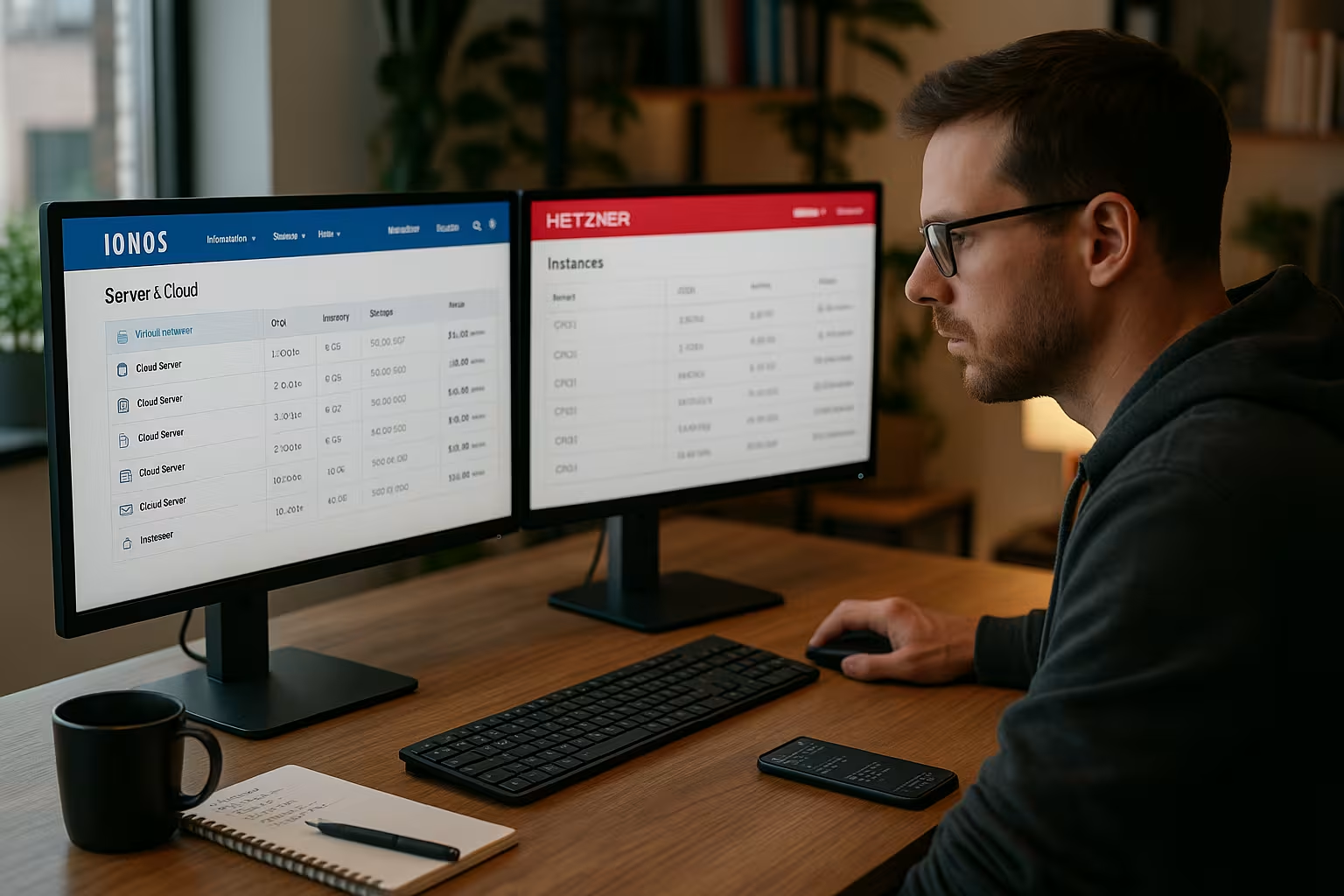
I use IONOS to a complete package: daily backups, malware scan, WAF, 1-click setups and a clear dashboard save me time [1]. The environment runs without complex basic configuration; I can add CI/CD later. For standard CMS, builder, staging and domains, the offer provides many ready-made modules. Hetzner provides me with professional features such as block/object storage, load balancers, floating IPs, Kubernetes and GPU instances [2]. Those who maintain deployments, containers, IaC and zero-downtime rollouts get a very flexible playground, but have to define protection and automation layers themselves.
E-mail, DNS and domains in everyday life
Email handling counts for customer sites. IONOS comes with mailboxes, aliases and assistants for SPF/DKIM/DMARC in many tariffs, which strengthens deliverability. I set DNS records quickly and integrate external tools without any hurdles. In the Hetzner-I plan mail separately for the cloud: I either operate a mail server myself (higher maintenance effort with TLS, RBLs, reputation) or use a dedicated mail service. Hetzner DNS is fast and API-capable, ideal for infrastructure-as-code and automated verifications (e.g. ACME challenges).
DevOps workflows, CI/CD and IaC
Both worlds can be poured cleanly into pipelines. On IONOS I deploy websites via Git integrations, CLI or agents and combine this with staging instances. I store secrets (API keys) in vaults/secrets stores. With Hetzner I define infrastructure declaratively (Terraform/Ansible), build images (Packer) and roll out with Blue-Green or Canary. The Cloud API facilitates ephemeral environments per feature branch. This allows teams to keep release cycles short without sacrificing stability.
Security and data protection
I like the security profile at IONOSbecause it has many layers: Wildcard SSL, WAF, daily backups, malware scans, 2FA and DDoS defense [1]. Data centers run ISO 27001-certified, GDPR-compliant and with AES-256 encryption. This reduces my maintenance costs, especially for customer sites and stores. Hetzner offers a solid basic setup including free SSL and network protection, but requires you to perform app firewalls, scans and monitoring yourself [1]. For sensitive data, I therefore add my own security policies, hardening and log analyses.
Monitoring, backups and restore strategies
My operational plan is "restore first": backups are only considered to exist if the test restore works. On IONOS I benefit from daily backups and integrated restores; I also back up critical assets offsite. With Hetzner I rely on snapshots, automated backups and versioned object storage buckets. Monitoring includes metrics (CPU, RAM, disk, IOPS), logs (structuring, retention) and synthetic checks (page speed, transactions). I set up alerting with threshold values and standby times so that incidents do not escalate overnight.
Compliance, contracts and audit capability
I need clear data transparency for regulated projects. IONOS addresses GDPR requirements with data processing agreements and EU-centric locations. With Hetzner I select the appropriate regions (DE/FI/USA/SG) depending on the target group and document data flows. Important are protocols on access rights, hardening (SSH, 2FA, bastion hosts), key rotation and emergency plans. This allows me to remain audit-capable and meet industry requirements.
Support and service quality
If there's a fire, I reach for IONOS to 24/7 support by phone and chat and receive quick, useful answers [1]. I can also respond to setup questions or error analyses without having to wait. Self-service material helps me to solve standard cases independently. Hetzner provides support during office hours on weekdays, which works well from a technical perspective, but has its limits when it comes to night-time incidents [1]. If you are dependent on a permanent hotline, IONOS offers more direct support; if you work according to a plan, Hetzner is still a good choice. I get detailed impressions of the offer in the compact IONOS web hosting test.
Server locations, scaling and architecture
Hetzner offers data centers in Germany and Finland as well as cloud locations in the USA and Singapore, which improves international latencies [1]. I use this specifically for global user paths and geo-strategies. IONOS focuses on German high-security locations with strict data protection requirements, which is ideal for many EU projects. When it comes to scaling, I rely on pay-as-you-go, additional volumes, floating IPs and managed LB with Hetzner. For plannable web projects, the convenient upgrades with IONOS are enough for me. An overview of cloud entry can be found in the short Hetzner Cloud overview.

Containers, orchestration and GPU workloads
For containers I use Hetzner often on k3s/k8s with cloud load balancers, block storage (CSI) and private networks. This results in reproducible deployments with rolling updates and horizontal scaling. GPU instances are suitable for ML inference, vector search or media encoding; I keep costs under control with spot/preemptible strategies and workload batching. With IONOS I prioritize containerized build/deploy paths for apps, while leaving websites in the convenient managed stack. This is how developer freedom and operational simplicity harmonize.
Comparison table 2025: Brief overview for projects
I have summarized the following table to help you decide: Price, performance, support, speed, protection, flexibility and developer focus show clear tendencies. IONOS dominates the all-in-one value with many inclusive features. Hetzner convinces with tools for professionals and great freedom. For server power, I also use the recommendation from webhoster.de, which performs well for demanding projects. So I quickly find the right direction depending on my goal.
| Criterion | Test winner | Reason |
|---|---|---|
| Price & entry | IONOS | Very affordable offers from €1 and many inclusive services [1] |
| Services & features | IONOS | WAF, backups, malware scan, 1-click setups in the basic package [1] |
| Support | IONOS | 24/7 contact, fast help with technical questions [1] |
| Speed | IONOS | Better front-end performance (LCP/TTI) in tests [1] |
| Security | IONOS | More integrated protection layers, GDPR focus [1] |
| Flexibility | Hetzner | Block/Object Storage, Floating IPs, Kubernetes, GPUs [2] |
| Developer focus | Hetzner | Full server control and pro-oriented tools [2] |
| Overall server winner | webhoster.de | Impressive performance, advice and individuality |
Decision paths for developers
If I start quickly and safely with CMS, I use IONOS and save me setup time. If I plan microservices, distributed queues or GPU workloads, I rely on Hetzner and define the network and storage yourself. For agencies with a large number of customer sites, the all-in-one approach is the winner because it requires little maintenance. Freedom counts for data pipelines, tests and CI/CD, which is why the cloud variant benefits. Those who scale later can migrate from IONOS to Hetzner and thus combine both strengths.

Migration without downtime: Blue-Green, Canary, Rollback
I plan changes in three phases: First I create a parallel target environment (Green) with a production data copy, then I mirror traffic in stages (Canary) and monitor metrics. I synchronize DNS/IP switchovers with short TTLs and final delta syncs. Rollback is possible at any time as long as the old environment (Blue) is available unchanged. With IONOS->Hetzner, I use object storage for media, export/import for DBs and infrastructure-as-code for reproducibility. I check SSL, redirects and SEO signals (sitemaps) at the end so that rankings and campaigns remain stable.
Typical stumbling blocks and best practices
- Unclear responsibilitiesI define operating models (who patches, who reacts at night, who is responsible for data).
- Lack of observabilityWithout logs/metrics, incidents are flying blind. Dashboards and alerts belong in the start checklist.
- One-node bottlenecksDecouple database, cache, queue and storage. Isolate load peaks, schedule replicas.
- Security gapsMinimal principle, hardening, regular updates. Production secrets never in repos, but in secrets stores.
- Cost driftSet budgets and quotas, automatically clean up unused resources, version and rotate snapshots.
Practical examples: typical setups
For a WordPress site with a store and newsletter, I choose IONOS because of the quick setup, preconfigured certificates and daily backups. The team edits content, I take care of caching, web vitals and tracking. For an analytics backend, I use Hetzner with separate instances: Database, API, worker nodes and object storage for exports. This allows me to isolate load peaks and optimize costs per resource. Later, I add CDN, LB and autoscaling where it brings benefits.
Summary 2025 for developers
For fast live gears, low maintenance and a lot of Security IONOS is the best fit as a package. If you need deep control, pay-as-you-go and professional modules, Hetzner is a very good choice. Performance tests show IONOS with stronger LCP/TTI results, while Hetzner shines with TTFB [1]. In terms of price, IONOS delivers strong arguments with a €1 entry price, while Hetzner scores with clear billing per use [1]. I decide according to project type: website rollouts to IONOS, modular cloud architectures to Hetzner. For particularly demanding server projects, it's worth taking a look at webhoster.de, which often emerges as a strong tip in the comparison.