 Skip to content
I show specifically how latency optimization, hosting architecture and network paths reduce the response time of global applications and increase conversions. With targeted CDN-I can deliver content to any location in milliseconds using a wide range of caching and routing strategies.
Key points
- Distance minimize: Serving users close to data centers
- CDN deploy: Delivering content worldwide
- Caching Strengthen: Use server and browser cache
- Protocols modernize: HTTP/2, TLS 1.3, QUIC
- Monitoring establish: Measure TTFB and routes

What does latency mean in international hosting?
Latency stands for the time it takes for a data packet to travel from the server to the user, and I treat this Milliseconds like a hard KPI. Every additional route, every hop and every delay on the transport route costs measurable revenue and satisfaction. For global projects, what counts most is how close I bring computing power and data to the target group and how consistent the paths are. I measure key figures such as Time To First Byte (TTFB), Round Trip Time (RTT) and Server Response Time in order to quickly identify bottlenecks. If you actively control these values, you will noticeably reduce loading times and ensure a reliable user experience with less terminations.
How distance, routing and peering shape latency
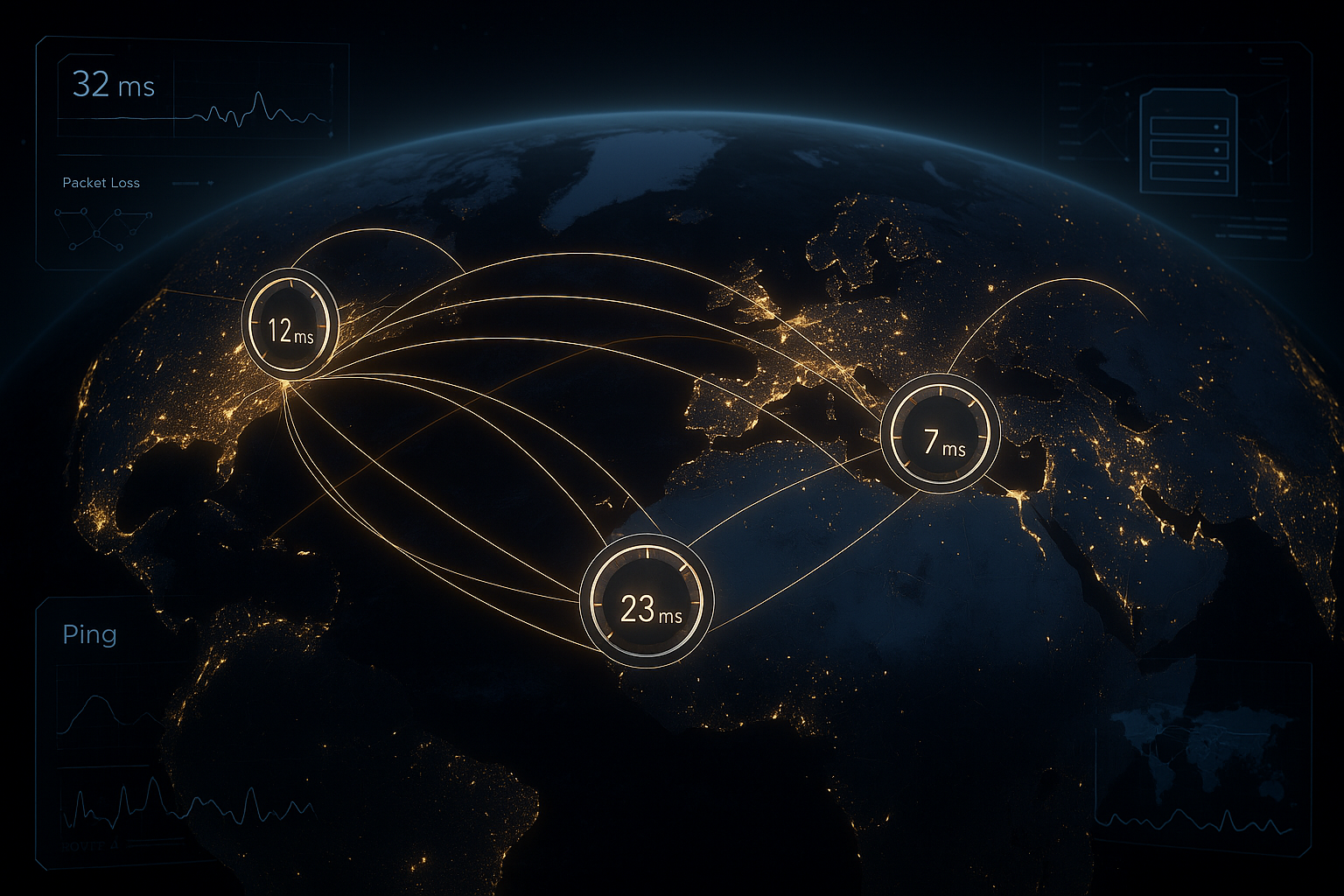
Physical distance remains the greatest lever, as the speed of light in optical fiber acts as a natural Border. I therefore reduce detours in routing, pay attention to few hops and prefer networks with good peering relationships. Good connections to large Internet nodes save milliseconds because data requires fewer intermediate stops. Bandwidth also helps, but it is no substitute for short distances and a sensible topology. If you want to optimize distance, route quality and Peering The new system achieves a significantly better response time for users on several continents.

Global server locations and location strategy
I plan locations according to user distribution, legal requirements and expected traffic times so that content is always short way. For international target groups, I rely on several data centers in Europe, America and Asia that are connected via fast backbones. The combination with anycast DNS and clean health checking distributes requests to the best instance. In scenarios with varying loads, I use Geographical load balancing, to stay close to the users. This allows sessions to run consistently while keeping latency low and Failures elegantly cushioned.
Content delivery networks: mandatory for global performance
A CDN stores static assets at dozens of edge locations, drastically shortens paths and noticeably reduces the load on the origin server for Peak load. I activate intelligent cache bypass for personalized shares and cascade rules for images, scripts and APIs. I also use HTTP/2 push replacement via preload hints and test cache TTLs by file type. For high requirements, I combine POPs from different providers via Multi-CDN strategies, to play to regional strengths. This gives me a consistent delivery and ensures Redundancy against failures of individual networks.
Server configuration, protocols and compression
I enable HTTP/2 and TLS 1.3, use OCSP stapling and optimize prioritization so that critical assets load first and Handshakes can be completed quickly. QUIC/HTTP/3 helps on networks with packet loss, for example with mobile users, as connections are restored more quickly. Keep alive parameters and connection reuse also reduce overhead. At server level, I remove unnecessary modules, tune worker and thread pools, use epoll/kqueue and select modern TLS ciphers. For data compression, I start Brotli for static files and Gzip for dynamic responses so that transferred Bytes without impairing the image quality.
Caching strategies: server and browser cache
On the server side, I accelerate PHP with OPcache, keep HTML fragments in RAM and use Varnish as a fast HTTP accelerator for Hits. For dynamic parts, I use edge-side includes or use AJAX to fetch what needs to be personalized. In the browser cache, I work with Cache-Control, ETags, Last-Modified and clear TTLs for each asset class. Immutable headers and file names with a content hash prevent jams caused by old versions. This means that the first view remains fast and subsequent calls are achieved Subseconds-times even for many assets.

DNS optimization and name resolution tuning
The first request often determines the speed, so I rely on fast authoritative servers with anycast and short Lookups. Reducing external domains lowers the number of parallel DNS queries. I check resolver chains, activate DNSSEC without unnecessary overhead and cache responses with a sensible TTL. For applications with a flood of subdomains, I use wildcard strategies to limit the number of new hostnames. Short DNS times contribute directly to TTFB and improve the perceived performance. Speed before the first byte.
Network optimization in cloud environments
In the cloud, I reduce kernel overhead with Accelerated Networking, which gives packets a direct data path to the NIC. use. Receive Side Scaling distributes network load sensibly across cores, which helps noticeably with high PPS rates. Proximity placement groups bring VMs close together to reduce latency between app, cache and database. I also choose regions with good interconnect connections and regularly check cross-region latencies. This keeps the data path short, while I Spikes with autoscaling.

Edge computing and peering strategies
I move logic to the edge, such as image transformation, A/B decisions or auth pre-check, so that answers can be given without long return paths. arise. This brings tangible benefits for time-critical applications such as gaming, IoT or live events. I also negotiate direct peerings or use internet exchanges to reach large networks without detours. This reduces jitter and packet loss, which benefits streams and interactions. If you want to go deeper, you can find Edge Hosting a clear path to shorter Paths.
Monitoring, metrics and load tests
I measure TTFB, Speed Index, CLS and FID separately by region and device to reflect real user experience and Trends to recognize. Synthetic tests from many countries supplement real user monitoring and uncover routing errors. Traceroutes clarify path inflation, while packet loss checks shed light on mobile networks. Pre-release load tests prevent surprises by checking caches, databases and queues in the network. With SLO-based alerting, I react early and keep the Availability high.
Database proximity, replication and consistency
I bring read access geographically closer to users, without the Writing paths Read replicas in regions shorten RTT for queries, while a clear write primary maintains consistency. For globally distributed apps, I rely on read-local/write-global, check multi-primary only for use cases with Conflict resolution (e.g. via CRDTs) and define latency budgets for commit paths. Connection pooling prevents TCP/TLS overhead per query; hotsets are stored in the in-memory cache. I reduce chatty patterns, bundle queries and use idempotency keys for replays. This keeps data consistent, while read paths short and remain plannable.
API design and front-end optimizations
I minimize round trips by using endpoints consolidate, streamline payloads and actively use HTTP/2 multiplexing. Connection coalescing reduces additional TCP/TLS handshakes if certificates contain suitable SANs. I reject domain sharding because it interferes with prioritization and reuse; instead, I work with preload and priorities for critical resources. I compress JSON with Brotli, remove fields without UI relevance and use delta updates instead of full responses. The frontend gets Critical CSS inline, fonts with Preconnect/Preload and a lazy Hydration, so that Above-the-Fold stands quickly.
Mobile networks, QUIC and congestion control
Mobile radio brings higher RTT and Packet Loss. I therefore rely on QUIC/HTTP/3 with fast recovery, activate TLS 1.3 Session Resumption and only test 0-RTT where replay risks are excluded. On the server side, I test BBR against CUBIC and select the best congestion control depending on the packet loss profile. Priority hints, defered JS and image lazyloading help to speed up the first interaction. Where TCP Fast Open is blocked, I rely on Connection Reuse and long idle timeouts to avoid handshakes and Jitter cushioning.

Cache invalidation and freshness models
Gains in latency stand and fall with Hits. I control freshness with stale-while-revalidate and stale-if-error, use surrogate keys to thematically purge, and use soft-purge to keep caches „warm“. Negative caches reduce repeated misses to 404/410, while I encapsulate personalized areas with hole-punching (ESI). For APIs, I use differentiated cache keys (e.g. language, region), Vary headers sparingly and ETags/If-None-Match for light 304 responses. In this way, I prevent cache storms and maintain response times even with releases stable.
Safety at the edge without loss of speed
I outsource WAF, DDoS protection and rate limits to the Edge, to slow down harmful traffic at an early stage and relieve the burden on origins. I prioritize rules so that favorable checks (IP/ASN, Geo, simple signatures) take effect early. TLS configurations receive HSTS, modern ciphers and consistent OCSP stapling; I plan certificate rotation without interruptions. Bot management runs with low latency using fingerprinting and adaptive challenges. Result: More security with minimal overhead and a calmer Origin even with peaks.
Observability, tracing and error budgets
I correlate Edge, CDN and Origin paths with trace headers (e.g. Traceparent) and set uniform correlation IDs through the entire chain. I combine RUM data from navigation and resource timing with synthetics, measure P50/P95/P99 separately by market and device and define SLOs including error budgets for latency. I keep sampling adaptive to capture hotspots with higher resolution. Blackhole and jitter checks run continuously so that routing drifts are detected early. This allows me to recognize causes instead of symptoms and control targeted to.
Costs, budgets and architecture trade-offs
Performance must pay off. I optimize the cache hit rate because every Miss egress costs and RTT, and plan 95th-percentile billing in the budget. Multi-region reduces latency, but increases data storage and replication costs; that's why I set clear rules: What belongs at the edge (static, transformable), what stays central (critical writes)? I keep deployments low-risk with configuration-as-code, canary releases and automated rollbacks. Prewarming ensures that new versions are released without cold caches start.
Compliance, data residency and zones
Regulation influences paths: I keep personal data in the respective Region, If possible, I process them pseudonymously at the edge and merge sensitive writes centrally. I route traffic from restrictive zones via local POPs, if required by law, and separate technical telemetry from user data. This keeps latency, data protection and availability in Balance - also for audits.
Routing fine-tuning with anycast and BGP
I control anycast routes with communities and targeted AS path prepending to correct misassignments and Hotspots to relieve the load. RPKI protects against hijacks, while regular traceroutes make path inflation visible. For special cases, I use region pinning when session stability is more important than the absolute shortest path. The goal is always a resilient, reproducible path with little Jitter.
Provider comparison: Latency management in check
For international projects, I pay attention to global presence, high-quality hardware and integrated CDN options so that the Delivery time remains short. I also check peering profiles, routing policies and monitoring functions. Providers with SSD storage, powerful CPUs and good support for HTTP/2/3 win points. An additional criterion is the simple integration of load balancers and health checks. The following overview shows a practical comparison with a view to Latency and equipment.
| Place | Provider | Locations | CDN integration | Hardware | Latency optimization |
|---|---|---|---|---|---|
| 1 | webhoster.de | Europe, USA, Asia | Yes | High-end | Excellent |
| 2 | HostEurope | Europe | Optional | Good | Good |
| 3 | Mittwald | Europe | Optional | Good | Medium |
| 4 | IONOS | Europe, USA | Optional | Good | Medium |
| 5 | Strato | Europe | Optional | Good | Medium |
In addition to technology, I also evaluate contract flexibility, IPv6 support, API access and migration paths, as they allow for later changes. Simplify. If you want to grow globally, you need short test cycles, capacity adjustment at any time and transparent routing. Providers with an optional multi-region setup and clear status pages score points in everyday life. This means fewer surprises in the event of traffic peaks or regional disruptions. Those who take these factors into account reduce risks and keep the Performance predictable.
Summary and next steps
For fast projects with global users, I combine proximity to the user, modern protocols, strong caching and consistent Monitoring. As a first step, I set up anycast DNS, activate HTTP/2 and TLS 1.3, define cache TTLs and measure TTFB in the most important target markets. This is followed by CDN fine-tuning, Brotli for static assets and QUIC tests on mobile routes. With regular traceroutes and load tests, I keep the paths short and recognize outliers early on. This results in a resilient setup that reduces latency, keeps costs under control and offers users worldwide Satisfied does.


