Skip to content
This Kubernetes comparison shows when a managed service is financially and organizationally convincing and when self-operation is the better choice. To do this, I examine the total cost of ownership, the ongoing costs and specific price indicators for Production and growth.
Key points
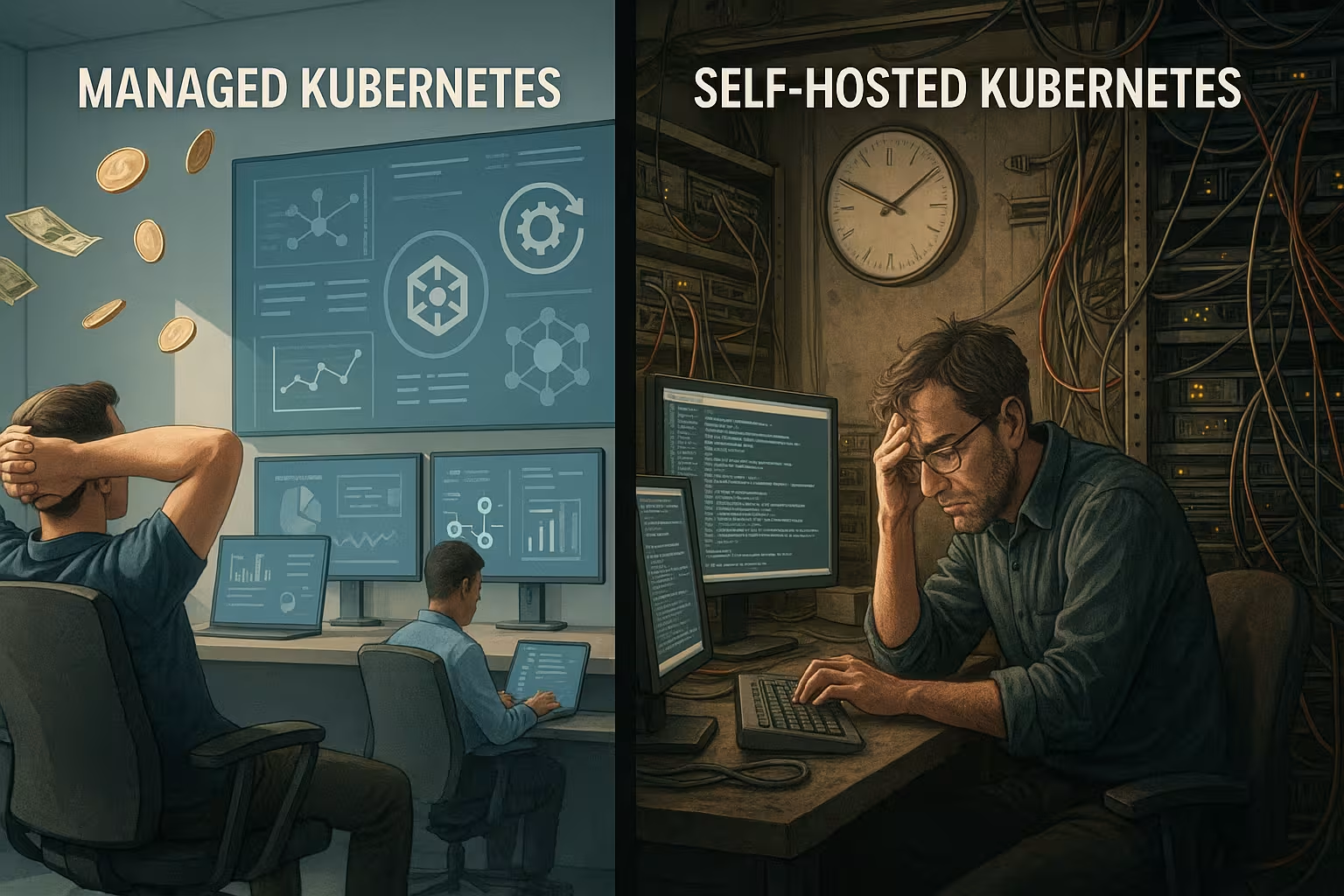
Before I go any deeper, I'll summarize the most important aspects in a nutshell. Looking at individual prices is rarely enough, because personnel, security and operation all carry a lot of weight. A managed offer saves time, while in-house operation provides maximum control. Companies should realistically plan capacities for SRE, monitoring and updates. If you have to meet regulatory requirements, location and data protection are given higher priority than pure infrastructure prices. I provide clear criteria, a sample calculation and a tabular overview to help you make your decision. Transparency to create.
- TCO instead of individual prices: Setup, operation, security, compliance, migration
- Time vs. control: Managed saves on operations, self-managed gives freedom
- Scaling as a cost driver: pay-per-use vs. capacity planning
- Compliance and location: GDPR, German data centers
- Personnel ties up budget: SRE, updates, monitoring
Cost structure in managed operation
A managed Kubernetes cluster significantly reduces the daily administration effort, but comes with a service fee and usage-dependent components. The costs arise from CPU, RAM, storage, network traffic and add-ons such as registry, security modules and automation [1][6]. Providers link services such as monitoring, upgrades and SLAs to a fixed fee, which simplifies planning and operation. I pay attention to clear differentiation in offers: what is included in the basic fee, what is charged additionally, and how traffic or ingress is billed. Response times, availability commitments and support levels are particularly important, as these provide real security in the event of an incident. Costs avoid risks. GDPR-compliant setups in German data centers are more expensive, but help to pass audits safely and reduce risks. minimize [1][4].
Price indicators in detail
For a reliable calculation, I break down managed offers into repeatable price indicators: control plane fee, worker nodes (vCPU/RAM), storage classes (block, object, read/write IOPS), load balancer/ingress controller, egress traffic and logging/monitoring ingestion [1][6]. I also check whether support tiers (Business, Premier) and SLA options are charged separately and how backups/restores are priced. For dynamic workloads, I calculate with automatic scaling and take reservation or commitment models into account, if available. A realistic business case is based on conservative load assumptions, peak factors and security surcharges for data traffic and storage growth.

Self-operation: effort and control
Operating Kubernetes independently gives you maximum control over versions, networks, security policies and tooling. This freedom costs time, as setup, high availability, upgrades, monitoring and incident response require qualified personnel [2][3][5][6]. I always plan fixed efforts for SRE, backups, security scans and tests in such setups. Errors in network rules, incomplete patches or poorly dimensioned nodes quickly lead to failures with direct revenue and image effects [2]. Self-operation is particularly suitable for teams with experience that consistently automate standards and establish clear operating processes. Without this basis, the Freedom quickly become expensive because unplanned work drives peaks and budgets blows up.
Organization, roles and responsibilities
In self-operation, I clarify early on who is responsible for what: platform team (cluster, security, network), product teams (workloads, SLOs), security (policies, audits) and FinOps (cost control) [5]. A binding RACI diagram and on-call rules prevent gaps in operations. For the transitions from development to production, I rely on gate checks (security, performance, compliance) so that risks become visible in good time.
Process maturity and automation
Without consistent automation, effort and error rates increase. I standardize provisioning (IaC), deployments (GitOps), policies (OPA/Gatekeeper or Kyverno), backup/restore and observability. Mature processes shorten MTTR, make releases predictable and reduce shadow work in firefighting phases [2][5]. The benefits of in-house operation stand and fall with this discipline.
Realistically calculate TCO
I never evaluate Kubernetes options solely on the basis of infrastructure prices, but over the entire service life. TCO includes setup, ongoing operation, maintenance, observability, security, compliance and possible migrations [5]. Personnel costs should be included in every calculation because SRE, on-call and upgrades add up directly. The difference between “price per vCPU” and “total costs per month” is often greater than expected. Only a complete TCO view shows whether a managed offer is cheaper than self-managed or whether the team can use its own capacities efficiently enough. If these factors are properly recorded, expensive Misjudgements and creates resilient Planning.
| Operating model | Infrastructure costs | Additional expense | Scalability | Compliance & Security |
|---|---|---|---|---|
| Managed Kubernetes | Medium-high | Low | Very high | GDPR-compliant possible |
| Distribution Managed | Medium | Medium | High | Individual options |
| Self-operation (on-prem/VM) | Low-medium | High | Medium | Full control |
Break-even according to team size and maturity level
The break-even point depends on the team size and degree of automation. Small teams (1-3 people) usually benefit from managed offerings because on-call and upgrades take up a disproportionate amount of time [3]. Medium-sized teams (4-8) reach a neutral point with a high level of automation, at which self-managed can keep up in terms of costs. Large, mature organizations reduce the marginal costs per service through standardization and dedicated platform teams and thus leverage economies of scale in in-house operations [4][5]. I validate the break-even with real deployment cycles, change volumes and incident history.
FinOps: Making costs visible and controllable
I embed FinOps practices regardless of the operating model: cost labels on namespaces/deployments, budgets per team, showback/chargeback, forecasting and alerts in the event of deviations. Technically, I rely on consistent requests/limits, resource limits per quota, rights sizes for storage and coordinated retentions in logging/tracing. This makes it possible to plan cluster costs and detect deviations at an early stage [1][6].

Scaling and performance in practice
Managed offerings score points with fast scaling and pay-per-use, which simplifies dynamic workloads. On my own, I have to plan capacities in advance and provide buffers so that load peaks do not lead to latencies or failures [4][5]. One quality metric is the time until the stable provision of additional nodes, including network and security policies. For teams with highly fluctuating traffic, a sophisticated Container orchestration measurable advantages in day-to-day business. If you have a constant load, you can calculate reserve capacity more tightly and thus reduce infrastructure costs. The key lies in realistic load profiles, clear SLOs and proven Autoscaling-values so that performance does not become Cost guzzler will.
Network and egress cost traps
In addition to CPU/RAM, network paths drive the TCO. I check egress pricing, load balancer types, ingress rules, cross-zone/region traffic and service mesh overhead. For chatty services, co-location or topology spreading is worthwhile to keep inter-pod traffic efficient. Caching strategies, compression and lean protocols reduce data volumes. For multi-region setups, I plan clear data paths and testable fallbacks so that failover does not trigger unexpected egress peaks [4][5].
Compliance, location and data protection
Many industries require strict rules for storage, access and logging. Data centers in Germany significantly reduce data protection and audit risks, which is why I often prioritize this option [1][4]. Managed offerings provide ready-made building blocks here, including SLA, data storage, logging and technical support. The same goals can be achieved in self-operation, but with additional effort for architecture, documentation and audit capability. Anyone serving international customers should clearly regulate data flows, backup locations and incident reports. Gaps in processes can lead to fines in an emergency, which is why the question of location has a direct impact on Risk and long-term Costs.
Security and compliance checklist for the start
- Hard baselines: pod security, network policies, encrypted storage volumes, secrets management [2][5]
- Supply chain: Signed images, SBOM, continuous image scanning, separate registries for staging/prod
- Access: Fine granular RBAC, SSO, least privilege, separate admin/service identities
- Auditability: central logging, unchangeable logs, retention periods, traceability of changes
- Resilience: Backup/restore tested, RPO/RTO documented, emergency processes practiced
Operational operation: updates, security and SRE
Kubernetes brings frequent releases, which I roll out, test and document in a controlled manner. Security aspects such as pod security, secrets management, network policies, image scanning and RBAC require discipline and repeatable processes [2][5]. A managed service takes care of large parts of this and standardizes backup, patching and monitoring. In an in-house operation, I calculate fixed on-call capacities, clear playbooks and test environments so that changes go live safely. If you underestimate this routine, you will pay for it later through downtime, bug fixes and rework. Through clear Maintenance window and hard Standards the operation remains manageable.
Release strategies, tests and incident readiness
For low-risk changes, I combine canary/blue-green deployments with automated smoke, integration and load tests. Progressive delivery reduces the risk of errors and accelerates rollbacks. I define SLOs with error budgets that serve as a guard rail for change frequency and stability. On-call teams work with runbooks, playbooks and synthetic monitoring to measurably reduce MTTD/MTTR. Chaos and DR drills increase operational reliability before real incidents occur [2][5].
Sample calculation: From Docker VM to Managed Kubernetes
In a typical production scenario with three services, six vCPUs and 24 GB RAM, classic Docker VM hosting costs around €340 per month; a managed Kubernetes setup is often 1.5 to 2 times this amount before security tools and SRE costs are added [2]. This difference is put into perspective when I factor in staff time, upgrades, monitoring and incident handling. For smaller teams, the operational savings often pay off because features go live faster and risks are reduced [3]. For very large installations, self-managed setups can be more cost-effective, provided the team works efficiently and pushes automation far [4]. Those evaluating alternatives can use a compact Docker Swarm comparison as a starting point for architectural decisions. In the end, it's the sum that counts: infrastructure plus Personnel plus Risk.
Variant calculation and sensitivity analysis
I create three scenarios: conservative (low peaks, slow growth), realistic (expected load, moderate growth) and ambitious (high peaks, fast rollout). For each scenario, I make assumptions about deployments/month, change volume, egress shares and storage growth. A sensitivity analysis shows which parameters strongly influence the TCO (e.g. log retention, number of LBs, ingress traffic). This transparency prevents surprises later on and provides a reliable basis for decision-making [5].

Decision tree: When which model?
I start with requirements: How many services, how much traffic, what data volumes and what availability targets? I then weigh up time-to-live versus maximum control and check how much internal expertise is available. If there are strict compliance requirements, location and GDPR move to the top of the priority list. Projects with a high growth rate usually benefit from managed offerings because scaling and operation remain predictable [3]. Large, experienced teams often prefer self-managed if they have established strict automation and clear processes [4][5]. A structured selection reduces Risks and prevents later Lock-ins.
Tooling and ecosystem: add-ons, monitoring, backups
In managed environments, I often receive integrated tools for observability, CI/CD, container registry and backup. These modules save time and reduce integration errors, but sometimes come with additional fees [1][6]. In self-operation, I choose tools freely and customize them, but take over maintenance, integration and operation completely. A mixed strategy also works: core operation managed, special components self-directed. The crucial point remains the transparency of all costs across licenses, network, storage and traffic. A clear tool map protects against Shadow IT and unnoticed Costs.
Multi-tenancy and platform team
As the number of services grows, a platform approach pays off: a central team provides secure, standardized clusters (or namespaces) and product teams consume these as a service. Technically, I rely on dedicated namespaces, network policies, resource quotas and labels for cost allocation. Admission controllers enforce standards, GitOps reproduces states. This creates multi-tenancy, which allows scaling without losing security and cost control [5][6].

Migration and exit strategy without vendor lock-in
I plan early on how a cluster can change providers or end up on-premises. Standardized manifests, portable CI/CD and documented dependencies make the move easier [4]. Managed customers protect themselves with data transfers, backup formats and clear SLAs. Self-managed teams avoid ties via open standards and proprietary APIs. Those who test exit scenarios gain certainty and negotiate better conditions. A resilient exit strategy reduces Dependencies and creates real Freedom of choice.
Practice exit tests regularly
I simulate provider changes with a shadow cluster, export/import backups, play through runbooks and measure downtimes. Particularly important: data paths (databases, object storage), secrets, ingress DNS, observability backends. A documented, rehearsed exit protects against lock-in and significantly speeds up negotiations [4][5].
Selection process and next steps
I start with a requirements profile that includes services, SLOs, data and protection requirements. I then compare offers according to price structure, support, location, performance guarantees and add-ons. A compact proof of concept with load profile and monitoring shows where the bottlenecks are and how well SLAs are working. To get started, a structured Kubernetes introduction with a focus on TCO and operating processes. I then use figures and availability targets to decide whether managed or self-managed makes more sense. This results in a decision that sustainable stays and budget clean controls.
SLA and contract review: what I look out for
- Scope of service: What is included in the basic fee? Which add-ons cost extra? [1][6]
- SLA key figures: Availability, response times, escalation paths, maintenance windows
- Security & compliance: data location, encryption, audit logs, shared responsibility model
- Data portability: export formats, retention periods, exit support, costs
- Support: time slots, languages, dedicated contacts, post-mortems and continuous improvement

Brief summary: Making a decision with figures
Managed Kubernetes saves on operations, accelerates releases and reduces risks, but costs a service fee and add-ons. Self-managed provides control and flexibility, but requires experience, time and reliable operating processes [5]. For growing teams with limited capacity, the relief often pays off in the first year. Large, mature organizations leverage economies of scale in in-house operations if automation is implemented consistently. Those who calculate TCO honestly make a decision that balances technology, budget and compliance. So Kubernetes remains a Growth levers, that keeps costs manageable and risks lowers.