Skip to content
Hosting providers use micro data centers specifically to bring computing power close to users and devices and thus control the data swarm efficiently. I show how these compact units reduce latency, save energy and strengthen security - today with a view to tomorrow.
Key points
The following key points give me a quick overview of the most important aspects of this article.
- Latency minimize, increase performance
- Energy save, reduce costs
- Scaling Modular and fast
- Security Standardized integration
- Edge Connect and cloud
Why micro data centers are changing everyday hosting life
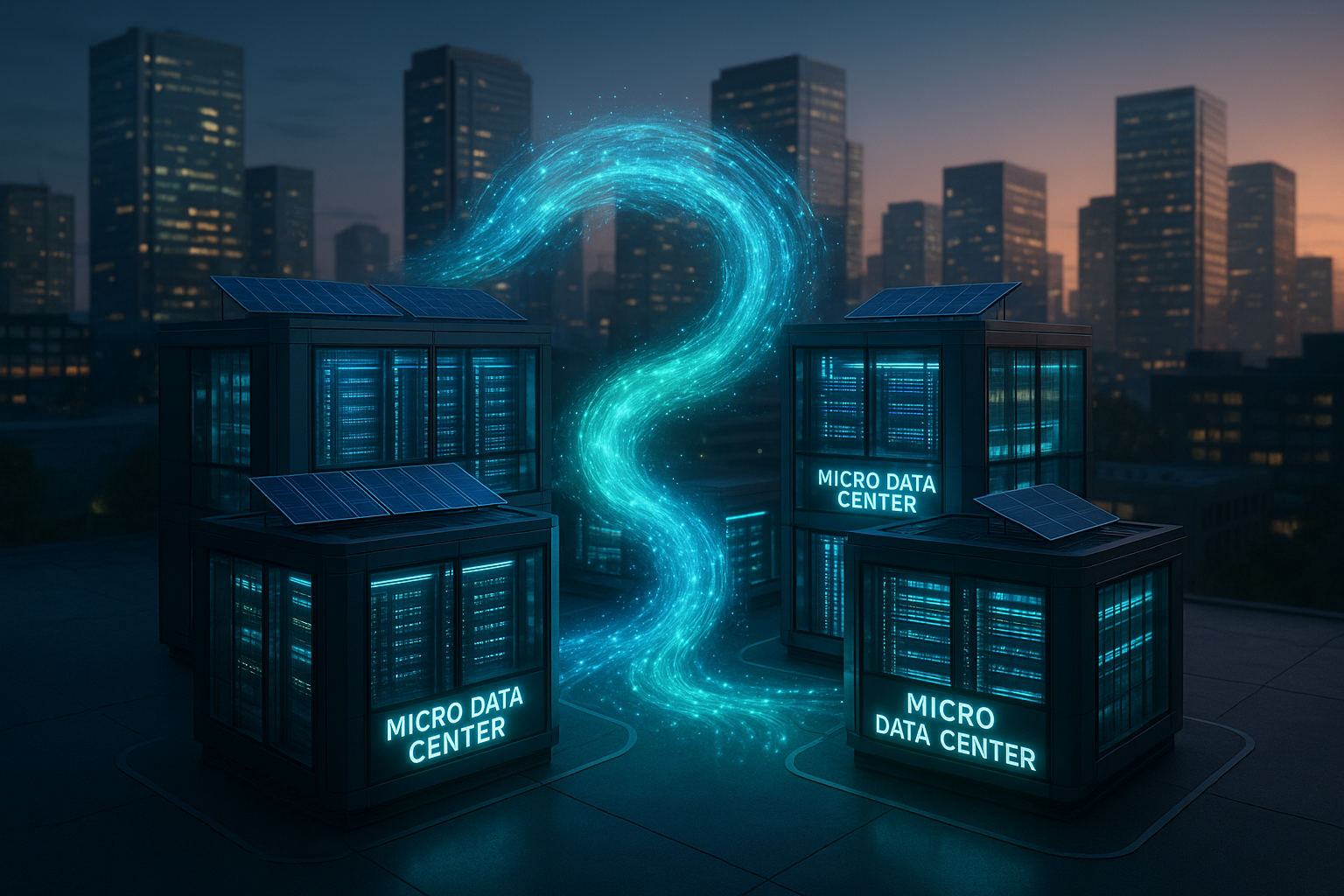
I move computing power to where data is generated and thus keep the Latency under control. Streaming, gaming, IIoT and AI workloads benefit because requests do not take the long route to the central data center. MDCs bundle servers, storage, network, UPS, cooling and monitoring in 1-3 racks, which significantly simplifies deployment. I start services faster, as many solutions come IT-ready and only need power, network and location. This proximity generates measurable effects: more Performance, more stable user experience and lower bandwidth costs on the backhaul routes.

Architecture of the data swarm: decentralized, networked, scalable
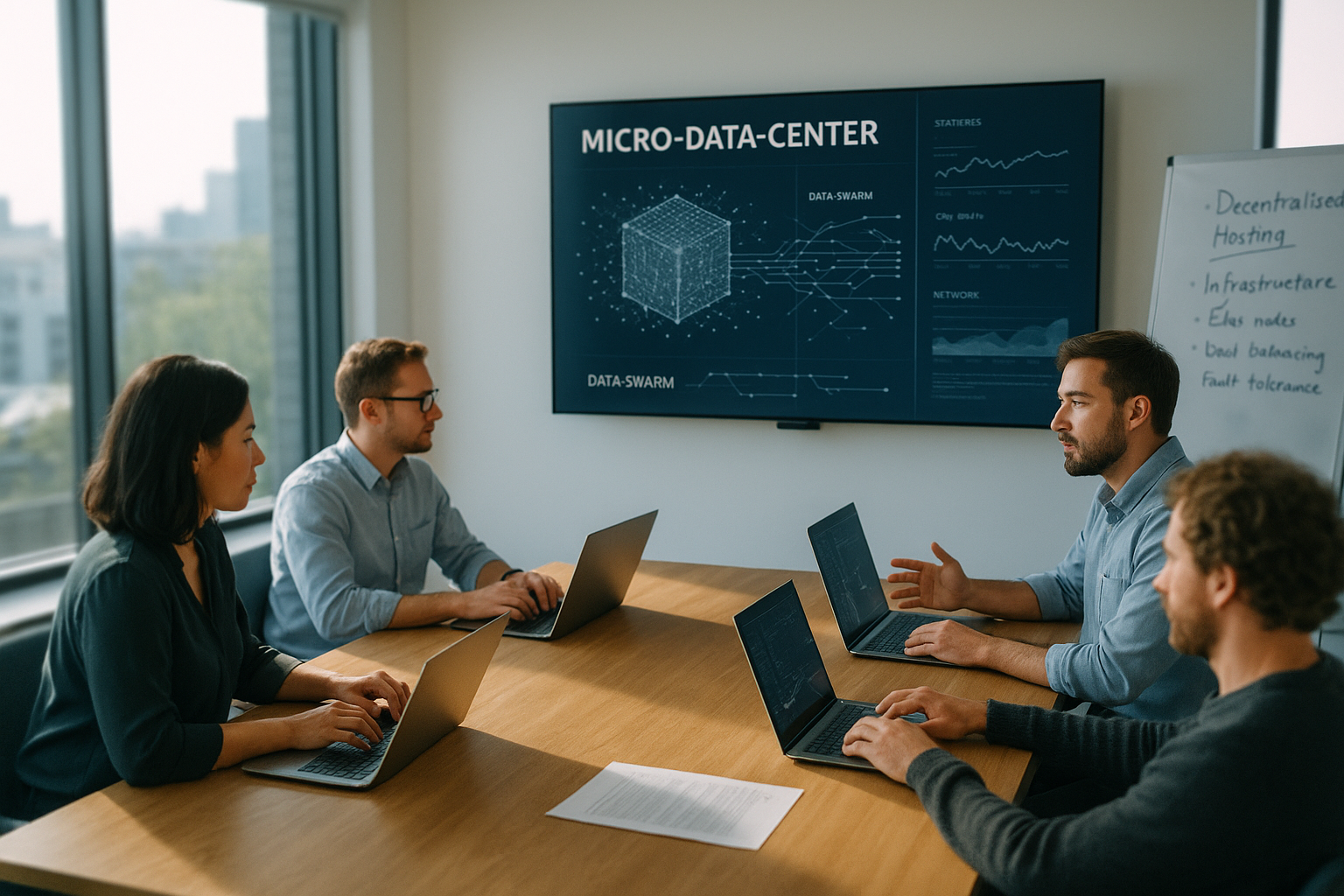
The data swarm works because many small units react quickly together and mutually support each other. secure. I distribute nodes to where users, machines or sensors are located and only keep what is necessary centrally. This topology facilitates load distribution, local processing and data protection-compliant storage in accordance with national law. I roll out additional racks in a modular fashion and remove them again when the peak is over. This allows me to remain flexible and keep the Costs under control.
Location selection and micro-latency: how I make decisions
I choose locations based on user clusters, fiber optic connections, 5G availability and energy prices. Proximity to logistics hubs or clinics reduces travel times and strengthens Compliance for sensitive data. I determine data protection requirements at an early stage and plan geofencing and local encryption. For content playout, I set up nodes close to the city, for industrial AI directly at the plant. For those who want to delve deeper into strategies, see Edge hosting strategies practical approaches that I use in projects.
Hardware and energy setup: small but efficient
An MDC scores points because I align the cooling, airflow and UPS precisely to the rack density. I rely on in-row cooling, closed cold aisles and smart sensor technology to keep the Consumption to lower. Modern racks support high densities per height unit without risking thermal hotspots. Depending on the location, I use free cooling and thus reduce the use of compressors. This saves electricity costs in euros and extends the service life of the Hardware.
Network design: from the rack to the edge cloud
I create dedicated data plane paths, prioritize real-time data and segment networks with VRF and VLAN so that workloads do not interfere with each other. For backhaul, I rely on encrypted tunnels and QoS that prioritize critical packets. IPv6 and automation reduce configuration effort and lower error rates. For control, I link telemetry directly to orchestration workflows. Those who want to bundle processes benefit from Cloud-to-edge orchestration, which I use for repeatable deployments.
Software stack and orchestration at the edge
A coherent software stack determines how smoothly an MDC works in a network. I rely on lightweight container orchestration and keep images small so that deployments run quickly via narrower lines. I cache registries locally and sign artifacts before they go to the edge. This minimizes Attack surfaces and prevents faulty versions from being rolled out on a large scale. For AI inference, I place runtime optimizations and models close to the sensor; training data is compressed and curated centrally.
It is also important to consistently think of operating data as events: I send telemetry, logs and traces in compact, low-loss formats. Prioritization via QoS ensures that control data does not have to share the line with debug information. This way Control and responsiveness even under full load.
Data management and governance at the edge
I classify data at an early stage: what must remain local, what can be anonymized, what needs to be strongly protected? Encryption? In MDCs, I rely on storage policies that automatically enforce replication factors, erasure coding and retention. Edge analytics decides whether raw data is discarded, aggregated or forwarded. For personal information, I use pseudonymization and geofencing so that Compliance and performance go hand in hand. This creates a clear data flow: process locally, refine centrally, evaluate globally - with verifiable limits.
Sustainability: PUE, WUE and waste heat recovery
An MDC can score ecologically if I measure and optimize energy flows. I track PUE and - where water is involved - WUE at rack level. Where possible, I feed waste heat back into building technology or local heating loops. Load shifting to cooler times of the day, free cooling windows and speed-controlled fans reduce the energy consumption. Consumption noticeably. Locally preferred energy contracts with a high proportion of renewable sources help to reduce the carbon footprint without jeopardizing security of supply. For me, sustainability is not an appendage, but a planning parameter such as latency and costs.
Regulation in practice: from KRITIS to industry rules
Additional requirements apply depending on the industry: I take into account reporting and verification obligations, check whether operating data must be stored in an audit-proof manner, and document protective measures from the physical Redundancy up to the patch status. Before the go-live, I define scopes for audits so that controls do not disrupt ongoing operations. In technical terms, this means clear zones, clean key management, traceable access chains and testable restore processes. Instead of seeing compliance as a brake, I build it into the toolchain as a repeatable pattern.
Lifecycle, remote hands and spare parts logistics
Everyday life is decided during operation: I plan OOB access points so that systems can be reached even in the event of network problems. I keep critical components such as power supply units, fans and switch modules on site and store them in a safe place. Runbooks for remote hands teams. I roll out firmware and BIOS updates in stages, with defined maintenance windows per node. After three to five years, a technical refresh is usually due: I then evaluate efficiency leaps of new generations against remaining depreciations and migrate workloads in an orchestrated manner in order to Downtimes to avoid.
Capacity planning and benchmarking
I start with a clean load assessment: CPU, GPU, RAM, NVMe and network requirements are measured by profile, not estimated. I supplement synthetic benchmarks with real-user metrics so that the sizing decision is reliable. For bursts, I plan buffers plus horizontal scaling via additional nodes. Where licenses are priced per core or socket, I specifically optimize the density in order to ROI and compliance. A defined performance budget per service helps to place the next rack early in the event of growth instead of upgrading too late.
Operation: monitoring, automation and SRE practice
I measure everything that counts: Current, temperature, vibration values, network paths and application metrics. DCIM and observability stacks provide me with alarms and trends, which I process in runbooks. Infrastructure as Code and GitOps ensure that every rack is reproducible and auditable. I test failovers regularly so that playbooks are in place in an emergency. This is how I keep SLAs stable and minimize Downtimes.

Zero Trust right into the rack
I regard every MDC as a potentially hostile environment and therefore rely on Zero Trustprinciples: identity-based access, fine-grained segmentation, short-lived certificates and consistent verification before every connection. Secrets are not stored on disk, but in secure vaults; images are hardened and signed. I supplement physical security with tamper-proof boot chains and regular integrity checks. This makes the perimeter smaller - and the resilience greater.
Use cases: industries that benefit now
In industry, I process sensor data directly on the production line and react to errors in milliseconds. Hospitals store patient data locally and meet regional requirements without having to forego modern analytics. Public authorities use distributed nodes for specialist procedures and reduce travel times and peak loads. Media platforms cache streams close to the audience and noticeably reduce buffering. Every industry benefits from shorter distances and stronger Control.
Disaster recovery with Micro-Data-Centres
I distribute backups geographically and consistently separate power and network paths. I define the RPO and RTO before I move the first byte and test scenarios on a recurring basis. Hot standby near the city and cold archives outside the metropolitan area strike a balance between cost and risk. Snapshots, immutable backups and isolated restore environments make attacks more difficult. At the end of the day, what counts is that I get services back quickly and business processes stable continue to run.

FinOps in edge operation
Keeping costs controllable is a team task in distributed operations. I maintain a tagging scheme for all resources, assign expenses to services and compare OPEX per transaction, frame or inference. I use reserved capacity and energy rate windows where workloads can be planned; I buffer spontaneous loads for a short time and regulate them using rate limits. Chargeback models motivate specialist departments to think about efficiency - for example through leaner models, better caches or less chattiness in the network. This makes savings measurable instead of just felt.
Cost planning and ROI: how I calculate projects
I start small, calculate electricity, rent, cooling, maintenance and backhaul separately and then add software and license costs. OPEX decreases if I manage capacity utilization properly and optimize cooling. Depending on the density, a typical pilot rack can already save five-digit euro amounts if I reduce expensive transit. At the same time, I minimize contract risks because I expand modules as required. The following table summarizes the key differences that my Decision influence.
| Micro Data Center | Traditional data center | |
|---|---|---|
| Size | Compact, few racks | Large, whole building units |
| Location | At the place of use | Centralized, often far away |
| Scalability | Modular, flexible | Extensions costly |
| Costs | Lower entry costs and OPEX | High initial investment |
| Latency | Minimal | Higher due to transmission paths |
| Provision | Fast, partly plug-and-play | Months to years |
Market overview: Providers with MDC expertise
I look at references, security, scaling options and service quality when making my selection. Tests show who offers reliable hosting on a modern DC basis and supports flexible scenarios. The following overview helps me to start discussions in a structured way and make requirements tangible. It remains important: Architecture, locations and operating model must fit the objective. The table shows a Classification common provider.
| Rank | Hoster | Rating |
|---|---|---|
| 1 | webhoster.de | Test winner |
| 2 | myLoc | Very good |
| 3 | Cadolto | Good |
| 4 | cancom | Good |
| 5 | Datagroup | Satisfactory |

Operational models: roles, processes, collaboration
Distributed systems require a clear division of tasks. I organize teams along services, not just technologies: SRE is responsible for SLOs, platform teams deliver secure standard modules, and specialist departments define measurable Business goals. Change and incident processes are tailored to edge conditions: short maintenance windows, asynchronous rollouts, robust rollbacks. Runbooks that guide remote hands stand alongside self-healing policies that automatically contain errors. This keeps operations manageable, even when the data swarm grows.
Classification and outlook: Hybrid counts
I see the future in hybrid architectures: central capacity remains, but the edge takes over latency-critical and data protection-sensitive tasks. Workloads move dynamically to where they have the best effect. Orchestration, automation and observability interlink these levels and significantly shorten deployment times. If you want to plan distributed landscapes cleanly, you should use the Distributed cloud as a connecting pattern. In this way, the data swarm grows step by step - with clear goals, measurable Efficiency and focus on user experience.