Skip to content
Microservices Hosting shifts hosting requirements from simple servers to containerized, orchestrated platforms with clear isolation, automatic scaling and end-to-end observability. The shift away from MonolithThis requires decisions on architectural boundaries, data storage and operating models that directly influence costs, speed and availability.
Key points
The following key statements help me to accurately classify the choice of architecture and hosting.
- ScalingMicroservices scale in a targeted manner, monoliths only as a whole.
- InsulationSmall services encapsulate failures and facilitate updates.
- OrchestrationContainers and Kubernetes set new hosting standards.
- Team speedIndependent deployments accelerate releases.
- CompetenciesOperation becomes more demanding, tools and processes count.

From monolith to service landscape
I make a clear distinction: A Monolith bundles functions in a code base, while microservices decouple individual domains and operate them separately. This cut brings faster changes because teams deploy independently and risks remain smaller. However, the operating costs increase as each unit requires its own runtime, data storage and monitoring. For small projects with manageable traffic, the monolith remains attractive and cost-effective thanks to simple deployment. If the application landscape grows, the division into Services more freedom in technology selection, scaling and fault tolerance, which increases agility and reliability in the long term.
Hosting requirements in comparison
The differences are clear when it comes to hosting: monoliths often run on a Managed server or inexpensive packages, while microservices require containers, network policies and orchestration. I pay attention to isolation, automation and observability so that operation and error analysis do not get out of hand. For a quick overview, I use the direct Monolith vs. microservices Perspective. The following table summarizes the key aspects and shows which capabilities the platform really needs to deliver.
| Feature | Monolithic architecture | Microservices architecture |
|---|---|---|
| Code base | One unit | Many Services |
| Scaling | Complete system | Targeted pro Component |
| Deployment | One step | Several Pipelines |
| Operation/Hosting | Simple, inexpensive | Container + Orchestration |
| Fault tolerance | Failure can affect everything | Insulated Failures |
| Infrastructure requirements | Basic skills | DevOps, network and Security-know-how |
| Choice of technology | Mostly fixed | Pro Service free |
| Maintenance | Central, risky | Decentralized, targeted |

Containers, orchestration and platform patterns
For microservices I rely on Container as a lightweight isolation and consistent runtime environment. Orchestrators like Kubernetes automate rollouts, self-healing, service discovery and horizontal scaling. I plan namespaces, network policies, secrets management and a reliable registry to keep build and operation cleanly separated. A service mesh strengthens traffic control, mTLS and telemetry without bloating code. For those who want to delve deeper, the Kubernetes orchestration the building blocks that reliably move microservices in everyday life, from Ingress to pod autoscaling.
Communication patterns and API strategy
I make a conscious decision between synchronous and asynchronous communication. Synchronous calls (REST/gRPC) are suitable for strongly coupled, latency-critical processes with clear response expectations. I use timeouts, retries with jitter, idempotency and circuit breakers to avoid cascade effects. Asynchronous events and queues decouple teams in terms of time and functionality; they tolerate short-term failures better and scale independently of consumers. An API gateway bundles authentication, authorization, rate limiting, request shaping and observability at a central entry point. I keep versioning strictly backwards-compatible, deprecations run according to plan and with telemetry on actual usage. Contract-first and consumer-driven contracts give me the certainty that changes will not break integrations unnoticed.
Data and consistency patterns
I prefer the "database per service" principle so that each team is responsible for its own schema and can migrate independently. I consciously avoid global transactions; instead, I rely on eventual consistency with clear semantics: Sagas coordinate multi-level business processes, either centrally (orchestration) or decentrally (choreography). The outbox pattern ensures that state changes and event dispatch remain atomic, while an inbox simplifies deduplication and idempotency. Where read accesses dominate, I separate writing and reading using CQRS and materialize suitable read models. I explicitly plan time-based effects (clock drift, reordering) so that retries do not generate double postings. Schema migrations run incrementally ("expand-and-contract") so that deployments are possible without downtime.
Safety and insulation
I treat everyone Service like a separate trust unit with clear boundaries. Minimal images, signed artifacts and policy controls prevent unnecessary attack surfaces. Network policies, mTLS and secrets rotation promote protection in communication and data access. Compliance is achieved by versioning access, archiving logs so that they cannot be changed and strictly checking the build path and deployment. In this way, I keep the risk low and achieve a reliable Security level across the entire platform.
Compliance, data protection and auditability
I classify data (e.g. PII, payment data) and define protection classes before services go live. Encryption at rest and in motion is standard; key management with rotation and separate responsibility protects against misuse. I address GDPR requirements with data localization, clear retention periods and reproducible deletion processes ("right to be forgotten"). Unchangeable audit logs, traceable identities and approvals on the build and delivery path ensure verification obligations. Pseudonymization and minimization limit exposure in non-prod environments. I document data flows and use least privilege across all services to prevent authorizations from getting out of hand.
Scaling and costs
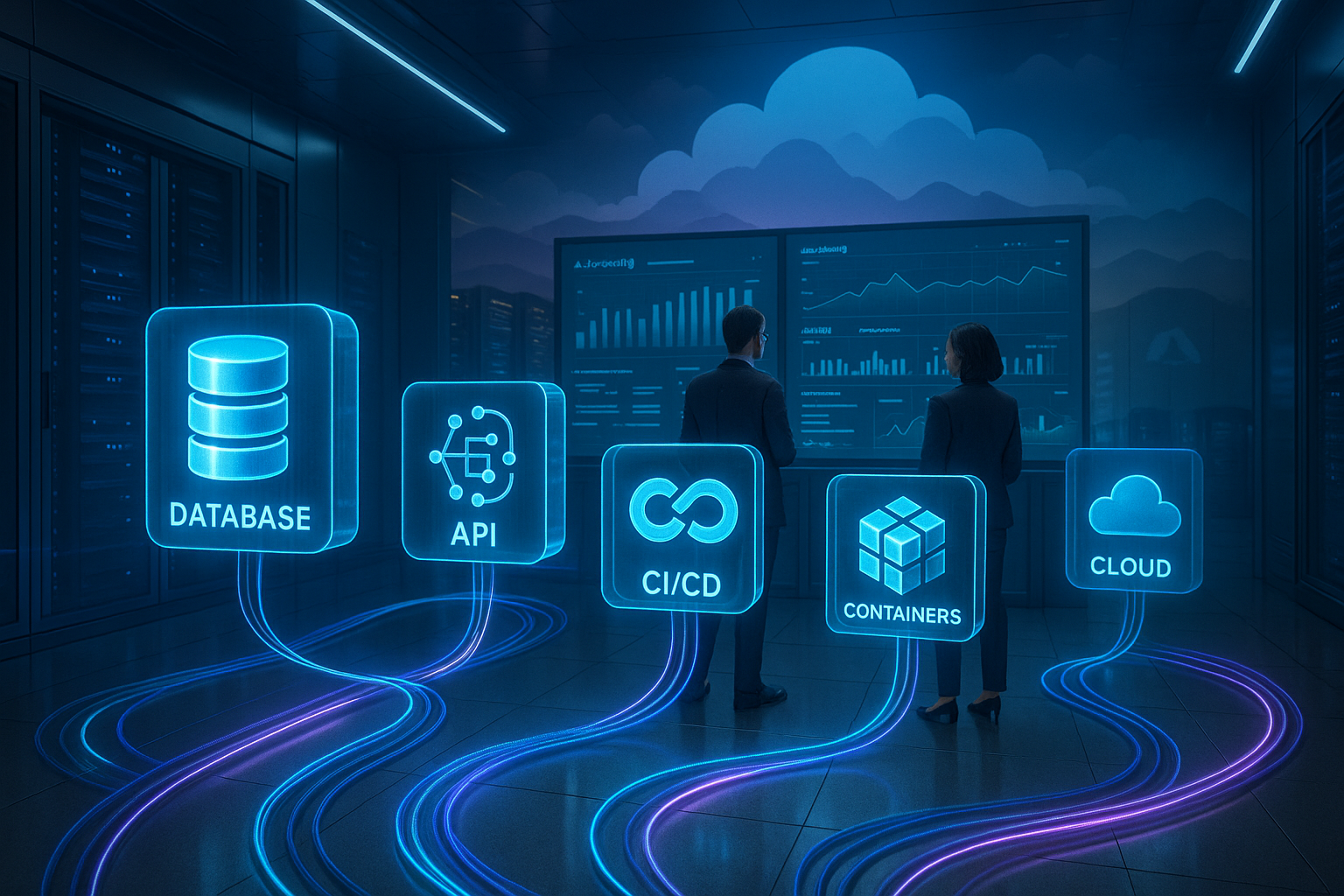
I plan scaling per Component and control them via load, queues or business events. Horizontal expansion brings predictability, while vertical limits provide protection against costly outliers. Cost control succeeds when I dampen peaks properly, dimension workloads correctly and coordinate reservations with demand. For uneven loads, I check short-lived jobs, spot capacities and caching to significantly reduce euro amounts. I also evaluate Serverless optionswhen cold start times are acceptable and events clearly drive usage.
FinOps, cost control and unit economics
I measure costs where value is created: Euro per order, registration or API call. Clean tagging per service and environment allowed Showback/Chargeback and prevents cross-subsidization. Budgets and alarms take effect early, rightsizing and scale-to-zero save in idle mode. I align autoscaling thresholds with SLO-relevant metrics (e.g. latency, queue length), not just CPU. Reservations or commit plans smooth out base load, spot capacity cushions peaks if interruptions are manageable. I pay attention to ancillary costs: log retention, metric cardinality, egress traffic and build minutes. This keeps the platform efficient without breaking the budget.
Observability and operation
Without good Observability I'm wasting time and money. I collect metrics, structured logs and traces to keep latencies, error rates and SLOs traceable. Centralized dashboards and alerting with meaningful thresholds improve response times. Playbooks and runbooks accelerate incident handling and reduce escalations. With reliable deployments, rolling updates and Canary-strategies, I noticeably reduce the risk of new releases.
Resilience and reliability engineering
I formulate SLIs and SLOs per critical path and work with error budgets to consciously balance feature speed and stability. Timeouts, retries with exponential backoff and jitter, circuit breakers and Bulkheads limit the effects of faulty dependencies. Load Shedding and backpressure keep the system controllable under load and degrade functions as elegantly as possible. Readiness/liveness probes prevent faulty rollouts, while chaos experiments uncover weak points in the interaction. For emergencies, I define RTO/RPO and test failover processes regularly so that restarts do not come as a surprise.

Test strategy and quality assurance
I build on a test pyramid: fast unit and component tests, targeted contract tests between services and few but meaningful end-to-end scenarios. Ephemeral environments per branch enable realistic integration runs without queues on shared stages. Test data is generated reproducibly via seed scripts, sensitive content is generated synthetically. Non-functional tests (load, longevity, fault injection) uncover performance regressions and resilience deficits. I test database migrations in advance in near-production snapshots, including rollback paths and schema compatibility across multiple releases.
Team organization and delivery
I set up teams along Domains so that responsibility and expertise coincide. Autonomous teams with their own pipeline deliver faster and more securely because dependencies shrink. Common platform standards (logging, security, CI/CD templates) prevent chaos without taking away freedom. A clear service catalog, naming conventions and versioning make interfaces maintainable in the long term. This increases the speed of delivery, while the Quality remains consistent.
Developer Experience, GitOps and environment models
I invest in a strong developer experience: reusable templates, golden paths and an internal developer portal quickly lead teams to secure standard setups. GitOps keeps the desired state of the platform in code, pull requests become the only source of change. Infrastructure-as-code, policy sets and self-service namespaces accelerate onboarding and minimize manual deviations. I use preview environments, feature toggles and progressive delivery for rapid iteration. I facilitate local development with dev containers and remote sandboxes to maintain parity with production.
Migration: Step by step from the monolith
I start with functions that are real Added value as a service, such as authentication, search or payment. The Strangler pattern allows me to rearrange routes and outsource parts cleanly. Anti-corruption layers shield legacy systems until data models are cleanly separated. Feature toggles and parallel operation secure releases while I reduce risks in a controlled manner. The journey ends when the monolith is small enough to use remaining components as Services continue in a meaningful way.
Data migration and legacy decoupling
For migration-critical domains, I avoid "big bang" cuts. I replicate data with change data capture, validate concurrency through id mapping and perform backfills in batches. I only use dual writes temporarily and with strict idempotence. I plan cutovers with shadow traffic and read-only windows until metrics and traces create trust. Only when data quality, performance and error rates are stable do I deactivate the old implementation for good.

Recommendations according to application type
For classic sites, blogs and stores with manageable functionality, I often opt for a Monolithon a high-performance managed offering. This keeps operations simple and cost-efficient without sacrificing performance. With growing functional diversity, multiple teams and frequent releases, microservices score highly thanks to independently scalable units. This is where I rely on container hosting, orchestrated platforms and API-driven deployment. webhoster.de is a reliable partner for both scenarios. Partner - in the classic setup as well as for sophisticated microservices landscapes.
Stateful workloads and data services in the cluster
Not every state belongs in the orchestrator. Managed databases speed up operation because backups, patches and high availability are outsourced. If I operate state in the cluster, I use stateful sets, suitable storage classes and verified backup/restore paths. Latency requirements, IOPS profiles and noisy neighbors flow into the placement. I isolate critical data services, avoid co-location with highly fluctuating load and test recovery regularly. Read replicas and caches buffer peaks, while clear RPO/RTO targets guide architecture choices.
Decision guide in 7 questions
I first check the LoadHow much does it fluctuate and which parts have peaks? Secondly, the release frequency: how often do new functions go live and which teams work in parallel? Thirdly, the business boundaries: Are domains clear enough to cut services sensibly? Fourthly, operations: what container, network and security capabilities are available or can be purchased? Fifthly, cost control: What mechanisms limit outliers in compute, storage and traffic in euros? Sixth, the data: What are the consistency requirements and how do I decouple schemas? Seventh, the RisksWhich failures must remain isolated and which SLOs are business-critical?

Cost models and governance
I separate Product- and platform budgets so that responsibilities remain clear. Tagging and cost reports per service create transparency and prevent cross-subsidization. Billing models with reservations, commit plans or workload profiles help to smooth out euro costs over months. Technical guard rails (e.g. resource quotas, namespaces, policy sets) stop unwanted expansion. Governance can be lightweight, but must binding to ensure that innovation and cost discipline work together.
Briefly summarized
Unleashing microservices Scalingautonomy and reliability, but require more platform expertise, automation and clear team interfaces. Monoliths impress with simple deployment, low entry costs and comprehensible operation. I use the load profile, team structure, data requirements and release tempo to decide whether the split justifies the expense. For uncomplicated projects, I use the monolith; for dynamic product landscapes, I invest in containers, orchestration and observability. If you want to cover both with confidence, choose a hosting partner that offers classic environments and Microservices confidently.