Skip to content
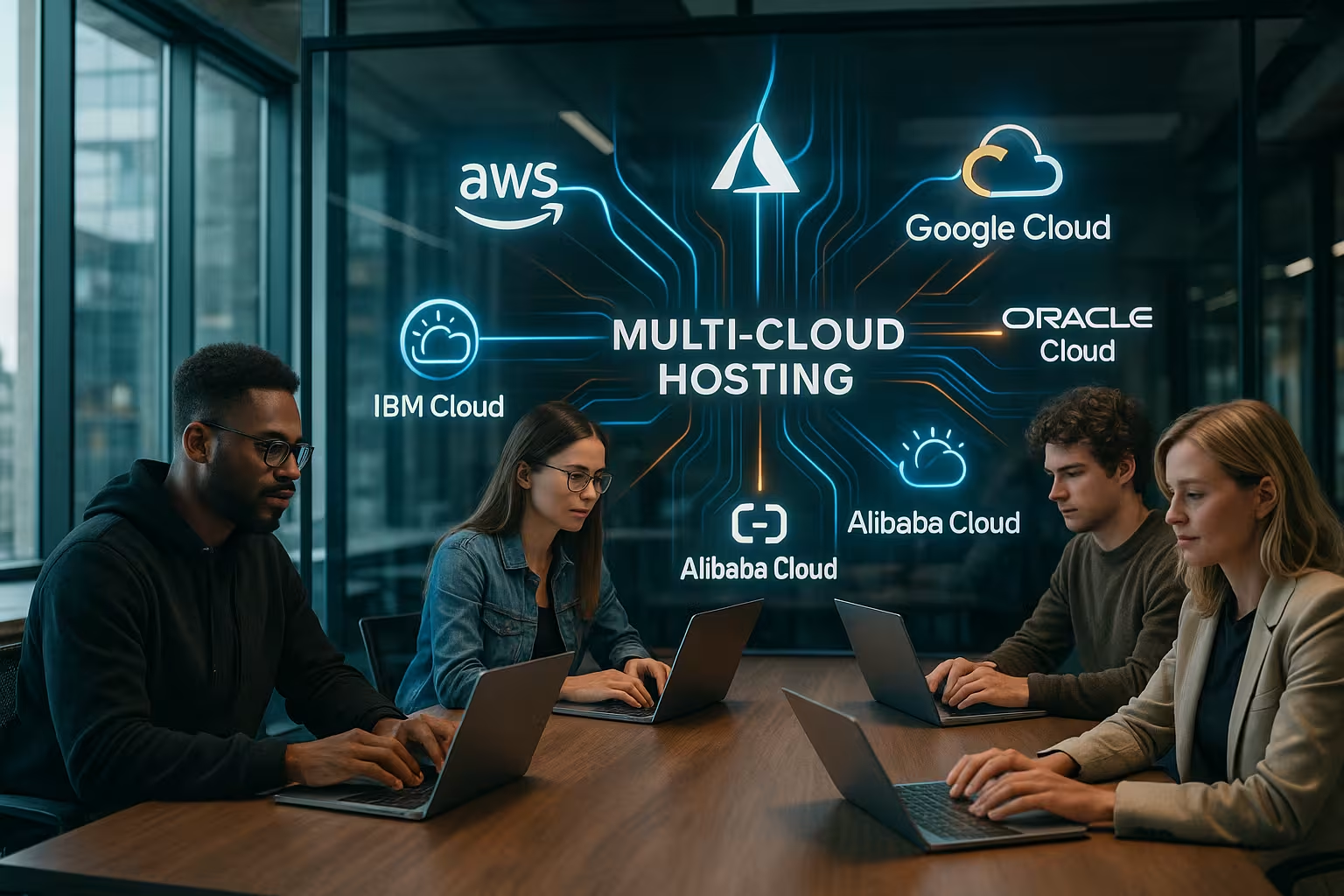
Agencies and developers secure with a multi-cloud hosting strategy their independence: I distribute workloads across multiple providers in a targeted manner, reduce risks, and keep projects flexible at all times. This allows me to combine performance, compliance, and cost control—without Vendor lock-in and with clear processes for operation and scaling.
Key points
I focus on the following areas when I want to make hosting independence for agencies and developers plannable—compact and directly implementable.
- Lock-in Avoid: Moving workloads between clouds, freely choosing prices and technology.
- Resources Optimize: Use the right provider for each application and save money.
- Reliability increase: Several regions and providers, services remain online.
- Compliance Secure: Choose GDPR-compliant locations, control access.
- Automation Use: CI/CD, IaC, and backups reduce effort and error rates.

Why hosting independence matters for agencies
I design projects in such a way that I can change providers at any time and Independence True. According to market analyses, around 80% of companies will be using multi-cloud models by 2025 [1], which shows that the trend is well established and delivers tangible benefits. Those who use only one provider risk rising costs, technical limitations, and longer outages—a distributed landscape significantly reduces these risks [1][3]. At the same time, I bring services closer to users by choosing regions wisely and noticeably reducing response times [1][3]. Data protection remains controllable: I place sensitive data in European data centers and rely on ISO-certified offerings to ensure that projects remain compliant [10].
From analysis to operation: How I plan the architecture
At the beginning is the requirements analysisWhat latency, availability, and compliance does each application require—and what dependencies exist [1][9]? I then compare providers based on price-performance, service, integration capability, and regional proximity; I prefer to implement high-performance setups with a strong developer focus with providers that visibly facilitate agency workflows [2]. For the migration, I clearly separate responsibilities, define APIs, and prepare test scenarios so that transitions can be made without downtime; local staging setups, for example with tools such as DevKinsta, accelerate transitions and roll out updates securely [12]. I establish governance rules for roles, cost centers, and approvals, combining them with central monitoring and automated security checks [10]. Finally, I define operational routines: backups, disaster recovery exercises, patch windows, and clear Runbooks – this keeps everyday life manageable.

Architecture patterns for portability and low coupling
I build applications portable, so that they can run between providers with little effort. Container workloads decouple build and runtime, while I strictly separate state and compute. 12-factor principles, clearly defined interfaces, and semantic versioning prevent breaks during changes. For data, I reduce “data gravity”: I minimize cross-regional/provider queries, use replication in a targeted manner, and transfer Schema changes Migration-proof (forward and backward compatible). Event-driven patterns with queues/streams buffer load peaks, while idempotent consumers facilitate rollbacks. Where services require provider-specific functions, I encapsulate these behind my own Adapter interfaces – this keeps the business logic independent.
Tooling and orchestration: less effort, more control
I bundle multi-cloud resources with Orchestration, so that deployments, scaling, and service mesh work together seamlessly. A clear toolchain ensures that I don't have to maintain special workflows for each platform. In practice, I use central dashboards to keep track of statuses, costs, and utilization across providers. The Multi-cloud orchestration with integrations for common hosting environments. This reduces friction in everyday life, saves time during rollouts, and keeps the Transparency high.
Governance, security, and monitoring
I consistently lead Least privilege-Access controls so that teams only see and change what is really necessary. GDPR-compliant locations, data processing agreements, and ISO27001 environments are mandatory for customer projects [10]. Continuous monitoring records latencies, error rates, costs, and security events; alarms are bundled so that I can make quick decisions. Policies enforce encryption, secure protocols, and lifecycle rules for data, which reduces risks and keeps audits lean. For recurring checks, I use automatic security scans so that I can find deviations early on and weaknesses close quickly.
Identity, secrets, and key management
I centralize identities via SSO (e.g., OIDC/SAML) and automatically synchronize groups/roles (SCIM) to ensure that permissions are consistent across all clouds. I manage secrets with precise versioning and access control, rotate them automatically, and rely on short-lived credentials instead of static keys. For encryption, I use KMS-supported methods, prefer BYOK/HSM options, and separate key management from operational teams. Secret scanning in repositories and build pipelines prevents leaks at an early stage; in the event of an incident, a central revocation process Quickly rotate compromised keys across all platforms.
Automation and DevOps as accelerators
I automate builds, tests, and deployments via CI/CD, so that releases run reliably and repeatably. Infrastructure as Code describes each environment declaratively, allowing me to track changes in a traceable manner and reproduce them quickly. I schedule backups based on time and events, regularly check restores, and document RTO/RPO targets. Blue-green or canary deployments reduce risk because I launch new versions with little traffic and roll back immediately if problems arise. Taken together, this reduces the error rate, speeds up go-lives, and keeps the Quality constantly high.
Migration and cutover strategies in multi-clouds
I plan switches precisely: I lower DNS TTLs in advance to CutoverI keep times short and test rollbacks realistically. I migrate databases using logical replication or CDC until the target and source are synchronized, followed by a short write freeze and the final switchover. During dual-write phases, I ensure idempotence and conflict resolution so that no duplicates are created. I encapsulate stateful services to minimize write paths; I empty caches and queues in a controlled manner. Feature flags allow me to finely control traffic per region/provider and ramp up step by step. For highly critical systems, I plan Parallel operation over several days – with metrics that immediately highlight deviations.
Cost model and budget control in multi-clouds
I break down costs according to Workloads, teams, and environments so that budgets remain transparent. Transfer fees, storage classes, compute types, and reservations affect the bill—I adjust the combination for each application. For predictable loads, I choose discounted instances, for peaks, on-demand; this way, I keep performance and price in balance. Alerts notify me of outliers in euros before the end of the month comes as a surprise; tagging and reports provide clarity down to the project level. Regular rightsizing analyses, data tiering, and archiving reduce consumption and strengthen the Cost transparency.
FinOps in practice
I embed cost control in everyday life: I set budgets per product/environment, Forecasts I update weekly. Unit economics (e.g., cost per 1,000 requests, per order, or per client) make the effects of architectural decisions measurable. Tagging guidelines enforce complete assignment; untagged resources are automatically reported. I establish cost-saving measures as code: shutdown plans for non-productive environments, Autoscaling with upper limits, storage lifecycle rules, and compression. Quarterly reviews check reservations and committed use—anything that is not used is consistently reduced.
Optimize performance and latency
I position services close to the Users, to ensure loading times are correct and conversion targets remain achievable. Multi-region setups shorten distances, caches and CDNs relieve backends, and asynchronous jobs keep APIs responsive. For data-intensive applications, I separate read and write paths, distribute replicas, and use read-only instances in user regions. Health checks and synthetic tests continuously measure where bottlenecks occur; I use this information to make targeted optimizations. It is important to take local characteristics such as holidays or peaks into account so that I can respond in a timely manner. scale.

Network design and data paths
I plan networks with clear segmentation: hub-and-spoke-Topologies, private endpoints, and restrictive egress policies prevent shadow IT. I implement connections between clouds via peering/interconnect or VPN/SD-WAN, depending on bandwidth, latency, and compliance. Zero-trust principles, mTLS, and end-to-end authentication protect services even in distributed operations. For data-intensive paths, I minimize cross-traffic, use compression and batch transfers, and continuously monitor egress costs. I maintain paths observable (flow logs, L7 metrics) so that anomalies can be quickly identified.
Agency workflows: From staging to disaster recovery
I separate Staging, testing, and production clean so that releases remain predictable. Local development environments—such as DevKinsta—replicate production settings well, promote team speed, and reduce errors before going live [12]. For backups, I rely on multiple locations and versioning; I test restores regularly to maintain RTO/RPO. DR runbooks contain clear steps, roles, and communication channels so that chaos does not ensue in an emergency. This way, reliability becomes routine rather than a special case and remains viable across multiple providers [1][3].
Typical scenarios from practice
Separate agencies with many clients Clients Strict: Security-critical projects run in DE regions, high-traffic campaigns in low-latency locations. WordPress projects use separate staging and production environments, automated testing, and rollbacks for fast releases. International teams work with region-specific resources and comply with data guidelines for each market. Hybrid architectures combine dedicated hosting for databases with elastic cloud services for peak loads. For launch phases, I plan temporary capacities and scale back after the campaign ends—this saves costs and keeps the Performance stable.

Provider overview for multi-cloud-enabled hosting
I compare providers on the basis of Integration, developer tools, customer management, performance, and compliance features. Benchmarks and practical tests, combined with a clear view of service and costs, help me make operational decisions. The Tool comparison 2025, to check key functions and integrations. The following table summarizes typical strengths and shows how I set priorities for agency setups. Important: Reevaluate results regularly, as offers, prices, and Features change.
| Provider | Multi-cloud integration | Performance | Customer management | Developer tools | GDPR/ISO | Recommendation |
|---|---|---|---|---|---|---|
| webhoster.de | Yes (test winner) | Top | Extensive | Strong | Yes (DE, ISO) | 1 |
| Kinsta | Partial | High | Very good | Very good | Partial | 2 |
| Mittwald | Possible | Good | Good | Good | Yes (DE, ISO) | 3 |
| Hostinger | Partial | Good | Good | Good | Partial | 4 |
Think systematically about reliability
I actively plan availability instead of leaving it to chance – with Redundancy about providers, zones, and regions. Health checks, automatic switches, and replicated data streams keep services running even if one part fails [3]. Runbooks define escalation paths, communication channels, and decision limits for critical minutes. In exercises, I train realistic scenarios, measure RTO/RPO, and improve processes step by step. The article on Fail-safe operation in companies, that I use for planning purposes.
Reliability engineering in practice
I define SLIs and SLOs for core paths (e.g., latency p95, error rate, availability) and consciously manage error budgets. Releases that use up budgets are slowed down; stability takes priority. I operate Game Days and chaos experiments in staging/production with controlled scope: zone failures, blocking of external dependencies, latency injection. Post-mortems are blameless and result in verifiable measures. This makes resilience measurable and continuously improves it—across all providers.
Team, processes, and documentation
I organize accounts/landing zones according to Mandates and environments, establish a service catalog with approved building blocks (database blueprints, observability stacks, network patterns). Golden paths describe recommended paths from repository to operation so that teams can get started quickly and comply with standards. On-call rules, on-call duty, and clear handovers between agency and customer prevent gaps. Documentation is versioned alongside the code (runbooks, architectures, decision logs) and is maintained in reviews – this ensures that setups remain traceable and auditable.
Avoid anti-patterns
- overdiversityToo many providers/services increase complexity – I standardize core components.
- Hidden lock-inProprietary managed features without abstraction make switching difficult – I encapsulate vendor dependencies.
- Inaccurate IAM: Inconsistent roles lead to security gaps – I harmonize role models.
- data proliferationCopies without a lifecycle drive up costs—I enforce retention and archiving policies.
- Lack of testingDR plans without practice are worthless—I practice failover regularly and document it.
30/60/90-day plan for getting started
In 30 days, I define goals, SLOs, budget frameworks, and select a pilot application. I set up basic IaC, CI/CD, and tagging. In 60 days, I build two providers I establish observability, secrets management, and initial DR exercises in a production-like environment; migration tests run in parallel. In 90 days, the pilot goes live, FinOps reviews start regularly, and golden paths are rolled out to other teams. After that, I scale patterns, automate more, and reduce special cases—with clear metrics for quality, speed, and costs.

My summary for agencies and developers
A strong Strategy Distribute responsibility, costs, and technology across multiple shoulders—this reduces risks and keeps options open. I start in a structured manner: clarify requirements, review providers, test migration, establish governance, and roll out automation. Performance, reliability, and compliance all benefit when I consciously combine regions, services, and data paths [1][3][10]. With centralized monitoring, clear budgets, and recurring DR exercises, operations remain manageable. Investing in knowledge, tools, and clear processes today secures the future. Independence tomorrow's.