Skip to content
In 2025, multi-domain hosting will reorganize the management of many brand and project sites: AI automation, edge performance and green strategies meet clear dashboards and robust security concepts. I'll show you which functions count today, how the most important providers perform and what you should look out for when setting up a multi-domain architecture.
Key points
I believe that the right structure is crucial for multi-domain projects because it reduces risks at an early stage and simplifies growth. AI automation and edge mechanisms will become much more important in 2025, as they have a noticeable impact on availability and response times. Providers score with centraln dashboards, integrated backups and granular authorizations. Those who plan for the long term take into account Scaling without downtime, transparent costs and GDPR security. Sustainable data centers, modern protocols and clean backup chains round off a reliable setup.
- AutomationUpdates, Monitoring, Security
- PerformanceEdge, HTTP/3, NVMe
- SecurityZero-Trust, SSL, Backups
- ScalingCloud, traffic peaks
- UsabilityDashboard, Documentation, Support

What is Multi Domain Hosting? Definition and use cases
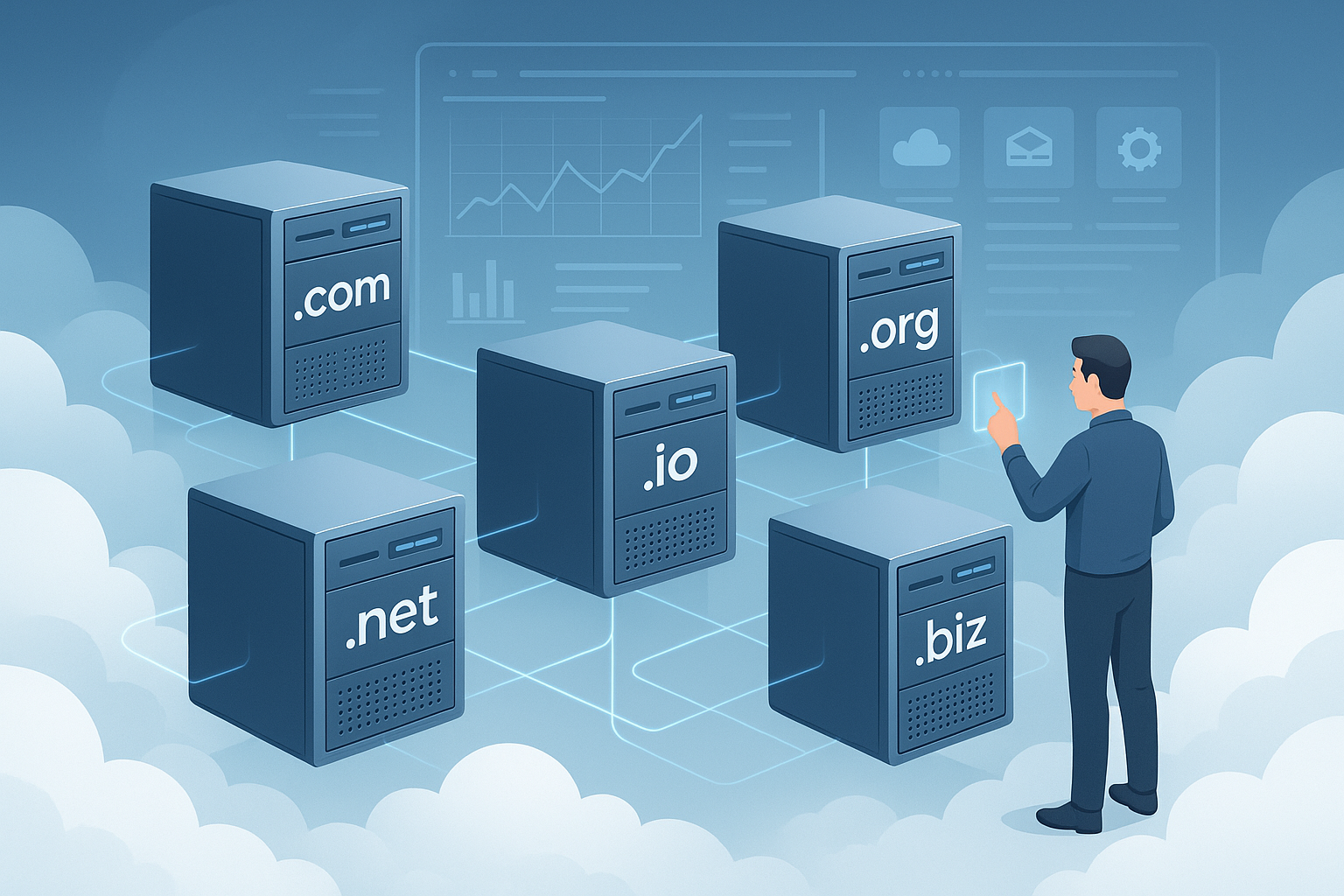
Multi Domain Hosting bundles several independent websites and domains in one account so that I can save costs, control them centrally and scale them cleanly. Agencies host customer projects, companies operate brand and country sites, and creators separate theme worlds. The big advantage lies in one login for DNS, SSL, email, backups and monitoring, which significantly streamlines processes. I still separate projects clearly, for example with separate FTP and email accounts for each domain, in order to keep responsibilities clear. This creates a structured toolkit that starts with three pages and can easily grow to dozens of projects.
Architecture variants and SEO strategy
For international or multilingual setups, I consciously choose between ccTLDs (deine-marke.de), Subdomains (deine-marke.de/fr) and Subdirectories (fr.deine-marke.de). ccTLDs have the strongest local impact, but mean more administrative effort, separate jurisdictions and often separate link building strategies. Subdomains separate technology and teams cleanly, but can fragment SEO signals. Subdirectories bundle authority, but require clean rights and caching concepts. For the search, I rely on hreflangconsistent canonicals and clear geotargeting settings. In multi-domain scenarios, I also plan which content remains globally consistent (e.g. brand guidelines) and what is localized (currency, legal texts, delivery terms). These decisions influence URL design, cache structures and later scalability.
Technological developments in 2025: AI, edge and green hosting
In 2025, automation will take center stage: AI-supported systems will plan updates, detect patterns in traffic and report anomalies before failures are imminent. Edge-nodes reduce latencies by bringing content closer to the user and speeding up TLS handshakes. HTTP/3, QUIC and NVMe storage improve loading times, especially with lots of media data and dynamic caches. Green hosting is gaining in importance because customers expect and reward CO₂ transparency and energy-efficient data centers. I also pay attention to security by design so that protection mechanisms are active rather than reactive.

Advantages and stumbling blocks in practice
A multi-domain setup reduces contracts, simplifies administration and keeps track of many projects. Costs because I book resources as a package and coordinate maintenance in one place. At the same time, the responsibility increases: each additional site takes up CPU, RAM, I/O and support time. I therefore define quotas per domain, set rate limits for APIs and ensure clear monitoring thresholds. If you disregard these guard rails, you risk slow sites, security gaps and unnecessary escalations in day-to-day operations.
Important functions for 2025
I first check whether unlimited domains are possible and whether DNS zones remain freely configurable. SSL per domain with auto-renew, daily backups, granular roles and separate SFTP access are a must for me. A tidy interface saves time, especially when I manage dozens of certificates and mailboxes. I look at uptime guarantees, status pages and failover mechanisms so that projects run predictably. WordPress Multisite, staging environments and API hooks round off the convenience and facilitate automation.
DNS, e-mail identity and deliverability
I scale in multi-domain environments DNS with templates, anycast nameservers, DNSSEC and CAA-records. This is how I secure the issuing of certificates and reduce spoofing risks. IPv6 dual stack is standard for me. For e-mail, I rely on clean SPF-entries (incl. all shipping services), DKIM-signatures with individual selectors and consistent DMARC with reporting. If you want a consistent brand image, you need to consider BIMI and maintains correct TLS policies (MTA-STS, TLS-RPT). I plan warm-up phases, bounce handling and dedicated IPs only where reputation and volume justify it. I renew certificates automatically and add HSTS and OCSP stapling to speed up handshakes and increase security.
Provider comparison 2025
I compare multi-domain tariffs according to functions, performance, support quality and transparent upgrade paths. Uptime-Commitments from 99.9 %, modern protocols and NVMe storage provide a noticeable advantage here. A low-cost plan is suitable for beginners, while growing projects benefit from cloud or VPS options early on. GDPR compliance and German data centers may be mandatory depending on the industry. The following table summarizes the core data from current tariffs.
| Provider | Domains manageable | Price from | Special features | Test winner |
|---|---|---|---|---|
| webhoster.de | Unlimited | from € 2.99 per month | German support, performance, GDPR, WordPress optimized | 1st place |
| Hostinger | 100 | from € 2.99 per month | Intuitive interface, good additional functions | 2nd place |
| A2 Hosting | Unlimited | from € 2.99 per month | particularly fast, many features | 3rd place |
| Bluehost | Unlimited | from € 2.95 per month | fast-growing, reliable customer service | 4th place |
| Liquid Web | Unlimited | from € 25.00 per month | for high performance, dedicated resources | 5th place |
Selection criteria and evaluation
I prioritize clear upgrade paths so that I can unlock additional resources without restarting. Support in the local language, reliable documentation and honest status pages help me to recognize bottlenecks in good time. Prices must be transparent: Domain limits, inodes, e-mail inboxes and backup storage should be clearly stated. For a well-founded assessment, I like to use a Webhosting comparisonto see performance, security and conditions side by side. I then decide whether shared, VPS, cloud or dedicated resources are suitable for the project profile.

Observability, monitoring and SLOs
For many domains I define SLIs (e.g. p95 latency, error rate, uptime) and anchor SLOs per project. Synthetic checks from several regions, certificate and DNS monitoring as well as cron job monitoring are part of my standard. I consolidate logs centrally with structured fields (domain, client, environment) to detect anomalies more quickly. I calibrate alerts to real, action-relevant events so that teams don't bleed out. Simple Runbooks and playbooks describe escalation paths, communication routines and rollback steps - so that an incident does not turn into a crisis.
Reseller and agency hosting: structures for professionals
Agencies and freelancers benefit from white label management, automatic provisioning and bundled billing. Packages with hosting, domains, e-mail, backups and monitoring simplify the business model. I set roles and quotas for each customer group so that each project has clear resources and rights. APIs connect billing and ticket systems so that onboarding and offboarding run without manual work. If you want to go deeper, you will find Reseller hosting 2025 concrete approaches for efficient service bundles.
CI/CD, GitOps and infrastructure as code
I standardize deployments via Gitstaging environments and automated tests. Branch strategies (e.g. trunk-based) and Blue/Green-Rollouts allow updates without downtime. I keep configurations as code so that I can clone environments reproducibly and minimize sources of error. IaC for DNS and hosting objects speeds up rollouts of new domains and reduces typing errors. I manage sensitive variables via secrets management and document version statuses in the changelog. Rollbacks are possible in minutes thanks to immutable artifacts (builds, snapshots).
Safety and sustainability: protection and responsibility
I take a proactive approach to security: MFA in the panel, SSH keys, hardening of PHP/NGINX/LiteSpeed and timely patches. Insulation between projects, web application firewalls and malware scanning reduce risks for many domains. Daily offsite backups with retention periods plus restore tests ensure real recoverability. GDPR features such as an AV contract, clear data flows and logs on EU servers create legal certainty. Sustainable hosting with green electricity, efficient cooling and modern hardware reduces energy requirements and strengthens the external image.

Database, caching and PHP worker tuning
Many sites in one instance require clean Resource designseparate PHP-FPM pools, defined numbers of workers and a generous OPCache so that projects do not block each other. I optimize databases with connection pooling, query caches and sensible indexes; read replicas or separate DB instances mitigate peaks. For dynamic platforms, I use Object caches (e.g. Redis) and page caches with unique cache keys per domain. A CDN with image optimization and edge caching shortens paths. Rate limiting, queue workers (e.g. for email, image processing) and clean cron scheduling prevent background jobs from slowing down live traffic.
WordPress Multisite and practical tips
Many projects run on WordPress, so I use Multisite when I want to manage uniform plugins and themes. Domains I assign them via mapping, secure each site with its own SSL and activate caching to match the traffic. I test updates in staging before I roll them out widely and keep child themes cleanly separated. For quick orientation, I use short checklists for backups, cron jobs and image optimization. I like to collect specific processes in compact guides, for example as Practical tips for everyday life.
Law, data locations and compliance details
I clarify early on where data is stored and who has access. A clean data processing agreement, documented TOMs, EU locations and clear deletion periods are mandatory. If there is a connection to a third country, I check the legal basis, technical protection measures and standardized contractual clauses. I only keep logs for as long as necessary and segment them per client. I also ensure consistent legal texts for each domain (legal notice, data protection, cookies) and implement consent management for each market. Encryption at rest, key rotation and access according to the need-to-know principle round off the compliance package.
Cost models and scaling: Plannable growth
I often start with low entry-level tariffs, but set limits and metrics for the next upgrade early on. Scaling without downtime when providers expand resources live and clearly define limits. I monitor I/O wait times, memory, PHP workers and database connections in order to mitigate bottlenecks in good time. I intercept traffic peaks with CDN, object cache and image CDN so that pages remain fast. On the cost side, I calculate add-ons such as additional backups, IPs, staging slots and premium support in euros.

Portability, vendor lock-in and exit strategies
I minimize dependencies by relying on open formats: Databases as dumps, files as snapshots, DNS zones as text exports. I document certificates, secrets and cron jobs in detail. A practiced Exit plan includes restore tests with a second provider, the separation of registrar and hoster as well as clear steps for email migration (incl. mailbox exports and DNS cutover). This means that a change can be planned - and I retain the power to negotiate prices and services.
Migration, structure and governance
During a migration, I record all domains, DNS entries, certificates, mailboxes and cron jobs in a checklist. Sequence and TTL planning prevent outages while I move emails and databases consistently. I then document responsibilities, access data and SLAs so that teams can work securely. I set notifications for status changes, remaining capacity and certificate expiry to avoid surprises. Regular audits check authorizations, backup integrity and patch levels across all projects.
For larger moves I use Blue/Green-strategies and carry out canaries via individual domains. Write-intensive systems are given a short freeze, replication and final switchover point. I migrate emails with parallel delivery and careful DNS cutover so that no messages are lost. On the governance side, I establish Rollersjust-in-time access and a breakglass procedure for emergencies. I regularly recertify access rights and rotate secrets to prevent leaks.
Summary and next steps
Multi Domain Hosting 2025 combines automation, speed and clear management in one platform. Choose a provider with 99.9 % uptime, GDPR security, HTTP/3, NVMe and a clean pricing structure. Plan roles, quotas, backups and monitoring from the outset and document every step. Regularly check whether shared, VPS, cloud or dedicated resources are better suited to growth. If you implement these guidelines consistently, you can keep many projects on track clearly, securely and economically.