Skip to content
Next-gen firewalls are setting new standards in web hosting because attackers exploit obfuscated payloads, legitimate services and nested protocols. Classic filters stop ports and IPs, but today I need context-sensitive checks right down to the application level, otherwise Visibility incomplete.
Key points
- Layer-7 Analysis for applications and user context
- DPI Detects hidden malicious code and zero-day patterns
- Segmentation Separates clients, zones and workloads
- Automation with threat feeds and AI analysis
- Compliance through logging, policies and audit trails
Why classic filters fail in hosting
Today, attacks disguise themselves in legitimate traffic, which means that pure port blocking is no longer sufficient and next-gen firewalls are becoming a Mandatory. Operators host CMS, stores, APIs and email at the same time, while attackers abuse plugins, form uploads and script endpoints. I often see malicious code rolling in via known cloud services or CDNs that a simple stateful rule doesn't recognize. Zero-day exploits bypass old signatures because they lack context. Without insight into payload and application, a dangerous blind spot remains.
It becomes even more critical with lateral traffic in the data center. A compromised customer account scans laterally through other systems if I do not check the communication between servers. Classic filters hardly recognize these movements, as they allow source and destination IPs and then show “green”. I only prevent this sideways movement if I track services, users and content. This is exactly where NGFW their strengths.

What next-gen firewalls really do
I check packets in depth with Deep Packet Inspection and thus see content, protocols in the tunnel and faulty payload data including. Application Awareness identifies services regardless of port so I can enforce policies at the app level. IDS/IPS blocks anomalies in real time, while threat intelligence provides new patterns. Sandboxing decouples suspicious objects so that they can be analyzed in a controlled manner. This is how I prevent attacks that are hidden behind normal usage.
Decryption remains important: TLS inspection shows me what happens in the encrypted stream without leaving any blind zones. I activate it selectively and strictly adhere to data protection requirements. Identity-based rules link users, groups and devices to policies. Automated updates keep signatures up to date so that protection mechanisms do not become obsolete. This combination creates Transparency and ability to act.
More visibility and control in hosting
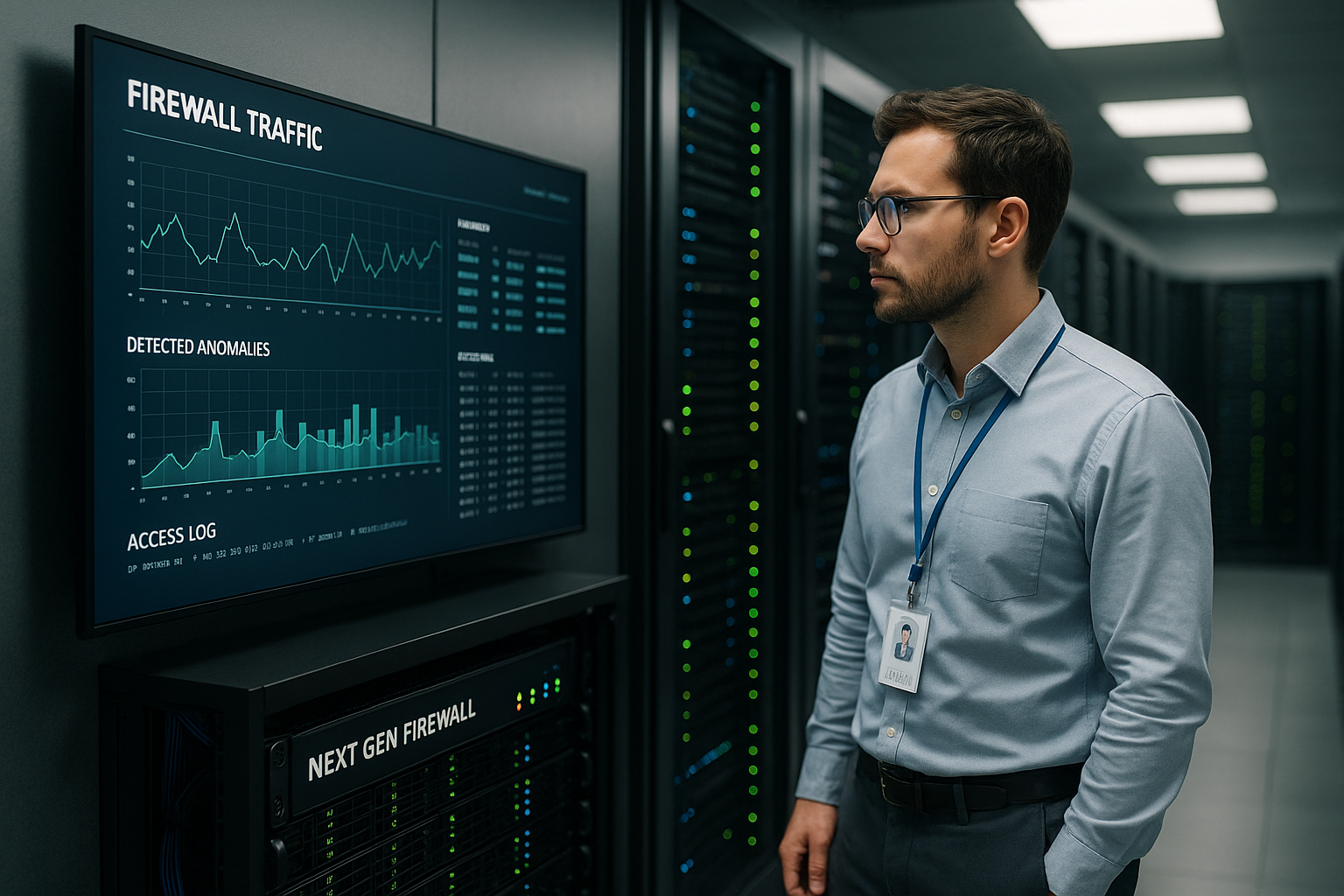
I want to know which customers, services and files are currently passing through the lines in order to limit risks immediately and Error to avoid. NGFW dashboards show live who is talking to whom, which app categories are running and where anomalies are occurring. This allows me to identify insecure plug-ins, outdated protocols and atypical data volumes. I specifically block risky functions without shutting down entire ports. As a result, services remain accessible and attack surfaces shrink.
I use segmentation for multi-tenant environments. Each customer zone has its own policies, logs and alarms. I prune lateral movements with micro-segmentation between web, app and database. I keep clean logs and maintain a high level of traceability. This results in more Control for operators and projects.

Efficient protection for customers and projects
What counts with managed hosting is that security rules apply close to the application and Risks stop early. I link policies to workloads, labels or namespaces so that changes take effect automatically. For popular CMSs, I block known gateways and monitor uploads. An additional block protects WordPress instances: A WAF for WordPress complements the NGFW and intercepts typical web attacks. Together they form a robust line of defense.
Multi-client capability separates customer data, logs and alerts without bloating the administration. I regulate access via SSO, MFA and roles so that only authorized persons make changes. I adhere to data protection requirements with clear guidelines that limit sensitive data flows. At the same time, I closely monitor email, APIs and admin interfaces. This takes the pressure off teams and protects Projects consistent.
Compliance, data protection and auditability
Companies require comprehensible protocols, clearly defined guidelines and Alarms in real time. NGFWs provide structured logs that I export for audits and correlate with SIEM solutions. Data loss prevention rules restrict sensitive content to permitted channels. I ensure that personal data only flows in approved zones. This is how I document compliance without wasting time.
A modern security model strictly separates trust and checks every request. I strengthen this principle with identity-based rules, micro-segmentation and continuous verification. For the strategic setup, it is worth taking a look at a Zero trust strategy. This allows me to create traceable paths with clear responsibilities. This reduces Attack surfaces noticeable.

Cloud, container and multi-cloud
Web hosting is moving to VMs, containers and functions, so I need Protection beyond fixed perimeters. NGFWs run as an appliance, virtually or cloud-native and secure workloads where they arise. I analyze east-west traffic between services, not just north-south at the edge. Policies follow workloads dynamically as they are scaled or moved. This keeps security in line with the architecture.
Service mesh and API gateways complete the picture, but without layer 7 insight from the NGFW, gaps remain open. I link tags and metadata from orchestration tools with guidelines. Segmentation is not created statically, but as a logical separation along apps and data. This increases efficiency without Flexibility to lose. Deployments run securely and quickly.
Changing protocols: HTTP/3, QUIC and encrypted DNS
Modern protocols move detection and control to encrypted layers. HTTP/3 on QUIC uses UDP, encrypts early and bypasses some TCP approximations. I make sure the NGFW can identify QUIC/HTTP-3 and downgrade to HTTP/2 if needed. Strict ALPN and TLS version requirements prevent downgrade attacks. I set clear DNS policies for DoH/DoT: I either allow defined resolvers or force internal DNS via captive rules. I take SNI, ECH and ESNI into account in the policies so that visibility and data protection remain in balance. This allows me to maintain control, even though more traffic is encrypted and port-agnostic.
Classic vs. next-gen: direct comparison
A look at functions helps to make decisions and Priorities to set. Traditional firewalls check addresses, ports and protocols. NGFWs look at content, record applications and use threat intelligence. I block specifically instead of blocking broadly. The following table briefly summarizes the core differences.
| Criterion | Classic firewall | Next-Gen Firewall |
|---|---|---|
| Control/detection | IP, ports, protocols | DPI, applications, user context, threat feeds |
| Scope of protection | Simple, familiar patterns | Hidden, new and targeted attacks |
| Defense | Signature emphasized | Signatures plus behavior, real-time blocking |
| Cloud/SaaS connection | Rather limited | Seamless integration, multi-cloud capable |
| Administration | Local, manual | Centralized, often automated |
I measure decisions in terms of actual risk, operating expenses and Performance. NGFWs offer the more versatile tools here. Configured correctly, they reduce false alarms and save time. The advantages become apparent very quickly in day-to-day business. Those who know applications protect them more specifically.
Understanding evasion techniques and hardening policies
Attackers use protocol special cases and obfuscation. I harden policies against:
- Fragmentation and reassembly tricks (deviating MTUs, out-of-order segments)
- HTTP/2 and HTTP/3 smogging, header obfuscation and transfer encoding abuse
- Tunneling via legitimate channels (DNS, WebSockets, SSH via 443)
- Domain fronting and SNI mismatch, atypical JA3/JA4 fingerprints
I take countermeasures with protocol normalization, strict RFC compliance, stream reassembly, TLS minimum versions and fingerprint analyses. Anomaly-based rules mark deviations from the known basic behavior; this is the only way I can catch creative evasions beyond classic signatures.
Requirements and best practice in hosting
I rely on clear rules per client, zone and service so that Separation takes effect at all times. I define policies close to the application and document them clearly. I automatically install updates for signatures and detection models. I secure change windows and rollback plans so that adaptations run without risk. This keeps operations predictable and secure.
At high data rates, architecture determines latency and throughput. I scale horizontally, use accelerators and distribute the load across several nodes. Caching and by-pass rules for non-critical data reduce effort. At the same time, I keep a close eye on critical paths. This balances Performance and security.
High availability and maintenance without downtime
Web hosting needs continuous availability. I plan HA topologies to match the load:
- Active/passive with state sync for deterministic failover
- Active/Active with ECMP and consistent hashing for elastic scaling
- Cluster with central control plane management for large numbers of clients
Stateful services require reliable session takeover. I test failover under load, check session pickup, NAT state and keepalives. In-service software upgrades (ISSU), connection draining and rolling updates reduce maintenance windows. Routing failover (VRRP/BGP) and precise health checks prevent flaps. This means that protection and throughput remain stable even during updates.

DDoS defense and performance tuning
Volume traffic quickly pushes any infrastructure to its limits, so I plan relief shifts and Filter early on. An NGFW alone is rarely sufficient for massive currents, so I add upstream protection mechanisms. A practical overview can be found in the guide to the DDoS protection for hosting environments. Rate limits, SYN cookies and clean anycast strategies help with this. This keeps systems available while the NGFW detects targeted attacks.
TLS offload, session reuse and intelligent exceptions reduce overhead. I prioritize critical services and regulate less important flows. Telemetry shows me bottlenecks before users notice them. From this, I derive optimizations without weakening protection. That keeps Response times low.
Integration: steps, pitfalls and tips
I start by taking stock: which apps are running, who is accessing them, where are the Data? Then I define zones, clients and identities. I import existing rules and map them to applications, not just ports. A shadow run in monitor mode uncovers unexpected dependencies. Only then do I gradually activate blocking policies.
I activate TLS inspection selectively so that data protection and operational requirements fit. I make exceptions for banking, healthcare services or sensitive tools. I create identity and device bindings via SSO, MFA and certificates. I route logging to a central system and define clear alarms. I react quickly with playbooks and uniform to incidents.
SIEM, SOAR and ticket integration
I stream logs structured (JSON, CEF/LEEF) into a SIEM and correlate them with endpoint, IAM and cloud telemetry. Mappings to MITRE ATT&CK facilitate categorization. Automated playbooks in SOAR systems block suspicious IPs, isolate workloads or invalidate tokens - and open tickets in ITSM at the same time. I keep escalation paths clear, define threshold values per client and document reactions. In this way, I shorten MTTR without risking a proliferation of manual ad hoc interventions.
Pragmatically assess cost framework and license models
I plan operating expenses realistically instead of just looking at acquisition costs and lose Support not out of sight. Licenses differ according to throughput, functions and runtime. Add-ons such as sandboxing, advanced threat protection or cloud management cost extra. I compare Opex models with dedicated hardware so that the math is right. The decisive factor remains avoiding expensive downtime - in the end, this often saves significantly more than license fees of a few hundred euros a month.
For growing projects, I choose models that keep pace with data and clients. I keep reserves ready and test peak loads in advance. I check contract terms for upgrade paths and SLA response times. Transparent metrics make evaluation easier. This way Budget manageable and protection scalable.
Certificate management and GDPR-compliant TLS inspection
Decryption needs clean key and rights management. I work with internal CAs, ACME workflows and, where necessary, HSM/KMS for key protection. For forward proxy inspection, I distribute CA certificates in a controlled manner and document exceptions (pinned apps, banking, healthcare services). GDPR-compliant means for me:
- Clear legal basis, purpose limitation and minimal access to personal content
- Role and rights concept for decryption, dual control principle for approvals
- Selective bypass rules and category filters instead of full decryption „on suspicion“
- Logging with retention periods, pseudonymization where possible
I regularly check certificate expiry times, revocation and OCSP stapling. This keeps TLS inspection effective, legally compliant and operationally manageable.
Targeted control of API and bot traffic
APIs are the backbone of modern hosting setups. I link NGFW rules to API characteristics: mTLS, token validity, header integrity, allowed methods and paths. Schema validation and rate limiting per client/token make abuse more difficult. I slow down bot traffic with behavior-based detections, device fingerprints and challenges - coordinated with the WAF so that legitimate crawlers are not blocked. This keeps interfaces resilient without disrupting business processes.
KPIs, false alarm tuning and rule life cycle
I measure success with tangible key figures: True/false positive rate, mean time to detect/respond, policies enforced per zone, TLS handshake times, utilization per engine and dropped packet reasons. I derive tuning from this:
- Rule sequence and object grouping for quick evaluation
- Exceptions precise instead of global; simulation/monitor phase before enforcement
- Quarterly policy reviews with remove-or-improve decisions
- Base lines per client so that deviations can be reliably identified
A defined control life cycle prevents drift: design, testing, staggered activation, remeasurement, documentation. This keeps the NGFW lean, fast and effective.

Brief practical check: three hosting scenarios
Shared hosting: I clearly separate customer networks, limit lateral connections and set Policies per zone. Application Control blocks risky plug-ins, while IDS/IPS stops exploit patterns. I use TLS inspection selectively where legally possible. Logging per client ensures transparency. This keeps a shared cluster safe to use.
Managed Cloud: Workloads migrate frequently, so I bind rules to labels and metadata. I tightly secure east-west traffic between microservices and APIs. Sandboxing checks suspicious files in isolated environments. Threat feeds deliver fresh detections without delay. This keeps Deployments agile and protected.
Enterprise email and web: I control file uploads, links and API calls. DLP slows down unwanted data outflows. Email gateways and NGFWs work hand in hand. I keep policies simple and enforceable. This lowers Risk in everyday communication.
Briefly summarized
Next-gen firewalls close the gaps left open by old filters because they consistently take applications, content and identities into account and Context deliver. I achieve real visibility, targeted control and rapid response to new patterns. Anyone who operates web hosting benefits from segmentation, automation and centralized management. In combination with WAF, DDoS mitigation and zero trust, a sustainable security concept is created. This keeps services accessible, data protected and teams able to act - without blind spots in traffic.