Skip to content
I use the latest on-page SEO techniques to boost my visibility in the 2025 search results, increase user interaction and optimize my content specifically for search engines and people. In this guide, I'll show you all the proven components I use to make a website future-proof in terms of technology, structure and content.
Three technical basics that every modern website needs
Whether you're a freelancer, start-up or club - a website can be created quickly. But so that it also really worksthere are a few technical basics that are often overlooked or underestimated. In this article, we explain briefly and clearly what really matters when it comes to domains, email and encryption - even without an IT background.
1. your own domain - your digital brand name
Your own domain is more than just a web address. It makes your project findable, professional - and trustworthy. Who wants to understand, how domains work technicallywill find a compact introduction here.
2. professional email addresses - instead of Gmail senders
If you want to be taken seriously in business, you shouldn't start with [email protected] appear. An e-mail under your own domain shows reliability. Here's how to set it up in 5 minutes.
3. HTTPS - protection, trust & ranking advantage
Google prefers HTTPS. Modern browsers warn of insecure sites. And users only trust websites with a "lock symbol". Why SSL certificates are not an option in 2025, but standardexplains this article.
Key points
- Keyword strategy and analyze search intent
- Meta tags Update regularly with focus keywords
- Structured data Use for better visibility
- Mobile performance and continuously improve loading times
- Internal linking Place user-friendly in the content
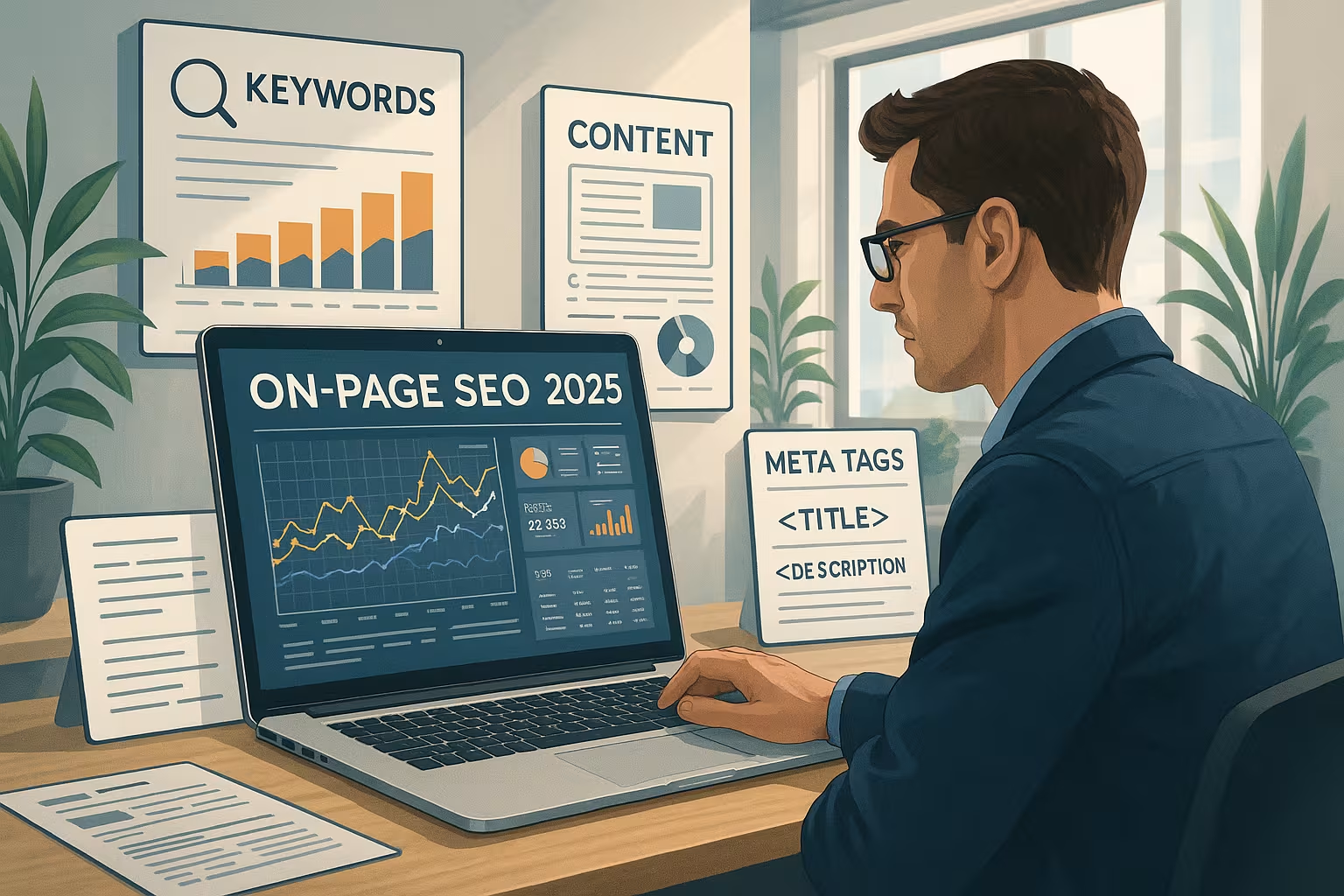
Basics: What on-page SEO must achieve in 2025
On my website, I optimize content not only for search engines, but also for real users. On-page SEO means optimizing text, code and structural features in such a way that Google can understand content logically and users can consume it intuitively. This includes keywords, meta tags, titles, media, loading times and technical standards.
In 2025, the focus will be on user-friendliness, an up-to-date content strategy and a semantically clear structure. Each section must deliver added value and precisely reflect the needs of the target group. Without relevant on-page measures, websites miss out on their potential rankings - often despite good off-page optimization.
Competition is intensifying as Google increasingly judges content according to E-E-A-T: Experience, expertise, authority and trustworthiness. High-quality optimization creates trust and visibility.
There is also a greater focus on the holistic user experience, so that the Core Web Vitals - such as Largest Contentful Paint (LCP), First Input Delay (FID) and Cumulative Layout Shift (CLS) - are of central importance. I regularly check how smoothly the page load runs on different end devices and minimize potential shifts in layout elements. This is because a bumpy or delayed display leads to dissatisfaction and increasing bounce rates.
At the same time, I pay attention to a structured content organization in order to arrange my posts logically by topic. In doing so, I use Topic Cluster in which a main article deals with a central topic and is linked to suitable subtopics via internal links. This approach not only strengthens the internal linking, but also helps Google to better understand connections within my niche.
Use keyword strategy & search intent correctly
I start every content optimization with a thorough keyword research. I strategically combine short-tail, mid-tail and long-tail keywords and link them to the actual search intention of the user. Placement takes place in the headlines (H1-H3), meta tags and in the introductory and concluding content areas.
Important: I take care not to stuff keywords indiscriminately, but to integrate them sensibly into the flow of the text. This significantly improves both relevance and readability. In order to take seasonal fluctuations into account, I regularly adapt keywords to changes in search behavior.
I have found a particularly helpful tool for the further development of my keyword strategy at SEO strategies for better rankings It offers me new insights on a regular basis.
Adequate consideration of search intent also means that I cover different types of intent: informational, transactional and navigational. For important money keywords that indicate an intention to buy, I ensure clear calls-to-action and a clear presentation of my offers. For purely informational keywords, the focus is on depth of detail and added value so that the user feels comprehensively advised.
In addition to the classic text form, it makes sense for some search queries to use voice query offer optimized content. By answering potential questions in conversational form, I increase the chances of my page appearing in voice assistant results. This is particularly beneficial for long-tail keywords that are pronounced in full sentence structure.
Content quality as a ranking factor
Relevant content remains my strongest wild card among the on-page factors. I write texts that specifically solve my users' problems. It's not just about text length, but about depth of contentstructure, readability and seriousness. Google recognizes whether a text merely wants to list keywords or offers real added value.
I structure paragraphs clearly, use lists only where they support readability and pay attention to clear subheadings (H2 and H3). Since expertise counts for Google, I state my technical expertise or cite reference knowledge without overloading the presentation.
I update content regularly - at least once a quarter. I revise paragraphs that don't work. I also assign new meta descriptions if the thematic focus changes.
In addition to pure text, I also investigate whether users might want other content formats. If my target group likes to watch videos, the inclusion of short explanatory clips or interviews can be a decisive advantage. In addition, infographics, diagrams or checklists can loosen up the flow of reading and increase comprehensibility. Whitepapers or e-books are ideal for more in-depth topics.
The Readability I use tools that provide me with Flesch values or other key figures. I keep the text easily accessible by using uncomplicated sentence structure and avoiding superfluous technical terms. I don't lose sight of complex topics - I simply explain them in a way that an interested user can follow. After all, a good user experience also has a positive effect on the length of stay and the ranking.
Meta tags, featured snippets & structured data
Title and meta description are among my direct click impulses in the SERPs. That's why I always design titles so that the main keyword is as prominent as possible. I also pay attention to Clarity and call to action in the description.
I also work with structured data via Schema.org. This increases the chance of rich snippets, such as FAQ displays or rating stars. This visual enhancement measurably increases the click rate.
I regularly check my pages with tools such as the Rich Results Test Suite to check structured data for validity. I rectify incorrect markup promptly. I also prepare special content as FAQ markup or how-to to maximize visibility.
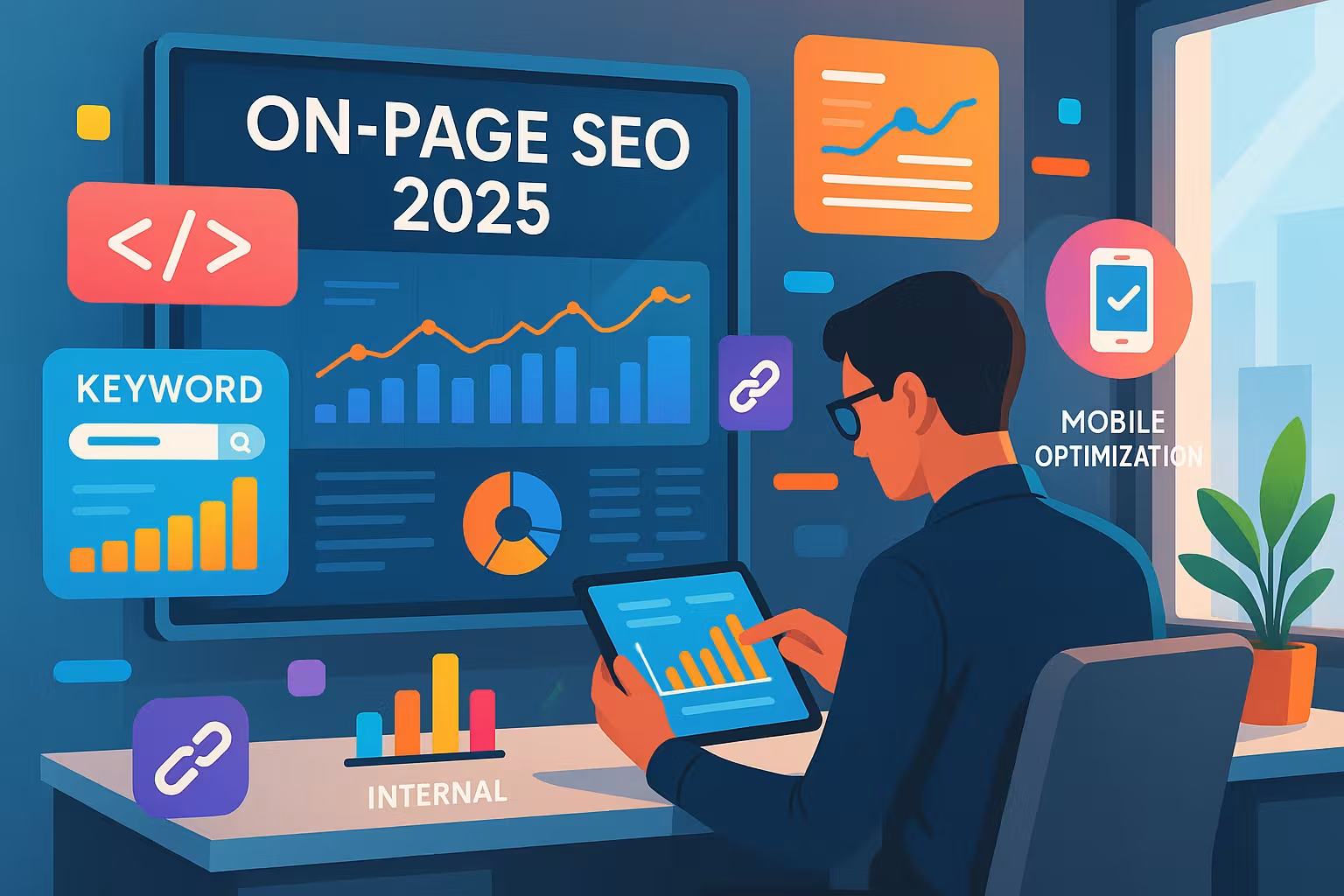
So-called Featured Snippets and the position "0" in the search results. To be considered for a featured snippet, I answer questions as concisely as possible in a separate paragraph or via a list structure. A defined definition of terms, a short summary or an introductory sentence with a clear reference to the search query can already help to be favored by Google.
In addition to classic FAQs, I make sure to mark up data such as prices, events or recipes using recognized schema markup - depending on the content of my site. Company data such as address, opening hours and contact details also benefit from localBusiness markup in order to improve findability in local search results to improve. Consistent information across all channels - from your own website to Google My Business - increases the trust of search engines and users alike.
Do not underestimate images, file formats and alt tags
Images can generate extreme traffic - provided they are optimally delivered. I name files appropriately (e.g. on-page-seo-leitfaden-2025.webp) and always use alt texts with keyword references. I reduce the image size on the server side to less than 200 KB and use modern formats such as WebP.
The visual structure of the page has a direct impact on the UX. I pay attention to balanced text-to-image ratios and use graphics in a targeted manner to make content easier to grasp. If a lot of images are loaded, I use lazy loading and activate browser caching.
For WordPress, the article offers Make WordPress faster a collection of effective techniques for image compression and performance boost.
Images are also essential when I am linked to on social media platforms. With suitable Og:image tags and descriptive alt texts, I can generate appealing previews when sharing on social networks. Especially with regard to Visual search (e.g. via Google Lens), correct image optimization is an additional ranking factor. Users searching for specific objects or product categories will find my content more quickly.
Another optimization option is the integration of icons or symbols as SVG files, as these are usually smaller and scalable without any loss of quality. In this way, I benefit from shorter loading times and improve the aesthetics of the website at the same time.
Mobile usability & loading time as a basis for ranking
PageSpeed is directly relevant for ranking in the Google index. I optimize my code (HTML, CSS, JS), introduce structured caching and eliminate unnecessary plugins. I compress images on the server side and prioritize essential content via Lazy Loading.
Mobile users now account for over 65 % of my traffic. That's why responsive design is not an option, but a must. I fix buttons on touch surfaces, load menus only when needed and design all interactive elements to be finger-friendly.
I regularly measure the loading time with Google Pagespeed Insights. I give priority to optimizing pages with scores below 80, as a delay of just a few seconds in loading time can double bounce rates.
In addition, I also great importance to user guidance. For mobile devices, I adjust my headline lengths and avoid pop-ups that obscure the content. Instead, I use subtle methods such as appealing banners or sticky footers to place important information without disrupting the reading flow.
I reduce scripts and CSS files by either minifying them or delivering them via a content delivery network (CDN). This allows my content to reach the end device faster and ensures an all-round pleasant user experience that Google rates positively. Efficiency is the key to success, especially with limited mobile data connections.
As part of the Core Web Vitals I specifically check that my fonts load quickly and that no Flash of Unstyled Text (FOUT) occurs. Pleasant typography and fast response times increase user satisfaction and signal to Google that my site is working properly.
Technical architecture and stable basic structure
A technically correct website makes crawling easier and strengthens the trust of search engines. I keep the source code lean, forward incorrect URLs cleanly via 301 and use consistent HTTPS encryption. An error-free XML sitemap speeds up indexing.
I also pay attention to high-performance servers when hosting. The following table shows how providers compare:
| Provider | Performance | Price-performance | Support | Recommendation |
|---|---|---|---|---|
| webhoster.de | 1,0 | 1,1 | 1,0 | Test winner |
| Provider X | 1,3 | 1,4 | 1,4 | |
| Provider Y | 1,5 | 1,6 | 1,6 |
If you want to save money here, you are saving SEO potential. A detailed overview of which hosters are also worthwhile for the ranking can be found at SEO hosting comparison.
The technical architecture also means that I adhere to clear URL structures. I use relevant keywords in the URL, avoid superfluous parameters and keep the path depth as low as possible. I use canonical tags to prevent duplicate content by referring Google to the primary version of a page. It is also recommended for extensive projects, Log file analysis to see how Googlebot actually accesses my structure and whether certain areas may be omitted or run through several times.
I also attach great importance to a clean information architecture that guides users and bots alike through the site. A well-structured main menu item, under which subpages are thematically bundled, optimizes the navigation logic. This helps both the user to find their way around and the search engine to crawl the site. I provide error pages with a user-friendly 404 template that politely directs the visitor to the most important areas in order to reduce bounces.
Place internal links strategically
I use internal linking to connect topics and guide visitors through the website. lead. Each link in the body text not only supports navigation, but also crawling by bots. I choose anchor texts with thematic relevance.
Only relevant content is linked. I also regularly check whether linked pages have been deleted or changed. Faulty internal links significantly weaken SEO performance. A structured linking plan helps me to secure all nodes.
When building up Topic Clustering internal linking can be particularly effective. I define a main article (pillar content) that deals comprehensively with the core topic. I then create cluster articles that expand on individual aspects and link back to the main page. This method signals to search engines that I cover a topic holistically and increases the authority for this focus.
I also check how visitors move through my site. With the help of heat maps and click analyses, I find out which links are clicked on particularly frequently and where there may be potential to direct users to further content. This allows me to increase the conversion rate by offering targeted cross-selling or thematic additions.
Summary: Regularity results in rankings
On-page SEO in 2025 is made up of over 10 core factors - from keyword strategy and semantics to technology. No measure works in isolation, but in combination. I continuously adapt content, meta texts and image formats to the current standard and ensure technical stability.
A good host, fast loading times and regularly checked content not only secure rankings - they also make websites more successful. If you adjust all relevant levers once a quarter, you will always be one step ahead of algorithm changes.
It is also worth keeping an eye on new search functions and trends. Voice Search and image search are continuing to develop, meaning that precisely tailored formatting will become even more important in the future. Dynamic content such as interactive graphics or augmented reality elements could also become more relevant. The aim remains to focus on the user - if my content and technology answer a question better than the competition, Google will ultimately reward this.
To remain successful in the long term, I combine on-page optimization with clear goals: Increasing dwell time, reducing the bounce rate and promoting engagement signals such as comments or shares. Every optimization I implement should be based on real problems or needs of my target group. This not only improves my rankings, but also the bond between user and website.
This also gives me more TrustVisitors automatically associate a high-quality presentation, reliable information and a fast website with competence and credibility. This effect is reinforced when I actively respond to opinions and incorporate feedback. In this way, I create a lively environment in which search engines can measure numerous positive user signals.
Ultimately, on-page SEO 2025 is not a one-off action, but an ongoing process. Those who regularly take the time to modernize content as well as review technology and structure will remain competitive in an evolving digital landscape. By constantly reacting to the latest developments and focusing on the needs of users, I am well equipped for sustainable success.