Skip to content
I compare on-premise and cloud hosting along costs, security, scaling and compliance so that your company makes a sound decision. Based on clear criteria and typical IT scenarios, I will show you when local servers offer advantages and when the cloud is the better option from an economic and organizational perspective. Option represents.
Key points
- Control vs. flexibility: On-premise offers maximum sovereignty, the cloud scores with dynamism.
- Cost modelCapex for on-premise, opex and pay-as-you-go in the cloud.
- ScalingHardware-bound locally, almost immediately in the cloud.
- ComplianceFull data sovereignty locally, check EU locations in the cloud.
- OperationOwn IT team locally, provider services in the cloud.

On-premise hosting briefly explained
With on-premise hosting, you operate the server, storage and network in-house and therefore retain full control over the Control. You determine hardware generations, security measures, network segmentation and admin rights without being dependent on the provider. This sovereignty helps to implement strict specifications from the financial, healthcare or industrial environment. At the same time, you are responsible for procurement, operation, patching, monitoring and troubleshooting. I see on-premise as strong when legacy applications, strict compliance and special integration requirements come together and you have an experienced IT team have.
Cloud hosting to the point
Cloud hosting provides computing power, storage and services from distributed data centers that you can use as needed and bill to the minute - ideal for fluctuating demand. Loads. You scale resources in real time, benefit from global locations, automatic updates and managed security. This relieves the burden on internal IT and noticeably shortens project runtimes. At the same time, I always check data protection, data locations, contractual clauses and exit strategies to minimize lock-in risks. For dynamic workloads, remote teams and fast product cycles, the cloud provides a very efficient solution. agile Base.
Decision factors: costs, scaling, operation
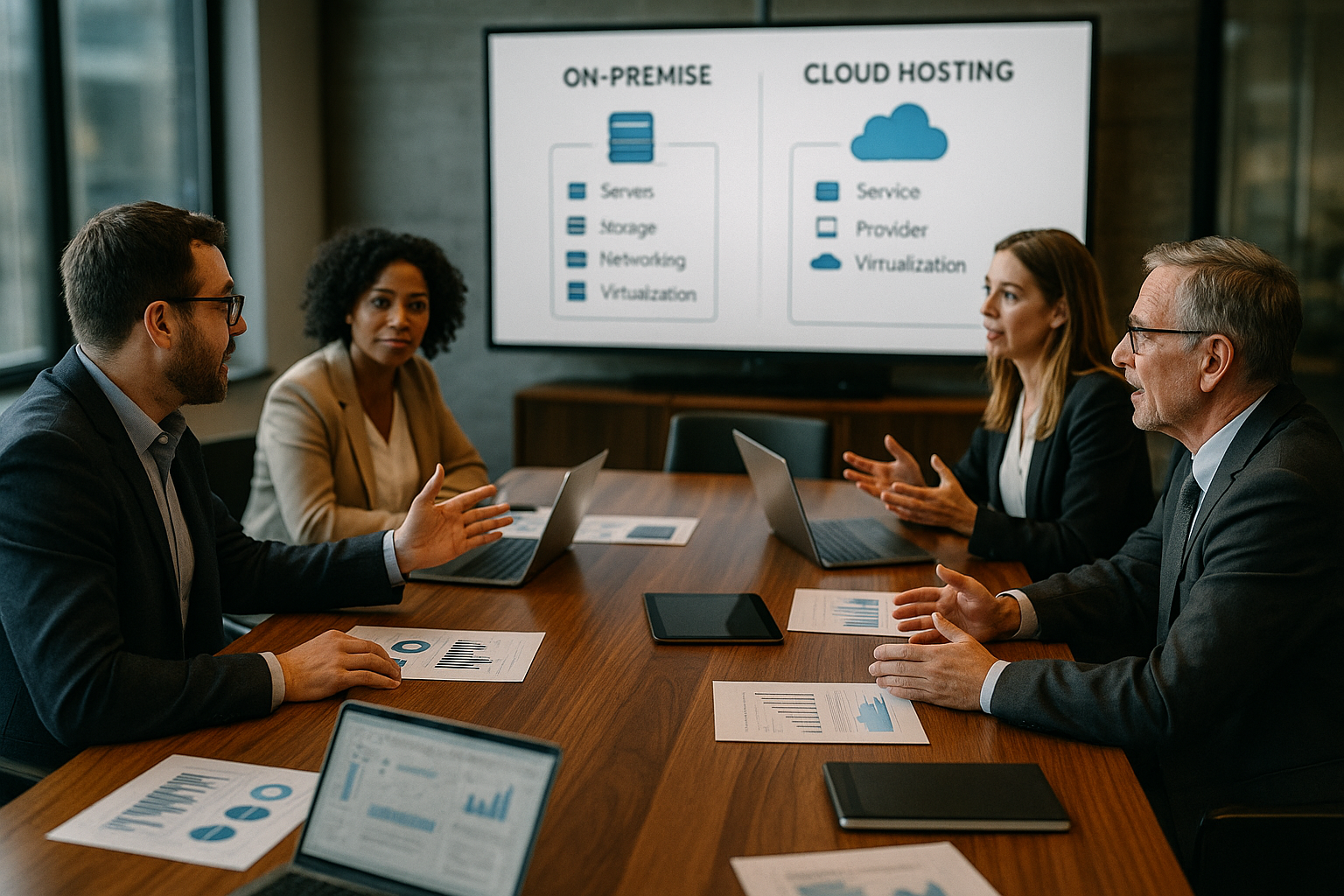
I first evaluate the cost profile: on-premise ties up capital in hardware and licenses, cloud converts expenses into ongoing costs. Opex around. Then I look at scaling - local systems grow with hardware, cloud environments expand at the click of a mouse. The following applies to operation: on-premise requires internal expertise for updates, backups and hardening; in the cloud, the provider takes care of this. For migration projects, I also check data volumes, latency paths, dependencies and test windows. For a detailed comparison, see the Hosting comparison practical orientation and clear decision-making aids that I like to refer to.
Direct comparison: on-premise vs. cloud at a glance
The following table summarizes the most important criteria that I regularly evaluate in projects; it shows strengths, limitations and typical application patterns of both Models. It is no substitute for an individual business analysis, but it does help you to conduct targeted discussions with management, IT and specialist departments. When reading, pay attention to which line has the greatest leverage for your route planning: Cost, security, availability or compliance. I often derive a shortlist from the table and test two to three candidates in a narrowly defined Pilot phase. This allows the theory to be quickly compared with real load profiles and translated into reliable decisions.
| Criterion | On-Premise Hosting | cloud hosting |
|---|---|---|
| Cost structure | One-off investment, maintenance can be planned later | Pay-as-you-go, variable usage costs |
| Scalability | Hardware-bound, with lead times | Immediate, automatable via API |
| Operation & maintenance | Own team, full responsibility | Provider takes over updates and patches |
| Security | Full sovereignty, deep hardening possible | Modern security stacks, split model |
| Compliance | Data sovereignty can be implemented internally | EU regions selectable, contract review necessary |
| Availability | Dependent on own redundancy | High uptime thanks to multi-zone operation |
| Updates | Manually or via tooling | Automated by the provider |
| Access | Rather local, VPN for external | Available worldwide, mobile use |
Security, data protection and compliance
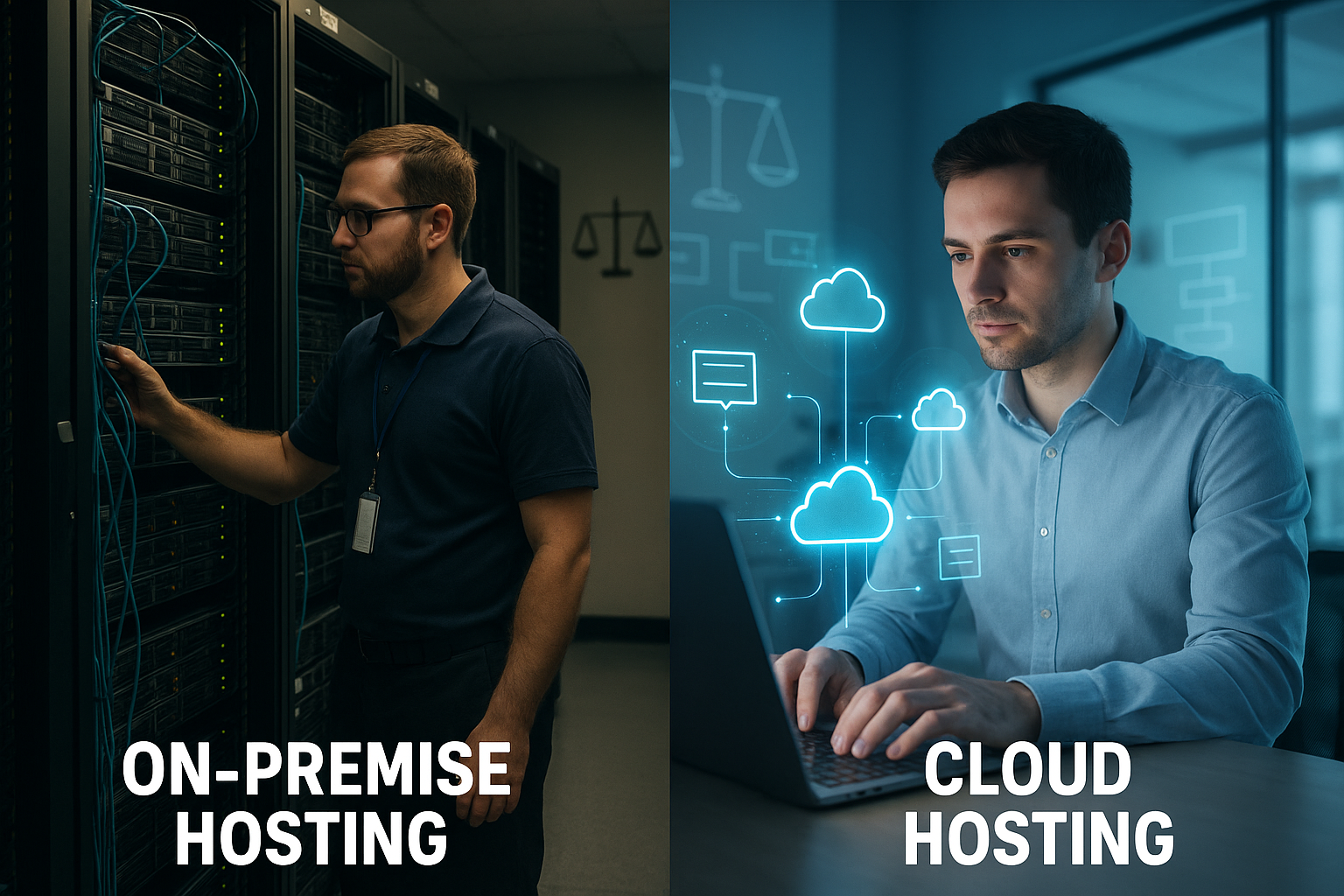
For sensitive data, I set clear policies, graduated rights and regular updates. Audits regardless of the hosting model. On-premise enables fine-grained control down to rack, switch and service level, which is helpful for strictly regulated environments. In the cloud, I check regions, encryption, key management and logs in order to demonstrably fulfill data protection and audit security requirements. The exit strategy remains important: I define data export, API usage and retention periods before the start. With this foresight, compliance requirements can be met permanently, even in dynamic environments. comply.
Performance and SEO effects
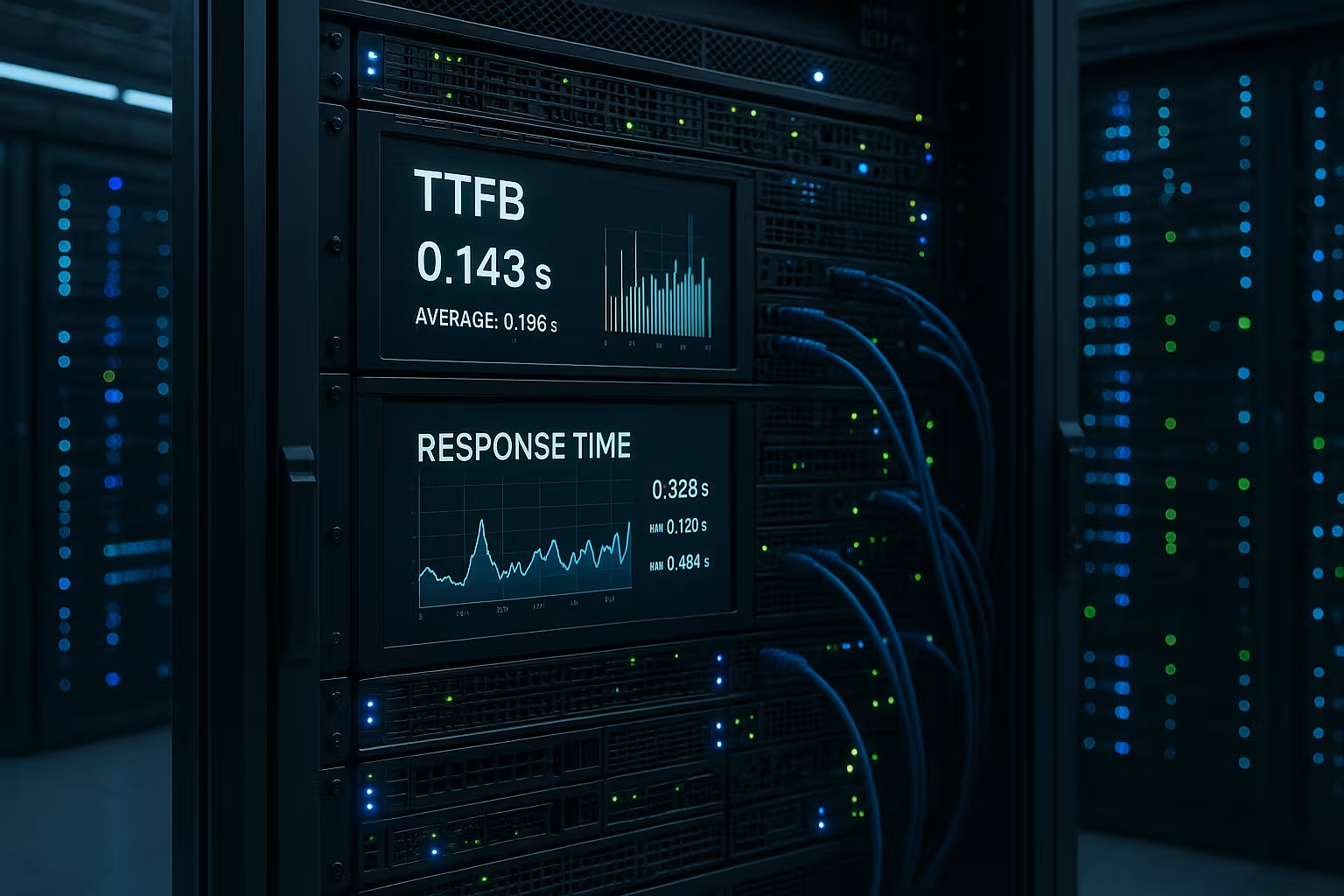
Speed has a direct impact on conversion, user experience and visibility, which is why I optimize latency, caching and CDN-targeted deployment. Cloud regions close to your target groups shorten distances, while on-premise impresses with a strong connection and clean tuning. For SEO, short time-to-first-byte, stable response times and low failure rates count. For high I/O requirements, I compare instance types, storage classes and network profiles very closely. For an in-depth look at hardware-related performance effects, see my reference to Bare metal vs. virtualized, which I use for critical workloads when every millisecond counts.
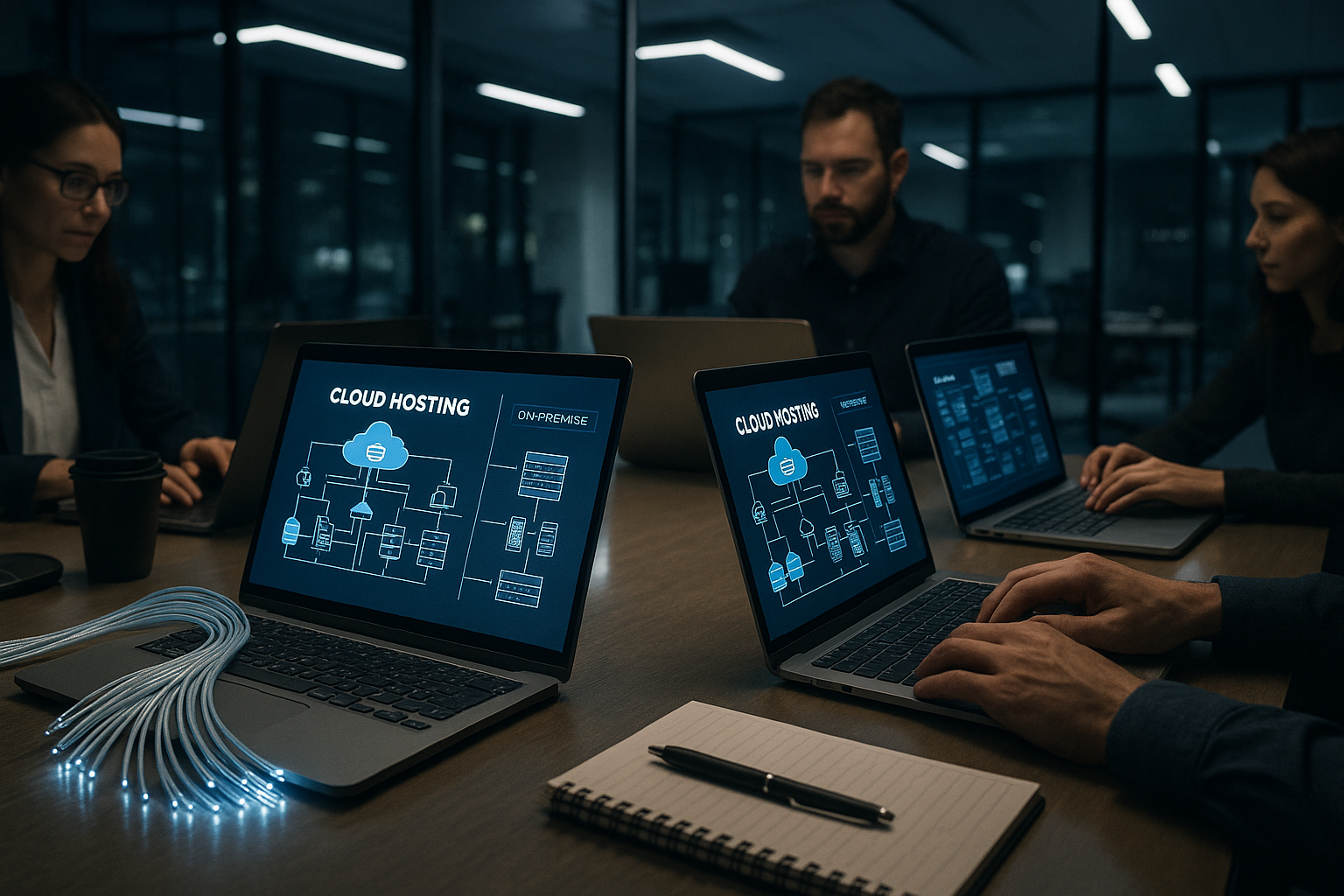
Cost planning: TCO, Opex vs. Capex
I separate capital expenditure for hardware (capex) from ongoing operating and license costs (opex) in order to keep the total costs clean. visible to make. On-premise can be more cost-effective over its useful life if capacity utilization is high and runtimes are long. Cloud is convincing when projects fluctuate, new products are launched or load peaks occur. I also take personnel, training, security tools and spare parts into account in financial planning. Only with a complete TCO calculation can a reliable statement be made as to which variant is the better option over three to five years. Economic efficiency offers.
Scaling and operating models
Planning determines efficiency: on-premise tends to scale in steps, cloud scales granularly and frequently automatically. Autoscaling, reservations and spot models reduce costs in the cloud, provided that monitoring and alerting work properly. Stability is achieved locally through redundancy, clustering and failover designs. For remote work, I check VPN, zero-trust models and identity-based access. In this way, I ensure that teams can access systems securely, quickly and reliably, regardless of location. access.

Hybrid models in practice
I often combine the best of both worlds: sensitive databases locally, scaling front ends and analyses in the Cloud. This means that critical assets remain under your own control, while dynamic workloads grow flexibly. The interface is crucial: Network, latency and data synchronization must be properly planned. For agencies and teams with project-related peaks Hybrid cloud hosting proved to be very effective. This set-up allows me to optimize costs, control and performance in a targeted manner. balance.
Decision tree: How to make the choice
I start with four questions: How sensitive is the data, how much does the load fluctuate, what budget is available in the short term and what expertise is available internally? If the answer is in favor of high compliance and constant workloads, I tend towards On-Premise. With fast releases, an international audience and unclear load profiles, the path leads to the cloud. I then substantiate the assumptions with a proof of concept and measure real key figures. Only then do I make a final decision and plan operation, monitoring and backup along clear SLAs.
Purchase criteria for provider selection
With cloud providers, I check location, transparency, support times, backup strategies and comprehensible SLAs. With on-premise, I count delivery times, maintenance contracts, spare parts logistics and energy efficiency. The competence of the team that will later operate the solution remains important. A clear migration and rollback plan reduces risks when switching between models. Among providers, webhoster.de stands out with its strong performance, good service and reliable Availability out.
Practical scenarios for orientation
E-commerce with seasonal peaks benefits greatly from elastic capacity in the Cloud. Manufacturing companies with store floor integration and legacy PLC systems often stay closer to on-premise. Startups with a rapid product focus go to the cloud and save time during setup. Authorities and regulated industries often choose hybrid to maintain governance while operating innovation parts in an agile way. These scenarios show how I structure requirements and derive the hosting strategy that really works in day-to-day business. carries.
Migration strategy: step by step
I start migrations with a Inventoryapplications, data flows, dependencies, licenses and operating windows. I then classify workloads according to 6R patterns (rehost, replatform, refactor, retire, replace, retain) and assign them targets for cost, performance and Compliance to. I plan data migrations incrementally - first synchronization, then switching windows with clearly defined Rollback. For complex legacy systems, I rely on low-risk pilots, measure latency, throughput and error rates and adjust the design. Freeze phases, a communication plan for stakeholders and a change board that documents acceptances and go/no-go decisions are important.
Disaster recovery, backups and resilience
I define RTO/RPO targets per application and translate them into Topologieslocally with a second location, in the cloud via zones/regions. Backups follow the 3-2-1 rule with immutable copies and encrypted storage. I include regular restore tests in the operating calendar - for me, untested means non-existent. For critical systems, I plan warm or hot standbys, test failovers automatically and keep runbooks ready for incident response. In hybrid setups, I like to use the cloud as a DR target, to activate capacities only in an emergency and keep running costs low.
Cost control and FinOps in the cloud
Transparency is the lever: I lead Tagging standards allocate costs to jobs, products and teams and set budgets with alarms. Rightsizing, shutdown outside of business hours, lifecycle rules for storage and the selection of suitable reservation or spot models significantly reduce opex. I establish monthly cost reviews with product owners, compare forecasts with actual values and document deviations. Egress fees, dataGravity and Chatty services - this is often where the biggest surprises arise. I look at on-premise including energy, cooling, space, maintenance, contract terms and expenses for Personnel.
Minimize lock-in and increase portability
I rely on open formats, Infrastructure as Code and container orchestration to keep switching costs low. Standardized interfaces (e.g. object storage-compatible APIs), decoupled services and clear export paths for data form the basis of a resilient exit strategy. I use proprietary PaaS services specifically where their added value justifies the commitment; for core systems, I plan abstracted deployments that can be reproduced on other infrastructure. Regular Exit drills show whether documentation, scripts and data formats will work in an emergency.
Network, latency and secure connection
Network design often determines user experience and costs. I plan bandwidth, Latency paths and redundancies right from the start: VPNs or dedicated lines for site coupling, segmented networks with zero-trust principles for secure access, as well as DDoS and WAF protection in the right places. DNS, anycast and caching nodes help to speed up access. For hybrid architectures, I pay attention to NAT, IP address spaces, IPv6 capability and clean Firewall-policies. Measuring points at all transitions - edge, WAN, cloud gateway - make bottlenecks visible at an early stage.

Monitoring, observability and SRE
I establish observability with Metrics, logs and traces, define service level objectives (SLOs) and monitor error budgets. Central log and metrics pipelines, synthetic monitoring and alerting with clear escalations ensure operational stability. Runbooks and postmortems are mandatory - without apportioning blame, but with concrete measures. For security, events flow into a SIEM to detect anomalies and compliance violations at an early stage. The goal is reliable On-Call-organization that quickly classifies, prioritizes and sustainably resolves faults.
Sustainability and energy efficiency
I rate data centers according to PUE, energy sources and cooling concepts. In the cloud, I use provider metrics, schedule workloads where possible and reduce idle time through autoscaling. On-premise is more sustainable when utilization is high, hardware is modern and waste heat can be used. I don't just measure total kWh, but kWh per transaction/request - this makes efficiency tangible. Storage tiering, data archiving and dispensing with Overprovisioning help to measurably reduce footprints.
Licensing and manufacturer loyalty
Licenses strongly influence the choice of platform. I clarify BYOL-options, subscriptions versus perpetual, virtualization rights and audit obligations in advance. In clouds, vCPU/socket counting methods and license mobility play a role; on-premise, maintenance contracts, support levels and runtimes must be included in the TCO. I keep a clean license inventory, document mappings per workload and plan buffers for unexpected changes. Audit-requests.
Team, skills and company organization
Technology follows organization: I establish a Platform team, which is responsible for automation, security and cost control, and trains specialist teams in self-service workflows. GitOps, pull requests and automated tests make deployments reproducible. Security champions in the teams raise the basic level, while clear roles (owner, maintainer, on-call) create accountability. For regulated areas, I consider change processes auditfest, but slim enough not to slow down innovation.
Making decisions measurable: KPIs and key figures
Whether on-premise or in the cloud - I measure success based on a few clear KPIslead time, change frequency, proportion of failed changes, MTTR, availability level per SLO, costs per product/team as well as security and compliance hit rates. I also monitor user satisfaction (e.g. TTFB, Core Web Vitals) and budget adherence. These key figures are incorporated into quarterly reviews and guide roadmaps, investments and Optimizations.
Briefly summarized
I choose on-premise when sovereignty, compliance and specific integrations dominate, and rely on cloud when scaling, speed and freedom of location count - with hybrid as a bridge in between for balanced Strategies. If you want decision-making certainty, start with a narrowly defined pilot, measure load profiles, costs and risk and transfer the findings to regular operations in a controlled manner. With this approach, your IT remains controllable, transparent and future-proof. This allows you to utilize the strengths of both worlds without committing yourself too early. In the end, what counts is that your choice of hosting supports your business plan and delivers tangible benefits in day-to-day operations. Operation supplies.