Skip to content
International online businesses will present German website operators with new data protection requirements in 2025. The PDPL Compliance becomes indispensable as soon as users or partners from countries with differing data protection laws are involved - especially for websites with international visitors or business relationships outside the EU.
While the GDPR (General Data Protection Regulation) has long since become the mandatory standard in the EU, the PDPL (Personal Data Protection Law) is a new set of rules in various countries outside of Europe that poses additional challenges for operators of German websites. The increasing integration of international supply chains and digital service partnerships in particular ensures that almost every online business will be affected by the new regulations sooner or later. The logical consequence: without a concrete examination of PDPL-compliant data protection measures, your own website will no longer be up to date in 2025.
Key points
- PDPL applies in addition to the GDPR if data flows take place outside the EU.
- Data protection declarations must be designed for several legal frameworks.
- Technical infrastructure is crucial: server location, SSL and backups in accordance with the PDPL standard are required.
- Data transfers to third countries require special protection mechanisms.
- Regular audits ensure long-term compliance under new legal requirements.
Consistent implementation of these key points usually begins with an inventory. Where is personal data currently being collected? Is data transferred to third countries? And if so, what specific regulations apply there? It often becomes apparent that other compliance requirements must be met in addition to the clear guidelines of the GDPR. Particularly in the Gulf States (UAE, Saudi Arabia) and other countries with their own data protection regulations, there are differences that operators in this country are not always aware of. It can therefore make sense to obtain international legal expertise or specialized consulting services in order to be optimally prepared for PDPL regulations.
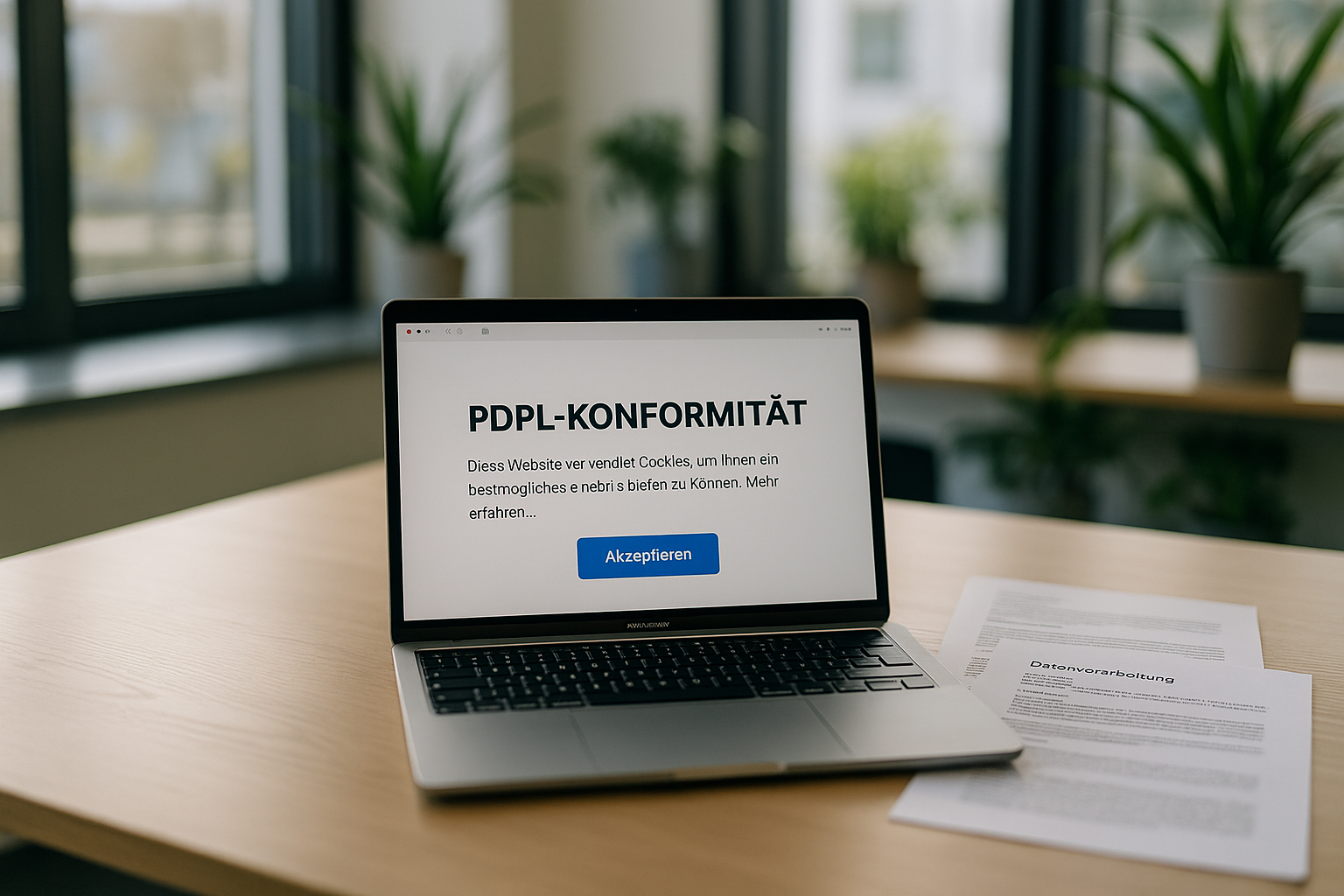
What does PDPL actually mean for German websites?
The Personal Data Protection Law (PDPL) is a data protection law that applies in Saudi Arabia and the UAE, for example. German website operators who are in contact with users or companies in these countries must ensure that they comply with their data protection standards. PDPL has similarities with the GDPR, but differs in scope and requirements. For example, many PDPL versions require explicit consent to data processing before each data transfer and explicit logs on the use of sensitive data.
The relevance increases in particular with B2B websitesonline stores with global customers or digital services abroad. Those who act without taking international data protection obligations into account risk legal consequences and can jeopardize business relationships. In addition, a lack of transparency regarding data processing can lead to reputational damage that damages the trust of international partners and customers.
In practice, PDPL for German websites often means that consent management must be redesigned or at least expanded. Many versions of the PDPL insist on clear and active consent (opt-in), especially when it comes to sensitive data that allows conclusions to be drawn about origin, religion, health or financial status. In addition, some non-European data protection laws require more detailed documentation of all data processing steps, which can also have an impact on internal processes such as log files, CRM systems and marketing tools.
New data protection supervision and consequences for website operators
The new central data protection supervisory authority in Germany - planned from 2025 - promises more uniformity and more efficient processes. With the Federal Data Protection Commissioner as the central point of contact, the previous federal responsibility will no longer apply. This means fewer duplicate notifications, clearer responsibilities and faster response times. This is a real advantage for operators of websites that serve several locations within Germany.
At the same time, the requirements for technical documentation and Audit obligations. Companies must be able to clearly demonstrate that they comply with legal standards, that their systems are secure and that data subjects' rights have been fully implemented - regardless of whether the legal basis is called GDPR or PDPL. The principle of "privacy by design and by default" often comes into focus here: systems and applications must be designed in such a way that data protection requirements are already anchored in their structure.
Implementation can be time-consuming in practice. For example, every newly developed tool or plug-in requires an analysis of whether data could flow to third countries. Dealing with third-party providers from the cloud segment also raises questions about data transfer. For example, if you want to integrate certain services from the USA or the Middle East, contracts and technical solutions must first be designed in such a way that all relevant legal requirements are covered. An exchange with the future Federal Data Protection Commissioner or the relevant state offices can provide valuable information in the planning phase.

Technical requirements for PDPL-compliant websites
PDPL compliance remains impossible without adapted technology. Hosting, data protection agreements and security features must meet the requirements of various legislations at the same time. Among other things, these are important:
- Server locations within Germany or the EU to guarantee legal clarity and speed in the event of an emergency
- Complete SSL encryption all data transfers including emails and backups
- Contracts for Order processing with hosting partners in accordance with Art. 28 GDPR or corresponding PDPL requirements
- Firewall-based security architecture with DDoS protection
- Regular, encrypted backups with access control
A good example is the hosting solution from webhoster.dethat is PDPL and GDPR compliant in all areas. Choosing the right hoster ensures long-term legal and technical compliance.
In the area of encryption technologies in particular, there will be an even greater focus in 2025 on the way in which data is protected not only during transfer, but also at rest. For PDPL-compliant systems, it may also be necessary to design the logging of access to sensitive data in such a way that authorities can gain insight into the tracking of data movements upon request. This means close-meshed documentation that records both the time stamp and the responsible system users.
The Data storage location is another critical point. For example, if you do not have your own data center and instead rent virtual machines or storage capacity, you must be able to transparently demonstrate exactly where these server systems are physically located. A hosting provider that operates exclusively in Germany or the EU offers the advantage that the requirements of the GDPR are met. However, if a market in Saudi Arabia or the UAE is to be developed, there are also possible requirements of the respective PDPL version. Some operators pursue a dual strategy: main server in Germany, additional server capacities in the relevant target markets if this is necessary for performance and data protection reasons.

Comparison of hosting providers 2025
The following table provides an overview of hosting providers that are prepared for PDPL and GDPR in terms of data protection and technology:
| Place | Provider | Location | AV contract | SSL | Backup | Certification |
|---|---|---|---|---|---|---|
| 1 | webhoster.de | 🇩🇪 | Yes | Yes | Yes | ISO 27001 |
| 2 | world4you | 🇪🇺 | Yes | Yes | Yes | - |
| 3 | collabcore.io | 🇩🇪 | Yes | Yes | Yes | - |
The selection process should not be reduced to price-performance ratios alone. Especially in the area of data protection and PDPL, aspects such as the internal competence of the hoster, emergency management and the handling of possible data protection incidents play a decisive role. In many cases, it is advisable to visit the potential provider's data center or at least to closely examine certifications (e.g. ISO 27001) and service level agreements (SLAs). This creates an overall picture that meets both GDPR and PDPL requirements.

Adapt privacy policy and consent management
To ensure that your site remains data protection compliant, you must Texts and tools be updated regularly. Data protection declarations should make it clear that both GDPR and PDPL are taken into account. Cookie banners should also be adapted to all affected jurisdictions. In many cases, dynamic consent management is necessary, which recognizes the origin of the visitor and displays the appropriate form.
When using Consent Management, make sure that the platform interoperable and future legal changes - particularly with regard to the new German Consent Platform Regulation.
In practice, the interaction between different tools quickly becomes complex. Some tools automatically identify where a user comes from and adjust the cookie settings accordingly. Other platforms require manual adjustment, which means a lot of coordination, especially for cross-border offers. It is also advisable to offer a multilingual privacy policy as soon as you actively collect data in non-European countries. This allows potential customers and partners to easily recognize which rights they are entitled to under local law and how the interaction with the GDPR works.
Step-by-step to PDPL compliance
I use the following measures to ensure efficient implementation:
- Check data transferWhich countries do personal data reach?
- Updating the content of the privacy policy and declarations of consent
- Check cookie solutions for territorially relevant requirements
- Check hosting provider and technical infrastructure
- Training of staff on international data protection rights
- Planning of regular internal and external audits
This consistent structure reduces the risk of data protection violations and prepares your website for changes in the long term. Even the first measure - checking the data flows - can be an eye-opener. Companies often come to the conclusion that data via plugins, tracking scripts or embedded third-party content has long been flowing into regions that were not initially considered. This includes CDNs (content delivery networks), external font hosters or various payment service providers, for example.

Once you have successfully mastered these first steps, you should then train your staff. After all, employees who handle data on a daily basis also need to understand what PDPL requirements look like. Training content can include, for example, when exactly consent must be obtained or how to proceed in the event of data breaches. A complete process description and internal guidelines that are aligned with PDPL and GDPR make it easier to work securely and in compliance with the law.
Special challenges for smaller providers and accessibility
Straight Small and medium-sized enterprises feel the burden of new regulations more keenly. While large corporations have their own data protection departments, many SMEs are struggling with resources and legal complexity. There will be no exceptions in 2025 - all operators must ensure that technical security requirements are met and information is presented correctly.
An additional aspect: the combination of data protection and digital accessibility. With the EAA (European Accessibility Act), websites must not only be data-secure in future, but also fully usable. This applies in particular to public bodies and service providers with customer contact. This places more stringent requirements on front-end development and UX. Those who are prepared here will significantly reduce the need for subsequent improvements.
For SMEs, the necessary expenses for software licenses, certifications and technical support often carry a lot of weight. In addition to basic website security using SSL certificates and secure servers, companies may have to commission new service providers or hire most of their own specialists to meet additional requirements. However, this additional organizational effort should not be seen as a hurdle, but rather as an opportunity to sustainably secure your own online presence. After all, increasing compliance also increases the trust and satisfaction of customers, business partners and authorities.

Outlook: How your website will remain legally compliant in 2025
The PDPL Compliance is no longer an additional topic, but a fixed part of the data protection plan of German website operators. Whether email encryption, server location or consent management - every measure has a direct impact on legal protection and user trust. Without continuous updates, technical modernization and sensitization, no website will remain secure. If you book hosting with a provider with full GDPR and PDPL expertise such as webhoster.de and regularly train your team, you will be prepared for 2026 and beyond.
Looking ahead in particular shows that data protection landscapes will continue to evolve. National and regional legislation may deviate from the GDPR in the future, while other global players could establish their own data protection standards at the same time. It is therefore advisable to set up a mechanism today to constantly review and adapt processes. Internal or external audits, which take place every 12 or 24 months and scrutinize both technical and organizational points, can help with this.
You can find further recommendations on legal obligations in the hosting environment here at a glance.