Skip to content
Data protection provisions on the internet regulate in detail how personal data may be processed in compliance with the law. Anyone who offers or uses online services must deal with the technologies used, legal obligations and personal requirements within the framework of the GDPR, the BDSG and the TDDDG - because Data protection Internet influences the daily digital lives of everyone involved.
Key points
- DSGVO as the overarching data protection standard in the EU
- BDSG specifies national characteristics
- New TDDDG protects end devices and non-personal data
- Important User rightsInformation, correction, deletion
- Website operator must fulfill specific transparency obligations

Legal bases in the digital data protection environment
Clearly defined rules on the processing of personal data have applied in Europe since 2018 - largely due to the General Data Protection Regulation (GDPR). It creates uniform guidelines on how companies, authorities and platforms must handle sensitive information. The Federal Data Protection Act (BDSG) supplements this legal framework and clarifies special national regulations in Germany. Additional protection mechanisms are in place, particularly for sensitive data such as health information or political beliefs.
Since May 2024, the new Telecommunications Digital Services Data Protection Act (TDDDG) has provided a legal extension: it also specifically protects communication content and data on end devices - regardless of their personal reference. Providers of digital services must demonstrably ensure that hardware, software and interfaces are protected against unauthorized access.
Important principles of data protection on the Internet
The GDPR has introduced six main principles that govern all digital data processing. They range from the Earmarking up to the storage limitation. Every processing operation must serve a clear purpose - no data collection may take place without this purpose. Furthermore, operators may only collect data that is absolutely necessary. Unnecessary analyses or permanent storage violate applicable data protection law.
A central element remains the TransparencyEvery user must be able to understand which of their data is being used for what purpose. This also includes the obligation to implement proportionate data security measures. Anyone who disregards these rules must expect significant sanctions - including fines of up to 20 million euros or 4 % of annual turnover.

Obligations for website operators and digital platforms
Anyone who operates a website potentially processes personal data - at the latest when it comes to comments, contact forms or analysis tools. The GDPR not only requires comprehensive Privacy policybut also active consent for cookies and trackers. It is not enough for the user to simply continue using the site: A Opt-in banner is mandatory if technically unnecessary data is collected.
The topic Order processing with hosting providers plays a role. Services such as Webhoster.de enable data protection-compliant hosting by providing contracts, technologies and documentation that meet the legal requirements. Operators must also ensure that data is not transferred to third countries without special precautions.
Data security through technical and organizational measures
Legal obligations alone are not enough - protection must be implemented technically. This includes, among other things Encryption of data connections using SSL/TLS, up-to-date software versions, access restrictions and regular backups. Those responsible are required to train employees and define clear responsibilities.
A central element remains the Logging of all data processing: Anyone who stores personal information must be able to prove who accessed or changed which data and when. This increases transparency and helps in the event of cyber incidents, legal claims and audits.

Data protection in online trading and web hosting
E-commerce platforms manage the data streams of thousands of customers - from shopping cart content to telephone numbers and payment information. The hosting of such services is just as critical. The choice of a data protection compliant hosting provider is therefore of strategic importance for online stores, platform operators and agencies.
A current evaluation of hosting companies shows clear differences:
| Place | Provider | Data protection assessment |
|---|---|---|
| 1 | webhoster.de | Very good |
| 2 | Provider X | Good |
| 3 | Provider Y | Satisfactory |
Risks and threats to online data
Phishing, data leaks and Ransomware are now everyday threats. Digital security therefore starts with the selection of trustworthy services and ends with the responsibility of each individual. Weak passwords and non-updated browsers can be just as risky as incorrectly configured cloud services.
My recommendation: Monitor your own data trail regularly. Use Requests for informationto find out what data is stored about you. Request deletion if there is no longer a legal basis. This strengthens your control and protects against misuse.

Understanding and applying user rights in everyday digital life
Personal data is the property of the individual - that is the basic principle of the GDPR. Everyone has the right to know what data is stored about them. Likewise, users may Corrections or request deletion if data is incorrect or outdated. The objection to individual processing operations requires a legitimate interest - not necessarily consent.
The importance of Legally compliant website design is demonstrated by how quickly infringements can be penalized. A correctly integrated cookie banner or a GDPR-compliant privacy policy are not an option, they are mandatory. Those who ignore this risk fines and a loss of trust.

An outlook on the future of digital data protection
Technologies such as AI, cloud architectures and networked devices raise new questions every day - both legal and ethical. While the GDPR has established fundamental principles, it is being further refined by amendments and national additions. The TDDDG shows where the trend is heading: away from a focus on personal data and towards holistic protection concepts for each digital communication.
In future, those responsible will have to integrate data protection even more strongly into processes - as an integral part of every software, app or platform. Users will only benefit from these developments if they are aware of their rights, actively use them and rely on trustworthy providers - like Webhoster.de.
What does this mean for your everyday Internet life?
Anyone who provides or uses online services must see data protection not as a burden, but as an opportunity: consistent compliance signals Sense of responsibility and creates trust. Even simple measures such as two-factor authentication, data minimization or a transparent cookie banner make all the difference. Users recognize such efforts immediately - and remain loyal in the long term.
Obligations for web hosting providers will continue to increase in the future. Those who prepare in good time will save costs, gain legal certainty and reduce legal risks. Data protection is not a project with an end date - but a permanent obligation in the Internet age.
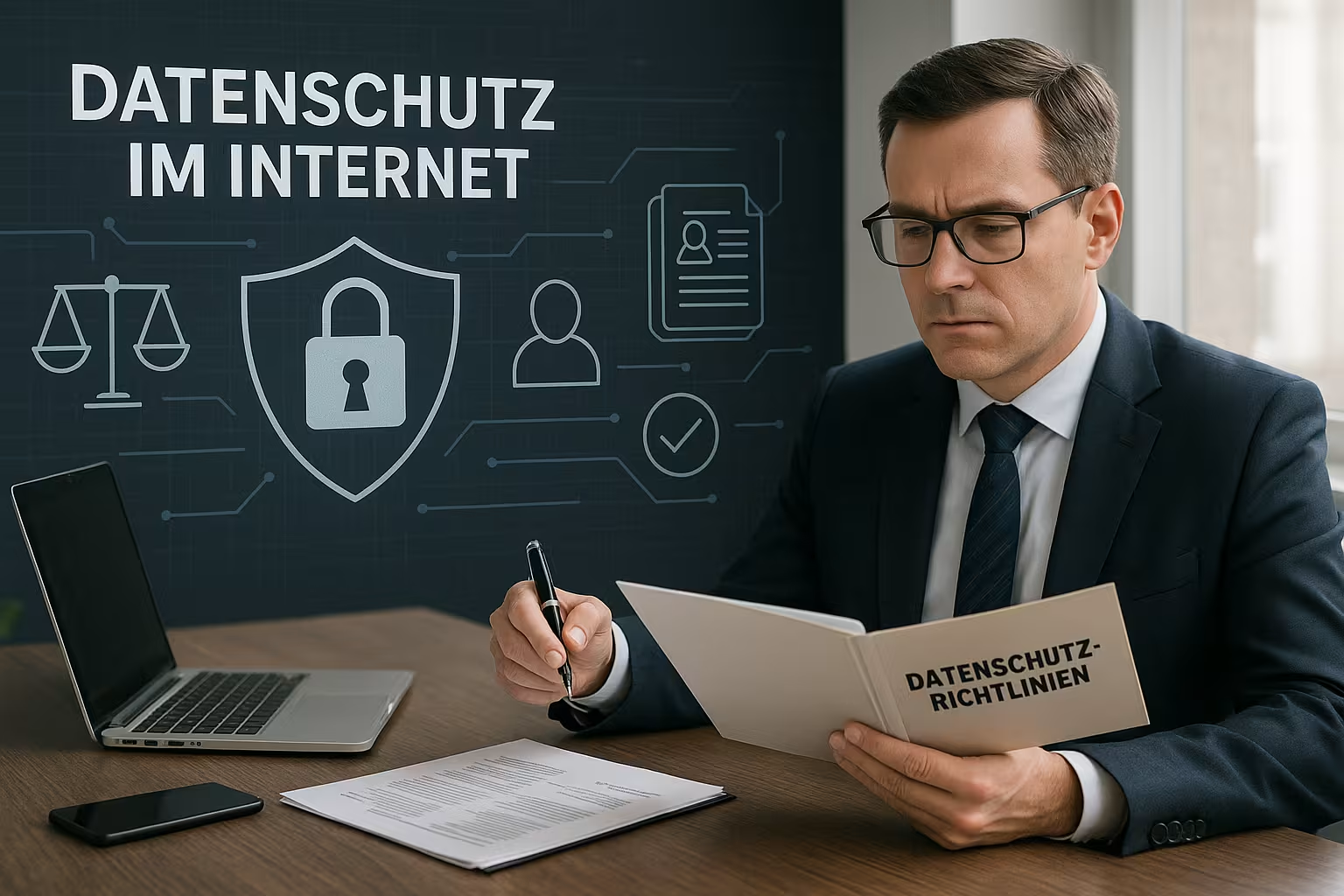
Advanced aspects of data protection on the Internet
Although the GDPR and the BDSG define the core rules of data protection on the internet, there are other regulations and recommendations that will significantly influence future developments. Particularly in the area of electronic communication, the so-called "ePrivacy regulation" is becoming increasingly important. This is intended to further specify data protection in electronic communications and will replace the current ePrivacy Directive in the near future. This will define even more precisely the types of activities - for example, online advertising or the use of communication services - for which explicit consent is required. For companies and private users, this may mean that cookie and tracking technologies will have to be handled more restrictively and more transparency will be created.
In addition, concepts such as Privacy by design and Privacy by default more to the fore. With Privacy by Design, a company commits to taking data protection into account as early as the development stage of platforms or apps. This goes beyond pure data protection guidelines and affects the entire architecture of systems. From conception to implementation, security-related requirements are incorporated in order to minimize subsequent risks. Privacy by default ultimately means that, by default, only the data that is necessary for the respective purpose is collected. Users therefore do not have to adjust the default settings themselves each time to achieve maximum privacy - the service already takes care of this.
Another key topic is the International data transmission. A considerable amount of data flows across national borders, especially for globally active companies and cloud providers. It becomes legally difficult when data is transferred to countries where the level of data protection does not meet the European standard. This is where Standard contractual clauseswhich are published by the EU Commission and are intended to ensure the protection of data outside of Europe. Nevertheless, companies are obliged to regularly review their compliance with the GDPR and additional regulations. Data transfers to the USA, for example, remain an ongoing issue due to unclear legal situations and changing court rulings; here, data controllers must provide evidence of technical and organizational measures (TOM).
In addition, the right to Data portability (data portability) is becoming increasingly important. According to the GDPR, users can request that a service provide them with their personal data in a portable, structured format or have it transferred to another service. This point is often underestimated in practice, as technical standards and smooth processes are required to transfer the data in a meaningful format. Information such as order histories, customer data or communication logs are particularly relevant in online retail or on social media platforms. Creating a high degree of automation here also prevents bottlenecks in the processing of user inquiries and increases trust.
Finally, for many operators, the question of a Data Protection Officer. Companies that regularly process large volumes of health data or other sensitive data, for example, are legally obliged to appoint an internal or external data protection officer. This officer coordinates all measures, advises management and is the internal and external point of contact for questions relating to data protection. For growing platforms, online stores or service providers in particular, it is worth establishing the role of the data protection officer at an early stage and assigning them clear responsibilities.
Children and young people in the digital space
An often neglected but increasingly important aspect is the special protection needs of Children and young people. The GDPR stipulates stricter requirements for obtaining consent when processing the personal data of minors. Depending on the age threshold and national legislation, the consent of parents or a legal representative is required if the child has not yet reached "digital maturity". Operators of apps, online games or learning platforms must adapt their processes accordingly. In addition, there are design requirements to ensure that children are not overwhelmed when using them or reveal personal information unnoticed. Dealing transparently with young users plays a key role in gaining their trust.
Technically, this is achieved, for example, through preselected privacy settings that set the profile to "private" in the default settings. Notices in child-friendly language or icons that make it clear what happens to the data are also possible. Anyone who opens up their platforms to this target group should also schedule regular security checks to identify and rectify potential vulnerabilities. Children are often the target of hacker attacks or phishing traps, as they are usually less sensitized and quicker to give out passwords or other information.
Technical aspects beyond cookies
Cookies are often used as a synonym for tracking and user analysis. However, in addition to classic cookie tracking, some services use local storage, fingerprinting or other mechanisms to store the behavior and settings of users. These methods also fall under the data protection regulations and, depending on the interpretation, may trigger a consent requirement. The ePrivacy Regulation is likely to clarify that all tracking methods that go beyond what is technically necessary require the express consent of users. Companies must therefore look for alternative solutions at an early stage that are as data protection-friendly as possible and at the same time allow the desired functions.
One area that is both innovative and relevant to safety is the End-to-end encryption of online communication. Messenger services and email providers are particularly challenged here to offer their users secure channels. While encrypted communication has long been considered standard, in practice there are various forms of implementation. It is not always guaranteed that metadata - i.e. information about the sender, recipient and date - is also sufficiently protected. The TDDDG is aimed precisely at these aspects in order to strengthen the integrity and confidentiality of digital communication. Operators should therefore have integrated comprehensive security concepts that are reviewed on an ongoing basis.
Compliance and continuous improvement process
Data protection on the Internet is not a static construct. Rather, it requires a continuous improvement process (CIP), in which companies and organizations constantly put their data protection measures to the test. This process includes training employees, conducting regular audits, updating technical protection measures and adapting data protection notices to new functions. Those who plan their data protection process strategically can not only meet the applicable requirements, but also communicate them to the outside world as a sign of quality.
A separate data protection or compliance management system is recommended, especially in larger organizations. This is where roles and responsibilities are assigned, processes defined and control points established. Communication between the legal and IT departments plays a key role here: data protection and IT security can only be successfully implemented if both sides work together smoothly.
At the same time, operators should always keep an eye on the future. New technologies such as smart assistants, wearables and devices in the Internet of Things (IoT) generate a wealth of additional information. Here, too, the next few years will show how high the requirements for data economy and transparency will be. Users should already develop a critical awareness when integrating new digital helpers into their everyday lives. Especially in the area of IoT, the issue of security will expand enormously - every additional networked device is also a potential gateway for attackers.
Final considerations
Rapid progress in the digital sector is constantly presenting all stakeholders with new challenges. It is essential for companies to see data protection not as an obstacle, but as a strategic resource. Those who respect the privacy of their users and structure their processes clearly will create trust in the long term and remain competitive. Ultimately, all stakeholders - from legislators to service providers and end users - have a duty to continuously educate themselves and make data protection-friendly decisions. Only through a shared awareness of the importance of our data can we shape a digital future in which innovation and privacy are not at odds.