Skip to content
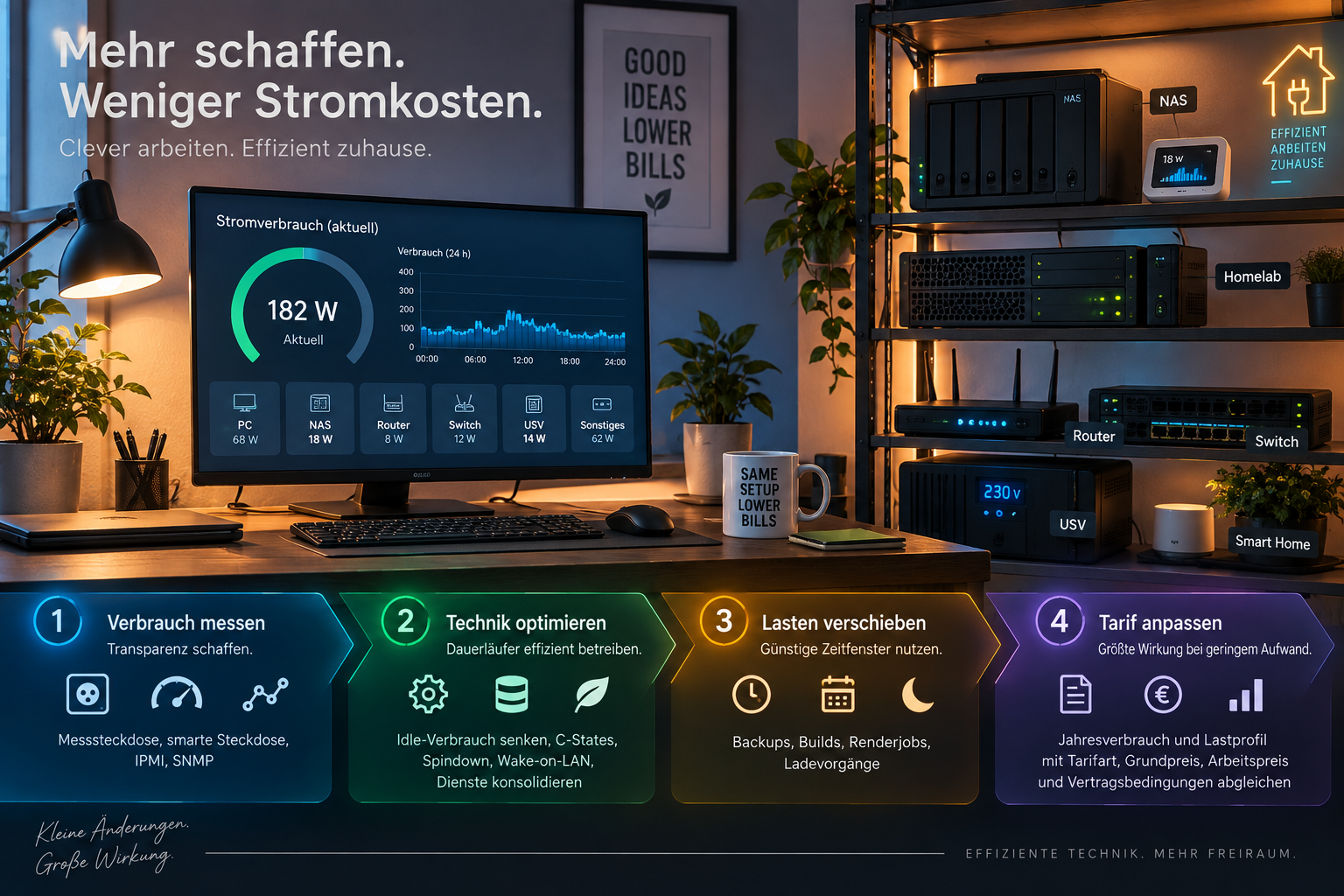
If you want to lower your electricity costs while working from home, there are four key strategies to focus on: measuring your consumption, properly configuring devices that run continuously—such as NAS systems and home labs—shifting loads to off-peak hours, and adjusting your electricity plan to match your load profile. Of these, the electricity rate is the lever that offers the best balance between effort and impact—it takes just half an hour to set up.
Key Points at a Glance
- Step 1 – Measure consumption: Measurement data provides the foundation. Metered outlets, smart outlets, IPMI, and SNMP reveal where sustained loads actually occur.
- Step 2 – Optimize Your Technique: Reduce idle power consumption, configure C-states appropriately, use hard drive spindown and Wake-on-LAN, and consolidate services.
- Step 3 – Move loads: Schedule backups, builds, render jobs, and loading processes during appropriate time slots.
- Step 4 – Adjust the rate: Compare annual consumption and load profile with the rate type, base rate, active rate, and contract terms.
How much electricity does a home office setup really use?
When it comes to the annual energy balance, what matters most is how much power devices consume over a long period of time—not the peak load a workstation reaches for a short period.
Why continuous loads are more expensive than peak loads
A high-performance workstation can briefly reach high power consumption levels during compilation, rendering, or local AI workloads. However, such peaks have less of an impact on the annual bill than the significantly lower power consumption that occurs day and night.
A NAS, home lab server, or switch may run for thousands of hours a year. For this reason alone, the analysis should not focus primarily on maximum power consumption, but rather on typical consumption during idle and partial-load operation.
Idle power consumption determines the annual cost of a home lab, not the power supply's rated output.
The typical long-running devices: NAS, home lab, router, switch, UPS
In a technologically equipped home office, there are often several devices that draw power continuously. These include, for example:
- NAS: File storage, media server, and backup destination
- Home Lab: Virtualization, development environments, or self-hosted services
- Router: Stable Internet and network connection
- Switch: especially for larger LAN or PoE installations
- UPS: Protecting Critical Equipment Against Power Outages and Voltage Fluctuations
- Smart Home Components: Gateways, Bridges, and Control Centers
The problem isn't so much a single device as it is the cumulative effect. If you look at five or six small devices that are constantly drawing power individually, it's easy to underestimate their combined impact.
Why Nameplates and Power Supply Ratings Can Be Misleading
The rated power of a PC or server power supply indicates how much power it can provide. This does not indicate how much power the connected system requires during normal operation.
The nameplates on other devices are also of limited use for calculating power consumption. Actual power consumption can vary significantly depending on CPU load, hard drive activity, network traffic, and connected components.
That is why the path to a reliable assessment always involves measured values.
Four Ways to Lower Electricity Costs in a Tech-Savvy Household
| Lever | One-time expense | Long-lasting effect | Prerequisite | Suitable for |
|---|---|---|---|---|
| Measuring consumption—a necessary first step | low | as a basis for decision-making | Measuring device or existing interface | every household with a continuous electrical load |
| Optimize Hardware and Operating Mode | medium | high | Access to BIOS/UEFI and Management Tools | NAS, home lab, and server operators |
| Defer Payments | low to moderate | Medium to high | Predictable Loads and Controllability | Backups, Builds, Render Jobs, Wallbox |
| Adjusting Your Electricity Rate—The Best Balance Between Effort and Impact | low | high | Annual consumption and load profile; appropriate metering technology for dynamic rates | virtually every household |
The order is important: First, the meter readings show which systems should be optimized. The load profile derived from these readings then helps in selecting the right rate plan.
How do you correctly measure the power consumption of individual devices?
Individual devices can be monitored using a measurement outlet or a smart outlet; servers and UPSs sometimes also provide consumption data via IPMI or SNMP.
A Comparison of Metered Outlets, Submeters, and Smart Outlets
For a desktop PC, monitor, or a single NAS, one power meter is usually sufficient. It is plugged in between the outlet and the device and measures power and energy consumption.
Smart outlets with energy monitoring also provide time series data. This shows when a device switches to idle mode, when backups start, and what load remains active at night.
If you're looking at an entire network cabinet or a group of outlets, a suitable submeter may be more practical.
Measurement accuracy is important. Very small standby loads or certain devices connected to a UPS can push inexpensive meters to their limits. Such readings should be considered approximations rather than billing figures.
Over what period of time should measurements be taken?
A snapshot is not very meaningful when it comes to dynamically used IT. A computer might be idle at one moment, while a NAS might start a backup a few hours later.
A full workweek is therefore a reasonable starting point. It covers typical workdays, nighttime periods, scheduled jobs, and at least part of weekend usage.
If workloads fluctuate significantly, it's worth using a longer measurement period.
Data retrieval via IPMI, SNMP, or a smart-home interface
With more professional hardware, power consumption does not necessarily have to be measured via the power outlet. Server boards can transmit telemetry data via IPMI Provide. Some UPSs, PDUs, and network components support SNMP.
If you're already using Prometheus, Grafana, Home Assistant, or another monitoring tool, you can log these metrics over the long term and compare consumption patterns with workloads.
However, internal telemetry does not always replace external measurements. If the actual grid consumption of an entire system is to be evaluated, a measurement on the power side serves as a useful control parameter.
Accurately extrapolate the measured values to annual consumption
The calculation process can be broken down into four steps:
- Track usage: Measured over [X] days, totaling [Y] watt-hours.
- Convert to kilowatt-hours: [Y] Wh ÷ 1,000 = [Z] kWh.
- Calculate the daily average: [Z] kWh ÷ [X] days.
- Estimate the annual value: Daily average × 365.
Alternatively, a meter can display consumption directly in kilowatt-hours.
Nevertheless, the projection is only as good as the measurement period. A week with an unusually high number of render jobs should not be extrapolated to an entire year as normal operation without further verification. The total consumption from the most recent annual statement can also serve as a plausibility check.
Which adjustments reduce fuel consumption the fastest?
When it comes to hardware, the first step is to optimize idle mode. This is followed by energy-saving features and the consolidation of underutilized systems.
Optimize Idle Power Consumption Instead of Peak Load
For a workstation, peak power is important for the power supply, cooling, and performance. For the annual power consumption of a system that runs continuously, however, what matters most is how much power it requires during the many hours when it is not under heavy load.
That's why, when making new purchases, you shouldn't just consider CPU performance, cores, or maximum performance per watt. For NAS and home labs, power consumption in a typical idle state should also be a factor in the decision.
Before replacing old hardware, however, it’s important to do the math: A new purchase also incurs costs and consumes resources. Not every more efficient device pays for itself through electricity savings alone.
Power-saving features: C-states, hard drive spindown, Wake-on-LAN instead of continuous operation
Modern systems already come with a wide range of features:
- C-States: In this process, unused portions of the CPU are placed into sleep states of varying depths. This is distinct from simple frequency control.
- Hard Drive Spindown: HDDs that are rarely used can temporarily stop their rotating components. Whether this is a good idea depends on the access pattern and the NAS being used.
- Standby: Equipment can be put into sleep mode after a defined period of inactivity.
- Wake-on-LAN: A system that is turned off or in sleep mode can be woken up again over the network.
- Timing: Services or hardware that are only needed at certain times do not necessarily have to remain active around the clock.
Not every feature is suitable for every system. Frequent access, for example, can render hard drive spindown ineffective if the drives restart shortly afterward.
Virtualization and Consolidation of Multiple Devices
Multiple servers that are barely being utilized mean multiple motherboards, power supplies, fans, and base systems, each with its own base load.
Virtualization can consolidate services onto fewer hardware resources. For example, an existing host can then run a development environment, monitoring, home automation, and test servers as virtual machines or containers.
However, utilization is also a key factor here. An oversized server that runs at near-idle capacity all the time is not automatically more efficient than several appropriately sized small systems.
When Switching to External Hosting Makes Financial Sense
External hosting can It would make more sense from an energy perspective if local systems ran primarily in idle mode and a provider could utilize hardware, cooling, and infrastructure more efficiently.
This does not apply automatically. The Federal Environment Agency points out that data centers also vary significantly in terms of capacity utilization and energy efficiency. Therefore, it is not just the „data center“ location that matters, but how efficiently resources are actually used.
Therefore, several factors should come together to inform the decision:
- actual usage of the local hardware,
- required computing, storage, and network capacity,
- Load on our own system,
- Energy efficiency of the hosting service,
- Data transmission,
- Latency and availability,
- Data Sovereignty and Data Protection,
- Total cost.
It may make sense for a single service to run externally, while backup storage or local smart-home systems remain on your own network.
What are the benefits of deferring payments?
Load shifting is particularly beneficial when electricity prices vary by time of day or when self-generated solar power is available at certain times.
Scheduling Backups, Builds, and Render Jobs
Many IT workloads do not need to be executed immediately. These include backups, container builds, synchronizations, rendering jobs, software updates, and large data transfers.
Cron jobs, CI systems, and task schedulers make it possible to schedule such processes. For a dynamic electricity rate plan, this results in an interesting load profile: computationally intensive jobs can then be scheduled for times when the electricity rate is lower.
Self-generated solar power as a timing reference
With your own photovoltaic system, a different approach can be taken. Predictable loads can be prioritized to operate when the system is currently generating electricity.
Whether additional self-consumption makes more economic sense than feeding electricity into the grid depends, among other things, on the price of purchased electricity, the feed-in tariff or marketing model, and the specific system.
Backups, wallboxes, battery charging, and other flexible loads can be coordinated accordingly.
Requirements for Time-Varying Use
Three conditions must be met:
- Flexible load: It must be possible to reschedule the process.
- Controllability: A timer, script, smart home system, or energy management system must be able to automate it.
- Rate or Generation: There must be an economic or energy-related reason for the postponement.
Without these conditions, one merely shifts consumption without significantly affecting its costs.
How do you find the right electricity plan for a tech-savvy household?
Annual consumption and the load profile serve as the basis. Based on these, the rate type, base rate, and active-use rate, as well as the contract term, price guarantee, and cancellation terms, are compared.
In addition to regional municipal utilities, E.ON, Vattenfall, EnBW, LichtBlick, Octopus Energy, Tibber, and Ostrom are among the providers whose rates may be worth considering, depending on the region and plan. For example, you can sign up online with E.ON for a Find the Right Electricity Plan.
Annual consumption as a starting point
The most recent annual statement shows total consumption in kilowatt-hours. Individual measurements then answer the more important technical question: What portion of that consumption is base load, and what portion can be shifted over time?
A household with a high, constant server load has a different load profile than a home office where the high-performance workstation runs only during the day.
Consider the base rate and the usage rate separately
When comparing rates, two factors are particularly important:
- Base price: is incurred regardless of individual consumption.
- Energy rate: is calculated per kilowatt-hour consumed.
The price of electricity structurally includes, among other things, procurement and distribution, grid fees, as well as taxes, levies, and surcharges.
Therefore, the price per unit of electricity alone is not enough to determine which rate is cheaper. The base rate and annual consumption must be considered together.
Basic Service, Special Contract, Green Electricity, and Dynamic Rate Plan
The Basic Services is the standard contract governed by law offered by the local basic service provider. Anyone who uses electricity without first having signed a separate supply contract can automatically be enrolled in the basic service program, provided they meet the legal requirements. The Federal Network Agency explains the distinction and the process for switching providers on its consumer pages.
A Special Agreement In contrast, it is specifically contracted with a supplier. The pricing structure, term, cancellation terms, and any price guarantees are set forth in the respective contract.
A Green Electricity Plan describes, above all, the procurement or accounting origin. This is documented through certificates of origin and electricity labeling. Physically, electricity in the public grid is not separated by individual rates.
At dynamic electricity rate The electricity rate varies depending on market prices. As a result, households with consumers whose electricity use can be shifted to different times of day can benefit, but at the same time bear a greater risk of price fluctuations.
Overview of Rate Types
| Rate Type | Price structure | Plannability | Technical Requirements | Suitable for which load profile |
|---|---|---|---|---|
| Basic Services | Terms and conditions published by the local utility provider | Relatively easy to plan; prices can be adjusted | No special measurement technology | Households covered by basic statutory health insurance |
| Special Contract with Price Guarantee | Contractually agreed base rate and usage rate; the guarantee may cover only certain components | high, depending on the scope of the warranty | No special measurement technology | Generally consistent usage and a desire for predictable contract terms |
| Green Electricity Plan | Depending on the provider, the pricing structure may be fixed or vary; the source is documented in the financial statements | depending on the contract model | Generally, no special measurement technology is required | different load profiles |
| Dynamic Rate Plan | Time-varying electricity rate linked to the market price | smaller, but more controllable | intelligent measurement system | Highly flexible workloads, such as Wallbox or schedulable IT jobs |
What Technology Is Required for a Dynamic Rate Plan
For a dynamic electricity rate plan, a intelligent measurement system required. The Federal Network Agency refers customers to metering point operators or suppliers for installation and specific procedures.
For households with smart home technology, however, this alone is not yet an advantage. Only when jobs or other consumers can automatically respond to price changes does the variable price result in a controllable load profile.
What to Look for in Terms of Contract Term, Price Guarantee, and Discount
In addition to price, the comparison should include at least five contract details:
- Initial term
- Term of notice
- Provisions Following the Expiration of the Initial Term
- Scope of the Price Guarantee
- Amount and Calculation of the Advance Payment
A price guarantee does not necessarily mean that every component of the final price will remain unchanged. The Consumer Protection Agency therefore recommends carefully checking which price components are actually covered by the guarantee.
The Federal Network Agency also lists contract terms, notice periods, price guarantees, price adjustment clauses, and payment terms as key factors to consider when comparing suppliers.
Changing your rate plan is the only way to achieve this without any technical intervention, and it has a lasting impact on your total consumption.
What changes when you add a solar system, a storage unit, or a wallbox?
With solar panels, energy storage, and a wallbox, a home that was once merely an electricity consumer becomes a system that combines generation, storage, grid consumption, and flexible loads.
Self-consumption Instead of Feeding into the Grid
When it comes to a rooftop solar system, a distinction is first made between a purchased system and a rental or lease model. Ownership, ongoing costs, and revenue models may vary depending on the choice.
A balcony power plant is also a photovoltaic system, but due to its size and technical integration, it cannot be equated with a larger rooftop system.
Self-consumption and storage are also two different things: Direct consumption uses the generated electricity immediately. An electricity storage system defers a portion of it to a later time. Depending on the system design, surplus electricity can be fed into the grid.
Before making a purchase or expansion, you should review the current subsidy and tax regulations.
Energy Management as a Control Center
An energy management system can coordinate photovoltaic systems, energy storage systems, wallboxes, and other controllable loads. Instead of a fixed sequence, priorities can be defined based on PV generation, state of charge, electricity prices, and user requirements.
In addition to electricity plans, E.ON also offers solar power systems, energy storage solutions, wallboxes, and the E.ON Home energy management system. E.ON describes the system, among other things, as an interface for managing solar power for charging, heating, and other household applications.
The benefits of such systems increase with the number of flexible components: A NAS on its own offers little in the way of control capabilities, but when combined with solar power, storage, a wallbox, and schedulable IT jobs, the potential is significantly greater.
Frequently Asked Questions About Electricity Usage and Rates When Working from Home
How much electricity does a home server consume when running continuously?
That depends primarily on the actual idle power consumption. A measurement taken over several days provides a better basis than the specifications on the power supply or the nameplate.
How do I measure the power consumption of individual devices?
Metered outlets and smart outlets are suitable for individual devices. Servers, UPSs, and network hardware can also provide data via IPMI or SNMP.
Is a dynamic electricity rate worth it for a home office?
This is especially true when relevant loads can be shifted. An intelligent metering system is a prerequisite; in addition, the technology should be capable of automation.
What is the difference between basic coverage and a special contract?
Basic service is regulated by law and is provided by the local basic service provider. The customer specifically selects and enters into a special contract with a provider.
How do I find the right electricity plan?
The starting point is your annual consumption and load profile. Next, you should review the base rate, the energy rate, and comparable contract terms. Providers such as E.ON combine rate comparison and switching services online.
Is green electricity really technically different?
Not at the outlet. The amounts of electricity fed into the grid are mixed together. The renewable origin of a rate plan is documented for accounting purposes through certificates of origin and electricity labeling.
Will my service be interrupted if I switch providers?
Changing suppliers affects the supply contract, not the physical power line. The Federal Network Agency notes that the supply remains guaranteed even when switching suppliers.
Is moving from my own home lab to external hosting worth it from an energy standpoint?
This may be the case if local hardware is primarily in idle mode and the external provider consolidates resources more efficiently. It is impossible to make a blanket assessment without comparing the two systems.
What are the benefits of an energy management system for a home solar power system?
It can coordinate generation, storage, and flexible consumers according to defined rules. E.ON combines such functions, for example, with solar power, energy storage, and wallboxes.
Should I turn off my devices completely overnight?
Devices used solely for work can often be turned off completely. For servers and NAS devices, standby mode, scheduling, or Wake-on-LAN are often more practical options if services do not need to be available at all times.
Conclusion: The order matters
If you want to systematically tackle electricity costs while working from home, don't start by replacing your hardware. First, you need to figure out which devices actually consume energy and which of them run continuously.
This is followed by idle optimization, C-states, spindown, Wake-on-LAN, and, if necessary, the consolidation of multiple systems. Only then can one meaningfully assess which jobs can be rescheduled and whether a dynamic load profile emerges.
The fourth factor is the electricity rate. It affects total grid consumption without requiring any technical changes to NAS devices, servers, or workstations. If you know your annual consumption, base load, and flexible loads, you can make a much more informed comparison between basic service, special contracts, green electricity rates, and dynamic electricity rates.
If photovoltaic systems are added later, the focus shifts once again: Electricity storage, wall boxes, and energy management then become part of the same system. However, the same basic rule remains crucial—first measure and understand, then optimize, and only then automate.
About the Author: Simon Peters is a freelance writer specializing in technology, digitalization, and consumer issues. His areas of focus include IT infrastructure, digital services, energy, and everyday technical questions. He explains complex topics in a clear, practical way, drawing on reliable sources.